Saturday, September 30, 2006

Performance-formula Cosequin SP Will Be Sold Only by SmartPak Equine


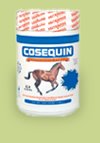
SmartPak Equine announced today that it has partnered with Nutramax Laboratories, Inc. to manufacture a special version of Cosequin targeted to the horse in intensive training and competition.

The new formula, called Cosequin "SP", is an exclusive Cosequin formulation with DOUBLE the amount of glucosamine (7200mg) and a full dose of MSM (10,000mg) in addition to the normal amount of Cosequin’s proprietary low molecular weight chondroitin sulfate. The target market will be competitive horses in their prime.

According to SmartPak, the price will be $49.95; recommended dose is one 21-gram scoop per day per horse. The new formula will be available exclusively from SmartPak.

By the way, SmartPak Equine was recently recognized in Inc. Magazine as the 106th fastest-growing private business in America of 2005! In the Consumer Products category, SmartPak was the 6th fastest growing firm in the country. With a growth rate of 868 percent in the last three years, SmartPak has achieved a recognition never before attained by a business in the horse industry.

This information was provided in a news release.

Learn more by checking SmartPak's ads in Hoofcare & Lameness Journal or visit them at http://www.smartpakequine.com

Biomechanics expert Bob Colborne will team with Equinalysis gait evaluation system


At the British Equine Veterinary Association Conference in England earlier this month, Equinalysis announced that Robert "Bob" Colborne PhD of the University of Bristol (UK) has joined the firm as Advisor on Equine Biomechanics. He is currently program director of the equine science program at Bristol.

Bob is widely published in the area of joint mechanics and gait energetics in horses, dogs and humans and was part of the ICEL conference at Michigan State in 2004, where many Hoofcare & Lameness subscribers met him. He was an author with Hilary Clayton of the paper "Net joint moments and joint powers in horses with superficial digital flexor tendinitis", published in the American Journal of Veterinary Research.

Bob's role at Equinalysis will be to provide experience to Equinalysis in the continued development of its practices and procedures as well as consult with business partners, horse owners and insurance companies. Bob will advise users of the Equinalysis system on methods of data capture and analysis to ensure standardisation of practice, and to optimise the information yielded by a clinical gait analysis. His biomechanics background will compliment the firm's existing veterinary and farriery expertise from leading practitioners John McEwen and Haydn Price, respectively.

Bob said “I am delighted to be helping to make biomechanical analysis of equine gait accessible to those in the field who will benefit most from it.” He added, “Kinematic gait analysis offers a quantitative way to evaluate equine movement, and to objectively track changes occurring over time as a result of training or treatment.”

To learn more about Bob Colborne, visit http://www.bris.ac.uk/Depts/Anatomy/about/staff/Colbourne.htm.

To learn more about Equinalysis, vist
http://www.equinalysis.co.uk

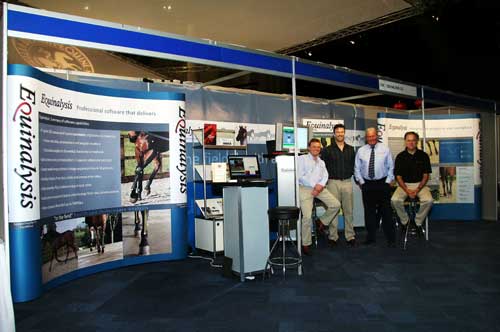
Photo: Equinalysis trade stand at BEVA Congress in September. Principals include farrier Haydn Price, veterinary advisor John McEwen, and human sportsmedicine doctor John Davies. Biomechanics expert Bob Colborne of the University of Bristol has now joined the team.

Friday, September 29, 2006

UK's Largest Equestrian Center to be Built near Edward Martin's Home in Scotland

News about Mr. Edward Martin is sparse, but thanks to farrier Jean Meneley of Nevada, we do receive occasional reports. For those who don't know him, Edward Martin is the senior statesman of the worldwide farrier industry and a friend to all in the horseshoeing and blacksmithing worlds. Among Edward's many accomplishments and honors include the MBE, "Member of the British Empire", awarded by the Queen for his services to farriery. I could do a blog just about Edward!

Edward is still quite weak from the complications of Parkinson's disease, but thanks to the efforts of his sister, Jane, is still able to live at home in the little village of Closeburn in the Scottish borders district. Edward enjoys hearing from old friends, so please write to him. The fact that you may not receive a response does not lessen the value of your effort in writing to him.

Edward's neighborhood is buzzing today! Former British Olympic event rider Karen Dixon is a neighbor of Edward's, and I believe one of his former clients, as well. According to a report received from Horse & Hound (UK magazine) today, Karen and her husband Andrew have just announced plans to build the largest equestrian center in all the United Kingdom, at a cost of 30 million pounds...somewhere around $65 million. In addition to stabling, arenas, and a cross country course, the plan also calls for a village, presumably with an equestrian theme.

The location is the town of Lockerbie, site of the horrific Pan Am aircraft bombing about ten years ago, and just up the road from Edward's village. With my tongue set firmly in my cheek, I can't help but wonder if it will be called "The Robert Burns Equestrian Center", after the area's beloved native poet.

Here's a PS from Horse & Hound that I thought was interesting: "The development trend comes on the back of a recent British Equestrian Trade Association (BETA) survey which found the number of people riding in Britain has nearly doubled from 2.4m in 1999 to 4.3m in 2006."

Those are numbers that you could take to the bank.

Tuesday, September 26, 2006

Barbaro Funds Will Help Laminitis Research


This is second-hand news, so please wait for an official announcement before believing it, but...

In an interview in the Philadelphia Inquirer this weekend, owner Gretchen Jackson reported that she expects half of the donations to the Barbaro Fund at the University of Pennsylvania's New Bolton Center will go to laminitis research.

"Isn't that nice?" you may be musing..."Bring me some real news!" But wait...generous people have already donated more than $1.25 million to the fund, which means that roughly $600,000 will go to research.

But whose research? Chances are, the funds will stay right at New Bolton Center, where a laminitis research initiative has been on the wish list anyway.

Here's a quote lifted from the article: One of her (Gretchen Jackson, owner of Babaro) top priorities, she said, is New Bolton's Barbaro Fund, which has received 1,500 contributions totaling $1,225,000. Jackson said half the fund is slated to go for laminitis research, in the grandest-scale attempt yet to eradicate the disease. She's had a conversation with Secretariat's owner, Penny Chenery, about the disease, because Secretariat died from it.

http://www.philly.com/mld/philly/news/special_packages/latest/15592399.htm

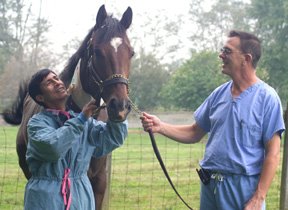
In the photo: jockey Edgar Prado visiting with Barbaro and surgeon Dean Richardson on September 19. Photo by Sabina Louise Pierce/University of Pennsylvania.

Thursday, September 21, 2006

Walking Horses May Have a 2006 World Champion After All

The Associated Press reported this afternoon that the Tennessee Walking Horse Breeders and Exhibitors Association has organized a last-minute championship show for Thanksgiving weekend. The news was first reported in, oddly enough, the International Herald Tribune. One can only imagine what people in Paris and Prague and Stockholm thought of the report.

Only three of nine finalist horses at the recent Tennessee Walking Horse Celebration in Shelbyville, Tennessee were allowed to compete; the other six were turned down by USDA veterinarians and inspectors, who said that their inspections found that the horses' feet or pasterns showed signs of "soring" and were in violation of the Horse Protection Act.

The three horses that did pass inspection never made it into the ring because an angry owner of a disqualified horse offered to pay them not to go in. Earlier in the show, classes had been cancelled for more than 24 hours after disagreements between trainers and inspectors erupted.

Called the Tennessee Walking Horse Invitational, the new show will be held at the Tennessee Miller Stadium, which I think is in Nashville; it will have 50 classes and a purse for the grand champion of $15,000. Horses must first pass inspection before they can compete.

Check the archives for August 2006 to read more about the fireworks at the Celebration.

2006 Kentucky Walking Horse Celebration Cancelled in Advance; USDA Inspection Cited as Reason

According to a report posted on www.tennessean.com, the 42nd Annual Kentucky Celebration Tennessee Walking Horse Show, which was to have been held this week, has been cancelled.

To quote tennessean.com: "Jerry Hoskins, a member of the board of the Show, said the decision to call off the show was based on what organizers believed to be unfair and inconsistent inspections by federal officials.

"We decided it's in the best interest of trainers and owners to not even try to show," said Hoskins of Liberty, Kentucky, where the show was to be held for the first time. "We do feel like the USDA would be very hard on us."

Wednesday, September 20, 2006

Grayson-Jockey Club Research Foundation "Welfare and Safety of the Racehorse Summit" Planned for Keeneland in October


A two-day workshop concerning the safety and soundness of the Thoroughbred racehorse, will be held on Monday, October 16, and Tuesday, October 17, at Keeneland racecourse in Lexington, Kentucky.

Three dozen individuals representing a cross-section of the breeding, racing and veterinary community have agreed to participate in the "Welfare and Safety of the Racehorse Summit", which is sponsored by Grayson-Jockey Club Research Foundation.

The first morning session will be open to the public. There is no admission, but a voluntary donation to Grayson-Jockey Club Research Foundation will be accepted.

The open session will be followed by a closed round table discussion and subsequent breakout groups. Monday afternoon, each group will give a 30-minute presentation on their ideas. Participants will meet in a closed session again Tuesday to develop and recommend definitive action plans.

The open session will include panel discussions and presentations by the following participants:

* Dr. Rick Arthur and Dr. Larry Bramlage, “Trends in Thoroughbred Racing by the Numbers”

* Dr. Wayne McIlwraith, “Joint Trauma and Osteoarthritis (DJD) — A Major Cause of Attrition in Thoroughbred Racehorses”

* Dr. Michael “Mick” Peterson, “Extending the Careers of Racehorses Through Engineered Racing Surfaces”

* Dr. Sue Stover, “Risk Factors for Musculoskeletal Injuries” and “Race Surface Preliminary Findings”

“To gain further public insight, we propose that anyone with suggestions is welcome to submit a one- to three-page summary of their ideas,” the Foundation's Ed Bowen said. “We will provide these summaries to the participants prior to the summit.”

Summaries should be sent in Word or WordPerfect to khix@jockeyclub.com no later than October 1.

“Horses are the core of the racing industry, and their safety and soundness is paramount to the industry’s success,” said Dell Hancock, chairman, Grayson-Jockey Club Research Foundation. “We hope our findings also benefit horses of all breeds and disciplines.”

To learn more, please visit: http://www.jockeyclub.com/mediaCenter.asp?story=254A Jockey Club press release was used as the primary source of this post.

Sunday, September 17, 2006

BEVA Congress in the UK

The news is coming in from the British Equine Veterinary Association Congress, which ended yesterday at the National Exhibition Center at Birmingham, England.

Hoofcare & Lameness Consulting Editor Dr. Hilary Clayton, McPhail Chair in Sport Horse Lameness at the Michigan State University College of Veterinary Medicine, was a popular speaker. Her lecture "Current Trends in Equine Gait Analysis" was sponsored by Equinalysis and will be summarized here as soon as possible.

Our British correspondent, Mark Andrews MRCVS, was at the conference and will provide his usual succinct reports.

Saturday, September 16, 2006

Carbon-Fibre Heel "Patch" Developed for Underrun Heels at Royal Veterinary College Structure and Motion Laboratory

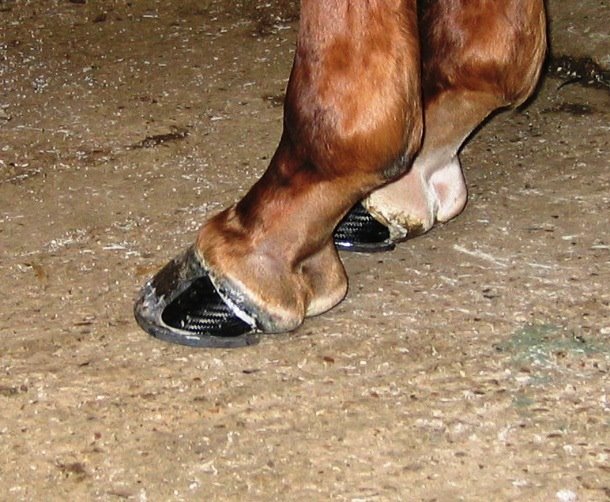
Carbon fiber heel patches developed at the Royal Veterinary College in England are designed to assist the growth of heel quarters.


It looks like a black potato chip and weighs about the same, but researchers at England's Royal Veterinary College believe that this tiny patch will, when applied correctly, aid horses with underrun heels by redirecting the horn tubule growth from the coronet.

I first heard about the "Heel Support" at the "Maximizing Equine Performance" conference in England this spring. I've been staring at the handful of samples I brought back ever since. Farrier Peter Day at the RVC helped develop the product, and claims that it can stengthen the wall by 40%. Before you scoff, remember that this is the RVC, home of Alan Wilson's Structure and Locomotion Laboratory, where they have any number of ways to test tensile strength of a product or the wall. Wilson's own farrier (and PhD candidate) Chris Pardoe showed me the product.

From a press release about the product: "The prevalence (of collapsed heels) is so high in Thoroughbreds (reportedly affecting between 52% and 97%) that it can lull individuals into thinking that the condition is a normal hoof variation rather than a serious pathological deviation. Despite its prevalence the condition is notoriously difficult to prevent or treat."

Last week I discussed the product with Frank Dugan from Vettec; his company's urethane-based adhesives are used to adhere the patch to the heel below the coronet--placement and adhesion would seem to be key components to success. Frank said that the product's marketing group does not yet have a USA distributor but he was enthusiastic. Since the "chips" are almost weightless, shipping from the UK might not be too expensive.

Marketing is currently through VetCell, the firm that is also marketing the RVC's bone-marrow stem-cell therapy for tendon injuries. The British racehorse Chancellor recently made a victorious comeback to the track wearing the patches; his foot is shown in the photo. No, I can't explain the steel shoes, perhaps they use a thicker training plate in the UK?

If the sea gulls haven't stolen the samples, I will send some to interested farriers or vets to try. Please contact Fran at the Hoofcare Publishing office during business hours: 978 281 3222.

Central Park Loses a Solid Citizen: Carriage Horse Dies

Juliet, one of the carriage horses at the southern end of Central Park in Manhattan, died early Friday morning in her stall on the third floor of a stable in the Hell's Kitchen neighborhood. To my surprise, and appreciation, the New York Times has published a combination news story and obituary of one of New York's beloved and controversial (depending on your politics) four-footed citizens. Click here to read the story on NYtimes.com. (But please come back to the HoofBlog.)

In the past, we have written articles about carriage horses slipping on the pavement and, in 2004, about a carriage horse in New York that was electrocuted through its steel horseshoes.

Thanks to the Ritz Carlton for coming to the horse's rescue with what was probably a very expensive rug. There's something tragically poetic about this story.


All HoofBlog text and images © Hoofcare Publishing 2006 unless otherwise noted.
To learn more about new research, products, and treatments for the horse's hooves and legs as reported to veterinarians and farriers
in the award-winning "Hoofcare & Lameness Journal", go to http://www.hoofcare.com

Direct link to subscribe via secure server to Hoofcare & Lameness Journal: http://www.hoofcare.com/subscribe.html
Save on books! Visit our "fall cleaning" sale of out-of-print, used, and damaged books: http://www.hoofcarebooksale.blogspot.com
Contact Hoofcare Publishing anytime: tel 978 281 3222 fax 978 283 8775 email bloginquiry@hoofcare.com
Fran Jurga, Publisher Hoofcare Publishing 19 Harbor Loop Gloucester, MA 01930 USA