Thursday, September 21, 2006

2006 Kentucky Walking Horse Celebration Cancelled in Advance; USDA Inspection Cited as Reason

According to a report posted on www.tennessean.com, the 42nd Annual Kentucky Celebration Tennessee Walking Horse Show, which was to have been held this week, has been cancelled.

To quote tennessean.com: "Jerry Hoskins, a member of the board of the Show, said the decision to call off the show was based on what organizers believed to be unfair and inconsistent inspections by federal officials.

"We decided it's in the best interest of trainers and owners to not even try to show," said Hoskins of Liberty, Kentucky, where the show was to be held for the first time. "We do feel like the USDA would be very hard on us."

Wednesday, September 20, 2006

Grayson-Jockey Club Research Foundation "Welfare and Safety of the Racehorse Summit" Planned for Keeneland in October


A two-day workshop concerning the safety and soundness of the Thoroughbred racehorse, will be held on Monday, October 16, and Tuesday, October 17, at Keeneland racecourse in Lexington, Kentucky.

Three dozen individuals representing a cross-section of the breeding, racing and veterinary community have agreed to participate in the "Welfare and Safety of the Racehorse Summit", which is sponsored by Grayson-Jockey Club Research Foundation.

The first morning session will be open to the public. There is no admission, but a voluntary donation to Grayson-Jockey Club Research Foundation will be accepted.

The open session will be followed by a closed round table discussion and subsequent breakout groups. Monday afternoon, each group will give a 30-minute presentation on their ideas. Participants will meet in a closed session again Tuesday to develop and recommend definitive action plans.

The open session will include panel discussions and presentations by the following participants:

* Dr. Rick Arthur and Dr. Larry Bramlage, “Trends in Thoroughbred Racing by the Numbers”

* Dr. Wayne McIlwraith, “Joint Trauma and Osteoarthritis (DJD) — A Major Cause of Attrition in Thoroughbred Racehorses”

* Dr. Michael “Mick” Peterson, “Extending the Careers of Racehorses Through Engineered Racing Surfaces”

* Dr. Sue Stover, “Risk Factors for Musculoskeletal Injuries” and “Race Surface Preliminary Findings”

“To gain further public insight, we propose that anyone with suggestions is welcome to submit a one- to three-page summary of their ideas,” the Foundation's Ed Bowen said. “We will provide these summaries to the participants prior to the summit.”

Summaries should be sent in Word or WordPerfect to khix@jockeyclub.com no later than October 1.

“Horses are the core of the racing industry, and their safety and soundness is paramount to the industry’s success,” said Dell Hancock, chairman, Grayson-Jockey Club Research Foundation. “We hope our findings also benefit horses of all breeds and disciplines.”

To learn more, please visit: http://www.jockeyclub.com/mediaCenter.asp?story=254A Jockey Club press release was used as the primary source of this post.

Sunday, September 17, 2006

BEVA Congress in the UK

The news is coming in from the British Equine Veterinary Association Congress, which ended yesterday at the National Exhibition Center at Birmingham, England.

Hoofcare & Lameness Consulting Editor Dr. Hilary Clayton, McPhail Chair in Sport Horse Lameness at the Michigan State University College of Veterinary Medicine, was a popular speaker. Her lecture "Current Trends in Equine Gait Analysis" was sponsored by Equinalysis and will be summarized here as soon as possible.

Our British correspondent, Mark Andrews MRCVS, was at the conference and will provide his usual succinct reports.

Saturday, September 16, 2006

Carbon-Fibre Heel "Patch" Developed for Underrun Heels at Royal Veterinary College Structure and Motion Laboratory

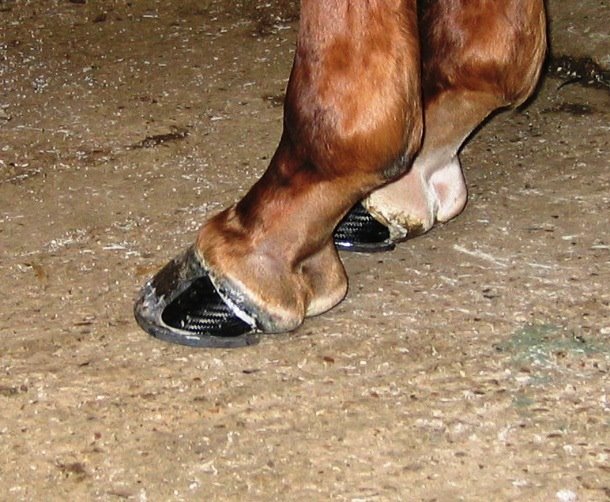
Carbon fiber heel patches developed at the Royal Veterinary College in England are designed to assist the growth of heel quarters.


It looks like a black potato chip and weighs about the same, but researchers at England's Royal Veterinary College believe that this tiny patch will, when applied correctly, aid horses with underrun heels by redirecting the horn tubule growth from the coronet.

I first heard about the "Heel Support" at the "Maximizing Equine Performance" conference in England this spring. I've been staring at the handful of samples I brought back ever since. Farrier Peter Day at the RVC helped develop the product, and claims that it can stengthen the wall by 40%. Before you scoff, remember that this is the RVC, home of Alan Wilson's Structure and Locomotion Laboratory, where they have any number of ways to test tensile strength of a product or the wall. Wilson's own farrier (and PhD candidate) Chris Pardoe showed me the product.

From a press release about the product: "The prevalence (of collapsed heels) is so high in Thoroughbreds (reportedly affecting between 52% and 97%) that it can lull individuals into thinking that the condition is a normal hoof variation rather than a serious pathological deviation. Despite its prevalence the condition is notoriously difficult to prevent or treat."

Last week I discussed the product with Frank Dugan from Vettec; his company's urethane-based adhesives are used to adhere the patch to the heel below the coronet--placement and adhesion would seem to be key components to success. Frank said that the product's marketing group does not yet have a USA distributor but he was enthusiastic. Since the "chips" are almost weightless, shipping from the UK might not be too expensive.

Marketing is currently through VetCell, the firm that is also marketing the RVC's bone-marrow stem-cell therapy for tendon injuries. The British racehorse Chancellor recently made a victorious comeback to the track wearing the patches; his foot is shown in the photo. No, I can't explain the steel shoes, perhaps they use a thicker training plate in the UK?

If the sea gulls haven't stolen the samples, I will send some to interested farriers or vets to try. Please contact Fran at the Hoofcare Publishing office during business hours: 978 281 3222.

Central Park Loses a Solid Citizen: Carriage Horse Dies

Juliet, one of the carriage horses at the southern end of Central Park in Manhattan, died early Friday morning in her stall on the third floor of a stable in the Hell's Kitchen neighborhood. To my surprise, and appreciation, the New York Times has published a combination news story and obituary of one of New York's beloved and controversial (depending on your politics) four-footed citizens. Click here to read the story on NYtimes.com. (But please come back to the HoofBlog.)

In the past, we have written articles about carriage horses slipping on the pavement and, in 2004, about a carriage horse in New York that was electrocuted through its steel horseshoes.

Thanks to the Ritz Carlton for coming to the horse's rescue with what was probably a very expensive rug. There's something tragically poetic about this story.


All HoofBlog text and images © Hoofcare Publishing 2006 unless otherwise noted.
To learn more about new research, products, and treatments for the horse's hooves and legs as reported to veterinarians and farriers
in the award-winning "Hoofcare & Lameness Journal", go to http://www.hoofcare.com

Direct link to subscribe via secure server to Hoofcare & Lameness Journal: http://www.hoofcare.com/subscribe.html
Save on books! Visit our "fall cleaning" sale of out-of-print, used, and damaged books: http://www.hoofcarebooksale.blogspot.com
Contact Hoofcare Publishing anytime: tel 978 281 3222 fax 978 283 8775 email bloginquiry@hoofcare.com
Fran Jurga, Publisher Hoofcare Publishing 19 Harbor Loop Gloucester, MA 01930 USA

Shoes for Thought: Burns Polyflex Synthetic Glue-on Prototypes Put to the Test at Major Racetracks

The new Burns Polyflex shoe is made of polyurethane with a wire core (Fran Jurga © photo)
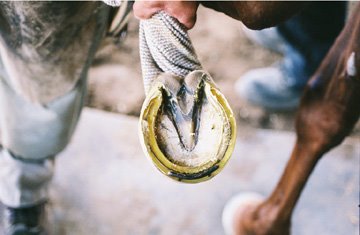
Have you seen one of these before? Probably not. You're looking at the prototype of a new glue-on shoe made entirely of polyurethane. What makes it different from most plastic shoes is that these are made with a steel core, so the shoe is somewhere shapeable, and it has a steel toe grab. The shoes are made in molds.

This shoe is the brainchild of Florida-to-New-York farrier Curtis Burns. I ran into him at Keeneland back in April, and then again at Saratoga. The shoes are underneath some very good horses--this is the foot of a top stakes-winning filly.

People talk about the eternal quest for a better mousetrap...for me, the quest is for a better horseshoe. And as long as there are farriers out there, they will never stop trying to come up with a better design and a safer way to keep a horse's feet in perpetual motion.

Curtis deserves a big pat on the back, as does his wife Diane, who does a lot of the molding. I think you'll all be hearing a lot more from them, but for now it is one horse at a time.

Will there be a special shoe design needed for the new Polytrack surfaces being installed at the California tracks and Woodbine in Ontario, among others? I'm sure there is one on a drawing board somewhere right now!

Friday, September 15, 2006

New DVD on Underrun Heels Will Be Marketed by Hoofcare Publishing


Client education takes a big step forward this month as we begin marketing the new dvd "Get Your Horse Sound" from California farrier John Suttle. In just 38 minutes, John does a remarkable job of explaining the lever theory of hoof construction/function and how underrun heels compromise a horse's ability to bear weight and lead an athletic life.

Not everyone will agree with John's "materialistic" solutions (Vettec should have bankrolled this dvd, given the heavy use of their adhesive hoof reconstruction materials in the shoeing) but the explanations are clear and the examples are good. I think John has a great career ahead of him in educating owners (as well as vets and farriers) because his low-key approach (he even wears a Mr. Rogers-type cardigan) is sincere and direct. And, he doesn't have anything to sell (except the dvd). It's like a breath of fresh air.

Click here to watch a simple preview.

(You will need the QuickTime viewer to see this film on your computer; you can download the application for Windows or Macintosh platforms for free at http://www.apple.com/quicktime/download.)
To place an order for the dvd, please call, fax or email the Hoofcare office with your name, address, and Visa/MC information. This dvd is made for North American format dvd players; if you are in another hemisphere, you'll need a universal player and even then, it may not work. Cost is $30 per dvd plus $5 post in USA.

Wednesday, September 13, 2006

All's Quiet on the Barbaro Front: Latest News from University of Pennsylvania's New Bolton Center

Barbaro is improving slowly and steadily according to veterinarians at Penn’s George D. Widener Hospital . “We are pleased with his progress,” said Dr. Dean Richardson, Chief of Surgery. “He is wearing the cast on his right hind limb well; we continue to monitor it closely, and we expect to change the cast and radiograph the leg within the next seven to 10 days.”

In addition, Barbaro, winner of the 2006 Kentucky Derby, continues to stand comfortably on his laminitic left hind foot. “The left hind foot is progressing well, especially as it grows down from the coronary band,” said Dr. Richardson. “However, we remain cautious, because Barbaro will still need several more months of healing before we’ll know how well the overall hoof structure can be restored.”

--end of official report from New Bolton Center

In an interview in The Thoroughbred Times, Barbaro's trainer Michael Matz said that he was still concerned with the possibility of laminitis in the front feet.

Read a FAQ page on laminitis with Dr. James Orsini of New Bolton Center: www.vet.upenn.edu/newsandevents/news/Laminitis.htm

Tuesday, September 12, 2006

Autumn Laminitis Warning: Restrict Grazing During Fall Months When Grass Risk is as High as Spring

(The following health alert was received from Spillers Feed/Waltham Trust and is not an original post.)

We all know that spring is a dangerous time for laminitis but it is important to remember that the second flush of grass in autumn can be just as risky. We get numerous calls during the autumn from worried owners wanting to know what they can safely feed laminitis prone ponies and how to manage those that have suffered a further attack.

Laminitis is second only to colic as the most common reason for presenting a horse for veterinary treatment. In a recent study in the UK it was found that over 1 in 10 horses were affected by laminitis with a greater prevalence during times of high grass growth. Work completed in the USA has also found that an overload of lush grass or cereals ("grain") is the cause of laminitis in more than 50% of the cases reported.

Recent research has identified a grass-storage carbohydrate called "fructan" as a possible trigger for laminitis; however, the level of fructan in pasture is difficult to estimate, as it varies because of the type of grass and the climatic conditions. Until further work is done to more accurately assess fructan concentrations in grassland and the exact mechanisms are identified as to how a hindgut disturbance can cause laminitis, the best way of reducing the risk is to follow these simple guidelines:

1. Restrict access to pasture at high risk times (spring and autumn) by strip grazing, grazing ponies with sheep and turning out in a bare paddock. In the case of known laminitics, avoid all grazing;
2. Turn your horse or pony out at night, as this is when the fructan concentrations are likely to be at their lowest;
3. Feed a high fibre, low starch diet. Choose a feed approved by The Laminitis Trust such as SPILLERS HAPPY HOOF® or High Fibre Cubes;
4. Put your pony on a diet to reduce bodyweight if he is overweight, but do not starve him;
5. Don’t feed high cereal (grain) mixes as these can increase the risk of another attack.

To learn more about insulin resistance in horses, visit
http://www.ecmagazine.net/ecSummer06/insulinResistance.htm

Sunday, September 10, 2006

American Farrier's Association 2006 Mid-Year Board Meeting Complete

The American Farrier's Association (AFA) held its mid-year board of directors meeting in Albuquerque, New Mexico this weekend. Hoofcare & Lameness did not attend but we have received a summary of events from our colleague Nancy Zwicker, editor of Farrier News in Washington State (and an AFA committee chairman). More news was provided by AFA acting executive director Mike Nolan.

According to Nancy, a general membership session was held on Friday night to ask AFA President Dave Ferguson questions about how the conversation was handled (and why) when former executive director Bryan Quinsey left the employment of the AFA.

In business matters, more than 30 proposed by-law changes were presented for vote. The big one, the re-organization of the Board to be representative of the paying membership rather than of individual chapters received more "yay" than "nay" votes, but was three votes short of the majority needed to be enacted. However, the change in the executive board, which adds a president-elect, gives the past president a vote, eliminates the position of secretary, etc. did pass.

The World Championship Blacksmiths' contest management company was approved as a chapter of the AFA.

Greg Burdette of Washington state has replaced Tim Quinn as the Board's representative to the Executive Committee. However, the new makeup of the executive committee does not include a board rep, so they will have to find a workaround for that problem.

A new liability insurance policy for chapter organizations was unveiled and was well-received, according to Nancy.

Watch for more news to be released from the AFA and (no doubt) corrections to this news. Thanks to Nancy Zwicker, who is chair of the membership benefits committee of the AFA, for her phone reports and thanks to Mike Nolan for verifying the facts and setting me straight.

Mike has posted more news at the AFA's site at http://www.americanfarriers.org