Northern Maine Community College in Presque Isle, Maine is the latest college to launch a new farrier program. The first class will be offered in the summer of 2007, with farrier Bob Solman of Caribou as instructor. The new school will adhere to the Natural Balance theory of trimming and shoeing and will the third farrier school in the United States (that I can validate) to offer an exclusively Natural Balance approach to farrier education.
In an interview with Hoofcare & Lameness on November 3rd, Solman said that the course will have three modules: two weeks of trimming, four weeks of shoeing, and four weeks of advanced shoeing. Bob was one of the first group of farriers to pass the new Natural Balance certification testing process this summer.
While Bob says that the program has been approved, the college's web site says it is looking for horses for the students to shoe.
Keep an eye on http://www.nmcc.edu/farrier.php for more details.

Saturday, November 04, 2006
Friday, November 03, 2006
French Researchers Study the Egg Bar Shoe
The fashionable use of the egg-bar shoe on performance may have peaked, but arguments over how and if the shoe helps performance horses or hurts them will go on and on and on.
Professor Jean-Marie Denoix of France has long been a stickler about the use of egg bars depending on if the horse is laid up or competing and, if competing or turned out, what surface the horse is working on.
We now have a new report from the vet school at Alfort in Paris, conducted by Denoix, with Henry Chateau and Christine Degueurce. They took the egg bar out of the hard force-plate track, which is how the shoe was tested by Alan Wilson's Motion and Locomotion Laboratory at the Royal Veterinary College in England. The French group tested it in sand.
Alas, the report does not specify if steel or aluminum was used, and what the thickness and width of the bar was. We will try to obtain that information. It is also not known if they measured both front and hind effects of egg bars. The data published is only on the front feet.
They used four sound horses and found that, compared to normal shoes, the heels really did sink less into the sand with the egg bars and that the horses' heels were raised at mid-stance phase, compared to plain shoes. Maximal flexion of the coffin and pastern joints was increased and extension of the coffin joint at heel-off (aka "breakover") was reduced.
In three-dimensional analysis, the egg bar affected the medial quarter's sinking into the ground.
Based on these findings, Denoix's group felt justified in recommending egg bar shoes for horses working in soft footing who might benefit from these changes in joint angles or who would work better moving more "over" than "into" soft footing.
Professor Jean-Marie Denoix of France has long been a stickler about the use of egg bars depending on if the horse is laid up or competing and, if competing or turned out, what surface the horse is working on.
We now have a new report from the vet school at Alfort in Paris, conducted by Denoix, with Henry Chateau and Christine Degueurce. They took the egg bar out of the hard force-plate track, which is how the shoe was tested by Alan Wilson's Motion and Locomotion Laboratory at the Royal Veterinary College in England. The French group tested it in sand.
Alas, the report does not specify if steel or aluminum was used, and what the thickness and width of the bar was. We will try to obtain that information. It is also not known if they measured both front and hind effects of egg bars. The data published is only on the front feet.
They used four sound horses and found that, compared to normal shoes, the heels really did sink less into the sand with the egg bars and that the horses' heels were raised at mid-stance phase, compared to plain shoes. Maximal flexion of the coffin and pastern joints was increased and extension of the coffin joint at heel-off (aka "breakover") was reduced.
In three-dimensional analysis, the egg bar affected the medial quarter's sinking into the ground.
Based on these findings, Denoix's group felt justified in recommending egg bar shoes for horses working in soft footing who might benefit from these changes in joint angles or who would work better moving more "over" than "into" soft footing.

AAEP Update from Dr. Steve O'Grady
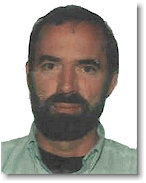
Here's some additional information from Dr. Steve O'Grady, who has been organizing the farrier conference at the upcoming AAEP Convention in San Antonio, Texas. Dr. O'Grady writes:
"The foot topics will kick off on Sunday afternoon December 3, 2006 with 3 X one and one half hour table topics. These are sessions on a given topic with two facilitators where a discussion is generated among the attendes.
"I will facilitate one on barefoot versus shod with Dr Dan Marks. This is a very controversial subject which will no doubt stimulate debate especially with farriers present.
"Two well veterinarians, Kent Carter and Tracy Turner will direct a session on foot lameness which always turns out to be a learning experience.
"Finally, Bill Moyer and well known farrier Rob Sigafoos will man a session on the management of various hoof wall defects. These two practitioners have a world of experience on crack repair.
"I will post highlights of the upcoming convention periodically in the near future. It should be a great experience for all."
--Steve O'Grady
Stranded Dutch Horses Rescue on BBC Site

Here's a link to some great stills and a video clip of the rescue of 100 horses stranded in floodwaters in Holland. I was stranded there myself, albeit in the comfort of the airport, earlier this week.
http://news.bbc.co.uk/1/hi/in_pictures/6114596.stm
Link to a Great Article!
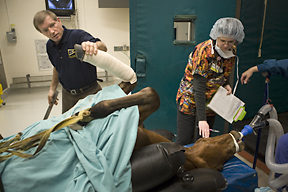
Everyone in the realm of Hoofcare & Lameness knows Michael Wildenstein, farrier at Cornell University's College of Veterinary Medicine. Mike is a consulting editor here at the magazine and a great friend. He'll be hosting Cornell's highly-regarded farrier conference next weekend at the large animal hospital, which will attract farriers from all over the country.
Cornell posted a nice story and photos about Mike today on their site; here's the link:
http://www.news.cornell.edu/stories/Nov06/Wildenstein.profile.jg.html
Photo by Jason Koski/University Photo.
Thursday, November 02, 2006
New Research: Raising Heels on Front vs. Hind Feet Have Different Effects
This just in: A new research report from the University of Vienna details a thoughtful project that many on the practical side of hoof research have wondered about for a long time.
At the recent International Conference on Equine Exercise Physiology (ICEEP) held in Fontainebleu, France in August 2006, researchers Girtler, Licka, Kicker, and Peham walked around to the back end of the horse to compare their colleagues' research findings from the front end.
They evaluated the horses barefoot, then added a 2 cm and finally a 4 cm wedge to the hind feet and worked the horses at a walk and a trot on a treadmill, with 8 markers per limb and 15 cycles per effort, per horse.
Among their findings: the angle of the coffin joint changed significantly between the walk and the trot; raising the heels increased the angle more at the walk than at the trot. Fetlock extension in the mid-stance phase was reduced when the wedges were added.
They concluded: "Raised heels decrease hind fetlock extension, which is different to the effect of raised heels on the fore fetlock. Additionally, raised heels led to a significant reduction of hock extension during stance phase at walk and trot, supporting the reported positive influence of raised heels in horses with spavin."
At the recent International Conference on Equine Exercise Physiology (ICEEP) held in Fontainebleu, France in August 2006, researchers Girtler, Licka, Kicker, and Peham walked around to the back end of the horse to compare their colleagues' research findings from the front end.
They evaluated the horses barefoot, then added a 2 cm and finally a 4 cm wedge to the hind feet and worked the horses at a walk and a trot on a treadmill, with 8 markers per limb and 15 cycles per effort, per horse.
Among their findings: the angle of the coffin joint changed significantly between the walk and the trot; raising the heels increased the angle more at the walk than at the trot. Fetlock extension in the mid-stance phase was reduced when the wedges were added.
They concluded: "Raised heels decrease hind fetlock extension, which is different to the effect of raised heels on the fore fetlock. Additionally, raised heels led to a significant reduction of hock extension during stance phase at walk and trot, supporting the reported positive influence of raised heels in horses with spavin."
Wednesday, November 01, 2006
Good-bye to Cal Chilton
Hoofcare & Lameness just learned that friendly salesman Cal Chilton has left the employment of Vettec. I have hardly ever been to a farrier event on the east coastt without seeing his friendly face and Cal has been a wonderful friend and help to many exhibitors and event organizers--as well as to farriers interested in Vettec's excellent products.
It just won't be the same without you, Cal. Good luck and stay in touch!
It just won't be the same without you, Cal. Good luck and stay in touch!
Monday, October 23, 2006
AAEP Extends 2006 Convention Registration Deadline for Farriers

UPDATE: As most of you know, the AAEP is hosting its first-ever farriers conference at their 2006 convention in San Antonio, Texas, to be held December 3-6. The farrier program is on Tuesday, December 5, but farriers can also attend any programs they wish, including a special program on palmar foot pain, during the convention.
I spoke with Dr. Steve O'Grady (AAEP's farrier conference organizer) over the weekend because I knew the deadline for the lower advanced registration price was coming up (today). The form can be a little confusing if you are trying to register as a non-vet. There is no place on the form that specifically says "farrier"; instead, you should just register as a "Spouse/Guest attending sessions" and, in the box, write "farrier". Don't worry if you have already registered and didn't write in the box.
By the way, Dr. O'Grady said that the AAEP has agreed to extend the registration deadline for farriers to receive the discount rate of $395 for at least one more week (til 10/30/06). I wrote a little article about the conference for the November issue of EQUUS, which people are receiving right about now, so it is a wonderful idea to extend the deadline for all the readers of that magazine who might want to attend.
I have already spoken to or heard from a lot of farriers, from all over the country, who plan to attend this first-ever farrier conference at an AAEP convention.
Here's a link to the AAEP convention site, where you can download the full convention program and forms:
http://www.aaep.org/convention.htm
(Don't forget to register for a hotel room; this conference is one that requires you to book through the organization for choice hotels near the convention center.)
The farriers-only conference doesn't seem to be listed on the AAEP site, but you will find info on the general lameness and foot lectures listed there, all of which are open to farriers.
It is easy to register online but I am sure that you could probably also print out the form and mail or fax it to the AAEP.
You can read and printout the AAEP hoof-related convention info from this link:
http://www.hoofcare.com/news_aaepconf2006.html
or, for an interactive version where you can post a comment or question and start a dialog, look right on this blog:
http://hoofcare.blogspot.com/2006/06/2006-aaep-convention-addresses-foot.html
Anyone who is attending and would like to be part of my informal network to stay in touch with developments and get tips on how to make the most of the convention's offerings and whatever impromptu fun that I can organize for the hoof-inclined, send me an email (fran@hoofcare.com) and I'll share with you anything I know.
Hoofcare & Lameness Journal will launch a special San Antonio-bound blog as soon as I get back next week.
Wednesday, October 18, 2006
Walking Horse Year-End Show Cancelled
The Tennessee Walking Horse Breeders' and Exhibitors' Association voted on Monday to cancel their Invitational Horse Show originally set for Thanksgiving weekend in Murfreesboro, TN. The show had been planned to crown a 2006 World Champion, after the final class was shut down at the Walking Horse Celebration because the majority of horses in the final class did not pass inspection for USDA/American Horse Protection Act soring regulations.
Tuesday, October 17, 2006
Racetrack Welfare and Safety Summit Nails Horseshoes as Culprit
Welfare and Safety Summit Participants Recommends Banning Toe Grabs, Stickers, Turndowns and Jar Calks.
A cross-section of prominent participants from the Thoroughbred breeding and racing industry who attended the Welfare and Safety of the Racehorse Summit in Lexington, Ky., on October 16 and 17 have drafted action plans in six areas to improve conditions in various facets of the Thoroughbred industry.
The six areas are Education & Licensing; Racing Conditions/Racing Office; Research; Health & Medical Records; Racing Surfaces/Shoeing/Hoof Care; and Breeding Practices.
Among the recommendations coming out of the two-day summit were:
* Make efforts to have scientific research more widely distributed among industry stakeholders.
* Examine the use or ban of certain horseshoes, such as toe-grabs, in the wake of presentations and research by Dr. Sue Stover and other participants.
* Provide continuing education for all horsemen, exercise riders, farriers and make initiatives like the Groom Elite Program more available throughout the country.
Above material quoted from a press release provided by the Jockey Club.
Mitch Taylor gave a brief presentation about shoes and shoeing and was on the working session committee designated to tackle the subjects of shoeing and surfaces.
Hoofcare & Lameness reached Mitch Taylor at home this evening. He said that he had been contacted before the meeting by the Jockey Club to present information about shoeing and hooves, and that when he arrived at the meeting, he realized that he was the lone representative of the farrier profession. Mitch gave a half-hour presentation which included an overview of hoof anatomy and function.
At the working session, the sub-committee recommended banning grabs, stickers, jar calks and turndowns by the end of 2007. Mitch Taylor was charged with reporting the group's recommendations to the larger group. The subject did come up about the use of toe grabs on hind feet, with a question being directed to Dr. Sue Stover of the University of California at Davis. As a result of her answer, the recommended ban would only cover toe grabs on the front feet.
Other recommendations included that horseshoers, trainers, and grooms should be required to show proof of continuing education efforts. One recommendation was that cd-roms be distributed for study, with questions to be answered before a track license can be granted.
Mitch said that he had discussed his role in the meeting with Thoroughbred expert farriers Steve Norman of Kentucky and Simon Curtis FWCF of England. He said that he had not been asked to be a spokesperson for any farrier group or school, but simply to provide information.
A few trainers and jockeys also provided information, but the majority of information came from a massive binder of research studies compiled from veterinary research. Veterinary surgeons Wayne MacIlwraith, Rick Arthur, Larry Bramlage and Sue Stover made presentations, as did Mick Peterson, a footing engineer who specializes in racetrack impact studies.
"I am glad that the Jockey Club decided to invite someone like me to be part of this meeting," Mitch told Hoofcare & Lameness. "Farriers and the work they do should be part of the big picture of lame horses, decreased numbers of starts, and breakdowns.
"A lot of good information was presented at this meeting," he continued. "I really believe that each person who was there wanted to do what they can to prove that the racing industry really does have the interest of the horse at heart. The recommendation about education was especially important, I think. More education will be good for the industry."
No date was set for a second meeting of this study group.
A cross-section of prominent participants from the Thoroughbred breeding and racing industry who attended the Welfare and Safety of the Racehorse Summit in Lexington, Ky., on October 16 and 17 have drafted action plans in six areas to improve conditions in various facets of the Thoroughbred industry.
The six areas are Education & Licensing; Racing Conditions/Racing Office; Research; Health & Medical Records; Racing Surfaces/Shoeing/Hoof Care; and Breeding Practices.
Among the recommendations coming out of the two-day summit were:
* Make efforts to have scientific research more widely distributed among industry stakeholders.
* Examine the use or ban of certain horseshoes, such as toe-grabs, in the wake of presentations and research by Dr. Sue Stover and other participants.
* Provide continuing education for all horsemen, exercise riders, farriers and make initiatives like the Groom Elite Program more available throughout the country.
Above material quoted from a press release provided by the Jockey Club.
Mitch Taylor gave a brief presentation about shoes and shoeing and was on the working session committee designated to tackle the subjects of shoeing and surfaces.
Hoofcare & Lameness reached Mitch Taylor at home this evening. He said that he had been contacted before the meeting by the Jockey Club to present information about shoeing and hooves, and that when he arrived at the meeting, he realized that he was the lone representative of the farrier profession. Mitch gave a half-hour presentation which included an overview of hoof anatomy and function.
At the working session, the sub-committee recommended banning grabs, stickers, jar calks and turndowns by the end of 2007. Mitch Taylor was charged with reporting the group's recommendations to the larger group. The subject did come up about the use of toe grabs on hind feet, with a question being directed to Dr. Sue Stover of the University of California at Davis. As a result of her answer, the recommended ban would only cover toe grabs on the front feet.
Other recommendations included that horseshoers, trainers, and grooms should be required to show proof of continuing education efforts. One recommendation was that cd-roms be distributed for study, with questions to be answered before a track license can be granted.
Mitch said that he had discussed his role in the meeting with Thoroughbred expert farriers Steve Norman of Kentucky and Simon Curtis FWCF of England. He said that he had not been asked to be a spokesperson for any farrier group or school, but simply to provide information.
A few trainers and jockeys also provided information, but the majority of information came from a massive binder of research studies compiled from veterinary research. Veterinary surgeons Wayne MacIlwraith, Rick Arthur, Larry Bramlage and Sue Stover made presentations, as did Mick Peterson, a footing engineer who specializes in racetrack impact studies.
"I am glad that the Jockey Club decided to invite someone like me to be part of this meeting," Mitch told Hoofcare & Lameness. "Farriers and the work they do should be part of the big picture of lame horses, decreased numbers of starts, and breakdowns.
"A lot of good information was presented at this meeting," he continued. "I really believe that each person who was there wanted to do what they can to prove that the racing industry really does have the interest of the horse at heart. The recommendation about education was especially important, I think. More education will be good for the industry."
No date was set for a second meeting of this study group.
Subscribe to:
Posts (Atom)