Thursday, November 23, 2006

Conformation Conundrum at the Brookfield Zoo: But Can She Trot?


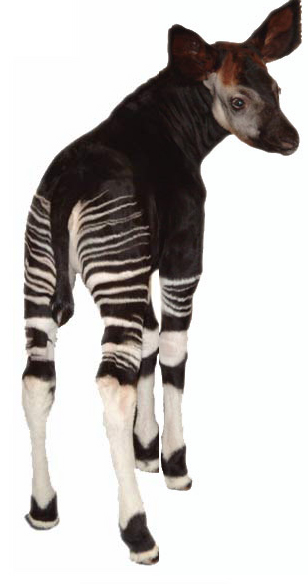
What do you get if you cross a giraffe and a zebra? And what if you throw in a little moose and, um, maybe some Oldenburg warmblood genes? Chances are, it would look a lot like Sauda, the new Okapi calf born this fall at the Brookfield Zoo in Wisconsin.

A shy native of the dark forests of the Democratic Republic of Congo, the okapi makes you want to sit back for a minute this Thanksgiving day, and thank Nature for not providing too-easy answers to all the questions we have about life on earth.

Read all about Sauda and see more photos at http://www.brookfieldzoo.org/0.asp?shttplink=../pgpages/pagegen.295.aspx&nsection=2

Thursday, November 16, 2006

Three-Dimensional Race Plates for Glueing


Several people have asked if a particular type of shoe was used on the horses at the Breeders Cup. (see story further down on this blog) The answer is that there were as many shoes as there were horses..or as many different farriers working on them.

From what we hear, Round Pond (winner of the Breeders Cup Distaff, trained by Michael Matz) was wearing race plates with Sigafoos cuffs.

Thoro’Bred Racing Plate Company has a new “Sticky Shoe” that has generated a lot of interest, though I do not know if any horses were wearing it on that particular day. I heard about them from Fred Cleveland, a longtime farrier from Marshall, Virginia. (Fred, by the way, has subscribed to Hoofcare & Lameness since 1986!)

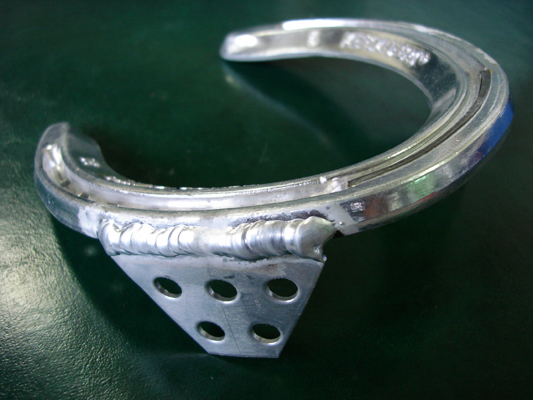
Most farriers start with a standard raceplate and add sometimes tabs over the bars, a la “onions”. Another technique is to add wings, or large clips of perforated aluminum, to increase the glue’s surface area. The Sigafoos cuff is another option.

In this photo, you see a large aluminum clip or “wing” welded to a raceplate. This photo was supplied by Raul Bras DVM of Rood and Riddle Equine Hospital in Lexington, Kentucky.

Tuesday, November 14, 2006

Luwex 2006: The World’s Most Intense Farrier Event?


I used to think that farrier competitions were tense, but then I went to Germany and experienced the Luwex Hufsymposium. No competitions at this event (except for a shoeing rig contest that was terrific) but the pressure was on.

Lectures start at 7 a.m. and the last one begins at 10 p.m. I left Mike Savoldi from California still lecturing, however informally, to a dedicated group at midnight in one of the lecture halls.

The marathon shoeing sessions are the focus of the day, as the speakers are put to the test in front of more than 500 farriers from 21 nations. As the cases roll in (and keep rolling in) the speakers evaluate the hooves, shoe them in front of an audience with a camera crew with microphones dangling in their faces, and eager veterinarian translators hanging on their every word. Oh, and an American editor popping off a flash every few seconds. Three shoeing stations are going constantly, with a trade show in the same arena…and a pub, too.

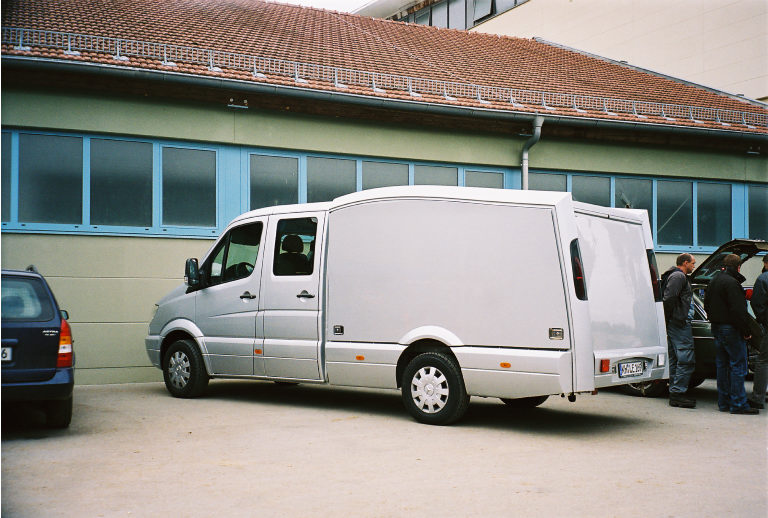
The visiting speakers shoe the horses often without their own tools, in the case of the Americans, and with the use of borrowed, albeit high tech farrier rigs crafted from Mercedes vans. If James Bond needed a farrier rig, he'd probably model his fter Rob Renirie's or Bernard Duvernay's or maybe the super-tall Mercedes of Dieter Krohnert. It would be criminal to leave a scratch, or to have a horse rap one of these rigs with an impatient hoof.

The newly-shod horse is trotted out for all to see…and he’d better be more sound than he was a few hours before. That’s sometimes a tall order for a horse that has been sedated or even just standing around for the hours it can take to get through a demonstration.

Sigi, the Icelandic farrier who did a great demo, took "clinician macho" to a new level when he hopped on his demo horse and headed for the tolting track on the grounds to demonstrate (at high speed) what the horse could do now that his feet were straightened out.

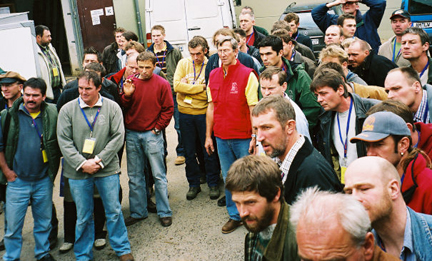
In this photo you see Switzerland’s Bernard Duvernay (red vest, center) anxiously watching his demo horse trot after shoeing. Look at the faces of the farriers in the crowd. If you make a mistake, these guys will remember it. Bernie did just fine.

Bernard divides his time between running a high-tech multi-farrier practice in posh Geneva (where he cruises the lake on a beautifully restored 1920s tug boat) and serving as a farrier education consultant in Third World countries. He might pop up almost anywhere there are horses, but is most often in India. In Germany, he had a young Iranian apprentice visiting him, Ahmad Abad, who turned out to be half-American and a frequent guest here, so you may meet him at an event.

To learn more about Bernie’s important work around the world, visit http://www.farrier.ch

To learn more about the Luwex Symposium, visit
http://www.luwex.de

Hoof Lifting Device Tests Foot Ligaments, Navicular Pain


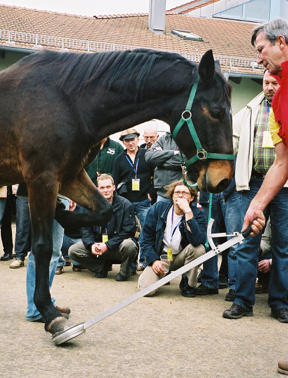
One of the most interesting products demonstrated at the Luwex Hufsympsium in Germany in October was what I called the “hoof lifter”, developed by Italian vet/farrier Hans Castilijns DVM, made in Italy, and demo’d by Swiss farrier Bernard Duvernay.

The horse stands on the device, which is covered with a rubber mat. It looks like that puck-like thing that curlers push around on the ice, with a three-foot handle and a protractor on the end. The operator stands one foot on the device and then stands back and slow raises the angle so that the horse is putting more and more pressure on the back of the foot as the coffin joint flexes.

After observing the horse, the operator than simply swivels the handle, without having to move the horse, and then can raise the lateral side of the device, tipping the foot to the medial side.

Accordingly, without moving the foot, the operator moves to the other side of the horse to test the lateral side.

The Europeans have always been keen on the hoof-lifting coffin-joint flexion tests for navicular pain, and this device gives expanded pain-response capabilities. It is well made and simple to use, but seems to keep the handler safe, too.

Mustad Equilibrium Shoe Debut with Dieter Krohnert at Germany's Luwex Festival

©Hoofcare Publishing
Before: Dieter Krohnert's spider shoes had been on this horse for a year. The horse has developed an infection in the back of the heel bulbs and up the pastern (blue arrow) and was possibly neglected. (Fran Jurga photo)
In October, I was on hand at the Luwex Hufsymposium in Krueth, Germany to see the first horse shod in public with Equilibrium shoes, the new shoe design from Mustad that was developed using research techniques pioneered by Meike Van Heel during PhD studies at the University of Utrecht in Holland.

But first, the horse! One of the interesting things about the Luwex event is that they brought back the horses that the speakers had shod the previous year, and they discussed how the horses were doing. He was a mature Hanoverian stallion training at the Grand Prix level.

German National Federation team photo Dieter Krohnert hufschmied
Dieter Krohnert,
German team farrier
They spoke in German, of course, but I think I understood. This horse had been shod with spider shoes by Dieter Krohnert, farrier to the German international teams, in 2005. He developed the shoe, which is similar to our aluminum spider plates that are riveted to shoes as an interface device.

Dieter said he thought the shoes had been successful the year before but that the horse had not been well cared for and perhaps had gone long periods without trimming. The heel bulbs contracted and thrush or some other bacterial infection had gone up the back of the pastern. The horse had medial quarter cracks in both front feet.


© Hoofcare Publishing Fran Jurga
This is the same foot, re-shod with one of the brand new Equilibrium rolled toe shoes from Mustad for a demonstration. There was a big crowd around, photography was difficult. The shoe was "invented" via research protocols to test characteristics of horseshoes at Utrecht University in The Netherlands during the PhD research of Meike van Heel. Mustad is now manufacturing the shoe. (Fran Jurga photo)
Dieter re-shod the horse with the new Mustad Equilibrium shoes, which are designed for easy breakover across the entire toe surface of the shoe.


Meike van Heel, researcher
The horse strode out very freely after standing for three hours to be shod in the demonstration. Dieter asked his helper to really trot the horse out and show what he could do, which he did, and then took a flying, bucking leap into the crowd. About 50 farriers ducked and ran, missing the flying hooves by inches.

I think I saw Dieter's hair turn gray right before my eyes but, as always, he kept his cool, shrugged, and said with classic understatement, "See, he's sound now."

For more on the festival, visit http://www.luwex.de

For more about Dieter Krohnert, read "High-End Hoofcare for High-Flying Horses : Dieter Kronhert and Steve Teichman" by Fran Jurga in Hoofcare + Lameness: Journal of Equine Foot Science, Issue 76. (print only) Also search the blog for articles about Dieter.


All HoofBlog text and images ©Hoofcare Publishing 2006 unless otherwise noted.
To learn more about new research, products, and treatments for the horse's hooves and legs as reported to veterinarians and farriers in the award-winning "Hoofcare & Lameness Journal", go to http://www.hoofcare.com
Contact Hoofcare Publishing anytime: tel 978 281 3222 email fran@hoofcare.com

Farrier Truck Competition in Germany


At the education-oriented Luwex Hufsymposium in Krueth, Germany in October, the only competition was for the title of “best rig”. What a collection! One of my favorites was a full cab old-timey Land Rover. Perfect for the farrier who does safari horses. And a homey Mercedes station wagon with a forge in the back. And there were trailers and vans and trucks, oh my.

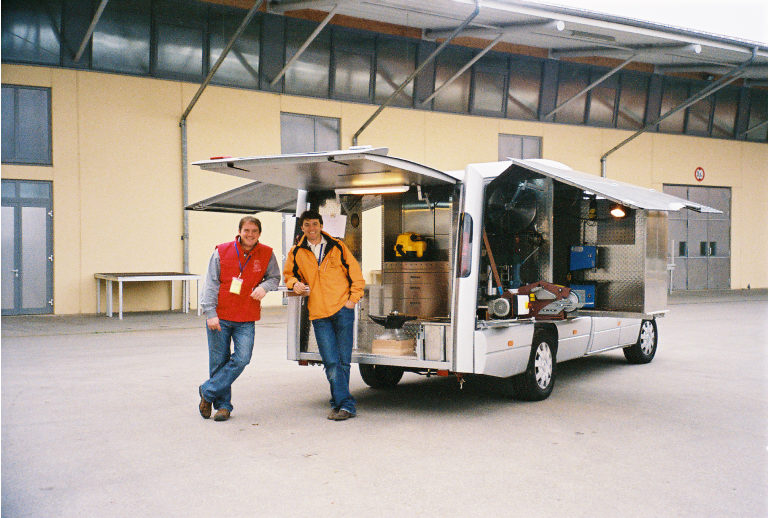
And then there was The Truck. Loic Entwistle’s new Mercedes custom truck is worth a second look, and a third. It even has a “store” full of horsecare supplies and supplements for customers to buy. It is hidden from view until he pushes a button and it glides out with all the products on display.

Loic is a German farrier and an old friend of Hoofcare & Lameness. He has been a subscriber since 1994. And I think he has been dreaming about this truck even longer!

Also in the photo: Italian veterinarian Lorenzo d`Arpe, who will be a speaker at the Bluegrass Laminitis Symposium in Louisville, KY in January 2007.

Monday, November 13, 2006

Champion Desert Orchid Has Died

I'd like to write a tribute to Desert Orchid, the great steeplechaser of modern times, who died in England this weekend except that The Sunday Times' obit is such a fine piece of writing, I'd like to just post a few lines of it here. If you don't know who Dessie is/was, you missed a great one. From the Times, no author listed:

(begin quote) Reading The Catcher In The Rye, many Britons nod instinctively when Holden Caulfield remarks: “A horse is at least human, for God’s sake.”

This might explain, to bemused foreigners, why today’s newspapers are so brimming with news of the death of the great steeplechaser Desert Orchid.

Every decade or so, in a process almost as mystical as the emergence of a new pope, the name of a thoroughbred escapes the cloistered world of racetrack bookies, and of punters hunched in betting shops tearing up betting slips scrawled with the names of nags so slow that they were beaten to the finishing line by the groundsman cutting the turf for the next meeting, to become as familiar to the general public as Lester Piggott’s tax returns.

Desert Orchid belonged to this elite stable, which stretches from Arkle — reckoned to be the greatest steeplechaser of all time — through Nijinsky, the last horse to win the English Triple Crown, Red Rum, the only one to win the Grand National three times, Shergar, the kidnapped winner of the 1981 Derby, and the explosively fast Dancing Brave, to Best Mate, the first steeplechaser since Arkle to bag three successive Cheltenham Gold Cup wins.

These are names as well known to most Britons as Silver, the Lone Ranger’s mount, Roy Rogers’ Trigger or Boxer, from Orwell’s Animal Farm.

We have measured out our lives in great horses. There is now a vacancy. (end quote)

http://www.timesonline.co.uk/article/0,,542-2452393,00.html

Monday, November 06, 2006

"Castaway" Day for Barbaro at New Bolton Center

KENNETT SQUARE, PA-- Kentucky Derby winner Barbaro’s right hind leg cast was removed today, according to his medical team. “Barbaro was placed under general anesthesia for the cast removal,” said Dr. Dean W. Richardson, Chief of Surgery. “In addition, his foot was trimmed and a new shoe glued on. A padded bandage with plastic and fiberglass splints was placed on his lower limb for support.”

Barbaro's lower right hind leg had been in a cast since surgery at Penn’s George D. Widener Hospital following his accident at the Preakness on May 20. “He had a perfect pool recovery and immediately stood; he walked easily back to his stall,” said Dr. Richardson. “He used all of his legs quite well.”

Barbaro’s left hind foot, which had laminitis, was also fully evaluated while he was under anesthesia. “There are no signs of new problems with that foot, but the hoof needs several more months of growth before we will know how much foot structure and function will be recovered," said Dr. Richardson.

(This news report was provided by the University of Pennsylvania.)

Sunday, November 05, 2006

Laura Florence Has Left New Bolton Center


Resident farrier and researcher Laura Florence has resigned her post at the University of Pennsylvania’s New Bolton Center after almost five years of service there. Laura reports that she will now pursue a private consulting practice under the name of Holistic Hoofcare, and that she plans to stay in the Philadelphia area.

“(My) impetus is to concentrate more on therapeutic benefits of trimming/barefoot. Though I won't be ruling out shoeing...it will not be a focus,” Florence predicted by email.

An interesting part of Laura’s work has been research on the hoof growth and adaptation of a herd of left-alone ponies at New Bolton Center with behaviorist Dr. Sue McDonnell. Florence’s research will be published soon in Equine Veterinary Journal; watch for the title “Hoof growth and wear of semi-feral ponies during an annual summer 'self-trimming' period”.

Laura's official title was Special Research Fellow of the Dorothy Russell Havemeyer Foundation for 2004–2006. To quote from the UPenn web site: "This appointment supports ongoing research of the hoof growth and natural trim cycle of the semi-feral equid. The goal of the study is to systematically describe equine hoof growth and wear characteristics under natural environmental and social conditions, using the semi-feral herd at New Bolton Center as one model."

Laura also played a key role in the 2nd International Equine Conference on Laminitis and Diseases of the Foot in Palm Beach.

We hope that Laura Florence will continue to provide positive input to Hoofcare & Lameness Journal.

Saturday, November 04, 2006

"Glue-y Ville" Hosts Breeders Cup: Shoes Stay On


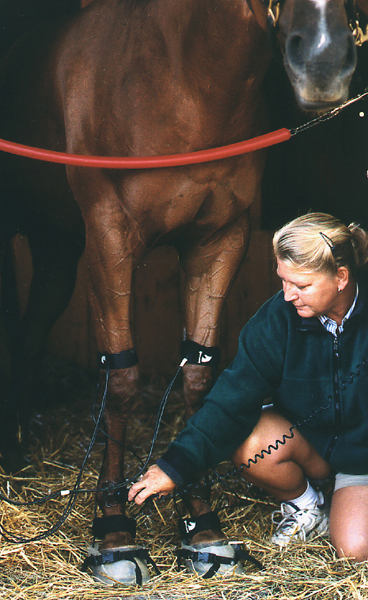
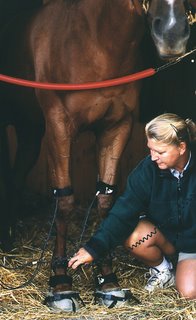
Photo: Therapist Diane Volz of Louisville, a subscriber to Hoofcare & Lameness Journal, helped at least 30 of the Breeders Cup entrees with bruised feet, sore backs, aching legs, and anxiety problems during the week leading up to the races. Photo by Fran Jurga, copyright Hoofcare Publishing.

Adrenalin, anyone? Today's Breeders Cup had thrills and spills and the hoof angles (pun intended) are still pouring in. The biggest story seems to be how many horses had their shoes glued on. But there's more...

First, let's talk about Round Pond and her heartwarming win of the Distaff being marred by the tragedy of the death of Pine Island and the breakdown of Fleet Indian. I am sure that those crashes are being replayed on the evening news tonight around the world. Just last May, Round Pond's trainer Michael Matz was watching from the stands at Pimlico when his star horse, Barbaro, stumbled to a halt on the track in front of him, his fetlock dangling.

But today, Matz was back in the winner's circle where he had stood with Barbaro after the colt's dramatic win of the Kentucky Derby in May. And he was looking over his shoulder at the horse ambulance. Did someone call the screenwriters' guild?

But Round Pond has a hoof story. According to the web site allaroundphilly.com, Round Pound sat out nearly five months this year because of hoof problems. Originally thought to be a foot bruise, the injury didn't clear up, so the filly was shipped to the podiatry unit at Rood & Riddle Equine Hospital in Lexington, Kentucky, where she was treated by Hoofcare & Lameness Journal consulting editor Scott Morrison DVM and his staff.

"They figured out that Round Pond has very thinly soled feet, and the nails from a standard shoe tend to pinch her feet," explained Round Pond's owner, Delaware car dealer Rick Porter, in the Philadelphia newspaper article. "The answer was to use glue-on shoes, which she used in the Beldame and will wear for the Breeders' Cup."

To read more about Round Pond's roundabout trip to the Breeders Cup, visit http://www.allaroundphilly.com/site/news.cfm?newsid=17421114&BRD=1671&PAG=461&dept_id=17782&rfi=6

Round Pond, by the way, is a real place; it is one of my favorite little Muscongus Bay towns on the coast of Maine.

Also dipping into the glue were three top horses wearing the Burns Polyflex shoe (http://www.burnspolyflex.com)

The filly Malibu Mint recently set a Polytrack record at Keeneland in Lexington, KY wearing the shoes; she didn't do quite so well against the colts in the Breeders Cup Sprint today. Gary Mandella's Silent Name in the Mile also wore the shoes, as did Brother Derek, trained by Dan Hendricks, who led for about half of the $5 Million Breeders Cup Classic (powered by Dodge) before fading.

Curtis and Diane Burns currently make the wire-cored urethane shoes themselves; scroll down for a more detailed article about the shoes, deeper in this blog; you can also click on the August archive link button in the right hand column.

Brother Derek, by the way, is usually shoeless; Hendricks prefers to train the colt barefoot. He had farrier/inventor Curtis Burns glue the see-through shoes onto the colt before the Goodwood at Santa Anita, where the horse ran second to Lava Man. The horse continued to train in the shoes, shipped east, and ran in them today.

I haven't checked in with my friends Dan Burke from Farrier Product Distribution and Steve Norman, ace shoer at Churchill to see what sorts of special shoes they whipped up, or saw whipped up, but I will update this story when I hear from Dan. He's in Virginia at Danny Ward's big farrier clinic today--along with everyone else in the farrier world!

Not to be outdone by the farriers, Hoofcare & Lameness subscribers Mimi Porter and Diane Volz have been hard at work all week providing therapy to the horses at Churchill. According to a news story on businesswire.com, Diane has used the Equitonic massager on 30 horses bound for the Cup races today. Since she provides therapy for the Todd Pletcher stable, that would be 17 horses right there. I know Diane will be heartbroken by the injury to Pletcher's Fleet Indian, but it sounds like the filly will recover.

AAEP On Call veterinarians Wayne McIlwraith and Larry Bramlage had a busy day. ESPN seemed to keep a bit more distance from the tragedy than the network sports broadcast team at the Preakness.

(An amazing fact from today's races is that trainer Todd Pletcher sent out 17 horses and did not win a single race. But he scored enough placings to take home almost $2 million in purse money, according to the Louisville Courier-Journal. Without winning a race. Think about it.)

Finally, the day ended with South American superstar Invasor running down the favorite Bernardini. I don't know what that horse had on his feet, but they worked just fine. I know a little bit about Invasor. Every time I saw him at Saratoga this summer he was sulking in his stall, but his existence here is thanks to Hoofcare & Lameness friend Hassan bin Ali, endurance racing trainer for Sheik Hamdan al Maktoum, and a former bloodstock agent for Sheik Hamdan's Shadwell Stud.

Hassan, who is an avid follower of shoeing technology innovations, popped in here one day last August in the middle of a heat wave, which was like a cold day in Dubai. He showed me videos on his cell phone and camera; he came here straight from Uruguay, where he had been buying endurance horses. To show off the sale horses, they galloped them on a paved road for miles, with Hassan following in a car with the windshield wipers flapping back and forth. It was quite a video.

I made a comment about road founder and he laughed. "Oh, and I bought a racehorse, too, while I was down there," he added nonchalantly. "The champion of Uruguay. I think maybe he will win the Breeders Cup."

The next time I saw Hassan was in the winner's circle after the Whitney at Saratoga. And today his impulse buy for the Sheikh won not just a Breeders Cup race, but THE Breeders Cup race, the Classic.

One of the saddest things about the end of the Breeders Cup, after the death of Pine Island, is that so many of the horses will not ship back to Belmont and Santa Anita, or even to Florida. They'll just take a 90-minute van ride to Lexington and their racing shoes will be pulled off forever as they start new careers in the breeding shed and broodmare band.

It was great to see older horse Better Talk Now charge up to second place in the Turf; sadly, 7-year-old Perfect Drift didn't do much in the Classic.

I'd like give a big thanks to all of the horses, and to the people who have worked so hard all year to keep them sound. This year had many fewer horses lost in the final weeks because of foot lameness. Is it the glue? Is it training on the Polytrack at Keeneland? Was it the wet summer up here in the North? I don't know, but racing has been great fun to follow this year, and the fact that they all have four feet means that the odds of me finding a story to tell are probably better than that I will ever cash a winning ticket.

And I wouldn't have it any other way.

Readers: if you have hoof-related stories from today's Breeders Cup, please send an email to fran@hoofcare.com and I'll share it!

This and all content on the Hoof Blog copyright 2006 Hoofcare Publishing. No use without permission. The Hoof Blog is created by Fran Jurga as an adjunct to Hoofcare & Lameness: Journal of Equine Foot Science. . For more information or to subscribe, please visit www.hoofcare.com or call 978 281 3222 in the USA.