Mr Ross Finnie, Scottish Minister for Environment and Rural Development has announced that from 30 March 2007 all those practising farriery in Scotland will need to be registered with the Farriers Registration Council (FRC) of Great Britain.
The new requirement ends a previous exemption which allowed unregistered persons to practise farriery in the Highlands and Islands areas of Scotland which comprises of: Highland Region, Western Isles Islands Area, Orkney Islands Area, Shetland Islands Area and all other Scottish Islands (including those in the Firth of Clyde).
Persons failing to register, and who continue to practise farriery anywhere in Scotland, could be fined up to £1,000.
Minister Ross Finnie said: “This measure will ensure that the practise of farriery is uniformly controlled throughout the whole of Scotland. Horses and their owners in the Highlands and Islands will have the same degree of protection as that currently enjoyed by those elsewhere in Scotland.”
The FRC was established under the Farriers (Registration) Act 1975 as the statutory body responsible for the administration of the “Register of Farriers”. The register records the details of all those farriers who have satisfied the prescribed registration conditions.
The Farriers (Registration) Act 1975 was introduced to prevent and avoid suffering by, and cruelty to horses, arising from shoeing by unskilled persons; to promote the shoeing of horses and the training of farriers; to establish the Farriers Registration Council (FRC) to register persons engaged in farriery and to prohibit the shoeing of horses by unqualified persons.
The Act came fully into effect in England and Wales in 1980.
The requirement to be registered came into force in Scotland on 1 November 1981, but specifically excluded rural areas and islands because of fears that there might not be enough farriers eligible for registration to cover these remote areas and carry out all necessary farriery work.
The Acts do not apply in Northern Ireland.

Friday, December 22, 2006
Wednesday, December 20, 2006
Barbaro Meets Morrison; Photo Shows Feet

Kentucky Derby winner Barbaro met Dr. Scott Morrison from Rood and Riddle Equine Hospital on Tuesday, December 20. Not much has been publicly said about what Morrison may have recommended, although the owners are now hinting to the press that the horse may be moved to Kentucky as early as next week.
Barbaro may be on the Good Morning , America television show on Thursday December 21, at approximately 7:30 a.m. Presumably you'd be able to watch the segment on the GMA / ABC News web site .
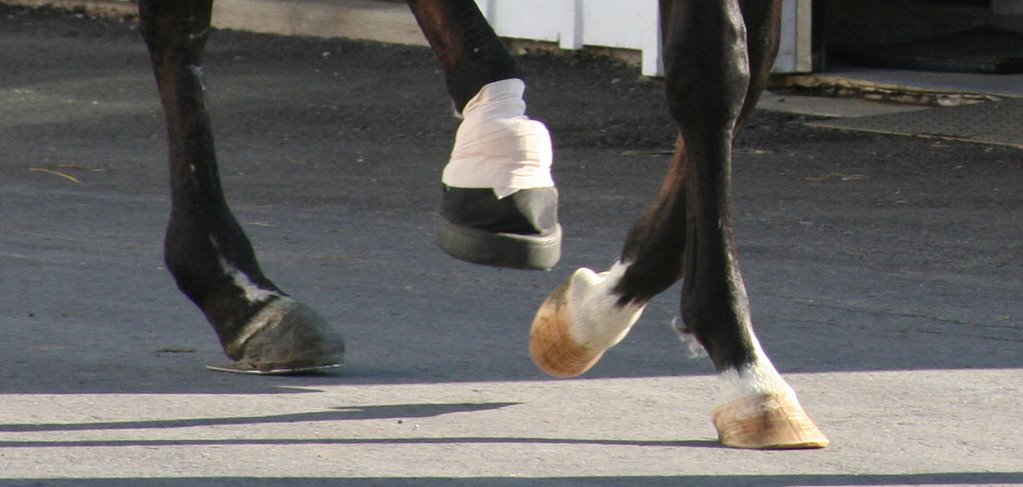
New Bolton Center released a new set of photos of Barbaro today; we are posting a closeup of his feet, since this is all our readers see of a horse anyway, and hopefully a second photo, showing his overall condition. Note: if you double-click on an image, it will open in a new window and you may be able to see a larger version, depending on resolution.
Please note that the horse is wearing a Sigafoos glue-on shoe on his right hind (the leg that was broken) and a Soft Ride hoof boot on the left hind (foundered foot).

Dr. Hilary Clayton Wins Two National Dressage Awards
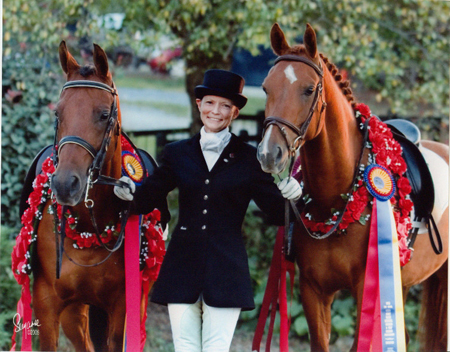

Hilary Clayton PhD MRCVS, McPhail Dressage Chair in Equine Sports Medicine at Michigan State University College of Veterinary Medicine, proved once again this year that she was talk the talk and piaffe the piaffe, as she won two US Dressage Federation/Arabian Horse Association first place awards in Fourth Level and Prix St Georges levels.
In both upper level standings, Hilary was riding her talented MSU MAGIC J+//, an Arabian gelding bred by the Michigan State horse breeding program and selected by Hilary for training in dressage based on his movement, rather than his conformation.
Lest you think that Magic is a one-horse wonder, Hilary also won the national championship at First Level with her young horse, MSU FANFARE+/, another campus homebred, who also placed third nationally at Training Level.
Both horses have won national championships in the past few years.
Dr. Clayton competes the horses both at breed shows and at open shows. She keeps the horses at home most of the year and cares for them herself. During the rough Michigan winters, the horses live on campus, where they can be ridden indoors.
Five years ago, Dr. Clayton was seriously injured in a trailer mishap while loading her horses. She has made a remarkable recovery to be able to ride again, let alone ride at the upper levels. I had the pleasure of grooming for her at the Michigan Arabian Horse Show in May...and I'm glad I don't have to compete against her!
By the way, Hilary has kept both these horses sound and competing at the very top of national levels without ever having shod either horse. Her farrier is Kappi Roghan, who applies what they term a "physiological trim" which Hilary has been analyzing in her laboratory with hoof anatomy expert Robert Bowker DVM.
I wonder what she does in her spare time...
By the way, Hilary is one of several generous contributing editors to Hoofcare & Lameness Journal. She is also author of the books, Conditioning Sport Horses, and The Dynamic Horse, both available from http://www.hoofcare.com.
Congratulations, Hilary!
Photos courtesy of Dr. Hilary Clayton.
Monday, December 18, 2006
Mustad Hoofcare Acquires the Simonds International Farrier Products Division; Transaction Strengthens Line of Hoofcare Farrier Tools
Mustad Hoofcare announced today that they have acquired the Farrier Product Division of Simonds International.
Sincerely,
Hans & Clarin
Sunday, December 17, 2006
Tis the season...
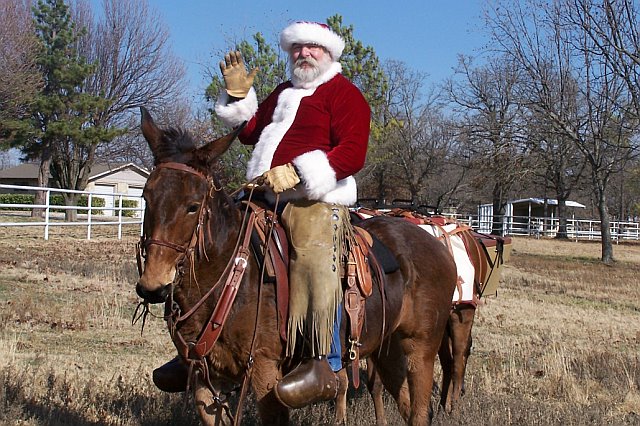
Thanks to everyone who is organized enough, and especially thoughtful enough, to have their holiday cards in the mail--and include me on their lists. I love receiving them and thought I would post a few of my favorites.
This is Oklahoma farrier and horseshoeing museum owner Lee Liles on his mule. The disguise didn't fool me for a minute.
Saturday, December 16, 2006
The Buzz on Barbaro: Morrison To Visit on Tuesday, Move May Be Soon

According to a report posted today on the Thoroughbred Times web site, Hoofcare & Lameness consulting editor Scott Morrison DVM of Rood and Riddle Equine Hospital in Lexington, Kentucky will be examining Barbaro's left hind foot, which was surgically debrided following his problems with support limb laminitis this summer. The report sets the appointment for Tuesday, December 19.
Click here for Thoroughbred Times story
Dr. Morrison is the founder and head of the Podiatry Clinic at Rood and Riddle; his unit is the largest such clinic in the world. The clinic currently employs four foot-specialist veterinarians and four lameness-specialist farriers, as well as a staff of technicians and administrative support staff. Morrison is a specialist in laminitis and founder and consults on cases all over the world.
Barbaro is still a patient at the University of Pennsylvania's New Bolton Center in Kennett Square but is expected to be moved to another facility this winter, according to interviews with owner Gretchen Jackson and with his attending veterinarian Kathy Anderson DVM of Fair Hill Training Center in Maryland. The horse has been at New Bolton Center since shattering his right hind leg during the running of the Preakness Stakes at nearby Pimlico Racetrack in Baltimore, Maryland in May 2006.
Photo credit: Haydn Price/www.hoofcare.com
Thursday, December 14, 2006
Chris Pollitt Named Honorary Fellow of the Worshipful Company of Farriers in London Ceremony

Australian veterinarian and laminitis researcher Chris Pollitt was honored by the Worshipful Company of Farriers (WCF; "The Company") last week in an honorary luncheon in London. The Company bestowed an honorary fellowship, stating,
(begin quote)
The Honorary Fellowship is the highest honor awarded by the Worshipful Company of Farriers and such an award is only made to exceptional people who have made an exceptional longstanding contribution to the art, craft or science of farriery.
It is even more exceptional for this award to be given to somebody from the other side of the world.
Professor Chris Pollitt is one such exceptional person.
.....
With countless publications to his name, no one has done more to advance the scientific understanding of the intricacies of the horse's foot than Professor Pollitt.
(end quote)
Chris is now entitled to use the letters (Hon)FWCF after his name.
Photo: Dr. Pollitt with HRH Princess Anne, a former master of the Worshipful Company of Farriers and a devoted student of horse science.
Farrier Paul Brewer Has Died in Kentucky
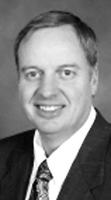
Long-time Kentucky farrier Paul Brewer died in a fall from a ladder on December 13, according to reports received here. The Lexington, Kentucky resident played a pivotal role in the growth of the American Farrier's Association in the 1980s and was for many years, the association's "IT" expert, as well as treasurer. Paul wrote programs for the AFA's membership and competition scoring, and taught many farriers how useful a computer could be in their businesses. He planned and orchestrated the 1988 American Farrier's Association convention in Lexington, which is still remembered as one of the best-attended and most successful AFA conventions in history.
I have known Paul as long as I have been in the farrier industry (and that is a long time). He was extremely dedicated to the AFA, and had a thriving business, known as The Bluegrass Forge, before retiring. His family's farm bordered the Kentucky Horse Park on Iron Works Pike in Lexington, and I have many fond memories of visiting his family and their horses.
Paul was an invisible stalwart of every AFA convention for at least ten years. He was always behind the scenes, always worked long hours, and never asked for recognition. I was with him one fateful night when an error was discovered in the scoring of the competition, resulting in the naming of incorrect people to the American Farriers Team, and he vowed to create a computerized scoring program for the AFA, which he did.
Paul was a champion of moving the association from its headquarters in New Mexico to the new office suite at the Kentucky Horse Park and fought diligently for the move, which was one of the most bitter political episodes in the AFA's history. He was also very involved in the Bluegrass Horseshoers Association.
If you are a member of the AFA or if you enjoy the privileges of being a farrier in the 21st century, you have people like Paul Brewer to thank.
"Another important piece of AFA history gone," sighed acting AFA executive director Mike Nolan today. Paul had been Mike's farrier for many years.
I agree.
The AFA's death notie for Paul is available at http://www.americanfarriers.org.
To leave a message in a memorial guest book dedicated to Paul via the Lexington Herald-Leader's web site, please click on this link: Paul Brewer's Memorial Guest Book
(Last edited 12/17/06)
Monday, December 11, 2006
Study Targets Gene in Bone Loss Similar to Pedal Osteitis, Navicular Degeneration Equine Lameness Conditions
 |
| A CT scan of the equine distal limb reveals the bony architecture. Image courtesy of Alex zur Linden, DVM, DACVR, Assistant Professor of Radiology at Ontario Veterinary College. |
By now, most Hoof Blog readers know the mechanism behind degenerative bone loss that is so clearly illustrated by foot conditions like pedal osteitis and navicular degeneration. Tildren is the current great hope for treatment of those conditions, although only now it has only been studied in navicular disease and bone spavin. Still, there's hope!
Enter a new hope this week, thanks to a study from the University of Pennsylvania, as mentioned in the journal Nature Medicine. Senior author Yongwon Choi, PhD, professor of Pathology and Laboratory Medicine at the University of Pennsylvania and colleagues report their findings.
To quote from their press release:
"The basic principles behind bone metabolism are largely understood, hence a handful of drugs treating osteoporosis are available. Most drugs inhibit osteoclasts, which cause bone decay. But there is also at least one that stimulates osteoblasts, enhancing bone formation. A combined treatment will not only prevent the occurrence of osteoporosis, but also make the quality of bone even better.
"Our discovery proves that inhibiting osteoclasts while simultaneously stimulating new bone formation can be done.
"Bone health is maintained by the balanced activities of osteoblasts and osteoclasts. The study shows that the inactivation of gene Atp6v0d2 in mice results in dramatically increased bone mass due to defective osteoclasts as well as enhanced bone formation.
"These findings may provide some clarity into the regulation of bone metabolism and show that targeting the function of a single gene could possibly inhibit bone decay while stimulating bone formation."
(end quote)
Before you start lining up all those lame horses, please realize that it may be a while before this gene therapy becomes a reality and trickles down to equine medicine. Then again, the equine model may be a good one for experimentation. Let's hope!
Hilary Cloos: Ivy League Farrier
It has been ten years since Hoofcare & Lameness subscriber Hilary Cloos graduated from Harvard University with a degree in physics. Just as many of her classmates went on to graduate studies in physics at places like New York's Cornell University, Hilary also headed to Cornell...but she chose to apply her physics to horses by studying with Michael Wildenstein to become a farrier.
The Harvard Crimson, daily campus newspaper for the sprawling city-of-ivy down the road, published a tribute article to Hilary today. She is one of their unique graduates, that's for sure!
Although...US Senator Lincoln Chafee of Rhode Island went to Montana State to study horseshoeing with Scott Simpson after he graduated from Brown University, also an ivy league school. Maybe there is a secret society of recovering ivy leaguers who are now servants of the hoof!
Here's the link to the Crimson's excellent article about Hilary Cloos, an upstanding citizen of the farrier nation:
http://www.thecrimson.com/article.aspx?ref=516321
Here are five things you probably don't know about Harvard University:
1) Harvard closed its vet school in 1901 and paid the remaining students to go to Penn;
2) Harvard's Museum of Comparative Zoology contains one of the largest collection of fossil bones of pre-Equus horse species, including a dazzling array of coffin bones and one of New Mexico's famous examples of what is called the Hagerman Horse;
3) the university has a thriving mammal and bird locomotion laboratory in nearby Bedford at the university's Concord Field Station, where studies on horses are sometimes done and all the force plates are ready to do more;
4) Dr. Castle McLaughlin, a cultural anthropologist and professor at Harvard's Peabody Museum, is founder of the Nokota Horse Conservancy, and compiled a 300-page study of the unique herd of wild horses in North Dakota, who are believed to be descended from the ponies of Sitting Bull.
5) Harvard University Press published a book I use a lot in research, Horse Power: A History of the Horse and Donkey in Human Societies by Juliet Clutton-Brock and most recently, the beautiful book Horses : History, Myth, Art by Catherine Johns.
And something that matters to me: Harvard has been scanning some of its old and rare horseshoeing texts and adding them to the online archive of accessible references. Thank you!
The Harvard Crimson, daily campus newspaper for the sprawling city-of-ivy down the road, published a tribute article to Hilary today. She is one of their unique graduates, that's for sure!
Although...US Senator Lincoln Chafee of Rhode Island went to Montana State to study horseshoeing with Scott Simpson after he graduated from Brown University, also an ivy league school. Maybe there is a secret society of recovering ivy leaguers who are now servants of the hoof!
Here's the link to the Crimson's excellent article about Hilary Cloos, an upstanding citizen of the farrier nation:
http://www.thecrimson.com/article.aspx?ref=516321
Here are five things you probably don't know about Harvard University:
1) Harvard closed its vet school in 1901 and paid the remaining students to go to Penn;
2) Harvard's Museum of Comparative Zoology contains one of the largest collection of fossil bones of pre-Equus horse species, including a dazzling array of coffin bones and one of New Mexico's famous examples of what is called the Hagerman Horse;
3) the university has a thriving mammal and bird locomotion laboratory in nearby Bedford at the university's Concord Field Station, where studies on horses are sometimes done and all the force plates are ready to do more;
4) Dr. Castle McLaughlin, a cultural anthropologist and professor at Harvard's Peabody Museum, is founder of the Nokota Horse Conservancy, and compiled a 300-page study of the unique herd of wild horses in North Dakota, who are believed to be descended from the ponies of Sitting Bull.
5) Harvard University Press published a book I use a lot in research, Horse Power: A History of the Horse and Donkey in Human Societies by Juliet Clutton-Brock and most recently, the beautiful book Horses : History, Myth, Art by Catherine Johns.
And something that matters to me: Harvard has been scanning some of its old and rare horseshoeing texts and adding them to the online archive of accessible references. Thank you!
Subscribe to:
Posts (Atom)