Friday, March 14, 2008

British Farrier/Vet Conference Planned for April


The British Equine Veterinary Association (BEVA) and the National Association of Farriers, Blacksmiths and Agricultural Engineers (NAFBAE) have joined forces to present an informative and stimulating one day conference with international speakers from the USA and The Netherlands.

The Diagnosis and Management of Conditions of the Foot: An International Approach will be held on Monday, April 14 in Nottingham, England.

The event will feature a Commercial Exhibition, strongly supported by manufacturers of equipment and related products, which presents an ideal opportunity to acquire the latest tools and materials and discuss the application of new techniques.

This conference sold out when last run. The event will be held on a Monday, at the East Midlands Conference Centre in Nottingham, a slightly larger venue than in previous years, with tiered seating and enhanced audio-visual aids to improve the ability to present to a large audience.

Speakers and topics include:
MRI of the equine foot (Application of a new technique and its implications): Tim Mair
Useful foot-related measurements from the horse and its radiographs: Richard Mansmann
Advances in diagnostic techniques: Peter Clegg
Pressure mat analysis in the assessment of foot balance: Ian Hughes
International perspective: Meike Van Heel (replacing Pascal Ebel)
Pathological conditions of the donkey foot: Karen Rickards & Colin Goldsworthy
Slip and grip (Dynamics of the hoof): Chris Pardoe
Foot measurements in approaching clinical cases: Richard Mansmann

Unfortunately Pascal Ebel of The Netherlands,who was scheduled to speak, has been injured and will be replaced by Dr Meike Van Heel. Van Heel is a movement scientist, equine physiotherapist, and part of the same team at Utrecht as Ebel. Meike Van Heel completed her PhD on "the effects of trimming and shoeing warmblood horses" and has developed a prototype horseshoe which benefits the horse’s joint load and limb movement. She has also carried out studies into the development of uneven feet in foals due to grazing behavior and conformation.

Click here to download the updated program schedule. (A one-page Adobe Acrobat pdf file will automatically download from the NAFBAE web site.)

Click here to download the seminar's complete color brochure. (A larger Adobe Acrobat pdf file will automatically download from the NAFBAE web site.)

Thursday, March 13, 2008

The Inside Track: Summit Sessions on Shoeing and Surfaces at Next Week's Jockey Club Racehorse Welfare and Safety Meeting


The second Welfare and Safety of the Racehorse Summit will be held Monday, March 17, and Tuesday, March 18, at the Keeneland Sales Pavilion.

Most of the topics to be covered will be of great interest to Hoof Blog readers, in particular reports on committee studies of hoof care and horseshoeing, synthetic racetrack surfaces and injuries in racing.

Click here to read a complete press release describing the mission of this meeting and its unique structure for dynamic planning sessions and also visit the Summit's web site, which describes accomplishments of the first Summit, held in October 2006. Several PowerPoint presentations are available at that site's "Presentations" menu for download and study, including Bill Casner's animated slide show on the detrimental effects of toe grabs. (Note: this is a 7 MB PowerPoint file. Download only if you are sure your system is capable.)

Fran Jurga of Hoofcare Publishing will be one of 60 participants in the study groups. Fran joins shoeing and hoof care committee members Bill Casner (chair), Dr. Rick Arthur, Ed Bowen, Bob Curran, Bob Elliston, Dr. Rob Gillette, John Harris, Richard Mandella, Chris McCarron. Wayne McIlwraith, Dan Metzger, Steve Norman, Denny Oeschlager, Dr. Mick Peterson, Todd Pletcher, Richard Shapiro, Dr. Scott Stanley, Gary Stevens, Dr. Sue Stover and Mitch Taylor.

Mitch Taylor of Kentucky Horseshoeing School will present high-speed video studies of racehorses galloping on different surfaces wearing different shoes. Mitch has been building on his initial filming of horses with and without toe grabs that he presented at the "Hoofcare@Saratoga" forum last August and at the 4th International Equine Conference on Laminitis and Diseases of the Foot in November.

In the synthetic surfaces study group, Dr. Preston Hickman of the Wichita Equine and Sports Medicine Clinic, who also uses video analysis technology, will examine the potential causes of on-track injuries. Hickman was a farrier before becoming a veterinarian and is certified by the American Farrier's Association. He is a proponent of Dartfish motion analysis software. Below are some examples of Dartfish "Stromotion" images from the Dublin Horse Show and a short example of a clip of Dr. Preston's high-speed video.

This might be the most important meeting of the year. There is no charge to attend for audience members; there will be two public sessions, one of Monday morning and one on Tuesday afternoon (see schedule).

Please contact the Jockey Club for more information: (859) 224-2850.


All HoofBlog text and images © Hoofcare Publishing 2006-2008 unless otherwise noted. Please request permission to reproduce or capture images or content. This blog is available for delivery via RSS feed or as a daily email of new content.

To learn more about new research, products, and treatments for the horse's hooves and legs as reported to veterinarians and farriers in the award-winning "Hoofcare & Lameness Journal", go to http://www.hoofcare.com

Direct “subscribe now” link to Hoofcare & Lameness Journal: http://www.hoofcare.com/subscribe.html

Contact Hoofcare Publishing anytime:
tel 978 281 3222; fax 978 283 8775; email bloginquiry@hoofcare.com

Resource for Your Files: "Managing Equine Joint Inflammation" Free Download

LinkOur friends at Idexx have a free download of a roundtable discussion featuring leading university lameness veterinarians at Colorado State University and Texas A&M University on the topic of joint inflammation. If you click on this link the download should start.

The document is a 2.4MB Adobe Acrobat (PDF) file created by Veterinary Learning Systems. You should end up with a 16-page document that you can print or read on your screen.

Idexx is the manufacturer of Surpass, a topical anti-inflammatory medication, and many other medications and products for equine veterinary care. The special report covers all aspects of new developments for equine joint problems.

Wednesday, March 12, 2008

Horseshoer Killed in Pancho Villa's Famous 1916 "Invasion" of New Mexico

Pancho Villa and officers, 1916.
General Francisco "Pancho" Villa was the people's hero during the Mexican Civil War in the early 1900s; depending on which history book you read, he was Braveheart with a great mustache...or Osama bin Laden in a sombrero.


Here's some history you won't find in any textbook. 

Montana farrier Scott Simpson and I share a fascination with the history of a raid by Mexican General Francisco "Pancho" Villa, who slipped across the border and raided the town of Columbus, New Mexico at dawn on March 9, 1916.  But I didn't expect there to be a horseshoer involved. Now I know otherwise.

Tuesday, March 11, 2008

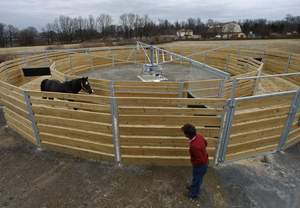
Friends at Work: Let's Clone Nicole Roberts!


You hear a lot these days about cloning horses. Top showjumpers, endurance horses, and especially those down-in-the-dirt cutting horses can now have their DNA recycled into a genetic match.

From where I sit, we need to not clone the horses but the horsemen, those people of either gender who are superb at understanding how to care for horses and, in particular, how to nurse them back to health after illness or injury.

We've always had layup farms, some of which include physical therapy, but most of which are benign holding facilities where racehorses can get some fresh air and a few hours in a paddock each day before they return to the track or maybe put on a few pounds and some dapples before they head to the sales ring.

But what if you had a dressage horse with a suspensory problem, a steeplechaser with a bad bow, a racehorse recovering from EPM and you couldn't provide the nursing care? Where would you send your horse? Who would you trust to bandage and medicate and just plain care for that horse? We live in a day of revolving barn helpers; if Miguel can't make it today, he sends his cousin, but his cousin isn't quite the poultice artist Miguel is. And if you're working on layups, poultice needs to be your art form.

My vote for cloning would be the people who are so good at care of lame horses. Whether it's a barefoot rehab farm or a high-tech racehorse recovery center, the care and results will only be as good as the skills and experience of the people who have their hands on the horse, day in and day out. The best intentions and Internet consultations won't take the place of "been there, done that, can do" and that takes years of experience and hundreds of horses to gain.

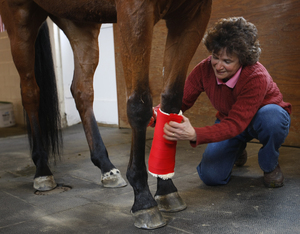
So we come to the story of Nicole Roberts. I'd like to say I know her, but I don't. I do know Dr. Midge Leitch, the vet who recommends that owners turn their recovering horses over to Nicole for care.

Today's Philadelphia Inquirer has an article about Nicole and her "halfway house" for recovering horses outside Kennett Square, Pennsylvania. The point of asking you to read this article is not that you will learn something about lameness, but that you will remember that there are people out there like Nicole.

I hope she takes on apprentices. It would be easy to say that she should write a book or make a dvd, but there is no substitute for hands-on experience with horses. Combine that experience with a genuine "feel" for horses and you have a valuable, if oft unsung, hero of the horse world who can often bring a horse back without sharing credit with high tech treatment tools or holistic cure-alls.

That's what they are talking about when they talk about horse sense. I hope you will take time to read the article and reflect on the role that people like Nicole play in our industry.

Favorite Video Clips: Underwater Treadmill at University of Minnesota


Thanks to twincities.com for this video clip of underwater treadmill at the University of Minnesota College of Veterinary Medicine's new Leatherdale Equine Center in Falcon Heights, Minnesota. You're watching a Hanoverian recovering from arthroscopic fetlock surgery enjoying some physical therapy, with some nice closeup photography of the hooves underwater and a brief glimpse of Dr. Stephanie Valberg, the center's director.

Clinical Farriery: New Book from German Farrier Leader

It's foaling season all over the Northern Hemisphere: these post-mortem photos are a reminder of the amazing process that creates the hoof from very soft tissue. Photos provided by Uwe Lukas.

It is a pleasure to announce the publication of a new book on farriery. Gesunde Hufe--kein Zufal! by Uwe Lukas was published recently by FN Verlag in Germany and my copy finally floated over to these shores.

The title translates to: "Hoof Recovery: No Accident" (sort of), meaning that hoof rehabilitation, the author's specialty, requires skill, experience, and a plan. I am sure someone will leave a comment with a better translation.

Uwe is the chairman of the Erster Hufbeschlagsschmiede Verband (EDHV), a.k.a. the German farriers association. His client list reads like a "who's who" of international dressage and show jumping, but his heart seems to be back at the vet clinic; he is the farrier at Tierärztliche Klinik Telgte (Telgte Equine Hospital and surgical center) and is based in Warendorf, the site of the state stud of the Westphalian breed. He also "rehabs" horses by offering long-term residential care at his forge, especially for laminitis cases.

While most Americans will be scared away by the German text, the photos in the book are compelling. The foal correction and sport horse shoeing images are among the most instructive without translation, but it is fascinating to see that the bulk of the book is therapeutic cases that are treated with the most high-tech support materials (Vettec and Luwex hoof support materials earn a big thumbs-up from Uwe) but also the most basic German-type Werkman and Kerckhaert shoes and big e-head nails.

As in the Hoof Problems book by Rob Van Nassau from Holland, this book has many detailed cases of canker, various types of "loose wall" conditions, coronitis and nasty quarter cracks. It's hard to say if those problems are more prevalent in Europe or if both authors had access to unusually severe cases.

I know this blog is read around the world, and some readers can surely read German (or live there), so please consider purchasing this book. I have a shelf of German farrier and hufpflege (hoof nurse) books, but this one seems by far the most contemporary, and breaks some of the stereotypes about traditional German farriery. Surely we are evolving to an international playing field where it will become harder and harder to discern the nationality of the farrier by looking at the shoe, just as the warmblood horses themselves are now so hard to identify by nationality.

Aluminum shoes may be the last frontier between American and European farriers. The only aluminum shoe in Uwe's book is a lovely ultra-toe specimen attributed to Dr. Jean-Marie Denoix of France.

A unique part of the book explains how to clean feet; the text goes on for quite a while about tidiness in the stable. As Uwe cleans a foot, there's an explanation of how to use bucket underneath to catch the water and keep the floor clean. All the settings for the photos are very tidy.

Uwe's book is published by FN Verlag, the national equestrian association in Germany, and may be purchased through their web site's bookshop.

Thanks to Uwe and the EHDV for all the help they give to Hoofcare and Lameness Journal.


Monday, March 10, 2008

Cheltenham Runner is No Relation to Blogger


Thanks to everyone who has suggested placing a Transatlantic wager on the Scottish horse Big Eared Fran, who is entered in the Cheltenham Festival's Championship Bumper this week. The Festival is the biggest jump racing event in the year's calendar in the UK and creates quite a frenzy.

Big Eared Fran is by the famous flat racing sire Danehill and originally was destined for flat racing with the Coolmore Stud but has changed hands (and racing genres). Trained by the legendary Martin Pipe, the horse is named for his current part owner, former England and Rangers football player Francis Jeffers.

A win by a Scottish-owned horse at "the biggest show on turf" would be a Seriously Big Deal, since the festival is normally dominated by Irish horses and trainers.

The horses to watch are the super star Kauto Star and his stablemate Denman, both entered in the Cheltenham Gold Cup. Kauto Star is recovering from a foot abscess but is expected to start.

Cheltenham is in the scenic Cotswolds district of England, west of London. To make the festival more challenging, southern England is bracing for the arrival of the storm that swept across the USA this weekend. Gale-force winds and torrential rains are predicted, which will make the "going" soft and deep, which is tough on jumping horses attempting Cheltenham's long, long course of what we Americans would call brush jumps.

Animal rights advocates are highly critical of the number of horses injured and killed at Cheltenham each year. During the 2006 Festival, 11 horses perished in just four days. In protest, a woman dressed in black gothic robes representing a mourning costume will be present at the Festival. She will be wearing a wide-brimmed hat that features a model racehorse tumbling over a hurdle.

Cheltenham is also noteworthy for its popular amateurs-to-ride races.

Favorite Video Clip: The Show-Off Jumper


Thanks to June Evers of Horse Hollow Press in New York for forwarding this clip of a young Belgian jump prospect. Assuming that this horse didn't break or rupture anything when he landed is testimony to the miraculous design of the equine limb.

The horse, whose name is Gesalme, is said to by Espom Gesmeray (you may remember him from the Athens Olympics in 2004) and is promoted by Béligneux-le-Haras.

Another Country Heard From: Hoof Project Research Center Grows in Texas

Dr. David Hood, director of The Hoof Project, at a recent seminar.


News from Texas is that the new Hoof Project Clinic and research center in Bryan, near College Station, is humming with activity. The clinic is open for the treatment of laminitic horses, and David Hood DVM, PhD is actively directing a team of researchers involved in 14 different studies related to laminitis.

Dr. Hood reports that 35 horses are in residence at the center, either in treatment or for use in studies, which include biomechanics, circulation, metabolism/nutrition, and laminitis pathology. Studies are particularly interested in the pain experienced by horses suffering from laminitis; Hood hopes to not just find ways to relieve the pain but also to determine the nature and source of the pain in order to prevent it.

His previous studies documented that horses with lamintiis suffer from secondary sources of pain. Changes in stance, posture, and gait affect tendons and ligaments in the legs, and joint angles may be altered, leading to arthritis. Even back and neck pain can develop in horses that are standing in abnormal positions for long periods of time. The fact that a horse has chronic laminitis may predispose it other co-existing lamenesses, such as ringbone, collateral ligament injuries, sheared heels, or navicular damage caused by long-term hoof capsule deformation and abnormally high heels.

Watch for announcements from The Hoof Project for the first series of seminars on hoof science to be held at the new facility.