Thursday, May 22, 2008

Favorite Photos: Square Horseshoes and Shoeless Soles

A few weeks ago, we showed a new design of horseshoe that is basically a square shape with rounded corners.

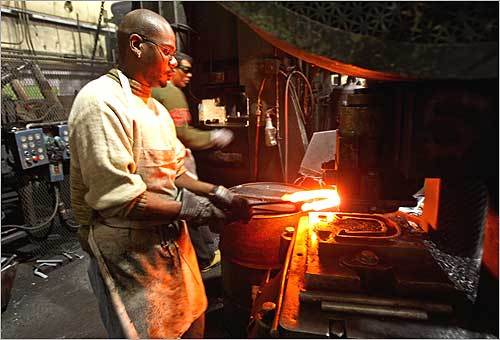
On Monday, the Boston Globe published its annual "Globe 100" report on business in our state, and included a feature on unusual things made in Massachusetts. Marshmallow "Fluff" and the game of Monopoly probably distracted a lot of people from finishing the article. I never even got to Fluff and Monopoly (not to mention Necco wafers and Nantucket Nectars) because the photo above caught my eye. It was taken in the forging room at the St. Pierre Horseshoe Company in Worcester, Massachusetts.
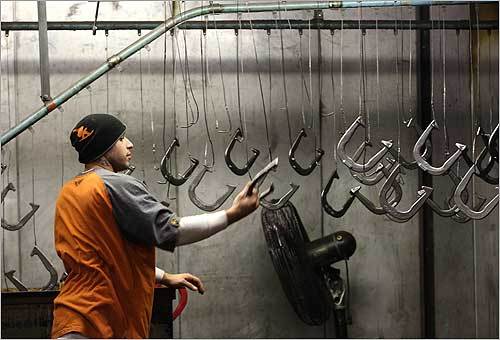
St. Pierre's squarish horseshoes won't see any hooves, though; they are pitching horseshoes. I guess the square toe and straight branch must help hook to the post. I've seen draft horse shoe shows of pretty much the same shape; maybe St. Pierre could add some nail holes and serve another market.

Also featured was the unlikely sounding but very credible Quabaug Corporation of North Brookfield. Turn your shoes over and you may see the little yellow "Vibram" logo, indicating that your shoe's sole was made in Massachusetts, by Quabaug. (They make all the soles of all the boots for the US Army...do that math!)

Quabaug is a funny sounding name for a very progressive company, and one of their newest products is a high tech hoof pad, which is reviving some interest in what pads can do in this age of hoof boots and bare hooves and how-clever-we-are custom treatments for laminitis and hoof injuries, as well as the classic use of pads for hoof protection with shoes.


I thought this photo interesting; Quabaug is making special shoes, or 3-D soles, for sports like martial arts and windsurfing. Imagine what they could do for and with the horse's hoof! Keep an eye on this company!

Thanks to my college pal and horseracing maven Karen Birch for finding these photos online after I had given up.

(Photos: Made in Massachusetts/Boston Globe)

Tuesday, May 20, 2008

Favorite Photo: The Hoof Goes Under the Leg

Wouldn't you love to see a radiograph of this horse's left front foot and lower leg? (the leg on the right in this photo) In what direction do you think the frog was pointing?

The photo was taken at the World Clydesdale Show in Wisconsin last fall.

Big Brown Arrives at Belmont with "Run Down" Problems from the Preakness

Big Brown arrived at Belmont Park on New York's Long Island yesterday. The Belmont Stakes, the final leg of the Triple Crown for three-year-old Thoroughbreds, will be run on June 7th.(Yahoo News linked photo)

The Blood-Horse reported yesterday that Kentucky Derby and Preakness winner Big Brown was affected by run down problems on his hind legs and feet in the Preakness.

This prompted a rash of questions about this sort of injury. And "rash" is the right word. Rundowns are sort of like a bad road rash! And if you've ever fallen off a motorcycle, fallen on the street while rollerblading, or skiied over rough terrain in shorts in the spring, you know what I'm talking about. Ouch!

With horses, it is usually the back of the pastern and the heel bulbs that get rubbed or scraped, but it can go up the back on the cannon, too.

Rundown injuries usually clear up pretty easily but the question to be asked is why it happened in the Preakness, and if the horse changed his gait or running style. It could also have been the track. And it could have happened in other races, but the horse wasn't under such a microscope of scrutiny until the past few weeks.

Big Brown ran with front wraps in the Preakness because of Dutrow's desire to avoid hitting injuries (interference) although it is not clear if the interference was front left to right, front to hind, or diagonal. Horses have all sorts of hitting issues based on conformation, fatigue, pulling up sharply, accelerating out of the gate, clipping heels, etc. and this is probably not something to think of as a performance-limiting injury.

Horses only get rundown injuries on dirt tracks, although I don't know about artificial surfaces. It seems like they could be abrasive, too. The Dutrow team will just have to wrap his legs and pad his pasterns when he trains at Belmont, until this clears up. There are all sorts of wraps and boots and patches that can be used so he can train normally.

It's not likely that this will be a problem for Big Brown, but with any animal you don't want the possibility of an association between speed and pain, or going out on the track and pain. Big Brown seems like a tougher horse than that.

My fellow blogger Alex Brown, exercise rider for Steve Asmussen, has some more insight into rundowns in today's New York Times.

Friday, May 16, 2008

Big Brown's Big Switch: New Shoes, New Heels for Tomorrow's Preakness

This morning, I stumbled out onto the lawn and grabbed the paper before the sea gulls could target it (or me). Once inside, I propped the paper up, set to peruse it with coffee in hand, when I sputtered in amazement: Hey! Hey! Hey!

There on the front page of the Boston Globe was not a photo of the Boston Celtics in their playoff bid for the NBA championship, nor a photo of the Red Sox, but rather a huge photo of Big Brown getting new shoes (and heels) yesterday at Pimlico in Baltimore, in preparation for tomorrow's Preakness Stakes, the second leg of the Triple Crown for three-year old Thoroughbreds.

(Sports, by the way, are front-page news here in Boston.)

I was surprised. Trainer Richard Dutrow obviously made a big change in plans here. Earlier this week, he said that Big Brown would not be re-shod for the Preakness, but that he would have Ian McKinlay work on the horse when he arrived in New York for the Belmont Stakes, the third race in the series.

Following the Kentucky Derby, farrier Tom Curl, who had worked on the horse through the winter in Florida, said that the feet came through the Derby very well and the adhesive wasn't cracked and the Yasha shoes were stable.

Obviously, they decided to give his feet a tuneup. The horse also went out for a light work over the Pimlico surface wearing bell boots to protect his new glue and a mud knot in his tail.

Other news this week was that Big Brown will not race as a four-year-old. He will go to stud sometime later this year. Also, if he does not win the Preakness tomorrow, he will not go on to the Belmont. But will he go on to Saratoga for the Travers and on to Santa Anita in the fall for the 2008 Breeders Cup?

Thanks to Yahoo.com sports desk for the following shots from a slide show of hoof repair specialist Ian McKinlay of New Jersey working on the Kentucky Derby winner.

Apparently, Ian drew quite a crowd yesterday, including Tom Hammond and Donna Brothers of NBC, so you may see Ian (or, more likely, the top of his head while he's working) on tomorrow's telecast of the race. Let's hope you see him in the winner's circle!

PS Friday Afternoon Update: Ian checked in and said that Big Brown's feet are "just fantastic", but that they had gotten a bit long. He just trimmed up the feet and reset the Yasha shoes and pads. He said that when he started, there was one guy standing around to watch and by the time he was into the job, the word was out and it "turned into a free-for-all".


Thursday, May 15, 2008

Favorite photo: How Big Was He?


farrier1, originally uploaded by Janey M.

Thanks to Janey M for sharing this photo of a farrier at the Colebrook Shire Horse Center in Cheshire, England. The photo was taken last week and she insists the farrier was not a small man. Sorry the farrier is not identified but he had a big, big job to do there!

Monday, May 12, 2008

Still Thinking About Eight Belles? Leading Vet Hogan Suggests That Thoroughbreds Could Learn A Lot From Standardbreds

Dr. Patty Hogan in surgery
Carol Hodes, former media relations director for the Meadowlands Racetrack in East Rutherford, New Jersey, has posted a terrific interview with one of my favorite sources, Patty Hogan VMD, ACVS of the new Hogan Equine Clinic LLC in Cream Ridge, New Jersey. Two years ago, it was Hogan who testified against her veterinary brethren in front of the US Congress, and explained why she was not aligning herself with AVMA and AAEP political positions regarding slaughter of horses for meat. She didn’t like the idea of the whole horse meat slaughter industry and she gave poignant compelling reasons why. Congress listened. So when Eight Belles died tragically on the track at the end of the Kentucky Derby, journalist Hodes turned to Hogan for insight. Hogan, after all, is often described as the veterinarian who saved Kentucky Derby winner Smarty Jones, and she is the AAEP’s “On Call” veterinarian for some harness races that are televised. Carol’s entire interview with Hogan is posted on the HarnessLink web site in New Zealand. I highly recommend you follow this link and read the entire interview, but here are a few savvy comments from one of the best industry’s most independent thinkers and leading surgeons. This fall, Hogan will take over as head surgeon of the new Ruffian Equine Medical Center at Belmont Park, owned by IEAH, who also own 2008 Kentucky Derby winner Big Brown. Hogan: “I’ve seen horses break both ankles, in fact I repaired one this past week that came to me with a fracture in one hind leg, and I repaired it. When he got up, the other leg was broken. He was a thoroughbred with bilateral injuries, similar to hers, but not so severe. But that’s so rare. “For it to occur at the end of the race is very unusual. She [Eight Belles] must have had enormous fatigue, and that’s just puzzling. I know she was very well taken care of. I don’t think there was any smoke and mirrors there. That trainer [Larry Jones] is very honest. I don’t think the jock [Gabriel Saez] deserves the criticism he’s received at all.” “I’m sure genetics has played a role because [catastrophic injury] has increased in recent years. A lot of horses that have retired to be bred are not necessarily the most durable horses. They’ve hurt themselves after one or two races, and then they are sent to be bred.” From there, the interview heads in a new direction: why don’t Standardbreds break down the way that Thoroughbreds do? Hogan’s practice is evenly divided between the two breeds. Hode digs for some answers and Hogan supplies some good ones: “(Standardbreds) are being bred for speed and they’re getting sore, but they don’t kill themselves. The horses that end up going to the breeding shed, at least with the stallions, they’re the ones that have performed incredibly well and raced well.” “The prognosis is always better for standardbreds than it is for thoroughbreds. They always come back from everything. I definitely have a different set of prognoses that I can give for a standardbred vs. a thoroughbred even if it is exactly the same injury. It’s rare for a standardbred to founder or have laminitis as a result of having an injury in the other leg. With a thoroughbred it’s a huge priority.” Thanks to HarnessLink.com and Carol Hodes for the good work on this interview.

Carbon-Fibre Hoof Supports Put Event Horse Back on Course


Vetcell’s Carbon Fibre Hoof Support Patches (HSP), have helped a flat-footed event horse in Great Britain, the company tell us. The HSP is a simple and affordable way to support and treat collapsed heels in competitive horses.

The patch was developed and patented by Peter Day DipWCF, farrier at the Royal Veterinary College in England and the RVC’s locomotor research group, two years ago.


According to Vetcell, Millie Tonks, competitor and British Eventing accredited trainer, was concerned when her seven-year-old thoroughbred x warmblood event mare became short-striding and uncomfortable when the ground became firmer during the early part of last year’s eventing season. The mare had previously suffered with collapsed heels and an intermittent lameness but radiographs had not revealed any specific problems.

Millie recalls: ”The mare was going really well at the beginning of the 2007 season and was being consistently placed. But when the ground started to get a little firm she became less extravagant with her jumping and was clearly not comfortable although she wasn’t actually lame.”

Millie’s vet, Susannah Reynoldson at Isle Valley Equine Clinic in Somerset continues: “The horse has typical flat Thoroughbred feet and had very little horn growth. She was tender in both feet and not truly comfortable in her stride. I had recently read about the HSP and thought it was worth a try. The results have been impressive.”

The HSP is a carbon fibre/resin composite sheet which is applied by the farrier to the hoof wall, using epoxy-type adhesive. Tests show that it increases the bending strength of the hoof wall by up to 40 percent, allowing the tubules within the heel to retain their strength, rather than collapsing, as the hoof grows, according to Vetcell. The goal is to prevent over-deformation of the compromised foot and thereby helps to maintain soundness.

Collapsed or under-run heels are one of the most important and common foot abnormalities faced by owners and trainers. The prevalence is so high in Thoroughbreds (reportedly affecting the majority of the breed in Britain) that it can lull individuals into thinking that the condition is a normal hoof variation rather than a serious pathological deviation.

The collapse of the heel is believed to contribute to many foot-related problems such as navicular syndrome, chronic heel pain (bruising), coffin joint synovitis, quarter cracks, heel cracks, and gait interference problems.

Despite its prevalence the condition often goes unaddressed until the horse actually becomes lame.

For further information please contact VetCell by email: info@vetcell.com.

Note: No, I don't know why the horse is nailed in the toe and yes, I agree, that this foot could use carbon-fibre support for its entire circumference. Barefoot advocates will say that this horse could be helped with a layup and rehab hoofcare, and that is true, but the owner was obviously determined to compete the horse. 

Question: What do you think is the effect of selective reinforcement of specific points on the circumference of a weakened foot? I want to see these patches on some horses and see what other applications people come up with for this interesting material.

Tuesday, May 06, 2008

Laminitis Product Receives Award from Queen of England


Not too long ago, people would call here and ask, “Is there anything I can safely feed my foundered horse?”

Now they call and ask, “Which one should I feed?”

The feed industry responded to the needs of foundered horses in a big way in the past few years, and things in the barn have changed, that’s for sure.

One of the things that has changed is the regimen for soaking beet pulp, a high-fiber replacement for cereal grains. You'd put it in a tub in the morning, and come home at night to a stringy seaweedy substance that horses can somehow chew (if they would eat it all ).

A British company, l’Anson Brothers of Yorkshire, figured out a way to bag and sell pre-soaked pulp, and “Speedi-Beet” is now sold around the world. Horse owners think it’s a great idea (and time/mess saver).

So does HRH, The Queen, who has just given l’Anson Brothers the 2008 Queen’s Award for Enterprise in the Innovation category.

The patented process used to produce Speedi-Beet was developed by I’Anson Brothers and turns sugar beet into a convenient quick-soak flake, which can absorb up to five times its weight of water in under 10 minutes

Speedi-Beet is the only sugar beet feed to be awarded the seal of approval by the Laminitis Trust, thanks to its low starch and high fibre content.

Saturday, May 03, 2008

A Toast! And Tears....Everyone's Dream; Everyone's Nightmare: Big Brown Wins Kentucky Derby on Heel-less Hooves, Gallant Eight Belles Right Behind...

Big Brown's all alone at the end of the Kentucky Derby. Notice his PMMA-adhesive adorned hooves. On the right front you can clearly see the repair to his wall separation. What you see on the outside of his left front is a reinforcing area of adhesive in the heel area. Both heel wall separations were on the inside.

Big Brown defied the odds today, when he broke from the 2oth post position and won the Kentucky Derby by several lengths. Favorites aren't supposed to win the Derby and it's been almost 100 years since anyone won from the outside post.

But most of all, horses aren't supposed to race in--let alone win--a Grade I race and the most famous race in the world, at that, with lumps of epoxy both filling cavities where his inside heels used to be and holding on shoes with rubber gaskets between the shoe and hoof wall.

Did he win in spite of his foot injuries or because of his designer shoes? We'll never know. Certainly he won because he was the dominant horse. The slightly other-worldly acceleration he showed as they rounded the turn was like a Hollywood special effect.

But charging gamely after him was the gallant filly Eight Belles, who galloped out, then collapsed on the track. Veterinarian Larry Bramlage reported on the telecast that she broke both front ankles and could not stand to be splinted and loaded into an ambulance. She was euthanized on the track. My guess is that she was pretty close to being in front of the main grandstand full of the second largest attendance in Kentucky Derby history.

What a tragic footnote to Big Brown's compelling and dominating performance. Bramlage said it was the first time he had heard of such an injury after the finish of a race.

Pulitzer Prize-winning novelist Jane Smiley offers some insights into Eight Belles' tragic demise in today's New York Times.


Memories of the 2008 Kentucky Derby will be a split screen. NBC's telecast minimized the breakdown of second-place finisher Eight Belles. The filly broke both front legs after crossing the finish line. She dumped her jockey and kept running until she collapsed, according to reports. NBC did not show her collapse but did offer veterinarian Larry Bramlage a comment/report opportunity. He seems to be on hand for the big breakdowns. (New York Times blog photo)

Friday, May 02, 2008

Derby Feet: Is Gayego Spanish for "Big Frog"?

When they were passing out frogs in the Kentucky Derby line, Gayego was first in line. Compare his frog to Visionaire's and Colonel John's and Big Brown's in the posts that follow this one.

Gayego, who won the Arkansas Derby, is available with pretty good odds, or at least they were good yesterday. Notice that his shoe has a toe clip. It's another Kerckhaert shoe, imported from Holland.

Gayego shipped east from California and is shod by Steve Norman. The colt is trained by Brazilian Paolo Lobo and his owners are Cuban-Americans. Talk about living the American dream!

Gayego had a quarter crack in one hind foot when his owners bought him for only $32,000 at the 2006 Keeneland September Yearling Sale. According to the Northwest Arkansas Democrat, the owners said that the horse went through the sale with a patch on the hoof and "there was electrical tape over it,” said Juelle, an accountant from Rolling Hills, California. “People started looking to the other side. They didn’t want to see the damaged horse. But the crack on the [hoof ] wasn’t a concern to us. It wasn’t a concern to our vet.” Juelle said Gayego was given about two months for the quarter crack to heal before being broken.

This horse is definitely one of my top picks. If you watch his videos on kentuckyderby.com you'll see why; he has the early speed needed to get out of the mess in the middle of the 20-horse pack. If his other performances are any indication, this horse could break free and the others will have to catch him. His work this week was on a wet track. If he does get to the front, I think he will find Big Brown there with him. The two of them are breaking from the 19 and 20 stalls so it's a logistics puzzle how they are going to get there. With three year olds, anything can happen out of the gate.

I will be doing my annual marathon holding-of-my-breath for roughly two minutes.

Z Fortune ran second to Gayego in Arkansas and is also in the Derby; I just learned that he is wearing Polyflex glue-on shoes, as is Steve Asmussen's other entry, Louisiana Derby winner Pyro.

Learn more about Gayego at http://www.gogayego.com/


Gayego looks out of his stall at Churchill Downs; his jockey will be Mike Smith. (USA Today photo by H. Darr Beiser)