Billed as the largest horse show in North America, it boasts 4,570 entries for an 11-day show, a ten year waiting list for box seats, and $650,000 in prize money but the 68th Annual Tennessee Walking Horse National Celebration in Shelbyville, Tennessee was suspended after two classes had been completed on Friday.
At issue: the USDA's federal mandate to examine horses to make sure they are not "sore"; the Walking Horse trainers want to do their own inspections.
At other shows earlier in the year, trainers simply refused to show, and sometimes didn't even unload their horses, if the USDA's veterinary inspectors showed up. Some shows are large charity fundraisers, and they simply didn't take place.
The Celebration is by far the largest showcase of the breed and this type of showing, and not all classes ask horses to do "the big lick" type of gait. The show has arranged for streaming video on the internet and even pay-per-view on cable television, in addition to selling thousands of reserved-seat tickets.
According to the Shelbyville Times-Gazette, "Trainers decided not to show because USDA inspectors were checking every horse presented for inspection, an unprecedented procedure. The requests (to cancel Friday night and Saturday classes) were made to allow for meetings between the Trainers' Association, the National Horse Show Commission and the United States Department of Agriculture. Attempts at reaching a resolution to the conflicts concerning the inspection of horses prior to showing, especially concerning what is known as the scar rule, failed Friday night, prompting the cancellation."
The newspaper also says, "The USDA inspectors arrived midway through the show Thursday night, but did not inspect any horses. Friday night the USDA inspectors took an active role in the inspection process. According to reports, more than 30 horses were turned down in the first two classes, including nine in a row. Apparently, the inspection of horses participating in the Two-Year-Old Gelding class forced the trainers to make their request.
"Attorney David Broderick of Bowling Green, Ky., told Tennessee Walking Horse owners on Saturday afternoon that a lawsuit filed earlier this summer is seeking clarification of the enforcement of the Horse Protection Act and could provide some long-term answers to the dispute between the industry and U.S. Department of Agriculture regulators.
"Industry personnel claim that federal regulators are being unfair in their inspections of walking horses, resulting in horses being unfairly excluded from competition. For example, Broderick said the technique of palpation, or examining a horse's leg for sensitivity by means of an inspector's touch, is sometimes done in too forceful a manner.
"Owners discussed other possible solutions with Broderick, including pressuring horse shows to hire veterinarians instead of designated qualified persons (DQPs) to inspect horse shows. It's also possible that horse owners will hire veterinarians to inspect horses before sending them into competition, in order to gather evidence which could be used to challenge the federal inspection techniques.
At the 100th anniversary Wartrace show earlier this month, many trainers opted not to show rather than subject their horses to inspection. At that show, a junior exhibitor's father complained, 'There are more people watching the inspectors than watching the horse show'," according to the newspaper.

Saturday, August 26, 2006
Thursday, August 24, 2006
Death in Aachen...And Other Hoofcare & Lameness News from WEG

An endurance horse has died at the World Equestrian Games. The Anglo-Arab name "Dubai" began to tie up severely early into the competition and was immediately withdrawn and treated but later died at the referral hospital affiliated with the Games.
The American dressage horse Brentina has been withdrawn from the individual competition after helping the USA team secure the bronze medal in the team competition. Ridden by Debbie MacDonald, the mare has filling in a hind leg and has been pulled from the roster. Gunter Siedel will take Debbie's place.
Haydn Price is team farrier for Great Britain; Steve Teichman is handling duties for the USA. They plan to get together today.
Meanwhile, the farrier/vet conference is underway; no news yet from that corner of the horsey town in eastern Germany!

Link to Barbaro Video on CBS Early Show
Millions of Americans woke up this morning to see Barbaro and Dr Dean Richardson on the CBS "Early Show". Here's a link to a video of the segment, although I do not know how long this link will be active.
http://www.cbsnews.com/sections/i_video/main500251.shtml?id=1927027n
http://www.cbsnews.com/sections/i_video/main500251.shtml?id=1927027n
Wednesday, August 23, 2006
Pharmacy Sued Over Horse Deaths in Saratoga
People here in Saratoga haven't forgotten the tragic death last year of the promising young racehorse Saratoga County in a local vet hospital. Saratoga County was one of several horses that developed colitis-like conditions that have been linked to the use of what is believed to have been a contaminated or improperly manufactured medication.
Severe laminitis is a common side effect of colitis and three of the four horses developed the hoof disease and were euthanized. A fourth horse at Belmont also received the medication and developed colitis and laminitis and was euthanized.
According to the Journal of American Veterinary Medical Association, the pharmacy is being sued for the alleged wrongful deaths of the horses.
Severe laminitis is a common side effect of colitis and three of the four horses developed the hoof disease and were euthanized. A fourth horse at Belmont also received the medication and developed colitis and laminitis and was euthanized.
According to the Journal of American Veterinary Medical Association, the pharmacy is being sued for the alleged wrongful deaths of the horses.
Sunday, August 20, 2006
Horseshoers aren’t always lucky...but they always have a lot of friends

Under the fledgling gingko tree, The Saratoga blacksmith stands…
Henry Wadsworth Longfellow would have approved: On Tuesday morning, August 15th, recently-deceased Saratoga horseshoers were remembered in a memorial service at the horseman’s blacksmith shop behind the Oklahoma training track. Their living shoer friends stood around an anvil, under a tree, to honor them.
Jim Brummitt, Charlie Campbell, and Bruce Scott were familiar faces around Saratoga, and all three became ill and died last year at what should have been the heights of their careers. Charlie was the paddock farrier at Saratoga until his death; his twin brother Joe has taken over for him now.
A group of friends of the three pulled together and raised funds to create a memorial area by the blacksmith shop. A fresh young gingko tree, a picturesque anvil on a stump and plaques in remembrance of many deceased track shoers were dedicated.
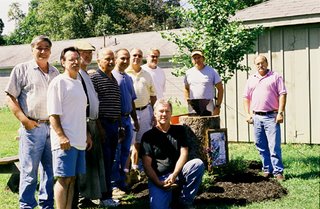
The names on the plaque are: Jim Brummit, Charlie Campbell, Bruce Scott, Tony Amato. Jim O'Connell, Rodney O'Domski, John Dern, Frank Starnes, Andy Gardner Sr., Tom McNabo, George A. Boyle, and George Boyle.
About 20 current horseshoers showed up for the service, which included prayers lead by former jockey Pat Day. He thanked the farriers for the part they played in making it safe for jockeys to ride in races.
I looked around and I noticed that none of them was younger than 40 or so. Where is the next generation of New York racetrack shoers? Maybe, because Tuesday is the dark day at Saratoga, they all had the day off.
I'm very glad I was able to be there for the dedication. It was a terrible shock for me to learn that Rodney O'Domski had died. I knew him quite well a long time ago when he was the farrier at Coolmore in Ireland and only learned of his death when I read the plaque.
Gingko is an herb that is supposed to prevent memory loss...an appropriate choice for a memorial tree.
Ray Amato promised he'd help me identify all the horseshoers in the photo; as soon as I have all the names, I will edit this post.
Henry Wadsworth Longfellow would have approved: On Tuesday morning, August 15th, recently-deceased Saratoga horseshoers were remembered in a memorial service at the horseman’s blacksmith shop behind the Oklahoma training track. Their living shoer friends stood around an anvil, under a tree, to honor them.
 |
Jim Brummitt, Charlie Campbell, and Bruce Scott were familiar faces around Saratoga, and all three became ill and died last year at what should have been the heights of their careers. Charlie was the paddock farrier at Saratoga until his death; his twin brother Joe has taken over for him now.
A group of friends of the three pulled together and raised funds to create a memorial area by the blacksmith shop. A fresh young gingko tree, a picturesque anvil on a stump and plaques in remembrance of many deceased track shoers were dedicated.

The names on the plaque are: Jim Brummit, Charlie Campbell, Bruce Scott, Tony Amato. Jim O'Connell, Rodney O'Domski, John Dern, Frank Starnes, Andy Gardner Sr., Tom McNabo, George A. Boyle, and George Boyle.
About 20 current horseshoers showed up for the service, which included prayers lead by former jockey Pat Day. He thanked the farriers for the part they played in making it safe for jockeys to ride in races.
I looked around and I noticed that none of them was younger than 40 or so. Where is the next generation of New York racetrack shoers? Maybe, because Tuesday is the dark day at Saratoga, they all had the day off.
I'm very glad I was able to be there for the dedication. It was a terrible shock for me to learn that Rodney O'Domski had died. I knew him quite well a long time ago when he was the farrier at Coolmore in Ireland and only learned of his death when I read the plaque.
Gingko is an herb that is supposed to prevent memory loss...an appropriate choice for a memorial tree.
Ray Amato promised he'd help me identify all the horseshoers in the photo; as soon as I have all the names, I will edit this post.
Wednesday, August 16, 2006
Get well, Chris Pollitt!
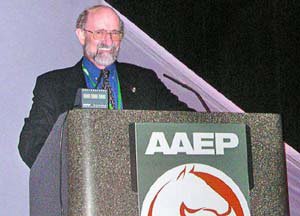
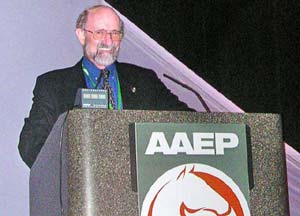
Dr. Chris Pollitt of the University of Queensland and director of the Australian Equine Laminitis Research Unit (AELRU) is recovering from injuries suffered both when he was kicked in the face by a horse and difficulties under anesthesia during surgery to repair broken facial structures and his nose.
Dr. Pollitt is a key contributor to Hoofcare & Lameness Journal; issue 80 contains information about his research to prevent laminitis using cryotherapy (intensive icing of the feet and legs).
Chris's smile may be a little crooked, but we should all be extra delighted to see him. In the USA, Dr. Pollitt is expected to attend the AAEP Convention in San Antonio, Texas in December. He is not a speaker, but will support his students and staff who are presenting new research from the AELRU. He has agreed to be a special guest at a gathering of Hoofcare & Lameness subscribers, tentatively planned for Monday evening of that event.
Send "get well" messages and maybe pledge a donation to: laminitisresearch@uq.edu.au or visit http://www.laminitisresearch.org>
In the USA, donations to Dr. Pollitt are channeled through the tax-deductible portal of the Animal Health Foundation. Read about laminitis research at http://www.ahf-laminitis.org
Stay tuned for more details.
Photo caption: Dr. Pollitt presented a marathon "master class" on the equine foot and laminitis at the 2003 AAEP Convention in New Orleans. (Fran Jurga photo)
Saturday, August 05, 2006
Dubai will build a horse park...
This just in from the TradeArabia news service: A Dh1.6 billion ($435 million) equine tourist attraction will be built at the Dubailand's Eco Zone area in the coming years, a report said.
"Al Kaheel Park will become the most comprehensive equine tourist attraction ever built. It will extend over almost 10 million sq ft of preserved desert landscape. Destined to be like no other horse centre in the world, Al Kaheel will be the ultimate equine experience," the Gulf News report said quoting a press statement. Al Kaheel will be an educational theme park and working horse farm dedicated to man's relationship with the horse. Strategically located in the heart of the desert in Dubai, the homeland for the Arabian horse, the park will be the place to get "up close and personal" with horses. Every evening, "Fly Without Wings", a nightly production of light, sound and action, featuring world class equine acts with over 45 performers and over 70 horses, will be held. In addition, the park will boast the world's first interactive and multimedia museum. Daily attractions such as virtual reality rides, stunt shows, horse presentations, hay rides, desert trekking to horse drawn carriage tours will be on offer.
Wednesday, August 02, 2006
Groucho said it best...
I just ran across this acerbic witticism from Groucho Marx on one of the Saratoga racing pundit blogs:
End of sermon. It must be the heat.
By the way, the Saratoga blogs are fun to read in the morning, here are a couple of them:
http://www.saratogaracingdaily.com/
http://leftatthegate.blogspot.com/
"I don't care to belong to a club that accepts people like me as members." ~ Groucho Marx
It reminds me of the nonsensical excuses that people give me for not belonging to professional organizations or subscribing to magazines. You're not marrying the concept, you're just opening yourself to some potential benefit that might at some point come your way, if you are open to it, and you are opening the door for your own opportunity to give something back to your profession or field of interest, if you feel like it.End of sermon. It must be the heat.
By the way, the Saratoga blogs are fun to read in the morning, here are a couple of them:
http://www.saratogaracingdaily.com/
http://leftatthegate.blogspot.com/
How Hot Is It? It's So Hot that...
...Saratoga actually cancelled racing today.
Now, if you have ever been to Saratoga, you know they invented "hot" there. I have been miserable there more times than anywhere else on the planet. They have misting fans at the finish line for the horses but they could use a few in the grandstand, too. I see the old photos of women in Victorian garb and men in starched collars and I just don't see how they stood it.
It's probably in the best interest of the horses--although I don't know how cool they will be in their stalls, either. The nice thing about Saratoga is that there's a a lot of shade.
I don't recall them ever cancelling racing for heat before. Thunderstorms, yes. What about all those people with their precious tickets for reserved seats? What happens to them?
From this morning's NYRA Press Office memo:
>>Due to severe heat and humidity that has plagued the entire East coast, Saratoga Race Course has canceled its nine-race program today. In a morning meeting with trainers, jockeys, the track veterinarian, stewards, track superintendent and senior management, a unanimous decision was reached to call off the races at 8:12 a.m. today.
“The consensus in the room was to take the ultimate precaution and cancel the entire card for the safety of all participants,” said Bill Nader, NYRA Senior Vice President. “Racing will resume tomorrow and Friday’s card will be expanded to a 10-race program.”
Today is one of the hottest days in Saratoga history with a predicted dew point index of approximately 110.<<
Tuesday, August 01, 2006
Second Strasser Trimmer Found Guilty of Cruelty in England
(text provided by ILPH.org)
The International League for Protection of Horses is “pleased” that Mrs Jo Kowalski of Baylham, Ipswich in Suffolk, England was found guilty of causing suffering to her pony Brambles at Ipswich Magistrates Court recently. She will be sentenced on Wednesday, 30th August.
This is the second time in recent months that someone using the Strasser technique has been successfully prosecuted.
Mrs Kowalski caused this pony to suffer by allowing many months to go past when the pony was in severe and obvious pain.
Mrs. Kowalski, who was a qualified Strasser Hoof Care Technician, failed to accept that the Strasser technique was unable to treat the pony’s laminitis problem.
Following up on a call to the ILPH welfare hotline, Field Officer Jacko Jackson found the pony, Brambles, at Mrs. Kowalski’s fields. He said: “I couldn’t believe it when I watched the pony trying to walk with the crossed-legged stance. It needed a vet there and then.”
Tony Tyler Head of UK Operations commented: “This was the most ‘in pain’ horse to have entered our centre and a guilty verdict is to be commended. We hope that this will send out the message to the equine world that this particular method used by Mrs. Kowalski is not to be recommended.”
ILPH Farrier John Blake who treated Brambles on arrival said: “Brambles was possibly the lamest animal I have seen in 26 years as a farrier. Mutilated is the best way to describe her." You can view an interview with John Blake which includes footage of Brambles arriving at the ILPH in the ILPH Media Centre.
This is the second time the Strasser technique has been shown to cause suffering in a British court of law. Both the ILPH and the RSPCA hope that people will treat this method with caution.
News item provided by International League for the Protection of Horses (www.ilph.org). "Hoofblog" is a news service provided by Hoofcare & Lameness, Journal of Equine Foot Science. Visit http://www.hoofcare.com for lots more in-depth articles and information about the care/prevention of lameness in horses. Reference books, videos, and dvds are sold at that site. Please subscribe to our award-winning journal at our "summer special" price: 4 issues $59, 8 issues $99. For more information, write to Hoofcare, PO Box 6600, Gloucester MA 01930; tel 978 281 3222; email news@hoofcare.com. All posts and photos protected by copyright 2006 Hoofcare Publishing--Fran Jurga, Publisher
Note: this blog is an interactive web page. By clicking on the envelope icon at the bottom of an article, you can instantly email that article to a friend. By clicking on the word “comment” after a post, you can leave a message, which may be viewed by future blog readers who click on the same “comment”. Commenting may require registering with Blogger.com. You may also comment by emailing the author, Fran Jurga, at fran@hoofcare.com and your comment will be posted for you, technology willing.
(text provided by ILPH.org)
The International League for Protection of Horses is “pleased” that Mrs Jo Kowalski of Baylham, Ipswich in Suffolk, England was found guilty of causing suffering to her pony Brambles at Ipswich Magistrates Court recently. She will be sentenced on Wednesday, 30th August.
This is the second time in recent months that someone using the Strasser technique has been successfully prosecuted.
Mrs Kowalski caused this pony to suffer by allowing many months to go past when the pony was in severe and obvious pain.
Mrs. Kowalski, who was a qualified Strasser Hoof Care Technician, failed to accept that the Strasser technique was unable to treat the pony’s laminitis problem.
Following up on a call to the ILPH welfare hotline, Field Officer Jacko Jackson found the pony, Brambles, at Mrs. Kowalski’s fields. He said: “I couldn’t believe it when I watched the pony trying to walk with the crossed-legged stance. It needed a vet there and then.”
Tony Tyler Head of UK Operations commented: “This was the most ‘in pain’ horse to have entered our centre and a guilty verdict is to be commended. We hope that this will send out the message to the equine world that this particular method used by Mrs. Kowalski is not to be recommended.”
ILPH Farrier John Blake who treated Brambles on arrival said: “Brambles was possibly the lamest animal I have seen in 26 years as a farrier. Mutilated is the best way to describe her." You can view an interview with John Blake which includes footage of Brambles arriving at the ILPH in the ILPH Media Centre.
This is the second time the Strasser technique has been shown to cause suffering in a British court of law. Both the ILPH and the RSPCA hope that people will treat this method with caution.
News item provided by International League for the Protection of Horses (www.ilph.org). "Hoofblog" is a news service provided by Hoofcare & Lameness, Journal of Equine Foot Science. Visit http://www.hoofcare.com for lots more in-depth articles and information about the care/prevention of lameness in horses. Reference books, videos, and dvds are sold at that site. Please subscribe to our award-winning journal at our "summer special" price: 4 issues $59, 8 issues $99. For more information, write to Hoofcare, PO Box 6600, Gloucester MA 01930; tel 978 281 3222; email news@hoofcare.com. All posts and photos protected by copyright 2006 Hoofcare Publishing--Fran Jurga, Publisher
Note: this blog is an interactive web page. By clicking on the envelope icon at the bottom of an article, you can instantly email that article to a friend. By clicking on the word “comment” after a post, you can leave a message, which may be viewed by future blog readers who click on the same “comment”. Commenting may require registering with Blogger.com. You may also comment by emailing the author, Fran Jurga, at fran@hoofcare.com and your comment will be posted for you, technology willing.
Sunday, July 30, 2006
It's Saratoga Time!
My fingers are itching to flip the calendar over to August, because that will mean it is time to head to Saratoga, where Hoofcare & Lameness will have a satellite office this summer.
Be sure to let me know if you will be in Saratoga, and let's get together.
Plans are for a series of Tuesday night gatherings in the out-back function room at The Parting, a favorite traditional Irish restaurant and pub on Lake Avenue, just a block off Broadway.
Here's the schedule:
8 August--"New Product Night"--lots of samples and information on new products from our advertisers, or just come and say hello! We'll have plenty to talk about!
15 August--Come by after the dedication of the farriers memorial at the Oklahoma track; later in the evening, a wonderful presentation on new laminitis research for prevention, causes and treatment by Dr Don Walsh of Pacific Equine Hospital and the Animal Health Foundation. He raises the funds for Dr Chris Pollitt, Katy Watts, Phil Johnson and other leading researchers.
22 August--"Make history, not horseshoes". This is a marathon event; daytime events a few miles away at the Burden Iron Works in Troy, site of the world's largest horseshoe factory back at the turn of the century. I will post more about that event. In the evening, come by the office at the Parting Glass and meet Ada Gates, the first woman to be licensed as a farrier on a USA racetrack. She now owns Harry Patton Horseshoeing Supplies in Los Angeles and guess what! Her great grandfather was Henry Burden, of Burden Iron Works fame. This evening fun is sponsored by Life Data Labs, who helped us launch the Tuesday evening sessions last year.
What to expect: This is one Saratoga night out where you won't need a black tie, a designer dress, or big wads of cash. You can help me post to this blog, maybe, or show me photos of your boat or your horse or your latest work project. Meet some other people, see some new things, maybe have a laugh. I travel a lot in the winter and see people at trade shows and events, but these Tuesday nights are a chance to slow down and just enjoy your company!
The phone number for the satellite office in Saratoga is . Look for me in the morning on the backside or check our ad in The Saratoga Special. I'll be the one taking photos of feet. I will also post updates on this blog.
Be sure to let me know if you will be in Saratoga, and let's get together.
Plans are for a series of Tuesday night gatherings in the out-back function room at The Parting, a favorite traditional Irish restaurant and pub on Lake Avenue, just a block off Broadway.
Here's the schedule:
8 August--"New Product Night"--lots of samples and information on new products from our advertisers, or just come and say hello! We'll have plenty to talk about!
15 August--Come by after the dedication of the farriers memorial at the Oklahoma track; later in the evening, a wonderful presentation on new laminitis research for prevention, causes and treatment by Dr Don Walsh of Pacific Equine Hospital and the Animal Health Foundation. He raises the funds for Dr Chris Pollitt, Katy Watts, Phil Johnson and other leading researchers.
22 August--"Make history, not horseshoes". This is a marathon event; daytime events a few miles away at the Burden Iron Works in Troy, site of the world's largest horseshoe factory back at the turn of the century. I will post more about that event. In the evening, come by the office at the Parting Glass and meet Ada Gates, the first woman to be licensed as a farrier on a USA racetrack. She now owns Harry Patton Horseshoeing Supplies in Los Angeles and guess what! Her great grandfather was Henry Burden, of Burden Iron Works fame. This evening fun is sponsored by Life Data Labs, who helped us launch the Tuesday evening sessions last year.
What to expect: This is one Saratoga night out where you won't need a black tie, a designer dress, or big wads of cash. You can help me post to this blog, maybe, or show me photos of your boat or your horse or your latest work project. Meet some other people, see some new things, maybe have a laugh. I travel a lot in the winter and see people at trade shows and events, but these Tuesday nights are a chance to slow down and just enjoy your company!
The phone number for the satellite office in Saratoga is . Look for me in the morning on the backside or check our ad in The Saratoga Special. I'll be the one taking photos of feet. I will also post updates on this blog.
Thursday, July 27, 2006
Slaughter Prohibition Update: Veterinarian Patty Hogan Testifies to Congress
Things are wrapping up in the US House of Representatives today, as the final testimonies have finished in the controversial equine slaughter prohibition legislation, a.k.a. HR Bill 503, which seeks to prohibit the commercial slaughter of horses in the United States. In spite of a huge groundswell of public support, donations, and even heartfelt efforts from individuals in the horse breeding community, this legislation seems doomed. The House Agriculture Committee failed to recommend it, and now it looks like two different versions of the bill are circulating.
Can this bill make it with the opposition of the AVMA, AAEP, and AQHA? Don't bet on it.
One of the few bright spots in it all was the eloquent testimony of Dr Patty Hogan of New Jersey Equine, at Tuesday's House Energy and Commerce Subcommittee hearing. She pointed out many of the ambiguities surrounding this issue.
Those speaking out this week against the bill, which is expected to come up for a vote in the full House in September, were Dr. Bonnie Beaver (president of the AVMA), Dr. Doug Corey (president of the American Association of Equine Practitioners) and Dick Koehler (vice president of Beltex, one of three U.S. equine slaughter plants).
Koehler cited issues of private property rights as they pertain to horse owners, "It is a matter of choice," he said. "If you wish to do that with your horse, I believe you should have the right to do that." (It's not clear if he is a horse owner himself or not.)
Two of the veterinarians differed in their perspective on the humaneness or lack thereof in the slaughter process or whether it would curtail the prevalence of horses being slaughtered for meat. "By banning slaughter in the U.S., it will not stop slaughter," said Dr. Doug Corey. "It won't stop a Ferdinand [a former Thoroughbred champion believed slaughtered for meat in Japan after being there as a stud]. I would prefer to have these horses processed in the United States where there are regulations."
Dr. Hogan cited, "confusion regarding humane euthanasia and horse slaughter. We must remember these are two distinctly different processes. Horse slaughter is not euthanasia by anyone's definition. ... Horse slaughter uses a method called the captive bolt which involves aiming a bolt gun at the forehead of a partially-restrained horse in what is commonly termed the ‘kill-pen.’ ...There is a great deal of room for human and technical error with the captive bolt method and the recommendation for 'adequate restraint' is loosely defined and open for interpretation.”
Material for this post was aided by input from Harness Racing Communications, a division of the United States Trotting Association.
To learn more about Dr. Patty Hogan and her work as an equine surgeon, visit the New Jersey Equine Center home page at http://www.njequine.com; some of you may remember her as the surgeon who worked on Smarty Jones and Afleet Alex, two leading US Thoroughbreds.
Hoof Blog is a news service provided by Hoofcare & Lameness, Journal of Equine Foot Science.
Note: this blog is an interactive web page. By clicking on the envelope icon at the bottom of an article, you can instantly email that article to a friend. By clicking on the word “comment” after a post, you can leave a message, which may be viewed by future blog readers who click on the same “comment”. Commenting may require registering with Blogger.com. You may also comment by emailing the author, Fran Jurga, at hoofblog@gmail.com and your comment will be posted for you, technology willing.
Wednesday, July 19, 2006
Barbaro Update: Cast changes and sling-dom
Here's the latest from New Bolton Center: "Monday afternoon we changed his right hind leg cast to take new radiographs and to examine the incision,” said Dr. Richardson. “The radiographs looked good; the plates we placed on July 8 to fuse the pastern are intact and the fetlock fusion is unchanged. The leg and the incision looked as good as we could have hoped.”
All posts and photos protected by copyright 2006 Hoofcare Publishing--Fran Jurga, Publisher
The right hind leg cast supports the repair of the injury suffered at the Preakness on May 20, and it extends from the colt’s foot to just below his hock.
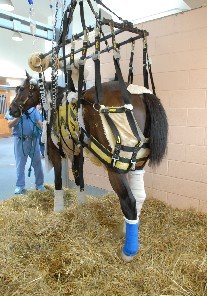
The modified foot cast, which acts like a bandage on Barbaro’s left hind foot, was also changed yesterday. The foot cast is rigid and provides stability and support, but will be changed often so that the hoof can be treated. Both cast changes were performed with Barbaro lightly sedated in a sling. He has adapted very well to being managed as needed in the sling. “He is a very intelligent horse,” said Dr. Richardson.
“He spends several hours a day in a sling, which he has adapted to very well,” said Dr. Richardson.Slings, which were originally designed for rescuing horses, are now common in the treatment of horses with conditions that include neurological problems or musculo-skeletal injuries. They have been in use for many years for long-term management of a horse’s movement. “We have a lot of experience in using slings for equine support,” said Dr. Richardson. “In Barbaro’s case, it is a part-time aid that we use to increase his comfort level.”
News provided by University of Pennsylvania Large Animal Hospital at New Bolton Center. Hoofblog is a news service provided by Hoofcare & Lameness, Journal of Equine Foot Science. Visit http://www.hoofcare.com for lots more in-depth articles and information about the care/prevention of lameness in horses. Reference books, videos, and dvds are sold at that site. Please subscribe to our award-winning journal at our "summer special" price: 4 issues $59, 8 issues $99. For more information, write to Hoofcare, PO Box 6600, Gloucester MA 01930; tel 978 281 3222; email news@hoofcare.com.All posts and photos protected by copyright 2006 Hoofcare Publishing--Fran Jurga, Publisher
Monday, July 17, 2006
Barbaro Update, Comment on Foot Cast
KENNETT SQUARE, PA — Chief of Surgery Dean Richardson reports today that Kentucky Derby winner Barbaro’s vital signs are good and that he had another quiet, restful night. “He remains in stable condition, and he is eating well,” said Dr. Richardson. “We continue to manage his pain successfully, and he is alert.”
Barbaro is tolerating his right hind leg cast well; this cast supports the repair of the injury suffered at the Preakness on May 20. To treat a severe case of laminitis in the colt’s left rear hoof, last week Dr. Richardson and his surgical team performed a hoof wall resection that removed 80 percent of the hoof. Doctors then applied a modified fiberglass foot cast to protect the hoof; this foot cast will be changed as needed so that the hoof can be treated and watched for signs of infection. The foot cast is rigid and provides greater stability and support than a bandage.
“It is important for people to understand that this is not a ‘routine’ laminitis. The care involved in treating a hoof with this degree of compromise is complex,” said Dr. Richardson.
(17 July update from New Bolton Center)
News provided by University of Pennsylvania Large Animal Hospital at New Bolton Center.
All posts and photos protected by copyright 2006 Hoofcare Publishing--Fran Jurga, Publisher
Barbaro is tolerating his right hind leg cast well; this cast supports the repair of the injury suffered at the Preakness on May 20. To treat a severe case of laminitis in the colt’s left rear hoof, last week Dr. Richardson and his surgical team performed a hoof wall resection that removed 80 percent of the hoof. Doctors then applied a modified fiberglass foot cast to protect the hoof; this foot cast will be changed as needed so that the hoof can be treated and watched for signs of infection. The foot cast is rigid and provides greater stability and support than a bandage.
“It is important for people to understand that this is not a ‘routine’ laminitis. The care involved in treating a hoof with this degree of compromise is complex,” said Dr. Richardson.
(17 July update from New Bolton Center)
News provided by University of Pennsylvania Large Animal Hospital at New Bolton Center.
All posts and photos protected by copyright 2006 Hoofcare Publishing--Fran Jurga, Publisher
Another Strasser Trimmer Charged with Cruelty in the UK
Portions of this text appeared in the British horse magazine, Horse & Hound:
An English woman has appeared in British court accused of causing unnecessary suffering to a pony by using the Strasser barefoot method of hoofcare.
Editor's note: Horse and Hound is the weekly newsmagazine of the horse world in Great Britain and often works together with Hoofcare & Lameness.
This is the second prosecution of a Strasser trimmer involved in a laminitis case to be tried in recent months. Previously, a trimmer was found guilty of cruelty and Dr. Strasser testified at the trial. In that case, charges directly related to the trimming were not found but the trimmer was found guilty for not seeking veterinary care for the horse.
An English woman has appeared in British court accused of causing unnecessary suffering to a pony by using the Strasser barefoot method of hoofcare.
In her trial, the trimmer denied two charges of causing suffering to "Brambles" between 3 June and 20 July 2004.
Brambles came into the trimmer's care in January 2004 after the previous owner could do nothing more to treat her laminitis. The pony was seized by the RSPCA on 20 July 2004 when she was found with "mutilated" hooves, walking with crossed legs and barely able to move.
The court heard how the trimmer had undergone training in the Strasser technique and had kept horses for about 35 years.
The prosecutor told the court the soles of Brambles' hooves had been trimmed away too thinly.
"The bone had rotated within the foot to an abnormal angle, so it protruded into the sole," he said, adding that there were abscesses present in the hoof and that a farrier had described it as the worst case of lameness he had ever seen.
Brambles was taken into the care of the International League for the Protection of Horses (ILPH), but despite five months of intensive care, was put down after failing to respond.
Counsel for the defendant said the defendant "wanted to give the pony a chance using the Strasser technique because it was clear conventional treatment had not worked."
Mr Vass admitted a vet was not called to treat Brambles, but stressed that the pony was well-fed, well-housed and given the freedom to roam.
He added: "With the benefit of hindsight, (she) may have taken on slightly more than she could handle."
The prosecutor said: "We are not suggesting (she) was deliberately trying to hurt this pony, but her treatment was the incorrect treatment for the pony and caused her to suffer additional pain."
He said the Strasser method was the "inappropriate method of treatment", and had "resulted in mutilation and caused extreme pain".
The verdict will be given on 26 July.
Editor's note: Horse and Hound is the weekly newsmagazine of the horse world in Great Britain and often works together with Hoofcare & Lameness.
This is the second prosecution of a Strasser trimmer involved in a laminitis case to be tried in recent months. Previously, a trimmer was found guilty of cruelty and Dr. Strasser testified at the trial. In that case, charges directly related to the trimming were not found but the trimmer was found guilty for not seeking veterinary care for the horse.
Saturday, July 15, 2006
Barbaro: the other point of view

I feel obliged to post about Barbaro; after all, he is the poster child for what we all do to help horses. It's also pretty darn interesting if you scroll down this page and watch the disaster story unfurl.
Not everyone agrees. Check out this scathing editorial on over-Barbarozation:
http://www.sportsfanmagazine.com/sfm/articles.html?id=2775
I apologize for the sheer number of posts, but this blog will stand as a record for anyone who wants to be able to document anything about Barbaro in the future, which is also why I post what New Bolton Center provides me, unless stated otherwise, such as direct communication with Rob Sigafoos, the chief of farrier services at New Bolton.
Unlike most of you, and certainly unlike the SportsFan guy, I don't have an opinion about this case, just a lot of hope that everything reflects positively on the vet and farrier and equine health professions and that we all learn something from this horse and his high-profile struggle.
I'm not there and neither are you. All I can do is believe that they can and will do everything they can and I am sure that they are in consult with experts around the world.
Many people have asked why Chris Pollitt's cryotherapy was not used. Well, we
 don't know that it wasn't! Pollitt has published a paper in which he induced laminitis; one leg was placed in a deep ice boot and the other left in ambient temperature. The cold leg did not contract laminitis.
However, that was "traditional" laminitis, i.e. carbohydrate-induced, not support limb overload laminitis.
And here's a special detail for all you nay-sayers and doubting Thomases out there: Pollitt's co-author on the cryotherapy paper and former student is now a resident at New Bolton. So, they have cryotherapy expertise right on staff, had it been pertinent to the case.
I also hope that somehow more money will go to laminitis research. Please visit these web sites to learn more about how you can help with laminitis research:
http://www.ahf-laminitis.org
http://www.laminitisresearch.org
Thanks.
Friday, July 14, 2006
How's Barbaro Today?
July 14, 2006 , 4:00 p.m., Eastern Time
KENNETT SQUARE, PA — Kentucky Derby winner Barbaro remains in stable condition according to his veterinarians at the George D. Widener Hospital at the University of Pennsylvania. “His vital signs, including heart rate and pulse, remain good,” said Dr. Dean Richardson, Chief of Surgery. “We are treating his laminitis aggressively and he continues to respond well and is acceptably comfortable.”
“As I said at the press conference on Thursday, we monitor his condition very closely because signs can change quickly,” said Dr. Richardson. “However, it’s important to remember that Barbaro’s treatment could easily continue for several weeks, and if all goes well, even months. Our goal is to keep him as comfortable as possible, and clearly that comfort level will be a major indicator for our treatment decisions.” Dr. Richardson also emphasized that Barbaro, as evident in the footage and still photos, has a very positive attitude.
Editor's Note: This is an extract from an official statement from New Bolton Center.
Thursday, July 13, 2006
It's Official: Barbaro Has Laminitis
It seemed like such a fairy tale that the Kentucky Derby winner could waltz through recovery from his broken leg without complications. A press conference was held this morning; you can view a video of it at
http://www.cbsnews.com/stories/2006/07/13/sportsline/main1799553.shtml
He is now face to face with severe laminitis and has had 80 percent of his hoof wall removed, according to the surgeon. No news on whether he "sank" or "rotated" but I am sure those details will be forthcoming.
Cross all your fingers and toes, and wish upon a star. This horse will need all the help he can get.
I'll try to keep everyone posted, but this is distressing. It's easy to second guess what is going on and what has been tried, but no one really knows. I am sure they are doing all they can and have the horse's best interests at heart. I'm also sure that ethical guidelines for pain and suffering will be observed, although it doesn't sound like the horse is suffering much at present.
Let's give him--and them--a chance!
http://www.cbsnews.com/stories/2006/07/13/sportsline/main1799553.shtml
He is now face to face with severe laminitis and has had 80 percent of his hoof wall removed, according to the surgeon. No news on whether he "sank" or "rotated" but I am sure those details will be forthcoming.
Cross all your fingers and toes, and wish upon a star. This horse will need all the help he can get.
I'll try to keep everyone posted, but this is distressing. It's easy to second guess what is going on and what has been tried, but no one really knows. I am sure they are doing all they can and have the horse's best interests at heart. I'm also sure that ethical guidelines for pain and suffering will be observed, although it doesn't sound like the horse is suffering much at present.
Let's give him--and them--a chance!
Billy Crothers World Champion (Again) at Calgary Stampede
This just in from the Calgary Stampede web site: Billy Crothers of Wales is world champion again for the fourth or fifth time, I am not sure which. Stephen Beane of England was second and Jim Quick of the USA was third.
Scroll down to read an article about Billy's wife, Lucy Diamond, successfully competing at Badminton Horse Trials back in May. They're on a roll! Billy and Stephen were also 1-2 in the shoeing competition.
Scroll down to read an article about Billy's wife, Lucy Diamond, successfully competing at Badminton Horse Trials back in May. They're on a roll! Billy and Stephen were also 1-2 in the shoeing competition.
Wednesday, July 12, 2006
12 July Barbaro Update

KENNETT SQUARE, PA — Kentucky Derby winner Barbaro is continuing to rest comfortably today according to Dr. Dean Richardson, Chief of Surgery. “As we said yesterday, Barbaro’s condition is potentially serious, and we are aggressively seeking all treatment options,” he said. “Today we will focus on further diagnostics and keeping our patient comfortable.” Barbaro is being treated for fractures received at the Preakness on May 20 as well as discomfort in his left hind foot.
“He’s facing tough odds and his condition is guarded,” said Dr. Richardson. “Our entire staff is determined to do all they can for this magnificent horse.” All decisions are being made in constant consultation with the owners, who continue to be only interested in his comfort.
Barbaro remains in the Intensive Care Unit of the George D. Widener Hospital at the University of Pennsylvania’s New Bolton Center.
Tuesday, July 11, 2006
Barbaro Report for 11 July: Resting comfortably after sixth cast applied
Direct from New Bolton Center, this report:
Dr. Dean Richardson, Chief of Surgery, reports today that Kentucky Derby winner Barbaro is resting comfortably after receiving his sixth cast yesterday since his accident at the Preakness on May 20. “Barbaro is eating well and resting in his stall,” said Dr. Richardson, who also treated the colt for an abscess in his left hind foot.
Dr. Dean Richardson, Chief of Surgery, reports today that Kentucky Derby winner Barbaro is resting comfortably after receiving his sixth cast yesterday since his accident at the Preakness on May 20. “Barbaro is eating well and resting in his stall,” said Dr. Richardson, who also treated the colt for an abscess in his left hind foot.
“He’s tolerating the new cast well,” said Dr. Richardson. “We have changed his left hind foot bandage and that looks improved. His vital signs remain stable and his attitude and appetite remain excellent.”
Calgary Update: Sketchy Details
File this under unofficial results from the Calgary Stampede World Championship Blacksmiths competition which moved into its final day Sunday. It sounds like Billy Crothers, representing Wales, won the "live shoeing" event on Saturday (or was it Sunday? it is hard to tell from the information provided) with Steven Beane, representing England, second. They then moved on to the finals. Stay tuned for more sketchy news from Calgary!
Monday, July 10, 2006
Cast #6 for Barbaro on Monday
July 10, 2006
News report verbatim for New Bolton Center: After evaluating Kentucky Derby winner Barbaro this morning, Dr. Dean Richardson, Chief of Surgery, replaced the cast on the colt’s injured hind leg for a sixth time. “The long leg cast was replaced with a short leg cast this morning. This was done with Barbaro in a sling and only under mild sedation,” said Dr. Richardson. “The long cast was used as extra support during the anesthetic recovery phase. It is much easier for him to move around his stall and get up and down with a short cast. We also found and treated an abscess in his left hind foot that was bothering him.”
Barbaro spent a comfortable night and is eating well after surgery to stabilize the pastern joint this weekend. “We’re continuing his pain medication, antibiotics and other supportive care,” said Dr. Richardson. “He appears more comfortable today and has had a normal temperature, heart rate and overall attitude.”
Barbaro continues to be monitored closely in the Intensive Care Unit of the George D. Widener Hospital at the University of Pennsylvania’s New Bolton Center.
Hoofblog note: Several readers said they have had trouble finding New Bolton Center on the map. That's because it is in the town of Kennett Square, Pennsylvania, about an hour outside Philadelphia. NBC is the name given to the large-animal complex of hospitals and research centers, which act as a sort of field station for the University of Pennsylvania's vet school, which is located in downtown Philadelphia.
Barbaro: Pastern Joint Infection, more surgery this weekend
The latest from New Bolton Center, direct transcript provided by the hospital:
Veterinarians treat Barbaro for infection, replace plate and screws in injured leg
July 9, 2006
KENNETT SQUARE, PA – Late Saturday, July 8, Dr. Dean Richardson, Chief of Surgery, replaced the plate and many of the screws that had been inserted into Barbaro’s injured hind leg on May 21. “Barbaro had developed some discomfort and a consistently elevated temperature so we believed it was in his best interest to remove the hardware and thoroughly clean the site of the infection,” said Dr. Richardson. “We also applied a longer cast on that leg for additional support.”
While the main fracture is healing well, the pastern joint that doctors are attempting to fuse continues to be the area of concern. This joint was stabilized with new implants and a fresh bone graft.
“The recovery process from anesthesia took longer with this surgery, but Barbaro is now back in his stall in the Intensive Care Unit,” said Dr. Richardson. “He is receiving pain medication, antibiotics and other supportive care.”
Barbaro continues to be monitored closely in the Intensive Care Unit of the George D. Widener Hospital at the University of Pennsylvania’s New Bolton Center. Dr. Richardson emphasized that the complications are potentially serious. Both Barbaro’s owners and trainer continue to visit him at least twice daily.
Veterinarians treat Barbaro for infection, replace plate and screws in injured leg
July 9, 2006
KENNETT SQUARE, PA – Late Saturday, July 8, Dr. Dean Richardson, Chief of Surgery, replaced the plate and many of the screws that had been inserted into Barbaro’s injured hind leg on May 21. “Barbaro had developed some discomfort and a consistently elevated temperature so we believed it was in his best interest to remove the hardware and thoroughly clean the site of the infection,” said Dr. Richardson. “We also applied a longer cast on that leg for additional support.”
While the main fracture is healing well, the pastern joint that doctors are attempting to fuse continues to be the area of concern. This joint was stabilized with new implants and a fresh bone graft.
“The recovery process from anesthesia took longer with this surgery, but Barbaro is now back in his stall in the Intensive Care Unit,” said Dr. Richardson. “He is receiving pain medication, antibiotics and other supportive care.”
Barbaro continues to be monitored closely in the Intensive Care Unit of the George D. Widener Hospital at the University of Pennsylvania’s New Bolton Center. Dr. Richardson emphasized that the complications are potentially serious. Both Barbaro’s owners and trainer continue to visit him at least twice daily.
Sunday, July 09, 2006
Barbaro's Good-Foot Abscess is No Big Deal, Says Farrier Rob Sigafoos
Ok, everyone calm down. All the gloom-and-doom types out there are predicting that Barbaro is crashing with laminitis in his good foot. We went straight to the source.
New Bolton Center Chief of Farrier Services Rob Sigafoos reports that the horse does have a minor abscess near the tip of the frog which, to quote Rob, "Could (and does) happen to any horse." Accordingly, Rob "just put the same type of shoe back on and treated the abscess." He did not mention that he put a drain in, and I think he would have commented on that if he had done it.
Stay tuned...
New Bolton Center Chief of Farrier Services Rob Sigafoos reports that the horse does have a minor abscess near the tip of the frog which, to quote Rob, "Could (and does) happen to any horse." Accordingly, Rob "just put the same type of shoe back on and treated the abscess." He did not mention that he put a drain in, and I think he would have commented on that if he had done it.
Stay tuned...
Another Conference on the Equine Spine...
I don't know about you, but I think the surge of interest (and research) on the horse's spine is fascinating. I want to soak it all up. The conference in Newmarket, England in October is featured in this blog if you scroll further down the page, and now I find out about another to be held in The Netherlands in September.
This one is an eight-day course and includes speakers like Willem Back, Kevin Haussler, Jean-Marie Denoix, and some new Dutch and Belgian names that I would like to get to know. Learn more here:
http://www.cursuscentrum.nl/fes/
This one is an eight-day course and includes speakers like Willem Back, Kevin Haussler, Jean-Marie Denoix, and some new Dutch and Belgian names that I would like to get to know. Learn more here:
http://www.cursuscentrum.nl/fes/
Nothing to do with lameness, but...
Here's a nice story from the World Paint Championships, about a halter horse that was missing for three months after Hurricane Katrina but was finally reunited with his owner, just as vets were about to put him down because of his injuries. His owner was an emergency room nurse in New Orleans who did not leave her post when the storm hit. She never gave up looking for him; the vets ID'd the gelding by microchip. From today's Fort Worth Telegram.
(Those of you who know me, know I am not usually so sentimental but some of the Katrina stories really get to me.) Click on the colored-type link in the opening sentence to read the story.
(Those of you who know me, know I am not usually so sentimental but some of the Katrina stories really get to me.) Click on the colored-type link in the opening sentence to read the story.
More info from AAEP on foot-related presentations
Scroll down in this blog for lecture topics on the foot at the upcoming AAEP 2006 Convention in San Antonio, Texas in December, which will feature a farriers-only seminar.
Meanwhile, Dr. Steve O'Grady has updated the speaker/topic list with info on the "table topics"; these are 90-minute lunchtime discussions.
Barefoot vs. shod, Dan Marks and Steve O'Grady
Foot lameness, Kent Carter and Tracy Turner
Hoof wall cracks and defect repair techniques, Bill Moyer and Rob Sigafoos
Therapeutic shoeing, Scott Morrison and Steve O'Grady
Managing acute and chronic laminitis, Rustin Moore and Andy Parks
Save me a seat! (That's sort of a joke, since the table topics are usually "Standing Room Only", and I am sure that will be the case this year.) I am intrigued by the choice of USET jumper vet (and former jumper rider) Dr. Danny Marks for the barefoot topic. He is an astute observerer of the horse and functional biomechanics and should have something interesting to say. He's never let me down...
For more about the convention, please visit http://www.hoofcare.com for foot-related news, or go directly to the AAEP site, where registration information should be available soon.
Meanwhile, Dr. Steve O'Grady has updated the speaker/topic list with info on the "table topics"; these are 90-minute lunchtime discussions.
Barefoot vs. shod, Dan Marks and Steve O'Grady
Foot lameness, Kent Carter and Tracy Turner
Hoof wall cracks and defect repair techniques, Bill Moyer and Rob Sigafoos
Therapeutic shoeing, Scott Morrison and Steve O'Grady
Managing acute and chronic laminitis, Rustin Moore and Andy Parks
Save me a seat! (That's sort of a joke, since the table topics are usually "Standing Room Only", and I am sure that will be the case this year.) I am intrigued by the choice of USET jumper vet (and former jumper rider) Dr. Danny Marks for the barefoot topic. He is an astute observerer of the horse and functional biomechanics and should have something interesting to say. He's never let me down...
For more about the convention, please visit http://www.hoofcare.com for foot-related news, or go directly to the AAEP site, where registration information should be available soon.
Friday, July 07, 2006
Barbaro 7/7/06 Update: Another New Cast, Abscess in Good Foot


I am posting information as it was provided last night by New Bolton Center.
Fran Jurga, HoofBlog editor
July 6, 2006
KENNETT SQUARE, PA – On Wednesday, July 5, Dr. Dean Richardson, Chief of Surgery, replaced the cast on Barbaro that he had received on Monday, July 3. “Barbaro was not comfortable with the second cast, so we decided it would be best to replace it sooner rather than later,” said Dr. Richardson. “His appetite is healthy, and we are continuing to monitor him closely for an elevated temperature or other signs of discomfort.”
New Bolton Center continues to receive requests for additional information on Barbaro’s condition. Below are some of the most recent questions asked with responses from his medical team.
Q. Why was Barbaro’s cast changed again?
A. For several days before the second cast change, Barbaro showed a slight elevation in body temperature and his hind legs appeared uncomfortable, which led to Dr. Dean Richardson’s decision to reassess the leg and then change the cast. He was still not as comfortable as he had been so a new cast was applied on Wednesday.
Q. Why were two screws replaced and three new ones added?
A. Two previously implanted screws that cross the pastern joint were bent, so Dr. Richardson, who had predicted that bent screws in that area were likely, replaced them and added three new screws for additional support. Barbaro has been very active on his cast, and the repairs were needed as a result of force and motion in the affected area. The screws are bridging the pastern joint. They are not part of the repair of the primary fractures. The pastern joint needed to be fused because the proximal phalanx (long pastern bone) was so badly broken that the middle phalanx (short pastern bone) was needed to anchor the distal (lowest) part of the plate.
Q. What do the radiographs show about how well Barbaro is healing?
A. Barbaro's new radiographs show excellent progressive bone healing, a very positive sign.
Q. Were the repairs considered major surgery?
A. Barbaro was put under general anesthesia for the procedure. The repairs themselves were made under fluoroscopic control, which gives surgeons a live-X-ray view of the patient. This means that small one-centimeter incisions were made rather than any large incision.
Q. Did Barbaro have an abscess on his foot?
A. During the examination, doctors found a small infection on the sole of Barbaro’s uninjured left hind hoof near the frog, a V-shaped cushiony growth that helps absorb shock. Dr. Richardson is treating the infection topically; in addition, Barbaro is on systemic antibiotics, which is common post-surgical practice. He also has a new protective shoe.
Q. What is laminitis and what are you doing to prevent it in Barbaro?
A. Laminitis is a painful condition in horses that can be the result of a number of causes, including excessive weight bearing in one limb. It occurs when laminae, the strong connecting tissues that attach the pedal bone and the inner hoof wall, are inflamed. Laminitis is very serious and can result in severe consequences. To reduce this risk, we applied a supportive shoe to Barbaro's left hind foot immediately following the surgery for the fracture of his right hind leg.
Q. How long will Barbaro have to stay in a cast?
A. Barbaro will remain in a cast until we believe that the fracture and joint fusions have developed adequate strength.
Q. How long will Barbaro remain in Intensive Care?
A. Barbaro will remain in the Intensive Care Unit at the George D. Widener Hospital as long as necessary. Even though he is progressing well and has not had major complications, he is not out of danger. Even if things progressed perfectly from this point forward, it is likely that he would be here two more months.
Photos by Sabina Louise Pierce/University of Pennsylvania (except where noted). All rights reserved.
Sunday, June 25, 2006
Dressage Direct is free for a week
If you ever wonder where Hoofcare & Lameness or the Hoof Blog comes up with the news, here's the secret: we have friends. Good friends! Good friends all over the world. Good friends who just happen to also be good journalists and are in touch with the horse world and/or the horse health and farrier scenes.
Particular among these friends are people like Mark Andrews, publisher of Equine Science Update (please subscribe: http://www.equinescienceupdate.co.uk) or Bernard Duvernay, aka "The Flying Anvil" who is back and forth between his houseboat on Lake Geneva in Switzerland and the farthest corners of Asia and the Middle East (http://www.farrier.ch).
And those are just two! Their web sites are both worth a visit.
Another good friend is Claartje van Andel , publisher of the Dressage Direct news service. Even if you are not into dressage, her news service is a clear window into the top levels of performance and breeding in Europe (and sometimes other places). Claartje was one of only two (or three?) journalists allowed to attend the FEI conference on rollkur, and her insights are very valuable to absorb. She does NOT just report on who won, but more on how they won. And what it means. She also is very careful about telling you the breeding of the horses. She might be a little prejudiced to the KWPN and the Dutch riders, but that's her business!
Claartje is very generously offering her news service for FREE for one week; with WEG coming up in Aachen in August, a subscription to Dresage Direct will give you a front row seat with a knowledgeable friend next to you to explain what is going on. I know I will count on her, as always. You can too!
To receive Dressage Direct for a free week, send a mail to oneweekfreetrial@dresssagedirect.com with your name and email address. Please tell her I sent you! The web site is http://www.dressagedirect.com
Thanks to everyone who helps us, it is very much appreciated. We are not alone out there!
Particular among these friends are people like Mark Andrews, publisher of Equine Science Update (please subscribe: http://www.equinescienceupdate.co.uk) or Bernard Duvernay, aka "The Flying Anvil" who is back and forth between his houseboat on Lake Geneva in Switzerland and the farthest corners of Asia and the Middle East (http://www.farrier.ch).
And those are just two! Their web sites are both worth a visit.
Another good friend is Claartje van Andel , publisher of the Dressage Direct news service. Even if you are not into dressage, her news service is a clear window into the top levels of performance and breeding in Europe (and sometimes other places). Claartje was one of only two (or three?) journalists allowed to attend the FEI conference on rollkur, and her insights are very valuable to absorb. She does NOT just report on who won, but more on how they won. And what it means. She also is very careful about telling you the breeding of the horses. She might be a little prejudiced to the KWPN and the Dutch riders, but that's her business!
Claartje is very generously offering her news service for FREE for one week; with WEG coming up in Aachen in August, a subscription to Dresage Direct will give you a front row seat with a knowledgeable friend next to you to explain what is going on. I know I will count on her, as always. You can too!
To receive Dressage Direct for a free week, send a mail to oneweekfreetrial@dresssagedirect.com with your name and email address. Please tell her I sent you! The web site is http://www.dressagedirect.com
Thanks to everyone who helps us, it is very much appreciated. We are not alone out there!
Saturday, June 24, 2006
Hendra Virus Resurfaces in Australia; Vet Exposed to Potentially Fatal Disease
This just in from Oz, courtesy of http://www.news.com.au/story/0,10117,19578115-29277,00.html
A VIRUS fatal to both horses and humans has been found in southeast Queensland.
It has been confirmed by the Department of Primary Industries that a single affected horse has died from the Hendra virus at Peachester, near Beerwah."The property on which the horse was kept has been quarantined," primary industries minister Tim Mulherin said.
The diseased horse had been in contact with one other horse and two people, including Peachester veterinarian Rebecca Day.
The virus was first discovered 12 years ago in the Brisbane suburb of Hendra, when well-known horse trainer Vic Rail and 13 horses died of the disease.
One other person has died after acquiring the virus in 1995. This is the sixth separate occurrence of the Hendra since 1994.
Fruit bats are a natural host for the virus and horses are thought to be infected by eating virus-contaminated material.
Friday, June 23, 2006
Newmarket Horse Park? London 2012 Olympics May Build an Equine Hospital to Serve Equestrian Sports
There's more to the Olympics than meets the flame. According to reports in today's UK newspapers, funds may be available in England for the 2012 Olympics that would fund the building of a world-class equestrian sports park, and the race-y town of Newmarket wants first dibs on the available cash.
Among the cash expenditures would be a new equine hospital to service horses competing in the games.
No tongue in the cheek, honest! If you have ever been to Newmarket, you know that the town has almost as many veterinarians as horses. Among the world-renowned institutions already in town are the esteemed Animal Health Trust, where Hoofcare consulting editor Sue Dyson works on equine orthopedics with researcher Rachel Murray, and the Rossdales and Partners which, at last count, had something like three campuses, with separate specialties.
The veterinary college at Cambridge University is only 12 miles away and has an equine hospital as well.
Let's not forget Greenwood Ellis and Partners of Newmarket, where navicular expert and surgeon Ian Wright is hard at work.
And those are just the vets for referrals.
It is this last practice that will be petitioning 2012 Olympics czar Lord Sebastian Coe (right, that Sebastian Coe, remember the film "Chariots of Fire"?) for a role for vet med in a proposed equestrian park to be built on a 100 acre site in Newmarket.
Quoted in East Anglia News: "We would love to bring the Olympic Games in some form to Newmarket and to have some lasting legacy as a result," Mr Wright said.
The actual equestrian competitions are supposed to take place in Greenwich, England, near London. Greenwich is best known for being the home of the world's official clock, as in "Greenwich Mean Time". (That's what those BBC news announcers are always talking about when they give you the hour "GMT".) It is also the home of 0 degrees longitude, still used in all our maps and navigation. The whole world went out from the British empire back in the old days, and Greenwich could arguably have been the center of the universe. I've always wanted to visit the maritime museum there.
Newmarket, on the other hand, is the world's largest training center for Thoroughbred racehorses. Trainers have racing "yards" in the town and train/condition the horses on a magnificent hilly "heath". The little town also has two racetracks and a slew of farriers.
Wouldn't you think that the danger of Olympic horses bringing disease would cause some concern among the racing types, and vice versa?
Stay tuned for more details....
Among the cash expenditures would be a new equine hospital to service horses competing in the games.
No tongue in the cheek, honest! If you have ever been to Newmarket, you know that the town has almost as many veterinarians as horses. Among the world-renowned institutions already in town are the esteemed Animal Health Trust, where Hoofcare consulting editor Sue Dyson works on equine orthopedics with researcher Rachel Murray, and the Rossdales and Partners which, at last count, had something like three campuses, with separate specialties.
The veterinary college at Cambridge University is only 12 miles away and has an equine hospital as well.
Let's not forget Greenwood Ellis and Partners of Newmarket, where navicular expert and surgeon Ian Wright is hard at work.
And those are just the vets for referrals.
It is this last practice that will be petitioning 2012 Olympics czar Lord Sebastian Coe (right, that Sebastian Coe, remember the film "Chariots of Fire"?) for a role for vet med in a proposed equestrian park to be built on a 100 acre site in Newmarket.
Quoted in East Anglia News: "We would love to bring the Olympic Games in some form to Newmarket and to have some lasting legacy as a result," Mr Wright said.
The actual equestrian competitions are supposed to take place in Greenwich, England, near London. Greenwich is best known for being the home of the world's official clock, as in "Greenwich Mean Time". (That's what those BBC news announcers are always talking about when they give you the hour "GMT".) It is also the home of 0 degrees longitude, still used in all our maps and navigation. The whole world went out from the British empire back in the old days, and Greenwich could arguably have been the center of the universe. I've always wanted to visit the maritime museum there.
Newmarket, on the other hand, is the world's largest training center for Thoroughbred racehorses. Trainers have racing "yards" in the town and train/condition the horses on a magnificent hilly "heath". The little town also has two racetracks and a slew of farriers.
Wouldn't you think that the danger of Olympic horses bringing disease would cause some concern among the racing types, and vice versa?
Stay tuned for more details....
Tuesday, June 20, 2006
Conference Announcement: The Back and Beyond: Orthopaedic Poor Performance (Hindlimbs and Back)
British Equine Veterinary Association Conference Announcement
The Back and Beyond
Orthopaedic Poor Performance: Hindlimbs and Back
Sponsored by BCF Technology Ltd, EMS Optident and Boehringer Ingelheim
Date 20th – 21st October 2006
Venue Simon Gibson Room, Rossdales Equine Hospital, Newmarket, Suffolk, ENGLAND.
Course Organiser: Andy Bathe MA, VetMB, DipECVS, DEO, MRCVS
Registration Rebecca Hilton (rebecca.hilton@rossdales.com)
Fee: £500 for members
(£550 for non members)
COURSE LIMITED TO 36 DELEGATES
Description
This is an intensive course aimed at delegates with experience of orthopaedic work-ups and aims to explore the typical presentation of “won’t jump / won’t run / won’t engage”. These represent a diagnostic challenge to determine whether there is a primary back problem, hindlimb lameness or a schooling/behavioural issue. The course will cover diagnosis and treatment of conditions affecting the back and hindlimbs including clinical anatomy, biomechanics, diagnostic local analgesia, clinical and gait evaluation as well as imaging techniques. There will be sport-specific sessions for racing, eventing, dressage, and showjumping. Medical treatment, surgery, rehabilitation, farriery, equitation and alternative treatments will be discussed. The course will be limited to small numbers to facilitate audience-speaker interaction and there will be a large number of panel discussions.
Speakers
Prof J M Denoix DVM, PhD, Agrege, France
W Back DVM, PhD, DipECVS, DipIRNVA, Utrecht, Holland
A P Bathe MA, VetMB, DipECVS, DEO, MRCVS, Newmarket
M J Head BVetMed, MRCVS, Newmarket
M O’Donnell BVSc, MRCVS, Newmarket
S E Powell MA, VetMB, MRCVS, Newmarket
A Buthe Dr.med.vet., MRCVS, Cert.Acupuncture (IVAS), Felsted
C Bartle BSc, FBHS,- International Dressage and Eventing trainer, Yorkshire
A Sutton MSc Vet Phys, Grad Dip Phys, Cat A ACPAT, Winchester
Practical Sessions
Practical sessions will include ultrasonography of the back and hindlimbs, diagnostic local analgesia, clinical examination and palpation, gait evaluation and alternative treatments.
The cost of the course will include comprehensive notes, a course dinner, lunches and coffees during the course. A list of local accommodation can be provided.
For further information regarding the course please contact
Miss Rebecca Hilton
Rossdales Equine Hospital, Cotton End Road, Exning, Newmarket CB8 7NN
Tel: (UK 44) 01638 577754
Fax: (UK 44) 01638 577989
The Back and Beyond
Orthopaedic Poor Performance: Hindlimbs and Back
Sponsored by BCF Technology Ltd, EMS Optident and Boehringer Ingelheim
Date 20th – 21st October 2006
Venue Simon Gibson Room, Rossdales Equine Hospital, Newmarket, Suffolk, ENGLAND.
Course Organiser: Andy Bathe MA, VetMB, DipECVS, DEO, MRCVS
Registration Rebecca Hilton (rebecca.hilton@rossdales.com)
Fee: £500 for members
(£550 for non members)
COURSE LIMITED TO 36 DELEGATES
Description
This is an intensive course aimed at delegates with experience of orthopaedic work-ups and aims to explore the typical presentation of “won’t jump / won’t run / won’t engage”. These represent a diagnostic challenge to determine whether there is a primary back problem, hindlimb lameness or a schooling/behavioural issue. The course will cover diagnosis and treatment of conditions affecting the back and hindlimbs including clinical anatomy, biomechanics, diagnostic local analgesia, clinical and gait evaluation as well as imaging techniques. There will be sport-specific sessions for racing, eventing, dressage, and showjumping. Medical treatment, surgery, rehabilitation, farriery, equitation and alternative treatments will be discussed. The course will be limited to small numbers to facilitate audience-speaker interaction and there will be a large number of panel discussions.
Speakers
Prof J M Denoix DVM, PhD, Agrege, France
W Back DVM, PhD, DipECVS, DipIRNVA, Utrecht, Holland
A P Bathe MA, VetMB, DipECVS, DEO, MRCVS, Newmarket
M J Head BVetMed, MRCVS, Newmarket
M O’Donnell BVSc, MRCVS, Newmarket
S E Powell MA, VetMB, MRCVS, Newmarket
A Buthe Dr.med.vet., MRCVS, Cert.Acupuncture (IVAS), Felsted
C Bartle BSc, FBHS,- International Dressage and Eventing trainer, Yorkshire
A Sutton MSc Vet Phys, Grad Dip Phys, Cat A ACPAT, Winchester
Practical Sessions
Practical sessions will include ultrasonography of the back and hindlimbs, diagnostic local analgesia, clinical examination and palpation, gait evaluation and alternative treatments.
The cost of the course will include comprehensive notes, a course dinner, lunches and coffees during the course. A list of local accommodation can be provided.
For further information regarding the course please contact
Miss Rebecca Hilton
Rossdales Equine Hospital, Cotton End Road, Exning, Newmarket CB8 7NN
Tel: (UK 44) 01638 577754
Fax: (UK 44) 01638 577989
Monday, June 19, 2006
The Irony of Farrier Competitions....International Role Reversal?
Is it me, or does anyone else see the irony in the announcement by the new corporate farrier competition group, World Championship Blacksmiths, and a recent report on a big competition in the UK?
WCB is promoting the fact that their regional competitions (and presumably their national championship) will be conducted in rounds, using ten "permanent" stations so farrier competitors can fly in and not need their trucks. On the education side, farriers not in a given round can watch the others, something that competitors currently cannot do when they all compete at once.
Meanwhile, across the pond, Billy Crothers of Handmade Horse Shoes boasts of more than 60 competitors at his recent competition. Impressive...but Billy didn't provide permanent forges and anvils. It was a "bring your own" affair, and what's more, everyone was hammering away at the same time, "American-style", from the backs of 64 rigs and vans.
The UK is known for competitions that stress the actual shoeing of a horse, along with the making of a specimen shoe, and the USA is known for shoemaking contests. Is that changing? Will American judges start wearing white coats next?
WCB is promoting the fact that their regional competitions (and presumably their national championship) will be conducted in rounds, using ten "permanent" stations so farrier competitors can fly in and not need their trucks. On the education side, farriers not in a given round can watch the others, something that competitors currently cannot do when they all compete at once.
Meanwhile, across the pond, Billy Crothers of Handmade Horse Shoes boasts of more than 60 competitors at his recent competition. Impressive...but Billy didn't provide permanent forges and anvils. It was a "bring your own" affair, and what's more, everyone was hammering away at the same time, "American-style", from the backs of 64 rigs and vans.
The UK is known for competitions that stress the actual shoeing of a horse, along with the making of a specimen shoe, and the USA is known for shoemaking contests. Is that changing? Will American judges start wearing white coats next?
Sunday, June 18, 2006
2006 AAEP Convention Addresses the Foot; Farriers-Only Program Added
 Hoofcare & Lameness has received a document pertaining to the 2006 American Association of Equine Practitioners Convention, to be held in San Antonio December 3-6. While farriers have always been able to attend the convention, this is the first time that a farriers-only program has been offered.
San Antonio will be my 21st AAEP Convention! Hoofcare has always been part of this convention, and we have a busy booth in what is surely the largest horse health trade show in the world. It is worth going just for the trade show!
(Blogger's note: speakers are veterinarians unless otherwise designated, although Mike Pownall is both a DVM and a CF. Also the laminitis presentations are reports on research from the Australian Equine Laminitis Research Unit of Dr. Chris Pollitt. Dr Pollitt will be in San Antonio, but the new data will be presented by research staff).
Here is the message from the AAEP and Dr. Steve O'Grady:
The American Association of Equine Practitioners would like to invite farriers to attend our 52nd Annual Convention to be held in San Antonio, Texas on December 3-6, 2006. This year's program will feature multiple sessions devoted to the equine foot.
Monday Afternoon December 4
In-depth session on Palmar Foot Pain (3 hours)
*Structure and Function of the Equine Digit in Relation to Palmar Foot Pain - Andrew Parks
*Clinical Evaluation and Diagnosis of Palmar Foot Pain - Robert J. Hunt
*Therapeutic Considerations for Horses with Palmar Foot Pain - G. Kent Carter
*Strategies for Shoeing the Horse with Palmar Foot Pain - Stephen E. O'Grady
Tuesday Morning December 5
"Putting Science into Farriery" (session open to Farriers only)
*The Farrier-Veterinary Partnership: The Role of Diagnostic Imaging - Harry Werner
*Lameness evaluation: practice and theory - Andy Parks
*Hoof balance vs. hoof mechanics: is there a difference? - Bob Pethick, CJF
*The "tipping" point: radiographic assessment of the affect of wedge pads -- Mike Pownall
*Using composites to compliment farriery: when, where and how? - Scott Pleasant
*Lets review the landmarks that can be used to evaluate, trim and shoe the equine foot - Dave Duckett, FWCF
Wednesday Morning December 6
"How to" presentations on the hoof
How to...Use Hoof Wall Resection and Amniotic Membrane as a Treatment for Coronary Band Prolapse - Carrie Gatke-Long
How to...Surgically Access Lesions Beneath the Hoof Capsule - Clifford M. Honnas
How to...Radiographically Assess the Hoof Capsule and Related Lameness Problems - J. G. Merriam
How to...Prepare Equine Hoof Defects for Repair - William Moyer
How to...Manage White Line Disease - Stephen E. O'Grady
How to...Perform the Digital Venogram - Amy Rucker
How to...Assess the Equine Foot for Prepurchase - Tracy A. Turner
How to...Safely Perform a Mid-Metacarpal Deep Digital Flexor Tenotomy on a Standing Horse - Daniel J. Burba
How to...Cryotherapy Reduced the Severity of Laminitis Evaluated Seven Days after Induction With Oligofructose - Andrew W. van Eps
How to...Transcription of MMP-2 and MMP-9 in Horses with CHO Induced Laminitis Treated With an Intracecal Buffering Solution - Adriana H. Souza
How to...Acute Laminitis: The Temporal Evaluation of Serial Hoof Biopsies - Emma L. Croser
Additionally, Sunday through Tuesday there will be various 1.5 hour Table Topics including:
• Barefoot vs. shod,
• Foot lameness,
• Hoof wall cracks and defect repair techniques,
• Therapeutic shoeing,
• Managing acute and chronic laminitis.
Advance Registration fee for AAEP and farrier guests is $395*. (Registration includes complimentary lunch Sunday-Tuesday as well as access to the other program sessions and trade show.)
For more detailed program information or to register go to www.aaep.org or call 1-800-443-0177.
(Hoofcare.com and hoofcare.blogspot.com will post updates as available.)
* Update #1...23 October...pre-registration deadline extended to 30 October 2006.
Hoofcare & Lameness Journal Sunday, June 18, 2006
As posted on www. hoofcare.blogspot.com and hoofcare.com.
Thursday, June 15, 2006
What is "World Championship Blacksmiths"?
 We'll soon find out!
June 19th is the day set for unveiling of the new member-based organization designed at upgrading farrier competitions in the United States. Headed by farrier Craig Trnka of New Mexico and AFA Education Director Jill Ballard, World Championship Blacksmithis (WCB) has an ambitious plan to run regional farrier qualifiers leading to a national championship beginning in 2007.
Until the name catches on, I am sure that this will be called "the competitors' association" but it is more than that.
Among their plans are to use stations provided by the promoters, a la Calgary Stampede's farrier contest, so farriers will not need to bring trucks and anvils to a contest site. The stations will be owned by WCB and moved from site to site.
According to Jill, "The organization is kicking off the 2007 season with a preview competition in Edgewood, New Mexico on September 22nd, 23rd, and 24th, 2006. The first year's regional competitions are slated for Bossier City, LA; Durango, CO; Dillon, MT; West Springfield, MA; and Atlanta, GA." A "Super Clinic" is scheduled for the weekend of January 11.
The Massachusetts event will be held as part of the Equine Affaire horse expo.
Principles of the LLC (Limited Liability Corporation--not a non-profit organization) are three farrier-and-wife teams: Craig and Chris Trnka of New Mexico, Jeff and Julie Ridley of Iowa, and Kyle and Jill Ballard of Nebraska.
Rumors that WBC intends to take over the AFA are premature, according to the authorities I interviewed this week.
I did question Myron McLane, chairman of the American Farrier's Association's Rules Committee, which makes him the de facto czar of the AFA's competition. On June 11, Myron said, "I can't tell you what (WCB's) plans are but I am the chairman of the rules committee and the rules committee runs the AFA contest. I can't comment on rumors. If anyone has questions about the contest in Albuquerque they can contact me at 508-678-0117. We also welcome new ideas and input on the contest from any AFA member."
AFA Acting Executive Director Mike Nolan told me on June 13, "I have been in touch with WBC and urged them to come to the AFA with specifics and how their plans impact the AFA."
A full article with information directly from WCB will be posted on www.hoofcare.com in the next day or so.
By the way, Jill Ballard asked me to convey the important information that she is still working for the AFA, as well as for WCB.
The WCB web site will go live on the 19th; URL is http://www.worldchampionshipblacksmiths.com
EIA in Ireland: Not Good News
Another horse disease is in the news today: Equine Infectious Anemia has hit Ireland for the first time, ever. That's the problem with being an island; your flies don't get exposed to diseases. The horses in Ireland have never needed Coggins tests, so what will they do now? According to news reports, the outbreak is blamed not on imported flies, as you might expect, but to a tainted supply of medication or vaccine.
No matter how it got to Ireland, it's there, and when flies bite an infected horses, the fly becomes a carrier and infects other horses. And horses that recover can be carriers forever.
It's not unusual for Irish horses to pop over to England or Scotland or even France to race, and we all know that every horse in Ireland is for sale. It is a market country and a nursery for the Thoroughbred and jumping horses of all types. This outbreak will require a major national education campaign.
I can hear them down at the pub now, asking "Who's this fellow Coggins, then, and why do our horses need to take his test?"(Good questions, who is/was Coggins?)
Keep an eye on this story. It reminds me of when West Nile Virus arrived in New York. Let's hope Ireland finds a way to stop a major outbreak, and a major change in how they manage and move their fabulous horses.
No matter how it got to Ireland, it's there, and when flies bite an infected horses, the fly becomes a carrier and infects other horses. And horses that recover can be carriers forever.
It's not unusual for Irish horses to pop over to England or Scotland or even France to race, and we all know that every horse in Ireland is for sale. It is a market country and a nursery for the Thoroughbred and jumping horses of all types. This outbreak will require a major national education campaign.
I can hear them down at the pub now, asking "Who's this fellow Coggins, then, and why do our horses need to take his test?"(Good questions, who is/was Coggins?)
Keep an eye on this story. It reminds me of when West Nile Virus arrived in New York. Let's hope Ireland finds a way to stop a major outbreak, and a major change in how they manage and move their fabulous horses.
Tuesday, June 13, 2006
Barbaro's cast was replaced today
From our friends at New Bolton Center:
KENNETT SQUARE, PA – Today Chief of Surgery Dean W. Richardson replaced the cast that had been on Barbaro’s hind leg since surgery on May 21. “His leg looks excellent,” said Dr. Richardson. “The incision has healed well and judging by the radiographs, the graft is opacifying (“taking”). Callus is forming nicely, and all of the implants (plate and screws) look unchanged.” The cast was replaced under general anesthesia, and Barbaro had a very smooth pool recovery.
Subscribe to:
Posts (Atom)