Monday, March 24, 2008

New Podiatry Center Set to Open in Texas

Dr. Conklin with the famous Quarter horse mare Royal Blue Boon, who was one of his patients when she suffered from laminitis. The mare is the leading dam of cutting horses, and the dam of the great Peptoboonsmal. "She is living out her days at her owners' ranch, is virtually pain free from the laminitis and hasn't had any complications in over a year. She has arthritis but gets along really good for being 27 years old," says Conklin's technician, Kelsey Bohannon.

In just a week, the doors will open on a new podiatry center in the heart of cutting horse country in Weathersford, Texas, west of Fort Worth.

The 3,000 square foot, climate-controlled Podiatry Center at Reata will be the realization of a lifelong dream for Dr. Britt Conklin, a certified farrier and equine-specialist veterinarian, when it opens on April 1, 2008.

The new facility includes a complete farrier shop, several treatment areas, four stalls and a conference room. Clients will have the benefit of state-of-the-art diagnostic equipment such as Eklin digital radiography, venograms, GE Logiq 5 Ultrasound, MRI and bone scan modality access. Local farriers will have access to the facilities and diagnostic equipment to allow them to better serve the needs of their clients.

Cutting-edge treatments and services will include shock wave therapy, IRAP, stem cell therapy, sling and high scale bedding parameters, and customized diet, nutrition and rehabilitation plans for patients.

“We are excited about the opportunities The Podiatry Center at Reata will offer Texas horsemen,” said Conklin. “A top-notch equine podiatry center has been a goal of mine for many years. Having such a center available and easily accessible will allow us to better serve the horses by offering the best possible care and treatment of all hoof problems.”

Dr. Conklin worked as a farrier to put himself through undergraduate school at Texas Tech University and attended veterinary school at Texas A & M University. While at A&M, he apprenticed under Danny Taylor CJF, PhD, who in turn worked in conjunction with Dr. David Hood on "The Hoof Project"; Taylor earned his PhD for his research in the biomechanics of the equine foot’s digital cushion.

Dr. Conklin is co-owner of Reata Equine Hospital, and he has dedicated the majority of his practice to equine podiatry. He is very passionate in his research and is continually working to find new and more improved ways to prevent and treat laminitis.

“We do 90 percent of our work on cutting/reining horses, but have several dressage/eventing barns as well,” Dr. Conklin writes.

Reata Equine Hospital is a seven-doctor referral practice, located five miles south of I-20 in Weatherford, Texas. It houses complete reproductive, surgical, sports medicine facilities in addition to the new podiatry center. Veterinarians on staff include a board certified theriogenologist, surgeon, and certified farrier.

For additional information on The Podiatry Center at Reata, please contact Kelsey Bohannon by phone at 817-599-9635 or via e-mail at brittconklindvm@reataequinehospital.com.


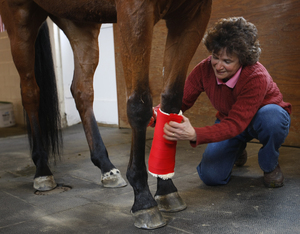
Dr. Conklin bandages a patient's legs.

Thursday, March 20, 2008

American Farrier's Association to Provide Farriers for 2010 Games

(Note: this is an official press release received today from the World Equestrian Games 2010 Foundation, confirming news reports previously published on this blog. It is published in its entirety without edits or interpretation and contains no graphic symbols or images.)

LEXINGTON, KY- The World Games 2010 Foundation today announced that the American Farrier's Association has been named the Official Certified Farriers of the 2010 Alltech FEI World Equestrian Games.

As the Official Certified Farriers, the American Farrier's Association will provide a farriery on the venue grounds of the Kentucky Horse Park from September 11 until October 10, 2010. Two farriers will be on site per day for the two weeks prior to the Games, and up to six farriers will be on site daily during the 16 days of competition, depending on the event schedule. Athletes will be charged on an individual basis for farrier services according to their needs.

"We are so pleased to have this partnership with the American Farrier's Association," said Competition Director Kate Jackson. "We know that the equine athletes competing in these world championships will be in professional and skilled hands."

"Naming the American Farrier's Association as the Official Certified Farriers of the 2010 Alltech FEI World Equestrian Games constitutes a true honor for our organization. While this event showcases competition, it's genuinely built upon cooperation, and our association is pleased to be a part of this international effort that will bring us together in Lexington," said Andrew Elsbree, CJF, President, American Farrier's Association. "We look forward to 2010 and the opportunity for our AFA Certified Farriers to offer participants the finest in hoofcare services."

Headquartered in the Kentucky Horse Park's National Horse Center, the American Farrier's Association (AFA) focuses on improving equine welfare through excellence in the practice of hoofcare and farriery. As North America's premier farrier organization, the AFA centers upon five basic tenets: certification, education, communication, research, and innovation. Working through the AFA's education and certification programs, AFA farriers provide exceptional, professional services for horses and the people who use and enjoy them.

"Many of the horses competing in the Alltech FEI World Equestrian Games will be there, in part, due to the ongoing, exceptional work of AFA Certified Farriers," said Elsbree. "We are honored to have the opportunity to continue providing excellent care throughout the Games."

The Alltech FEI World Equestrian Games, to be held at the Kentucky Horse Park September 25-October 10, 2010, are the world championships of the eight equestrian disciplines recognized by the Fédération Equestre Internationale (FEI), and are held every four years. The Games have never before been held outside of Europe, nor have all eight disciplines ever previously been held together at a single site- both firsts that will be achieved at the Kentucky Horse Park. The 2010 Games are expected to have a statewide economic impact of $150 million. It is anticipated that more than 600,000 spectators will attend the 16-day competition.

Wednesday, March 19, 2008

The Humane Society of the United States Announces $10,000 Reward for Information on Horse Soring in Tennessee

(this is an abbreviated version of an HSUS press release received March 18, 2008)

The Humane Society of the United States has announced it will offer a reward of $10,000 for information leading to the arrest and conviction of any violator of Tennessee's "horse soring" law, which prohibits the deliberate infliction of pain to horses' feet to produce an artificially high-stepping gait.

Ads announcing the reward will appear throughout middle Tennessee, an area still believed to be a hotbed of soring activity.

The soring of Tennessee Walking Horses and other breeds of gaited show horses is one of the most heinous forms of abuse inflicted upon equines in the U.S. The practice involves the use of caustic chemicals and chains on the legs of the horse, creating severe pain and forcing an exaggerated, high-stepping gait.

Pressure shoeing — another especially egregious form of soring — is the abusive technique of cutting a horse's hoof almost to the bloodline so the shoe puts painful pressure on the horse's sole with each stride. In some instances, foreign objects are placed between the hoof and the shoe to create painful pressure on the sole.

Passage of a federal law (the 1970 Horse Protection Act) has not had the intended effect of eliminating soring. Tennessee also has a state law prohibiting soring, but enforcement of these laws has proven difficult.

Anyone with information on this cruel practice should call 1-866-411-TEAM (8326). The Humane Society of the United States will protect the identity of all callers.

(Editor's note: please read this announcement carefully: this reward apparently only applies to alleged violations within the state of Tennessee)

Sunday, March 16, 2008

Happy St. Patrick's Day!

Have some fun today! This photo is from sport.yahoo.com's coverage of this year's Cheltenham Festival of steeplechase racing in England.

Friday, March 14, 2008

Hoof Blog Retrospective: Slide Show for the 500th Article Published


Photo highlights from the first 500 posts on Fran Jurga's Hoof Blog.

Sometimes a good idea sticks, and that has been the story with this blog. We now have 500 stories posted here and hundreds of people visit this blog daily...from every corner of the planet. Most zip in to grab details of a single story (Tildren and collateral ligament injuries are always at the top of the list) or watch a video. Others, mostly loyal Hoofcare and Lameness Journal subscribers, start at the top and read the new posts each day.

An uncountable number of people read this blog by email now and many more read an RSS feed of the headlines on their Yahoo/Google/AOL newsreader pages (but miss all the photos and videos). This blog now have a "widget" of code that will display the headlines on anyone's web site or blog (just ask).

No matter how they read it, people do read it. I know because so many leave encouraging or disparaging remarks, usually by email. These remarks either make or break my day.

The only thing that gets me up in the morning (or keeps me up late at night) to post these stories is the positive feedback from the people who tell me that they check the blog before they head out off to work or the barn/track/forge/clinic or when they get home at night. That, and wanting to share with you all the news of the hoof.

It's just too interesting to keep to myself.

Thank you all for reading and for the emails and occasional comments. Thanks for being patient about the erratic publishing schedule of Hoofcare and Lameness. Thanks for being not passive readers of the news, but the makers of the news. This blog is yours.

All HoofBlog text and images © Hoofcare Publishing 2008 unless otherwise noted.

To learn more about new research, products, and treatments for the horse's hooves and legs as reported to veterinarians and farriers in the award-winning "Hoofcare & Lameness Journal",
go to http://www.hoofcare.com
Contact Hoofcare Publishing anytime:
tel 978 281 3222 or fax 978 283 8775 or email bloginquiry@hoofcare.com

British Farrier/Vet Conference Planned for April


The British Equine Veterinary Association (BEVA) and the National Association of Farriers, Blacksmiths and Agricultural Engineers (NAFBAE) have joined forces to present an informative and stimulating one day conference with international speakers from the USA and The Netherlands.

The Diagnosis and Management of Conditions of the Foot: An International Approach will be held on Monday, April 14 in Nottingham, England.

The event will feature a Commercial Exhibition, strongly supported by manufacturers of equipment and related products, which presents an ideal opportunity to acquire the latest tools and materials and discuss the application of new techniques.

This conference sold out when last run. The event will be held on a Monday, at the East Midlands Conference Centre in Nottingham, a slightly larger venue than in previous years, with tiered seating and enhanced audio-visual aids to improve the ability to present to a large audience.

Speakers and topics include:
MRI of the equine foot (Application of a new technique and its implications): Tim Mair
Useful foot-related measurements from the horse and its radiographs: Richard Mansmann
Advances in diagnostic techniques: Peter Clegg
Pressure mat analysis in the assessment of foot balance: Ian Hughes
International perspective: Meike Van Heel (replacing Pascal Ebel)
Pathological conditions of the donkey foot: Karen Rickards & Colin Goldsworthy
Slip and grip (Dynamics of the hoof): Chris Pardoe
Foot measurements in approaching clinical cases: Richard Mansmann

Unfortunately Pascal Ebel of The Netherlands,who was scheduled to speak, has been injured and will be replaced by Dr Meike Van Heel. Van Heel is a movement scientist, equine physiotherapist, and part of the same team at Utrecht as Ebel. Meike Van Heel completed her PhD on "the effects of trimming and shoeing warmblood horses" and has developed a prototype horseshoe which benefits the horse’s joint load and limb movement. She has also carried out studies into the development of uneven feet in foals due to grazing behavior and conformation.

Click here to download the updated program schedule. (A one-page Adobe Acrobat pdf file will automatically download from the NAFBAE web site.)

Click here to download the seminar's complete color brochure. (A larger Adobe Acrobat pdf file will automatically download from the NAFBAE web site.)

Thursday, March 13, 2008

The Inside Track: Summit Sessions on Shoeing and Surfaces at Next Week's Jockey Club Racehorse Welfare and Safety Meeting


The second Welfare and Safety of the Racehorse Summit will be held Monday, March 17, and Tuesday, March 18, at the Keeneland Sales Pavilion.

Most of the topics to be covered will be of great interest to Hoof Blog readers, in particular reports on committee studies of hoof care and horseshoeing, synthetic racetrack surfaces and injuries in racing.

Click here to read a complete press release describing the mission of this meeting and its unique structure for dynamic planning sessions and also visit the Summit's web site, which describes accomplishments of the first Summit, held in October 2006. Several PowerPoint presentations are available at that site's "Presentations" menu for download and study, including Bill Casner's animated slide show on the detrimental effects of toe grabs. (Note: this is a 7 MB PowerPoint file. Download only if you are sure your system is capable.)

Fran Jurga of Hoofcare Publishing will be one of 60 participants in the study groups. Fran joins shoeing and hoof care committee members Bill Casner (chair), Dr. Rick Arthur, Ed Bowen, Bob Curran, Bob Elliston, Dr. Rob Gillette, John Harris, Richard Mandella, Chris McCarron. Wayne McIlwraith, Dan Metzger, Steve Norman, Denny Oeschlager, Dr. Mick Peterson, Todd Pletcher, Richard Shapiro, Dr. Scott Stanley, Gary Stevens, Dr. Sue Stover and Mitch Taylor.

Mitch Taylor of Kentucky Horseshoeing School will present high-speed video studies of racehorses galloping on different surfaces wearing different shoes. Mitch has been building on his initial filming of horses with and without toe grabs that he presented at the "Hoofcare@Saratoga" forum last August and at the 4th International Equine Conference on Laminitis and Diseases of the Foot in November.

In the synthetic surfaces study group, Dr. Preston Hickman of the Wichita Equine and Sports Medicine Clinic, who also uses video analysis technology, will examine the potential causes of on-track injuries. Hickman was a farrier before becoming a veterinarian and is certified by the American Farrier's Association. He is a proponent of Dartfish motion analysis software. Below are some examples of Dartfish "Stromotion" images from the Dublin Horse Show and a short example of a clip of Dr. Preston's high-speed video.

This might be the most important meeting of the year. There is no charge to attend for audience members; there will be two public sessions, one of Monday morning and one on Tuesday afternoon (see schedule).

Please contact the Jockey Club for more information: (859) 224-2850.


All HoofBlog text and images © Hoofcare Publishing 2006-2008 unless otherwise noted. Please request permission to reproduce or capture images or content. This blog is available for delivery via RSS feed or as a daily email of new content.

To learn more about new research, products, and treatments for the horse's hooves and legs as reported to veterinarians and farriers in the award-winning "Hoofcare & Lameness Journal", go to http://www.hoofcare.com

Direct “subscribe now” link to Hoofcare & Lameness Journal: http://www.hoofcare.com/subscribe.html

Contact Hoofcare Publishing anytime:
tel 978 281 3222; fax 978 283 8775; email bloginquiry@hoofcare.com

Resource for Your Files: "Managing Equine Joint Inflammation" Free Download

LinkOur friends at Idexx have a free download of a roundtable discussion featuring leading university lameness veterinarians at Colorado State University and Texas A&M University on the topic of joint inflammation. If you click on this link the download should start.

The document is a 2.4MB Adobe Acrobat (PDF) file created by Veterinary Learning Systems. You should end up with a 16-page document that you can print or read on your screen.

Idexx is the manufacturer of Surpass, a topical anti-inflammatory medication, and many other medications and products for equine veterinary care. The special report covers all aspects of new developments for equine joint problems.

Wednesday, March 12, 2008

Horseshoer Killed in Pancho Villa's Famous 1916 "Invasion" of New Mexico

Pancho Villa and officers, 1916.
General Francisco "Pancho" Villa was the people's hero during the Mexican Civil War in the early 1900s; depending on which history book you read, he was Braveheart with a great mustache...or Osama bin Laden in a sombrero.


Here's some history you won't find in any textbook. 

Montana farrier Scott Simpson and I share a fascination with the history of a raid by Mexican General Francisco "Pancho" Villa, who slipped across the border and raided the town of Columbus, New Mexico at dawn on March 9, 1916.  But I didn't expect there to be a horseshoer involved. Now I know otherwise.

Tuesday, March 11, 2008

Friends at Work: Let's Clone Nicole Roberts!


You hear a lot these days about cloning horses. Top showjumpers, endurance horses, and especially those down-in-the-dirt cutting horses can now have their DNA recycled into a genetic match.

From where I sit, we need to not clone the horses but the horsemen, those people of either gender who are superb at understanding how to care for horses and, in particular, how to nurse them back to health after illness or injury.

We've always had layup farms, some of which include physical therapy, but most of which are benign holding facilities where racehorses can get some fresh air and a few hours in a paddock each day before they return to the track or maybe put on a few pounds and some dapples before they head to the sales ring.

But what if you had a dressage horse with a suspensory problem, a steeplechaser with a bad bow, a racehorse recovering from EPM and you couldn't provide the nursing care? Where would you send your horse? Who would you trust to bandage and medicate and just plain care for that horse? We live in a day of revolving barn helpers; if Miguel can't make it today, he sends his cousin, but his cousin isn't quite the poultice artist Miguel is. And if you're working on layups, poultice needs to be your art form.

My vote for cloning would be the people who are so good at care of lame horses. Whether it's a barefoot rehab farm or a high-tech racehorse recovery center, the care and results will only be as good as the skills and experience of the people who have their hands on the horse, day in and day out. The best intentions and Internet consultations won't take the place of "been there, done that, can do" and that takes years of experience and hundreds of horses to gain.

So we come to the story of Nicole Roberts. I'd like to say I know her, but I don't. I do know Dr. Midge Leitch, the vet who recommends that owners turn their recovering horses over to Nicole for care.

Today's Philadelphia Inquirer has an article about Nicole and her "halfway house" for recovering horses outside Kennett Square, Pennsylvania. The point of asking you to read this article is not that you will learn something about lameness, but that you will remember that there are people out there like Nicole.

I hope she takes on apprentices. It would be easy to say that she should write a book or make a dvd, but there is no substitute for hands-on experience with horses. Combine that experience with a genuine "feel" for horses and you have a valuable, if oft unsung, hero of the horse world who can often bring a horse back without sharing credit with high tech treatment tools or holistic cure-alls.

That's what they are talking about when they talk about horse sense. I hope you will take time to read the article and reflect on the role that people like Nicole play in our industry.

Favorite Video Clips: Underwater Treadmill at University of Minnesota


Thanks to twincities.com for this video clip of underwater treadmill at the University of Minnesota College of Veterinary Medicine's new Leatherdale Equine Center in Falcon Heights, Minnesota. You're watching a Hanoverian recovering from arthroscopic fetlock surgery enjoying some physical therapy, with some nice closeup photography of the hooves underwater and a brief glimpse of Dr. Stephanie Valberg, the center's director.

Clinical Farriery: New Book from German Farrier Leader

It's foaling season all over the Northern Hemisphere: these post-mortem photos are a reminder of the amazing process that creates the hoof from very soft tissue. Photos provided by Uwe Lukas.

It is a pleasure to announce the publication of a new book on farriery. Gesunde Hufe--kein Zufal! by Uwe Lukas was published recently by FN Verlag in Germany and my copy finally floated over to these shores.

The title translates to: "Hoof Recovery: No Accident" (sort of), meaning that hoof rehabilitation, the author's specialty, requires skill, experience, and a plan. I am sure someone will leave a comment with a better translation.

Uwe is the chairman of the Erster Hufbeschlagsschmiede Verband (EDHV), a.k.a. the German farriers association. His client list reads like a "who's who" of international dressage and show jumping, but his heart seems to be back at the vet clinic; he is the farrier at Tierärztliche Klinik Telgte (Telgte Equine Hospital and surgical center) and is based in Warendorf, the site of the state stud of the Westphalian breed. He also "rehabs" horses by offering long-term residential care at his forge, especially for laminitis cases.

While most Americans will be scared away by the German text, the photos in the book are compelling. The foal correction and sport horse shoeing images are among the most instructive without translation, but it is fascinating to see that the bulk of the book is therapeutic cases that are treated with the most high-tech support materials (Vettec and Luwex hoof support materials earn a big thumbs-up from Uwe) but also the most basic German-type Werkman and Kerckhaert shoes and big e-head nails.

As in the Hoof Problems book by Rob Van Nassau from Holland, this book has many detailed cases of canker, various types of "loose wall" conditions, coronitis and nasty quarter cracks. It's hard to say if those problems are more prevalent in Europe or if both authors had access to unusually severe cases.

I know this blog is read around the world, and some readers can surely read German (or live there), so please consider purchasing this book. I have a shelf of German farrier and hufpflege (hoof nurse) books, but this one seems by far the most contemporary, and breaks some of the stereotypes about traditional German farriery. Surely we are evolving to an international playing field where it will become harder and harder to discern the nationality of the farrier by looking at the shoe, just as the warmblood horses themselves are now so hard to identify by nationality.

Aluminum shoes may be the last frontier between American and European farriers. The only aluminum shoe in Uwe's book is a lovely ultra-toe specimen attributed to Dr. Jean-Marie Denoix of France.

A unique part of the book explains how to clean feet; the text goes on for quite a while about tidiness in the stable. As Uwe cleans a foot, there's an explanation of how to use bucket underneath to catch the water and keep the floor clean. All the settings for the photos are very tidy.

Uwe's book is published by FN Verlag, the national equestrian association in Germany, and may be purchased through their web site's bookshop.

Thanks to Uwe and the EHDV for all the help they give to Hoofcare and Lameness Journal.


Monday, March 10, 2008

Cheltenham Runner is No Relation to Blogger


Thanks to everyone who has suggested placing a Transatlantic wager on the Scottish horse Big Eared Fran, who is entered in the Cheltenham Festival's Championship Bumper this week. The Festival is the biggest jump racing event in the year's calendar in the UK and creates quite a frenzy.

Big Eared Fran is by the famous flat racing sire Danehill and originally was destined for flat racing with the Coolmore Stud but has changed hands (and racing genres). Trained by the legendary Martin Pipe, the horse is named for his current part owner, former England and Rangers football player Francis Jeffers.

A win by a Scottish-owned horse at "the biggest show on turf" would be a Seriously Big Deal, since the festival is normally dominated by Irish horses and trainers.

The horses to watch are the super star Kauto Star and his stablemate Denman, both entered in the Cheltenham Gold Cup. Kauto Star is recovering from a foot abscess but is expected to start.

Cheltenham is in the scenic Cotswolds district of England, west of London. To make the festival more challenging, southern England is bracing for the arrival of the storm that swept across the USA this weekend. Gale-force winds and torrential rains are predicted, which will make the "going" soft and deep, which is tough on jumping horses attempting Cheltenham's long, long course of what we Americans would call brush jumps.

Animal rights advocates are highly critical of the number of horses injured and killed at Cheltenham each year. During the 2006 Festival, 11 horses perished in just four days. In protest, a woman dressed in black gothic robes representing a mourning costume will be present at the Festival. She will be wearing a wide-brimmed hat that features a model racehorse tumbling over a hurdle.

Cheltenham is also noteworthy for its popular amateurs-to-ride races.

Favorite Video Clip: The Show-Off Jumper


Thanks to June Evers of Horse Hollow Press in New York for forwarding this clip of a young Belgian jump prospect. Assuming that this horse didn't break or rupture anything when he landed is testimony to the miraculous design of the equine limb.

The horse, whose name is Gesalme, is said to by Espom Gesmeray (you may remember him from the Athens Olympics in 2004) and is promoted by Béligneux-le-Haras.

Another Country Heard From: Hoof Project Research Center Grows in Texas

Dr. David Hood, director of The Hoof Project, at a recent seminar.


News from Texas is that the new Hoof Project Clinic and research center in Bryan, near College Station, is humming with activity. The clinic is open for the treatment of laminitic horses, and David Hood DVM, PhD is actively directing a team of researchers involved in 14 different studies related to laminitis.

Dr. Hood reports that 35 horses are in residence at the center, either in treatment or for use in studies, which include biomechanics, circulation, metabolism/nutrition, and laminitis pathology. Studies are particularly interested in the pain experienced by horses suffering from laminitis; Hood hopes to not just find ways to relieve the pain but also to determine the nature and source of the pain in order to prevent it.

His previous studies documented that horses with lamintiis suffer from secondary sources of pain. Changes in stance, posture, and gait affect tendons and ligaments in the legs, and joint angles may be altered, leading to arthritis. Even back and neck pain can develop in horses that are standing in abnormal positions for long periods of time. The fact that a horse has chronic laminitis may predispose it other co-existing lamenesses, such as ringbone, collateral ligament injuries, sheared heels, or navicular damage caused by long-term hoof capsule deformation and abnormally high heels.

Watch for announcements from The Hoof Project for the first series of seminars on hoof science to be held at the new facility.

Sunday, March 09, 2008

UPenn Laminitis Research Project Hopes to Clarify the Mechanism of Developmental Laminitis

Dr. Hannah Galantino-Homer, senior research investigator of the newly created laminitis research initiative at the University of Pennsylvania School of Veterinary Medicine, is beginning her research in 2008 with a grant from Grayson Jockey Club Foundation.

“Molecular and Cellular Level Studies of Laminitis” is the title of the project.

Currently, laminitis still is so baffling to scientists that researchers tend to be split into two camps (theories) as to cause of the problem — vascular and enzymatic.

“The lack of agreement about the basic pathophysiology of laminitis explains why standard guidelines for therapy are not yet available,” noted Dr. Galantino-Homer in her research statement.

If this project can identify which specific genes and proteins are up-regulated or down-regulated during the first phase of the disease — when identifiable symptoms are not yet manifested — it “will determine the pathways of the disease and allow institution of preventive or interventional treatments sooner,” according to Galantino-Homer.

The first phase of laminitis, the developmental phase, is followed, of course, by the acute phase. One of the frustrations of dealing with the disease is that often by the time it is diagnosed, the horse may be gravely threatened.

Galantino-Homer believes the study “will provide information that we and other investigators can use to verify or elaborate on existing theories about laminitis, explore previously unrecognized cellular and molecular events during laminitis, and validate in vitro models of laminitis.” The latter will facilitate research projects that do not require laminitic horses.

Click here for information about Galantino-Homer's appointment at PennVet.

Friday, March 07, 2008

"Lucky" Horseshoes in India Are Not So Lucky for the Horse

In India, shoes from black horses are considered lucky, meaning many horses are continually and carelessly re-shod by poor owners simply to feed the "lucky horseshoe" trade. Yes, it has to be a shoe from a black horse.

Vets from the international equine charity "The Brooke" (Brooke Hospital) in Delhi witnessed this in a black horse called Kalu, who was brought to them in pitiable condition. Kalu had overgrown, cracked and severely damaged hooves caused by years of re-shoeing (but not necessarily re-trimming) and was suffering chronic foot pain.

Brooke vets helped the horse and taught his owner, Bhoora, better shoeing skills, although he looks like he is pointing a very sharp object at Kalu's sole in this photo.

"Now Kalu is happy to be with me," says a grateful Bhoora.

Here's a link to a spiritual web site in India that will send you a horseshoe from a black horse in India for $6.95. They explain the legend, which is similar to the Western superstition about horseshoes. But they also claim that a horseshoe is good Feng Shui. A lot of Freisian and Percheron owners are doing the math...

The Brooke’s mobile vet teams and community animal health workers, and partner organizations worldwide provide free treatment to animals and train animal owners, local healers, farriers, saddlers, feed sellers, harness and cart makers. They currently operate across nine countries in Asia, Africa, Central America and the Middle East with over 750 highly-skilled staff working directly in the field.

The Brooke Hospital was organized in Cairo, Egypt in the 1930s to assist in the care of thousands of surviving American, Australian and British military horses that had been abandoned there at the end of World War I. Their reward for gallant service in war was a lifetime of hard labor on the streets of Cairo and as they aged, their health suffered terribly. However, the horses were so valuable to their owners' survival that the only humanitarian recourse was a campaign to improve their health. A first equine hospital was built...and the rest is history.

Please support the efforts of charitable organizations who put teams of professionals in the field and at disaster sites to help horses. Some day they might show up to help you.

Wednesday, March 05, 2008

The Evolution of the Horseshoe: Nail Holes of Antiquity


Would anyone care to comment on these 12th century horseshoes from the Museum of London? Yes, that's right: 12th century. That means these shoes were hammered out not long after the Battle of Hastings (1066) when the Normans beat the local Brits.

I have a terrific little booklet call "Old Horseshoes" by Ivan G. Sparkes, and it creates a timeline of horseshoe shapes and details, but it certainly doesn't have any nail holes like these shoes have, although he does reference wavy-rimmed shoes to the Saxon period of British history. (Horseshoes are mentioned in the Domesday Book of 1086.)

According to Sparkes, there is evidence that horseshoes were not deviced to protect horses' hooves, as is so often put forward. He claims that the nails were like keys, and were only nailed halfway into the hoof, in order to provide traction; the heel calks were built up to the same height as the protruding nail heads.

What you see in these nail holes is, of course, a spent hole that looks like it was made by a t-shaped punch, but an argument could be made for a t-shaped nail head wearing down into the soft iron of the shoe. If Sparkes' theory holds, the shoe would last much longer than the nails and go through a sequence of nails as they wore down.

If a modern design nail sat in that hole, you'd end up with a semi-fullered (creased) shoe. Various historical references quoted by Sparkes place the introduction of fullering in the mid-16th or 17th century.

Photo courtesy Museum of London.

Monday, March 03, 2008

The Circus Farrier

Check out this detail from an old photo for sale on eBay this week. It's from a collection of photos of the Ringling Brothers Barnum and Bailey Circus in the late 1930s or early 1940s. The credit is given to a photographer in Chicago.

The entire image includes a performer perched on the horse's back while he's being trimmed!


Leading Hoof Researcher Doug Leach Has Died

Dr. Leach leading a discussion group at the 1987 Bluegrass Laminitis Symposium

The leading contributing researcher and author on the equine hoof of the 20th century died on February 10th in Lexington, Kentucky.

Douglas H. Leach PhD authored major studies on the basic mechanics and anatomy of the hoof in the 1980s, and went on to write about racetrack surfaces, exercise physiology, equine locomotion and a dozen aspects of the hoof's physiology. His name is probably the most often seen in reference lists and research citations.

Leach believed that basic studies of the normal hoof were tantamount to studying laminitis or the function of certain shoes, so his papers created a very valuable base on which more specific studies could be built.

A native of Canada, Leach received his Bachelor and Masters of Science degrees at the University of Guelph and Ontario Veterinary College, then proceeded to the University of Saskatchewan to complete his PhD on the equine hoof, which he earned in 1980.

While at Saskatoon, he co-authored papers with Dr. Hilary Clayton, who was conducting research at the Equine Locomotion Laboratory there and also spent a sabbatical year at the Animal Health Trust in Newmarket, England, where he pursued studies of the function of the navicular bone with collaborating researchers Chris Colles and Sue Dyson there.


Leach was so intent on studying the hoof that he learned to read German so he could reference old shoeing and anatomy texts. He collaborated with researchers at Utrecht, Vienna and Uppsala and cheerfully corresponded with veterinarians and farriers from all over the world.

Dr. Leach played a major role in the First International Seminar on Navicular Disease in 1984 and authored a monograph summary of the papers presented there for Hoofcare and Lameness Journal. He was a key contributor to Hoofcare and Lameness in its early years.

In 1990, Leach was appointed to the John S. and Elizabeth A. Knight Professorship in Equine Veterinary Science at the University of Kentucky. The professorship was expressly created to study causes and prevention of equine lameness.

Soon after moving to Kentucky with his wife, Jane, and their three sons, Dr. Leach became ill and was ultimately diagnosed with Pick's disease, a rare and incurable degenerative brain condition.

Reading Dr. Leach's papers today, it is hard to believe that most are 20 years old. The best collection of his papers is in the University of Sydney's 1990 proceedings book Equine Lameness and Foot Conditions; it contains six of Leach's last papers, and a seventh on racetrack surfaces co-authored with Dr. Bill Moyer.

Dr. Leach was 56 years old when he died. There is no way to estimate how different veterinary medicine and farriery might be if he had been able to continue his study of the foot. What he accomplished in ten short years is an impressive mass of work that will be studied and referenced for years and years to come, but which was only the beginning of a brilliant career cut tragically short.

Friday, February 29, 2008

Laminitis Research from the Field to the Feed Room

Research by Bridgett Byrd (M.S., PhD candidate) at Virginia Tech, was used to create this graph. It shows that pastures at certain times of year have specific times of the day when plants contain high levels of non-structural carbohydrates (NSC). This is effectively mirrored by the insulin concentrations of the horses grazing on such pastures, in a similar way to the feeding of high starch and sugar diets. While this research has been available for the past few years, many horses owners have not been informed of the cumulative effects of long-term high-sugar diets on horses, particularly on sedentary recreational horses. (Graph and caption credit Virginia Tech.)

Remember the image in that graph. We have just turned the calendars to March, so spring will soon be here and the time is here to start planning how horses will be managed on spring grass.

This year, thanks to increased educational efforts, many horse owners are seeking advice on how to avoid laminitis caused by spring grazing. Many horses suffer annual bouts of laminitis that can adversely affect the horse’s soundness for months, or may develop into serious chronic laminitis with its many problems.

Nutritional experts, however, caution that laminitis and insulin resistance are year-round problems and that a horse's entire feeding program should be scrutinized, not just the turnout on pasture.

The Waltham® Equine Studies Group, led by Dr Pat Harris MA PhD, VetMB DipECVCN MRCVS, offers this summarized explanation: “Turning certain ponies out onto lush pasture in the spring and autumn is a common triggering factor for the development of laminitis. It is currently thought that high levels of water soluble carbohydrates, (which include simple sugars as well as Fructan – the more complex storage carbohydrate) – and/or starch may be involved in this process.

"Previous research carried out in collaboration with Virginia Tech by the Waltham® Equine Studies Group in 2004 confirmed a link between insulin resistance and laminitis. This work demonstrated that a high starch and sugar diet, that causes corresponding peaks and troughs in glucose and insulin, increases the degree of insulin resistance.

Dr Harris continues: “The new revelations linking pasture directly to the potential risk of insulin resistance have important consequences for certain horses and ponies prone to laminitis and tying up, as well as obese animals that will already have a greater degree of insulin resistance. For these animals it is likely to be safer to feed alternative sources of forage at key times of year.”

Last month, Florida-based Seminole Feeds announced that it would no longer be the US distributor for Spillers brand feed products, which are developed with Waltham research principles. “Happy Hoof”, a high-fiber alternative to high-sugar hay, was one of the products sold by Seminole in the USA. Seminole has launched a new line of low-starch feeds under its “Wellness” label.

Hoofcare and Lameness does not have much information at present for horse owners "orphaned" by the dearth of Spillers products in the USA.

Maine-based Lucerne Farms, makers of the Dengie product lines of alfalfa-based chopped hay in the USA, is now offering high-fiber, low-sugar products for horses at risk for laminitis. The company also offers excellent customer support.

Thursday, February 28, 2008

Farrier Convention Update: Competition Alive with New Faces

Farrier competition at Peterborough, England's Shire Horse Show painted by Michael Murfin graces the cover of out 2008 AFA Survival Guide. Everyone thinks it's a photo, but it's a painting!

My energy is fading after standing up for six hours in our booth at the trade show, but the American Farrier's Association today made some history that I thought I would share.

A big part of this convention is the forging and shoeing competition, which this year is being held at a remote location in the big arena at the Kentucky Horse Park, while the convention lectures and trade show are in downtown Lexington.

But you can almost hear the hammers across the miles.

Some joyous faces stopped at my booth tonight to say hello. Today was the preliminary forging (horseshoe making, no horses), which count towards a farrier's qualification (or disqualification) from the "live" shoeing finals tomorrow.

The happy faces belonged to supporters of the Japanese team. For the first time, two Japanese farriers made it to the finals. Also in the finals: two women (congratulations, Raleigh and Sarah!), one American and one Scottish. There is at least one British male in there too. There were lots of new names and faces on the list, which is encouraging.

Competition chairman Myron McLane also told me tonight that the contest went very well and he is looking forward to tomorrow. Sadly, one of the USA's top competitors, former World Champion Austin Edens of Texas, had to scratch today because of a back injury, but said he hopes to compete in just the draft horse class tomorrow.

The convention is an international event even moreso than usual this year. I saw a European plastic shoe company's booth located next to an Amish booth and wondered, as always, about the way that this event brings people from diverse backgrounds under one roof.

A special highlight last night comes to mind. How many conventions have a "jam session" night? So many musicians showed up to play that they didn't even all fit on the ballroom stage. And many of them were superb musicians. There's no group quite like farriers!

From the AFA Convention: Dr Scott Morrison on Hoof Capsule Injury/Distortion

Dr Scott Morrison of Rood and Riddle Equine Hospital in Lexington, KY was the AFA convention's first speaker.

Predictors of a low turnout at this year's AFA Convention could not have been more wrong, if attendance at the convention's first lecture this morning is an indicator of how many people are here.

Kentucky is coated in snow/ice and I know some people were not able to get here, but many hundreds braved the elements!

I attended the kickoff lecture this morning, wedged into a crowded lecture hall. I was privileged to sit next to Blaine Chapman of Lubbock, Texas, son of the late-great heart bar expert farrier, Burney Chapman. Blaine's running commentary at a low whisper was approving as Dr Morrison sprinted through a 90-minute narrated slide show of interesting cases from the Podiatry Clinic at Rood and Riddle Equine Hospital here in Lexington,Kentucky.

Cases that drew the most comments and questions were the ones where he showed correction of negative palmar angles with roller motion shoes and his preference for the use of hoof casts on hoof wall avulsion and heel bulb injuries.

Much of the wall/bulb injury lecture really was based on the encourage of new growth, what Dr Morrison calls the foot's ability to "epithelialize" (generate new epithelial tissue, as in skin; epithelial simply means cells that form the outer lining of an organ or body structure. Endothelium is the inner lining.).

He recommended using tissue-friendly antiseptics, rather than iodine "...and not kerosene" he added with a chuckle.

Inventing another verb, Morrison said he "domes" the foot surface of his foot casts. Under the casting padding on the wall is povidene creme or a similar antiseptic, covered with gauze, with carpet felt under the sole. He also "domed" a wet leather pad before shoeing, inserted hoof packing from a gun, so the pad bubbled outward, forming a domed ground surface.

While some criticize the use of casts, Morrison saw no problem with leaving them on, and was confident in the healthy growth that he would find what it was removed. He said that if the coronary band is not under pressure from weightbearing, the growth will be more rapid.

A big hit was his slide of a racehorse with an interference injury: the front shoe was imbeddedin the coronet of the hind foot. Also food for thought: he showed a severely neglected miniature horse with grossly overgrown hooves.After a cleanup trim, the horse required extension shoes to stand because the collateral ligaments of the coffin joint (and probably the fetlock joint as well), had been so stretched by the deformity.

At the end of the lecture, a line formed to ask questions.

Tuesday, February 26, 2008

Survival of the Best Informed: Convention Insider's Guide Published

Once again this year, Hoofcare and Lameness Journal has collaborated with Vettec to produce an official insider's tip sheet for the American Farrier's Association convention, which begins in Lexington, Kentucky on Thursday. Here you see the front cover, which is graced by a Michael Murfin painting of a farrier competition. Competitions for the AFA this year will be held in the arena at the Kentucky Horse Park outside Lexington.

Anyone headed to the convention? If so, I can email you a pdf version of the Survival Guide so you can read our suggestions.

A few facts about the convention:

600 farriers from all over the world have pre-registered...

A big crowd is expected on Saturday, March 1 for a half-day program on racehorse shoeing and toe grab research...

Allie Hayes of Horse Science has revived the "anatomy lab" concept and has a crew of distinguished crew leaders including Dr. Ric Redden and AFA President Dave Ferguson. The lab this year will be on Thursday and Friday mornings and have a "wet" component with dissection groups supervised by Paul O'Sullivan of Kentucky Horseshoeing School. Water Varcoe will have a complete horse skeleton on display in the lab.

Rood and Riddle Equine Hospital has two speakers: Dr. Scott Morrison, who will speak on injuries and distortion of the hoof capsule, and farrier Chuck Jones, who will speak on therapeutic shoeing of sport horses, primarily show hunters.

The trade show has 98 companies listed as exhibitors. The big booths seem to be Delta Horseshoe Company and Farrier Product Distribution, each of whom has a city block of booths! Vettec will have a big presence too; they will be teaching everyone about their new Sole Guard product for barefoot horses. (See previous post on Sole Guard from February 1.)

Booths I will visit: Harry Patton Horseshoeing Supplies (Ada Gates has designed a new hoof measuring tool that I want to check out); Life Data Labs, to check out their expanded line of supplements; Vibram (as in the soles of your work boots; they are now making horse hoof pads); Footings Unlimited because I really do need to learn more about footing; AirShod because I want to see how the pump-me-up shoe inserts are going; Gibbins UK because Carl Bettison is bring over a treasure trove of old farrier books from England and they are for sale!

I want to check in with Thoro-Bred and Victory to see if either has plans for a shoe specifically designed for synthetic tracks, and with TracMe Shoes to see how their improvements are going with the high-tech new aluminum shoes.

The best things at trade shows are the ones that you don't know about until you get there. I'm sure there will be the usual flood of new products from all corners of the globe and I am prepared to be amazed at the world's largest hoof products trade show!

Saturday, February 23, 2008

Friends at Work: Cheryl Henderson in Jacksonville, Oregon

If you looked into a crystal ball and could see the future of hoofcare for horses, you would probably see Cheryl Henderson smiling back at you. Cheryl started out as a hoof trimmer convert, but the bigger mission of sharing expertise with others, and studying the hoof more deeply inspired her to launch "www.ABC Hoofcare" and position herself as a clinic host and a friendly ambassador to veterinary researchers and anyone who might have something to share or learn.

The Southern Oregon Mail Tribune heard about Cheryl and her work with lame horses and sent a reporter out to get the story. I bet that reporter had no idea what a fun time she would have on this interview. And I bet she left with a head full of hoofish aspirations.

Be sure to visit Cheryl's website, http://www.abchoofcare.com/

Note: “Friends At Work” is a regular feature of the Hoof Blog. When newspapers and web sites alert us to features on our hard-working readers and friends, I sometimes can figure out how to link to the story and share the photo with blog readers. Preference is given to people who aren’t normally in the news…and the more exotic the locale, the better! Scroll down the blog to read more "Friends at Work" posts from all over the world. You could be next!

Thursday, February 21, 2008

California Update: Foot injuries up, shin troubles down since synthetic tracks installed

A six-hour meeting yesterday reviewed the status of synthetic racing surfaces at Thoroughbred tracks in California.

The California Horse Racing Board organized the meeting, which was attended by about 150 people, according to the Daily Racing Form.

I have reviewed three quite different reports on the meeting and extracted a few key quotes that relate to the concerns of Hoofcare and Lameness readers. Here are some key quotes, but I hope you will read the reports in their entirety:

Veterinarians Sue Stover of the University of California at Davis and Northern California track vet Diane Isbell reported that injury rates on synthetic surfaces often dropped when horses ran without toe grabs behind. Dr. Isbell said that some trainers have had success training their horses without shoes and urged the CHRB to allow horses to race barefoot. (from Blood-Horse report)

Jeff Blea, a private vet in Southern California, provided evidence that the number of shin X-rays conducted by his five-person practice had dropped since synthetic tracks were installed, but that injuries related to the pelvis and feet had increased. (DRF report)

Rick Arthur, D.V.M., the CHRB’s equine medical director, presented statistics showing that fatalities have decreased by 60% in racing over synthetic surfaces in California, compared to the previous dirt tracks. (TT report)

Trainer Bob Baffert: "I think these surfaces disrespect the ability of a horse and they disrespect the contest of horse racing, where the best horse is supposed to win.” (BH)

Trainer Ron Ellis: "I can unequivocally say that horses stay a lot sounder." (DRF)

Trainer John Shirreffs: “It’s like being in quicksand.” The Blood-Horse also attributed Shirreffs as saying that he sees more hind-end injuries, hoof bruises, and gravel (hoof abscesses). (BH)

Dr. Greg Ferraro of the University of California-Davis called for a five-year study on synthetic racetracks to gain information on how the tracks change over the short and long term. "You want consistency day to day," Ferraro said. "These synthetic surfaces are engineered surfaces and are the beginning of a new science to construct racetracks. This isn't the end, it's the beginning." (DRF report)

Read the Racing Form's report on the meeting, posted on the CBS Sports site so subscription is not required.

Read the Blood-Horse 's report.

Read the Thoroughbred Times report.

Laminitis Prevention: Body Condition Podcast for Scoring Exam


The International League for the Protection of Horses (ILPH) has a new podcast, which is now available for downloading via their website. The podcast is part of the ILPH's comprehensive educational effort to increase horseowners' awareness of the problem of obesity in horses. The audio program coaches owners through the weight tape evaluation to determine both weight and relative condition of horses.

Obesity and irregular body fat storage have been linked to a high risk of laminitis in horses; with spring on the way, now is the time to identify horses that may be at high risk for laminitis when spring grass increases carbohydrate intake in many horses.

The fat scoring podcast brings an expert (via ear buds) to the barn with owners while they "fat score" a horse for the first or the twenty-first time. By downloading this podcast onto an iPod (or any mp3 player), owners can follow steps correctly; then the audio helps them interpret the weight of their horse.

Project leader Samantha Lewis said: “We already have a body condition video on our website as well as a leaflet but we realized something was missing. We felt that if you could listen to someone while actually having a go at fat scoring, owners would be able to understand exactly what we were talking about and how this relates to their own horses.”

To download the free podcast go to www.ilph.org and follow the instructions.

Wednesday, February 20, 2008

Ian Hughes of Wales Will Head Farrier Services at Hong Kong Olympics


Welsh farrier Ian Hughes DipWCF will be head of services in the farrier clinic at the 2008 Beijing Olympic and Paralympic equestrian events, to be held in Hong Kong in August.

It's a long way from Mold, Wales to Hong Kong, but Ian Hughes DipWCF already knows the way. After heading up farrier services at the Olympic test event there in 2007, Ian has been named head of farrier services for both the 2008 Olympics and the Paralympics.

In an interview yesterday with Hoofcare and Lameness Journal, Ian shared some of the details of his upcoming assignment, which may be of interest to readers who are connected to horses that will be traveling to Hong Kong without a dedicated Team farrier, or who may aspire to this type of work.

Ian will be assisted by Greg Murray, head farrier for the Hong Kong Jockey Club, and fellow British farrier Kelvin Lymer DipWCF of Worcestershire.

Ian spent 3 1/2 weeks in Hong Kong last year for the test event, trying out the new purpose-built forge area in the new veterinary center at Sha Tin racecourse. Only about 36 horses competed then, but the event put the footing, stables, humid climate, and facilities to a good test.

An estimated 240 horses are expected to arrive in Hong Kong; many will arrive in advance so that the horses can adjust to the climate and fulfill quarantine requirements. Only a few countries will send their own farriers, but many horses will arrive with spare sets of shoes all made up, and, hopefully, will have been shod before leaving home.

Ian said that he did not have much input on the design and layout of the forge and shoeing floor, and was glad to have had the test event to try it out in advance. The forge area was served by lots of fans but not air-conditioned, he said, "But it will be when we are there!" he remarked. He said that the workings of two double-burner gas forges cancel out the effects of an air-conditioner, so the shoeing floor would be separated from the forge area, so the horses (and the farriers) will be cool except when forges needs to be fired up.

Ian said that he would have to arrive before the horses to set up the service area, and that he would stay until September and serve the same role for the Para-Games. He'll need to be gone from his home in Wales for a total of eight weeks; he'll leave his busy practice in the hands of his two apprentices and his "qualified man" (a graduate farrier working as his employee).

Ian runs a general practice in Wales, and also serves as farrier consultant at Ashbrook Equine Hospital in Cheshire, England, one of Britain's leading clinics. He lectures on lameness one day a week at the veterinary college at the University of Liverpool.

One country whose horses Ian probably won't be shoeing will be those of his own Team GBR. Ian said that the British horses would probably be served by fellow Welshman Haydn Price and eventing specialist Brendan Murray. (You may remember my story about Brendan, who was one of the four escorts in the horse-drawn funeral procession of Princess Diana. According to tradition, the farrier must be present, in the event of a shoeing mishap on one of the horses pulling the gun carriage and casket.)

One note about "Olympic farriers" (and their tools, supplies, and equipment): Ian said that all gear will be shipped out several weeks in advance. Olympic protocol does not allow companies to make advertising claims that their products were used in the forge at Hong Kong. However, the policy is to allow nonreturnable donations of certain supplies, tools, and equipment that do not have strings attached.

Ian's announcement is great news, but I realize it should come as no surprise. Wales is a tiny country that has a penchant for producing farriers who excel on the international level. Calgary Stampede World Champion farriers Grant Moon, Billy Crothers, Richard Ellis, and James Blurton all are from Wales and come to mind, along with Haydn and Ian, and I remember from an earlier generation Glyn David and the late Tommy Williams excelling in the profession, too. I'm sure there are many, many more. John McEwen, chair of the FEI's veterinary committee and head vet for Team Great Britain, also lives in Wales.

Best of luck to Ian and all the farriers who head to Hong Kong this summer. It's great to see the role of farriers be recognized for the important part it plays in the safety and ultimate performance of the horses. The same is true if the farrier is working at a local horse show or the Olympics.

Read an interview with Ian Hughes for potential farrier apprentices.


Monday, February 18, 2008

Horseshoes in Art: The Kentucky Equine Summit Logo

My compliments to the artist. Louisville's Red7e is the marketing firm for the upcoming World Equestrian Games in 2010, but in the meantime, they created a logo for the University of Louisville's Kentucky Equine Summit, to be held in Lexington April 28-29, 2008.

At first glance, it looks like a snowflake, a star or a flower, but look closer, squint!; it's a horseshoe mandela.

Friends at Work: Greetings from France


This photo intrigues me. It was kindly provided by the French National Stud system (les Haras nationaux) but the farrier (le marechal ferrant) is not identified. If you double-click or otherwise enlarge the image to full screen view, you will see that this farrier is wearing his uniform; that's his coat and hat hanging on the wall behind the horse. This is odd, because the farriers I met in France at the national studs wore dark work clothes under their aprons, although the instructor at Haras du Pin (the famous state stud of Percherons in Normandy) would grab his military hat and put it on whenever I took his photo.

Perhaps this fellow had to wear his uniform to have his photo taken for the government.

All the military farriers I saw in France worked in teams--a floorman on the horse, a fireman usually some distance away in the forge, and several go-between fellows who tried to get the hot shoe to the horse while it was still hot. The go-betweens were very fit from running back and forth all day, but they did seem to bear the brunt of impatience from both the fireman and the floorman. They couldn't scurry fast enough and because so many horses were being shod at once, they kept bumping into each other.

The forge fires were in the shape of a huge wheel, with individual fires between the spokes. So the firemen were facing each other around a big round hearth. They were much too important to bump into anyone. And on the wall was a shrine to St. Eloi, the patron saint of farriers in France.

Also in the middle of things was the rider, in uniform, whose job it was to hold up the horse's foot for the floorman.

Maybe things are changing in France and the farriers work alone at the studs now.

Notice that there is no footstand in the photo. There are some very spiffy new Euro designs (and hot colors) for hoofstands, but you don't see them in traditional shops or schools. I remember they were outlawed at the British farrier school when the late Tommy Williams was the instructor. I wonder if that has changed too!

Except for the fact that this fellow's shirt seems to be a modern one, this photo could have been taken 100 years ago. Or 200 years ago. I wonder how long I'll be able to look at a photo and say that.

Sunday, February 17, 2008

Texas A&M Seeks Full-time Farrier for Vet Hospital

The Large Animal Hospital at Texas A&M University is seeking a full-time farrier. To learn more, click here.

Among the requirements: "Requires a High School Diploma and five (5) years of experience as a Farrier, with at least two years experience working under a corrective Farrier. Farrier Certification or ability to achieve Farrier Certification within 12 months of employment.

"Preferred Education and Experience: Completion of a Farrier training program recognized by the Professional Registry of Farrier Educators and four (4) years of farrier experience as a Corrective Farrier. Certification as a journeyman farrier through the American Farrier's Association."

Friday, February 15, 2008

Robert Bowker Heads Down Under on Lecture Tour

One of Dr. Bowker's many beautiful macro images of hoof structures. This one, from 2003, was part of a study of the tissue of the bars in the heels, where the hoof walls hooks inward. Bowker studied the laminae of the bars and found migrating cells from the laminar tips in the bars contributing to growth of the sole. This research was presented at the American Association of Equine Practitioners Convention in New Orleans in 2003.

Robert Bowker VMD PhD will be headed to New South Wales in Australia next month to speak at a March 29- 30 workshop for professional hoof care providers and veterinarians who deal in barefoot rehabilitation.

Organizer Chris Ware said about the event: “Attending are professional trimmers some who are traveling from as far away as Western Australia, Queensland and the Northern Territory. It is fully booked already and we are looking forward to having a wonderful weekend with (Dr. Bowker), who is keen to present his latest research and explain how it relates to hoof care at the ‘coal face’.”

As part of the weekends lectures, Andrew Bowe "The Barefoot Blacksmith" will also talk about his work with seriously foundered horses. Bowe is a Master Farrier of 20 years experience who runs Australia's leading rehabilitation centre for foundered horses, according to Ware. Mike Ware of Easycare Down Under will talk on the many aspects of using Easycare’s range of hoof boots for the rehabilitation of hooves with serious issues and present the new range of boots.

All the proceeds from this workshop will be given to Dr. Bowker for his new research.

On the following Friday Professor Bowker is scheduled to teach the first module of a new Diploma course in Equine Podio-therapy course in Melbourne at the National College of Traditional Medicine. Other lecturers in Melbourne also include Bowe and Ware plus Dr. Alison Mcintosh (a veterinarian and equine chiropractor and barefoot trimmer who has long championed the cause of barefoot rehabilitation for serious hoof issues), and Wayne Anderson, also a Master Farrier, barefoot trimmer, and natural horse educator.

Dr. Bowker’s role in this course is largely due to the generosity of Easycare’s Garrett Ford who has kindly offered a grant towards Dr. Bowker’s nonprofit research.

Dr. Bowker, head of the Equine Foot Laboratory at Michigan State University's College of Veterinary Medicine is a consulting editor to Hoofcare and Lameness Journal, where many of his papers have been published, along with those of his former research colleague, Lisa Lancaster DVM PhD. Lancaster's histological studies from Bowker's lab on the crena of the white line appear in the upcoming issue of Hoofcare and Lameness.

Dr. Bowker and his microscope at home in Michigan.

Thursday, February 14, 2008

Put the Hoof Blog's Headlines on Your Web Site, Blog, Or Facebook Page

The Hoof Blog now has a headline "widget", which is a little piece of code that will create a headline box on your web site, Facebook page, or blog so you can all display a list of the recent headlines from the Hoof Blog to keep your visitors informed. Once it is installed, if you or your visitors click on a headline, the Hoof Blog will open on the screen and display that story.

Just go to this link and copy the code; for many applications, it will load with one click.

Please let me know how it works for you!

British Hunt Racer Comes Back After Tendon Stem Cell Treatment

Knowhere charges home after a long, grueling jump race...notice how clean his right front leg looks, in spite of a serious bow in his past. Photo © Trevor Meeks/Horse & Hound/IPC+ Syndication.Thanks for the loan!

A horse with the intriguing name of Knowhere won the Cheltenham Gold Cup Trial (brush-type jumps) last week over favorite Our Vic. The celebration extended out of the winner’s enclosure and into a nearby veterinary hospital.

Three years ago, Knowhere was, literally, nowhere. After two wins in novice hurdle company, his promising four-year-old race career ended when he injured the superficial flexor tendons of both front legs. The left fore showed low grade tendonitis while the right fore had a significant percentage of fiber rupture—what we call a “bow”.

Knowhere’s connections opted for stem cell therapy and a long layoff, in hopes of returning him to the top races on the National Hunt circuit. He was treated by Tim Beauregard MRCVS of Summerhill Farm in Gloucestershire, west of London.

Bone marrow samples were collected from Knowhere’s sternum. The marrow was then processed in a laboratory over a five week period to generate millions of stem cells. Knowhere was sedated, the tendon area was anesthetised and then the leg was surgically clipped and disinfected The stem cells which had been suspended in serum obtained from the original bone marrow sample, were then injected using ultrasound guidance, into the core of the damaged area of the tendon fibers.

For the first week after the implantation, Knowhere was kept in his stall to allow the cells to adapt to their new environment. Each day after this he was given walking exercise in order to stimulate the activity of the stem cells, encouraging them to differentiate into tendon cells and form into strong tendon fibers. The amount of exercise was incrementally increased, building up over a three-month period from five minutes each day to 45 minutes twice a day.

By the autumn of 2005 both of Knowhere’s tendons had healed very well and showed good fiber pattern on ultrasonography. He was re-introduced to the racetrack the following year and of the 15 or so races he has been in since then he has finished in the frame on eight occasions and has amassed some £175,000 (US$345,000) in winnings.

Vet Tim Beauregard concludes: “Knowhere’s successful return to the track has been exciting and immensely satisfying to follow and he showed particularly brilliant form in the Cotswold Chase. It remains to be seen whether he will be heading for the Ryanair Chase, the (Cheltenham) Gold Cup or the Grand National (three top jump races in the UK) but all involved will be hoping for the best.”

Note to American readers: the procedure used on Knowhere is different from the Vet-Stem system commonly used in the US, which extracts fat cells at the tail head and harvests stem cells from the fat. The procedure detailed in this post is a specific treatment program from the Vetcell company in the UK, developed at the Royal Veterinary College of London.