Here's a snappy little pony getting some tuning up done at an unrecorded location in Suffolk, England in the 1920s or 1930s. I thought there were several interesting things about this photograph and hope you agree.
First, I wondered about a farrier working on a slope so perhaps these two fellows were making a call to a stableyard to replace a lost or twisted shoe on this nice pony.
I also wondered about the strap around the pony's neck; it looks like the leadline is attached to it, rather than putting a halter over the bridle, or removing the bridle. Or maybe it is someone's belt!
Notice the tail. Great Britain passed legislation banning tail docking of military horses in the late 1800s, and a national law in 1949 called the Docking and Nicking of Horses Act; Germany banned docking in 1933. Sharon Cregier from the University of Prince Edward Island in Canada has written extensively about tail docking in horses.
by Fran Jurga | 31 December 2009 | Fran Jurga's Hoof Blog
Here's a peek inside the Smiddy in Dundonnell, Scotland, which is almost as far north as you can go. It's past Inverness, and looks west toward the Outer Hebrides. It's a smiddy no more, but a mountaineering hut where up to ten hikers can rest for the night. But the forge fire blazes and the tools are still there and here's a fellow to serenade us on the accordion.
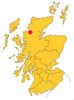
The red dot on the map at left locates Dundonnell on a map of Scotland. The islands to the left are the Outer Hebrides.
Auld Lang Syne is, after all, a Scottish tune penned by the great poet Robert Burns. But you knew that.
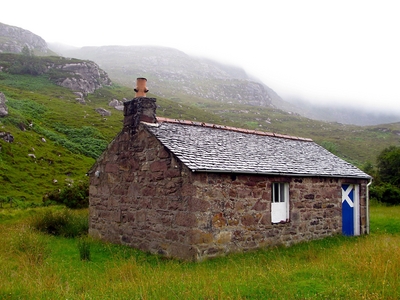
Here's the Dundonnell smiddy from the outside.
I can't think of anyone I'd rather spend an evening by the fire with than the readers of this blog. Of course I'm not really in Scotland, except maybe in a flight of imagination.
Thanks to Dundee, Scotland photographer Robbie Graham for the loan of this photo. Robbie asked for a "wee credit", but I'd give him a lot of credit. His photographs are extraordinary; take a "wee" tour of Scotland with Robbie with this set of images of the country he obviously knows and loves so well.
Happy new year from the Hoof Blog as I turn off the Big Mac for the year! May Auld Lang Syne's cup of kindness find you all often in 2010.
31 December 2009 | Fran Jurga's Hoof Blog at Hoofcare.com
Thank you for reading and watching and listening to this blog, and for sharing it with others, and for your support of all the projects, products and events associated with Hoofcare & Lameness.
by Fran Jurga | 31 December 2009 | Fran Jurga's Hoof Blog at Hoofcare.com
This is the story that stopped me in my tracks and I wonder what it will mean to you. Please watch these videos but understand that they are only the beginning of this very special end-of-the-year story.
The television crews showed up when the deed was done, and the film footage showed only the wreckage of a burned-out horse barn. You heard only the testimony of onlookers. Yet something about this little story from a small town outside Pittsburgh, Pennsylvania piqued my curiosity. There had to be more to it.
And there is. The fireman who rushed into the burning barn at Greenmoor Commons Equestrian Center in Cecil Township, Pennsylvaniawas not just a local volunteer fireman. He was a farrier. And he was rushing in to save a horse he knew very well.
Paul Williams knew exactly where Pearl's stall was, and though he said that she didn't seem to recognize him, we can only wonder about that. Others had tried to get her out but failed. Water from the fire hoses was filling her stall. She was standing in a foot of water.
"It was her blanket that saved this mare's life," Paul told me. "She was completely soaked. The blanket was saturated." That saturated blanket and the deep pool in the stall meant that the sparks and embers falling from above were doused as they entered the stall. Pearl was safe, for the most part, though. "And the wind direction was in her favor, too, " Paul recalled. "But it was that thick blanket that saved her."
The story doesn't stop there. "I was at the station when the call came in, and I heard a horse was trapped," Paul told me. Paul has been through special large animal rescue training and he is dedicated to educating horse owners and firemen about fire safety and horse rescue, along with a fellow firefighter who is a horse owner, Ed Childers.
And Paul does it all as a volunteer fireman, in addition to his farrier work, and the training of his horses. His fire department has only expertise, not equipment; they use an old bedliner out of a pickup truck as a glide for an injured horse. They have no slings or straps or pulleys. They rely on just their common sense, and (most of all), their horse sense.
Just ten days before Pearl's heroic rescue, Paul had been personally touched by fire. He trains Standardbreds, and had been looking into buying back one of his former trainees, a mare named Dancing Cassidy. She was stabled in southern Ohio at Lebanon Raceway.
On the morning of December 5th, two men and 43 horses died in a barn fire at Lebanon Raceway. One of those who died was Paul's mare, Dancing Cassidy. "She won the night before," Paul said, still proud of her. "I wanted to get her out of there and bring her home but I never got the chance."
You may have noticed in the video that Paul has an accent. "People ask me if I'm from Boston," he laughed. He moved to the USA 15 years ago from Brecon in South Wales, but the musical Welsh accent has stuck.
Paul rode National Hunt races back home in the winter; when he came to America, he set up his farrier business and started training Standardbreds and Thoroughbreds; he lives three miles from The Meadows racetrack. He estimates there are close to 3500 active riding and race horses in his county, and that he's picked a good place to shoe and live the life that suits him.
The horse rescue work is unfunded but Paul said that the day after the fire, an anonymous check for $500 arrived at the firehouse, and he was delighted. If you'd like to help Paul help more horses, I'd recommend that you learn what you can about fire prevention and emergency care of horses. And if you have a few dollars left at the end of year (or anytime), I know a donation would be put to good use if it was sent to the North Strabane Fire Department Large Animal Rescue Unit, 2550 Washington Rd., Canonsburg, PA15317-5224 USA. I'm sure Paul would also travel to give talks on rescue and safety.
The fundraising t-shirt for the North Strabane Large Animal Rescue team.
What a well-traveled group of readers checked the Hoof Blog today!
Our "Where in the world?" question asked for the location of the Three Smiths sculpture by Felix Nylund. I thought it would be a stumper, but a flurry of correct answers quickly came in from around the world!
The winner was farrier Jonathan Oehm of Queensland, Australia who, like so many Aussies, has been around the world and back again.
Close behind was farrier/doctor Mike Miller of Alabama and veterinarian Hank Greenwald of Washington. Then a three-way tie almost to the minute between "CJ" and Cynthia Dekker (locations unknown) and Sandy Johnson of Florida, who remembered the statue from her time in Helsinki shoeing at the FEI World Cup Finals in 1998.
The most recent winner is Frederick Marmander, a farrier from Sweden.
I had never seen the sculpture before and I was really excited to find these photos. Something unique about this statue is that it was damaged by bombing during World War II, and the anvil has a hole in it where shrapnel hit it.
As with so many artistic representations of smiths and farriers or anvils and hammers, the statue is said to be a celebration of the laborer, but the coordinated forging between the three men symbolizes the need to cooperate peacefully to get jobs done, according to the art museum in Helsinki.
Smiths are often depicted unclothed in classical art, but it seems a bit cruel of the artist for a city with the climate of Helsinki!
Thanks to everyone who answered or at least thought about where in the world this statue might be! What a worldly readership this blog has!
Who knows where this photo was taken? The name of the sculpture is The Three Smiths, and the name is also given to the square in the famous city where they stand, 365 days of the year.
Be the first person to correctly identify the location and you'll win a copy of the New Dictionary of Farrier Terms (2010 edition) by David Millwater.