Monday, January 24, 2011

Equine Physiotherapist Pioneer Mary Bromiley Receives British Queen's Recognition for Service to Equine Sports

This story is © 2011 Hoofcare and Lameness Journal. This is not a press release. No use without permission.

Congratulations to human and equine physiotherapist Mary Bromiley, who was recently listed by the British Monarchy as a recipient of the Queen's Honors for 2011. Mary will be awarded the prestigious title of MBE: Member of the British Empire by Queen Elizabeth for her services to equine sports.

Mary Bromiley is a Fellow of the Chartered Society of Physiotherapy (a licensed human physical therapist in Great Britain), who applied her skills to horses. She and American athletic-trainer-turned-horse-therapist Jack Meagher were early pioneers who began using their knowledge of human sports training principles and muscle rehabilitation therapy on sport and race horses--in particular, on international event horses in the Olympics, with excellent results.

Mary worked for the New Zealand Olympic Teams at several Olympic Games and has been a frequent guest lecturer at equine sports medicine conferences. She is credited with the formation of The Association of Chartered Physiotherapists in Animal Therapy (ACPAT), a sub-group of CSP.

Now 79 years young, Mary Bromiley may be found in rural Somerset, England, where she and her two daughters run Downs House, a rehabilitation center for horses and education center for equine therapy, at Combeleigh Farm, Exmoor. She also offers courses there.

Mary was quoted on her local equestrian web site Riders for the Bristol area: "It’s really an award that covers the work of an enormous amount of people. I could not have done it without my daughters, the veterinary profession and trainers such as Martin Pipe and Nicky Henderson who have allowed me to make suggestions and do things with their horses. It’s been a big effort all round."

If you know Mary Bromiley or have heard her lecture, you know she is never short of a good story. In one interview with the British website Southwest Business after receiving notification of her royal honors, Mary recalled this case about a filly that had slipped on the road and come down on her knees.

"I was told by a doctor friend about the benefits of the fabled bloodsucking leech and how its anti-coagulant saliva is routinely used to reinstate blood flow in wound areas. I drew (my) breath and rang a leech farm in South Wales. They duly arrived with 'handle with care' on the box but none of us wanted to put our hands in!"

Mary added: "The end result was that it made an amazing difference to the wound!"

British National Hunt trainer David Pipe dedicated a page on his web site to congratulating the woman who has helped so many of his horses, as well as his father's, the legendary Martin Pipe:

"I would like to start off by offering my heartfelt congratulations to Mary Bromiley for being awarded an MBE in the New Year's Honors List for services to equine sport. Mary pioneered the transference of human physiotherapy methods to horses many years ago and set up the country's only specialist horse and human rehabilitation center at Down's House, as well as founding the 'Flying Physios' who tend to injured jockeys at the race.

"Mary has tended to the horses at Pond House for many years and I have been privileged to see the amazing work that she has done first hand. Not only does she care for the equine inmates, but such is her kind and caring nature, she has also helped numerous employees. I am sure that everyone in racing will join me in congratulating Mary on this award, it is a thoroughly deserved recognition of her talents.

David included a quote from his father, Martin Pipe, who recalled years of working with Mary: "It was Mary who helped me to rebuild Carvill's Hill after all the bone scans and vets said that he would never be able to race again. He would certainly be one of her earlier success stories--we defied them by winning the Rehearsal Chase, Welsh National and Irish Hennessy. None of it would have been possible without Mary's regular contribution and expertise.

"It wasn't just the horses that she was so good with either, she helped to fix numerous members of staff and I was also a patient of hers as she helped considerably with the rebuilding of my new knee. She certainly put me through my paces, both before and after my operation! I couldn't be more pleased for Mary, it is great that she has been recognized for all that she has contributed to both equine and human health."

Mary is author of Massage Techniques for Horse and Rider, Natural Methods for Equine Health, Equine Injury and Therapy and co-author of Blackwell's Dictionary of Nursing. She has also made several videotapes to share her knowledge. Mary is sited as the inspiration behind the Equine Sports Massage Association in Great Britain and has been commercially associated with Respond Systems, as an advocate of their Bio-Pulse Magnetic Field Therapy Systems and laser systems for wound healing. She is also credited with the inspiration or collaboration in development of numerous other products and procedures for helping horses.

I thought you might find this video interesting; Mary uses a Respond laser to help treat a horse with the goal of increasing circulation to the foot in order to stimulate healing for tendon damage. Disclaimer: This is not an ad, it is a good video that shows Mary at work.


If you have a chance to learn from Mary, I highly recommend the experience, even if you have to travel to England to do it. She's been a great inspiration and resource for me and countless others and I think that her honor by the Queen is very much deserved.

Mary Bromiley's books are usually available from Hoofcare and Lameness. Some are out of print but can usually be sourced. They are excellent for reference. I hope she writes her memoirs some day!

Others from the horse world honored by the Queen were former racehorse trainer Tony Balding and accomplished horse photographer Bob Langrish.

Photo mirrored from Respond Systems web site. David and Martin Pipe quotes used with permission.

© Fran Jurga and Hoofcare Publishing; Fran Jurga's Hoof Blog is a between-issues news service for subscribers to Hoofcare and Lameness Journal. Please, no use without permission. You only need to ask. This blog may be read online at the blog page, checked via RSS feed, or received via a digest-type email (requires signup in box at top right of blog page). To subscribe to Hoofcare and Lameness (the journal), please visit the main site, www.hoofcare.com, where many educational products and media related to equine lameness and hoof science can be found. Questions or problems with this blog? Send email to blog@hoofcare.com.
 
Follow the Hoof Blog on Twitter: @HoofcareJournal
Join the Hoofcare + Lameness Facebook Page

Saturday, January 22, 2011

Beth Garner: Farrier Industry Legend Goes on Ahead


I took this picture in Australia. The Hunter Valley was flooded when Beth and I were visiting, but our host, farrier Billy Neville, still needed to get into a big stud farm. Life had to go on in the Hunter Valley, so the farm had strung a suspension foot bridge over the raging river so that employees could get to work.

I knew better than to look down. I've seen all the Indiana Jones movies. I know what can happen.

So I did what I had always done: I followed Beth's lead. She just strode right onto that rickety, swaying bridge. I took a deep breath and put one foot on the boards, then the next. The apprentices behind us lugged all the farrier tools and equipment and we must have looked for all the world like a horseshoeing safari. As we neared the end of the bridge, I got up the nerve to let go of one of the ropes and take this picture.

Two things proved to be true of so many years, when it came to following Beth: 1) it never failed to lead me into an adventure; 2) it was always a good idea. I'd be sure to learn something. I didn't really follow anyone else.

Beth has now gone on ahead. Way ahead. She died this week in her beloved home town on the California coast. She leaves GE Tools in the capable hands of her son. She leaves me wondering what it will be like with no one to follow, or whether it's time to take the lead she always thought I should take.

"You want to go first?" she'd say in Chantilly or Newmarket or Christchurch or Scone, whether it was crossing a bridge strung from trees or walking into Francois Boutin's racing stable or climbing up a castle's stairs on one of Edward Martin's tours of Scotland.

I always let her go first, or made her go first, or hoped against hope that she'd volunteer to go first. That way I could follow behind so that at times like this I could remember what she might do or how she'd act or where she would have lead us next.


Beth Garner, aged 93, was the long-time public face of her family-owned GE Forge and Tool Company, makers of fine farrier tools. She took the company global in the 1980s, before global was the accepted way to go, and was the first American that many people in the farrier world in other countries ever met because she simply went where they were, wherever that was. She didn't wait for them to come to the USA.

Few people know that Beth Garner was also the impetus behind the founding of Hoofcare Publishing, the initial investor in the company, and the most trusted adviser. In her retirement, she transitioned easily out of business traveler mode and drove the length and breadth of the USA in a motorhome and went on expeditions to places like Antarctica. 


Among Beth's non-business accomplishments were donations of her time and resources to the farrier world. She organized annual meetings of farrier school educators who had never even spoken to each other before, and put up the seed money to form the American Farrier's Association's equine research fund, and served on the first board. She also helped form the Farrier Industry Association and supported virtually every farrier education event in North America and many in other countries.

Beth always claimed to not know anything about horses, though her travels took her to the finest farms and stables and races and shows in the world. She was just as impressed with the horses at a county fair as she was with the jumpers at Hickstead. 


What Beth knew about was people, and how to go around the world and always be invited back. She found doors in solid walls, made grumpy men who couldn't understand a word of English smile in spite of themselves and crafted distribution deals for GE Tools on restaurant napkins that are probably still honored. Her business card could have read: Trailblazer, ambassador, innovator...and trusted friend to all. Especially me.
 
© Fran Jurga and Hoofcare Publishing; Fran Jurga's Hoof Blog is a between-issues news service for subscribers to Hoofcare and Lameness Journal. Please, no use without permission. You only need to ask. This blog may be read online at the blog page, checked via RSS feed, or received via a digest-type email (requires signup in box at top right of blog page). To subscribe to Hoofcare and Lameness (the journal), please visit the main site, www.hoofcare.com, where many educational products and media related to equine lameness and hoof science can be found. Questions or problems with this blog? Send email to blog@hoofcare.com.
Follow the Hoof Blog on Twitter: @HoofcareJournal
Join the Hoofcare + Lameness Facebook Page

Thursday, January 20, 2011

Todd Pletcher Wins Eclipse Award for Best Trainer, Gives Kudos to His Horseshoer, Ray Amato

I didn't see it live, but thanks to the wonders of YouTube and the NTRA's channel, I can share with you a magic moment at Monday night's 2010 Eclipse Awards. As Todd Pletcher accepted the Eclipse for Trainer of the Year, he made a little speech about the team behind  him. In particular he pointed out our friend, horseshoer Ray Amato, who was sitting at the table with him, and looking great in his tuxedo. I won't spoil it and tell you what Todd said; watch if for yourself. Suffice to say, it's the highest praise I've ever heard in a speech about a living horseshoer, let alone on national television. How about that!

Here's Ray at one of our Hoofcare@Saratoga events last summer. He's getting a hug from Ada Gates as he recalled how she came to him looking for an apprenticeship early in her career. Ada said he was the only horseshoer who'd even talk to her. She had to go to California to break into track shoeing; no woman had ever done it before, and few have since. Ada and Ray could have a comic speaker act. Like Todd Pletcher, Ray Amato won his first Kentucky Derby this year when he shod Super Saver for Pletcher. That night at Saratoga, he recalled how he had thought he had his first winner in 1973, when he shod Sham. But Secretariat had other ideas. The stories that these two can tell are amazing, as are their skills as storytellers!

 © Fran Jurga and Hoofcare Publishing; Fran Jurga's Hoof Blog is a between-issues news service for subscribers to Hoofcare and Lameness Journal. Please, no use without permission. You only need to ask. This blog may be read online at the blog page, checked via RSS feed, or received via a digest-type email (requires signup in box at top right of blog page). To subscribe to Hoofcare and Lameness (the journal), please visit the main site, www.hoofcare.com, where many educational products and media related to equine lameness and hoof science can be found. Questions or problems with this blog? Send email to blog@hoofcare.com.
 
Follow the Hoof Blog on Twitter: @HoofcareJournal
Join the Hoofcare + Lameness Facebook Page

Wednesday, January 19, 2011

IRAP Equine Lameness Therapy: Two Veterinarians, Two Videos to Show and Tell the Treatment's Story

Interleukin-1 Receptor Antagonist Protein therapy (IRAP™) for equine lameness came on the scene a few years ago and seemed to be the province of university and referral hospitals. It was first discussed on this blog back in May of 2007, in New Lameness Treatments: IRAP™ Therapy.

Fast forward to 2011 and IRAP has become a word you'll overhear trainers using at the racetrack, and dressage riders quipping about as they compare notes on their horses' injuries. IRAP may not be an overnight sensation, but it would be close to the equivalent and if you haven't had first-hand experience with a case yet, just hang on--you will. Or, you may even be around horses that have undergone IRAP therapy and you didn't even know it: there are no scars, no bandages, no clipped hair.

But horse owners still call here and ask for advice: what is it? what can go wrong? who's had it done? It's true; some owners can't quite catch the name or the concept, and think of IRAP as just a very expensive joint injection. But they are usually pretty happy with the results.

IRAP isn't a treatment with a lot of drama or big equipment or flashing lights. It is simply a treatment of a sample of the horse's own blood, creating an enriched serum which contains anti-inflammatory proteins. These proteins are very specifically targeted to block the harmful effects of interleukin-1, an inflammatory mediator that accelerates the destruction of cartilage.

Will IRAP help every horse? Will it reverse the degenerative effects of years of arthritis? As the numbers of treatments increase, veterinarians are becoming more specific about ideal cases and potential benefits.

For the horse, the treatment consists of just two injections: first the drawing of a vial of blood, then the enriched serum is injected back into the horse at the site of the injury. Because the serum is autologous, or derived from the horse’s own blood, there is only a minimal risk of an adverse reaction.

When I went looking for a video about IRAP, I thought I would share two instead of one, because together they tell a good deal about IRAP. The two videos are similar, but show a lot of details about the process. Dr. McKee of McKee Pownall Equine Services has a Standardbred racehorse on hand as a patient, while Dr. Charlene Cook of Central Georgia Equine Services has a pleasure horse on the cross ties.

This may seem like too much information...until the day comes when you need to know about IRAP. 


Melissa McKee DVM of McKee Pownall Equine Services in Ontario, Canada leads the horse world through the demystification of many horse diseases and problems through her practice's YouTube channel. In this video, Dr McKee's straightforward explanation of IRAP should put horseowners at ease when their vets recommend the treatment. Thanks to McKee Pownall for their ongoing excellence in client education. Via YouTube and Facebook, they are educating many more of us than just their clients!

If you or one of your clients would like to read more about IRAP on paper, we have a link to an excellent document download, IRAP Therapy for Equine Osteoarthritis, created by Amanda House DVM of the University of Florida's College of Veterinary Medicine's Extension Service.

© Fran Jurga and Hoofcare Publishing; Fran Jurga's Hoof Blog is a between-issues news service for subscribers to Hoofcare and Lameness Journal. Please, no use without permission. You only need to ask. This blog may be read online at the blog page, checked via RSS feed, or received via a digest-type email (requires signup in box at top right of blog page). To subscribe to Hoofcare and Lameness (the journal), please visit the main site, www.hoofcare.com, where many educational products and media related to equine lameness and hoof science can be found. Questions or problems with this blog? Send email to blog@hoofcare.com.
 
Follow the Hoof Blog on Twitter: @HoofcareJournal
Join the Hoofcare + Lameness Facebook Page

Monday, January 17, 2011

University of Queensland's Equine Hospital Keeps Its Head Up Above the Flood


The photos of the devastation on the campus of the University of Queensland are pretty discouraging. As you've probably heard by now, the Brisbane River rose far above its banks and spread through and, in some cases, over the beautiful city of Brisbane in Queensland province in the northeastern corner of Australia.

A core group of veterinarians has created a virtual Noah's Ark for the animals that have been able to reach them...but the tragedy of a true flood is that so many animals are stranded where they are.

A dedicated veterinary team fed, washed, provided medical treatment and comfort to the animals that had been able to make it to their new equine hospital in Gatton. Gatton is the site of the University's new vet school, which only opened on August 6th.

University officials described "horses that had worn down their hooves swimming for up to 30 hours to stay afloat. "

Laminitis researcher and equine specialist Andrew Van Eps BVSc, PhD, MACVSc, DACVIM said that seven horses were brought in for medical treatment for injuries sustained in the floods and his staff members were heading out to farms to treat more horses.

“We have horses in various states of health. Quite a few horses have contracted pneumonia after breathing in flood water while swimming to stay alive,” Dr Van Eps said.

“There is a horse here that was housed in a stable when the flood arrived and had to tread water for about a day to survive.

“We are also are caring for a miniature horse foal that is only a few days old and was orphaned by the floods.”

Besides Van Eps, the equine hospital team includes Dr Susan Keane, Dr Philippe Manchon, Dr Steve Zedler, Dr Claire Underwood, Rebecca Johnson, Kylie Semple, Kate Hertrick,Trent Dawson, David Manchon and Natasha Curlew.

Photos and flood details courtesy of the University of Queensland.

 © Fran Jurga and Hoofcare Publishing; Fran Jurga's Hoof Blog is a between-issues news service for subscribers to Hoofcare and Lameness Journal. Please, no use without permission. You only need to ask. This blog may be read online at the blog page, checked via RSS feed, or received via a digest-type email (requires signup in box at top right of blog page). To subscribe to Hoofcare and Lameness (the journal), please visit the main site, www.hoofcare.com, where many educational products and media related to equine lameness and hoof science can be found. Questions or problems with this blog? Send email to blog@hoofcare.com.


Follow the Hoof Blog on Twitter: @HoofcareJournal
Join the Hoofcare + Lameness Facebook Page

Friends at Work: John Edwards Is a Young Farrier Who Sees the Big Picture


When I first found out that John Edwards was only 22 years old, I thought that was pretty young. But when I listened to what he had to say about his chosen career as a farrier, I changed my mind, and I think you will, too.

John Edwards has the necessary sense of humility to understand that working with horses is a process, not a top-down delivery. And in almost any career you choose, when you work with horses your feelings for your career will go through changes. John Edwards may be keen on shoemaking now, but a few years from now he might get sidelined by working on some foundered horses or get fascinated with natural horsemanship or equine behavior.

All work with horses has many facets and phases, and he's absolutely right when he says that your learning is never done...and that anyone who claims to know it all or have all the answers must be very new to the scene.

John Edwards is a farrier in Navan, Ontario whose bio at the end of the slideshow gives the intriguing information that he plays the fiddle and curls. (Curling is that amazing ice sport played in the Olympics by players armed with brooms chasing what looks like giant spinning hockey pucks.)

This story originally was published in the Ottawa Citizen newspaper in Ottawa, Ontario. It was written by Bruce Deachman, who called John "One in a Million".

I know from personal experience that there are a lot more than "one in a million"...but we could still use a whole lot more young farriers like John Edwards.

Thanks to Bruce Deachman for making this multimedia file available for The Hoof Blog.

© Fran Jurga and Hoofcare Publishing; Fran Jurga's Hoof Blog is a between-issues news service for subscribers to Hoofcare and Lameness Journal. Please, no use without permission. You only need to ask. This blog may be read online at the blog page, checked via RSS feed, or received via a digest-type email (requires signup in box at top right of blog page). To subscribe to Hoofcare and Lameness (the journal), please visit the main site, www.hoofcare.com, where many educational products and media related to equine lameness and hoof science can be found. Questions or problems with this blog? Send email to blog@hoofcare.com.

Follow the Hoof Blog on Twitter: @HoofcareJournal
Join the Hoofcare + Lameness Facebook Page

Sunday, January 16, 2011

Historic Hoofcare: The Ice Harvest


What you are seeing in this video is a pond in the Pocono Mountains region of Pennsylvania. This particular project is to cut ice for one residence. The video follows the workers from the measurement of the thickness to the cutting of the ice to the removal of the blocks, loading the wagons, a visit from the man who had hired them, and then the transport and unloading of the ice.

It's hard to say how much ice a residence like the one in this film would require for a year, or even if the house is a year-round residence or not. But it was important to get the ice in, and if there's a saying for the summer months about making hay while the sun shines, there must have been a similar saying in the old days about cutting ice when the mercury's down in its bulb and the roads were clear of snow drifts.

I've been thinking a lot about ice lately. The heater isn't working in my car, which means that the defroster isn't, either. It's been below zero (Fahrenheit) and ice forms on the inside of the car while I'm driving. I'm not sure why, unless it is the condensation from my breath. But all the scraping (while holding my breath) gives me plenty of time to think about ice.

My conclusion: ice is great when it's where you want it (in a hockey rink, on an event horse's pastern, in your gin and tonic). But on the inside of your car, on your house steps, and especially in the form of black ice on a curvy road at night: not so great.

To say that we take ice for granted is an understatement.

But it wasn't always that way. Ice was an industry, and that industry used a lot of horses. And ice wasn't all created equal. Different climates, different water, and all sorts of different conditions affected the quality of the ice harvest. Some years have gone done in history for either the quantity of ice that was harvested or the quality--crystal clear blocks of ice were what they wanted to pull out of a pond. A warm winter sabotaged the preservation of perishable meat and foods the next summer.

So even though horses grow winter coats, they don't grow winter hooves. Crafty yankee horsemen had to figure out how to make their horses useful 12 months of the year. And so, it came to pass, that what we call "winter shoeing" was born.

Here's the ultimate in winter shoeing: four drive-in studs, a rim of borium, anti-snowball pads and frost nails on the hind foot of a Hanoverian driving horse who is in a serious training program in Vermont this winter. He's kept fit with regular sleighing work, but changing conditions mean that he can be on hard pavement, soft or hard-packed snow, ice, mud, or state-of-the-art indoor arena footing--or any combination of those. It's ok, he's ready for anything.
Winter shoeing these days is all about special anti-snowball pads, frost nails, studs or borium (or sometimes all of these!) to prevent slipping on multiple surfaces, or in some cases, studded removable hoof boots. Where we used to un-shoe horses for the winter months, many horseowners now opt add to their horses' shoeing complexity in the hope of making their lives safer. Many stables don't allow winter calks on hind feet for obvious reasons if horses are turned out in groups or blanketed.

In the old days, the concern was less about slipping in the paddock and more about helping the working horse stay on his feet and dig into the soft snow or hard ice to be able to pull a load, which was usually on some sort of a work sled in the winter months. Horsemen became connoisseurs of calks--just the right calk for that horse, that day, that road, that load.

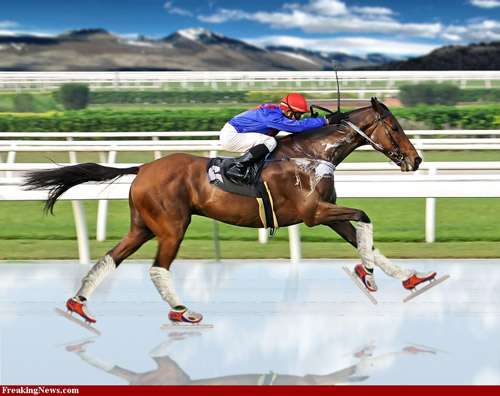
An exception was the unusual contraption shown in the photo at left. This strap-on ice shoe was on display at the Monetta Farrier Specialties booth at the American Farrier's Association Convention in 2009. You might scratch your head over that one, as I did, since that company is located in South Carolina, where they were importing ice, not making it! But...collectors are collectors.

This shoe is similar to the strap-on and bolt-on shoes worn around here for salt marsh haying so the horses didn't sink into the boggy ground. Except where those shoes have a platform bottom, these have a steel shoe on the bottom, with welded projectile calks protruding around perimeter. This device would have been easy to remove so the calks wouldn't be worn down on a paved road but could be used when a horse need to grip in the snow or get up a hill. I wonder why we don't see more of these, and why Never-Slip calks were used so extensively instead?

The ice industry relied on very cold weather (like today) but without a lot of snow. The conditions had to be right, and when it was, it was a community effort to harvest the ice. The horses had to be shod so they could walk out onto the ice, and that part of the history of ice shoes was made universally possible by the invention of Never-Slip interchangeable calks. Otherwise, a change in weather meant a trip to the forge to add or remove or sharpen calks. And an expense.

Harness racing on Saranac Lake in the Adirondack Mountains of New York State. From an article by Caperton Tissot in the Adirondack Almanac about ice racing. In Minnesota, the horses raced on the Mississippi River.
Here in New England and in Maritime Canada, it wasn't just the draft horses who needed ice shoes. The speedy trotters  and their sleighs set out on the lakes and ponds and often raced across the ice. In Maine, I believe they still have Standardbred racing on the ice. I've always wanted to see that (from inside a cozy warm ice-fishing shack.)

This is what an ice-racing horse would probably wear on its feet; they are still worn today, if you can find the legendary races. It is a lightweight steel shoe with a very thin roll on the edge, into which tungsten tips are embedded, using copper solder. I've seen these shoes made in farrier competitions--they are not easy! I believe that this antique shoe is from Michael Wildenstein's collection.

One of the most interesting things I've learned about ice racing was that trainers used the snow season to spell the good horses, since there was no Florida racing until the 1930s, and only the trainers with the wealthiest clients could afford to go south. What the local trainers learned is that their good horses benefited from a rest over the winter, but that sore-footed horses that couldn't race in the summer and fall when the tracks were hard often excelled on the ice and some even went back to racing the following summer. I don't know how they conditioned horses for ice racing, but it's a cinch that the ice-cold footing, the low impact and the return to use (and its resulting stimulating effects on the circulation to the foot) were a formula for salvation for a lot of horses. Or maybe they were just going faster to stay warm.

The next time you walk over to your refrigerator with the automatic icemaker and fill a glass with cubes, think of these fellows out cutting the ice on a very cold winter's day, and think of the horses diving into their feed bags because they knew they were going to have to haul the heavy ice straight up a steep hill. Maybe those calks did a little double duty.

This is one of my favorite Hoof Blog photos, from back in 2008 when a terrible ice storm paralyzed New England.
Thanks to Adirondack Almanac, Minnesota Historical Society, Cape Pond Ice, Prelinger Archives, Farm Collector Magazine, Birch Hill Farm, Emily and Sarah Schwartz and all the people who've told me all the stories about the legendary ice races in Maine. I believe they exist. Somewhere.

To learn more: Right on cue, an article on the history of harvesting ice from the Hudson River was published in Friday's Troy Record in Troy, New York.

© Fran Jurga and Hoofcare Publishing; Fran Jurga's Hoof Blog is a between-issues news service for subscribers to Hoofcare and Lameness Journal. Please, no use without permission. You only need to ask. This blog may be read online at the blog page, checked via RSS feed, or received via a digest-type email (requires signup in box at top right of blog page). To subscribe to Hoofcare and Lameness (the journal), please visit the main site, www.hoofcare.com, where many educational products and media related to equine lameness and hoof science can be found. Questions or problems with this blog? Send email to blog@hoofcare.com.
Follow the Hoof Blog on Twitter: @HoofcareJournal
Join the Hoofcare + Lameness Facebook Page

Friday, January 14, 2011

Trim Toes for Zenyatta

The New York Times has a slide show today that allows readers to see Zenyatta in her new life at Kentucky's Lane's End Farm, including a visit from horseshoer John Collins, who took care of her feet when she was a yearling.
The New York Times has given us something to brighten up this January day: a great Zenyatta-at-home slide show. The most talked-about new resident of Kentucky, Zenyatta has been going through a makeover that will ultimately, with luck, see her turn into an equine domestic diva.  

The Times peeks in at Zenyatta like she's a celebrity hanging out at a spa ranch. Watch the highlights of Zenyatta's day...none less important, of course, than having her hooves trimmed by John Collins. Love the tongue, Zenyatta.

Check it out: At Home with Zenyatta, in the January 14, 2011 online edition of the New York Times.

What the Times didn't tell us is that Johnny Collins and Zenyatta go way back.  The Georgetown breeding farm specialist took care of Zenyatta's hooves when she was a baby. Zenyatta "wrote" in her diary about life at Lane's End:

"My blacksmith here at Lane’s End is the same person who took care of my feet years ago when I lived in Kentucky! His name is Johnny Collins. He is the same man who put on my shoes when I went to the Keeneland Sale in September, 2005! He took care of my feet when I was a little girl!

"Now, here he is taking off my shoes at the farm several years later. This is absolutely adorable! Johnny told me he’d been keeping track of me and all of my progress since then! It was so great to touch base with him, my first blacksmith, after all of these years!"

Zenyatta stays in touch with her fans through daily diary entries on her popular Zenyatta Blog; she probably has more followers than anyone in the horse business!

She wrote a blog post about her hooves' history in and out of horseshoes, including a nice tribute to her longtime California shoer, Tom Halpenny, who has been so generous with information to the Hoof Blog throughout her career.

She wrote? I know, I know. But if you read Zenyatta's blog every day, you really will start to believe that the mare is talking to you. If someone is ghostwriting for Lady Z, or channeling her thoughts, he or she is doing a great job!

Still not announced: which of Kentucky's eligible stallions will be selected to sire Zenyatta's first foal? Which one would you choose? I'd go with Medaglia d'Oro, I think.

Thanks to the New York Times for the great slide show!

 © Fran Jurga and Hoofcare Publishing; Fran Jurga's Hoof Blog is a between-issues news service for subscribers to Hoofcare and Lameness Journal. Please, no use without permission. You only need to ask. This blog may be read online at the blog page, checked via RSS feed, or received via a digest-type email (requires signup in box at top right of blog page). To subscribe to Hoofcare and Lameness (the journal), please visit the main site, www.hoofcare.com, where many educational products and media related to equine lameness and hoof science can be found. Questions or problems with this blog? Send email to blog@hoofcare.com.


Follow the Hoof Blog on Twitter: @HoofcareJournal
"Like" the Hoofcare + Lameness Facebook Page

Tuesday, January 11, 2011

American Association of Equine Practitioners Convention Farrier Reception Slide Show

This slide show may take a minute or two to download, depending on your connection speed. Once it loads, it will begin to advance automatically to the end. At the end, you will see two symbols. One allows you to email the slide show to whomever you wish. The other ("share") provides code for you to either link to the slide show or you may embed it in your own web site or blog, providing no changes or extractions are made. The individual photos are the property of Hoofcare Publishing and are protected by international copyright law.

Following the Third Farrier Conference at the 2010 American Association of Equine Practitioners' Convention in Baltimore, Maryland, last month, the AAEP hosted a reception for farriers and veterinarians and guests. Here you will see a few quick snapshots of the attendees.

The conference and the reception were sponsored by Merial. Amanda McAvoy represented Merial at the event, along with Kelly Goss of Sullivan, Higdon and Sink. Farrier conference chairman Dr. Steve O'Grady worked with several corporate donors to arrange an impressive array of door prizes for the farriers. Guests from as far away as the United Arab Emirates and France were on hand.

Thanks to the AAEP and Dr O'Grady for a great day! I especially enjoyed meeting Mr Ed Warrington from Delaware, who reflected on his first 50 years of shoeing horses. It was a great presentation and very telling: at one point he showed sheared heels from 50 years ago and sheared heels from today side by side on the screen. Some things never change, but a thoughtful, well-planned presentation has the power to change the way you look at the problem. And that's how progress begins.

I felt a little bit like the paparazzi taking these photos, and I hope no one minded having their photos taken. 

© Fran Jurga and Hoofcare Publishing; Fran Jurga's Hoof Blog is a between-issues news service for subscribers to Hoofcare and Lameness Journal. Please, no use without permission. You only need to ask. This blog may be read online at the blog page, checked via RSS feed, or received via a digest-type email (requires signup in box at top right of blog page). The headlines are also on Facebook, on the Hoofcare & Lameness page. To subscribe to Hoofcare and Lameness (the journal), please visit the main site, www.hoofcare.com, where many educational products and media related to equine lameness and hoof science can be found. Questions or problems with this blog? Send email to blog@hoofcare.com.
 
Follow the Hoof Blog on Twitter: @HoofcareJournal
Join the Hoofcare + Lameness Facebook Page

Favorite Big (Big!) Horse Photo: Bart's Turn on the Cross-Ties


New Shoe, originally uploaded by Mountain Mike.
If you've been reading this blog for a while, you know that one of my favorite photographers is "Mountain Mike" Edminster. The Sun Valley pro has an eye for farriers, horses, and the great outdoors, and his camera just seems to like leather, rust, dust and cobwebs--which are, of course, some of my favorite things (in photographs).

To date, Mike has entertained the blog with photos of Idaho horseshoers in the dead of winter and the heat of summer, he's shown beautiful tools, and he's played with color and black and white in the same photo. But we haven't see many of the horses from Sun Valley, other than a hoof here or there.

Well, now we know that Mike's been holding out on us. Meet Bart. Where's he been all my life? Notice that the horseshoer, Jesse, and his dog, Sage, both look a little hesitant about working on Bart, who's just had an operation of his right front (hence the duct tape).

Does it appear to anyone else that Bart's head is longer than his legs? I'm just saying...

Thanks, Mike! I hope Bart gets well soon!

Friday, January 07, 2011

Favorite Rap Video of 2010: Equine Biomechanics Researcher Jacob Setterbo's "Stay in School" Message


Who says engineers can't be creative? Or cool? Score (another) one for Jacob Setterbo, PhD candidate in the J.D. Wheat Veterinary Orthopedic Research Laboratory at the University of California at Davis School of Veterinary Medicine. He's been part of the California-based research efforts to find some basic truths about the relationship between galloping horses' legs, hooves and racetracks--and his work there will ultimately mean that some horses' lives will be saved. He will soon receive his doctorate for his efforts in engineering the systems that measure the hoof-track interface.

But he can still have some fun. Jake has volunteered at a local elementary school and came up with the idea for a little rap music video to get kids to connect the dots between thinking what he does in his research is "cool" and the idea that they can do it too...if they just stay in school.

The first time I watched this video I couldn't believe it, and I've been forwarding the link to it to teacher friends ever since. I hope you will do the same, as well as show it to any school-age kids in your social circle.

Jake's backup singers, by the way, are some fifth graders.

For my part, I'd make a very similar one, but I'd be encouraging people to go back to school. It's never too late! In 2010, I spent a week at Michigan State University's McPhail Equine Performance Center taking Dr Hilary Clayton's Equinology class for non-veterinarians on gait analysis and biomechanics.

For me, it was almost better than a week on the beach at St Bart's. True, we just pretended to do research, but it was a hands-on experience with real horses at one of the world's leading centers for equine biomechanics research.

If nothing else, being in the class reminded me of all I don't know about horses, all I need to learn, how much things are changing and the fact that these courses are out there--all you have to do is sign up. You don't have to move away for a seminar or a year, you can try things out first, see how you like it, and spend time with people like Hilary Clayton and her staff and graduate and doctoral candidates, who will have suggestions of what you might do if you want to pursue education goals once you've been out of school for a while. Progams like Equinology are amazing!

Universities are full of comeback kids like you (and maybe even me, someday). Like most things, once you take that first step, the rest seems much easier. Sitting in a lecture seems more natural, and the whole idea is much less intimidating when you're looking at it from the inside than it ever was from the outside.
The Equinology course required pre-arrival anatomy study but it was still a challenge to apply the gait analysis stickers in exact locations. In other words, before we could connect the dots, we had to place the dots, and there's no wiggle room when you're palpating a joint to mark it for gait analysis.  (Sarah Miles photo)
To learn about the 2011 Equinology gait analysis course at Michigan State with Dr Clayton, visit www.equinology.com. Dr. Barb Crabbe will also offer a course in lameness identification before the gait analysis course; the two courses can be taken together.

© Fran Jurga and Hoofcare Publishing; Fran Jurga's Hoof Blog is a between-issues news service for subscribers to Hoofcare and Lameness Journal. Please, no use without permission. You only need to ask. This blog may be read online at the blog page, checked via RSS feed, or received via a digest-type email (requires signup in box at top right of blog page). To subscribe to Hoofcare and Lameness (the journal), please visit the main site, www.hoofcare.com, where many educational products and media related to equine lameness and hoof science can be found. Questions or problems with this blog? Send email to blog@hoofcare.com.
 
Follow the Hoof Blog on Twitter: @HoofcareJournal
Join the Hoofcare + Lameness Facebook Page

Monday, January 03, 2011

Best of the Old Year: Mr Beane On Top Of The Farrier World (Again)


On Top Of The World, originally uploaded by Feversham Lens.

Before 2010 fades to a distant memory, some credit where credit is due.

Congratulations to farrier Steven Beane of Trenholme Bar, North Yorkshire, England. Steve repeated his 2009 win as World Champion at the Calgary Stampede and brought home the title again in 2010. This beautiful portrait photo of Steven was taken as he fit a shoe to a client's horse. Credit where it's due again: image by Feversham Lens.

Saturday, January 01, 2011

From Post Parade to Rose Parade: Ada Gates is Underfoot as Pasadena's Official Horseshoe Safety Inspector

 From ABC News in Los Angeles: Would your horse's hooves pass the Ada Gates inspection?

It's not unusual to find Ada Gates behind the scenes at a parade but it would most likely be the post parade at California's Santa Anita racetrack. She's at a different parade today.

The first woman licensed to shoe racehorses in America picked up the feet of 236 horses--including Budweiser Clydesdales, silver-draped Andalusians and military mules--this morning as she made sure their hooves were in compliance with the rules of the Tournament of Roses Parade in Pasadena. The parade has specific rules for hoofcare that must be followed, as they hope to both prevent slipping on the pavement and lameness problems along the parade route. I did notice the horse trailers in the parade, ready to pick up any horses in distress or in need of relief.

NBC also has a video featuring Ada Gates and several of the equestrian units in today's parade, filmed at the parade's stabling at the Los Angeles Equestrian Center at Griffith Park in Burbank, but it did not have an embedding code so it can't be seen here on the blog. If a code becomes available, you'll see that video here, as well.

The Hoof Blog had a report from Ada after the 2008 Rose Parade with her observations about the hooves she sees at the parade: Traction Counts at the Rose Parade (Just Ask Ada).

© Fran Jurga and Hoofcare Publishing; Fran Jurga's Hoof Blog is a between-issues news service for subscribers to Hoofcare and Lameness Journal. Please, no use without permission. You only need to ask. This blog may be read online at the blog page, checked via RSS feed, or received via a digest-type email (requires signup in box at top right of blog page). To subscribe to Hoofcare and Lameness (the journal), please visit the main site, www.hoofcare.com, where many educational products and media related to equine lameness and hoof science can be found. Questions or problems with this blog? Send email to blog@hoofcare.com.
 
Follow the Hoof Blog on Twitter: @HoofcareJournal
Be friends on the Hoofcare + Lameness Facebook Page

Friday, December 31, 2010

What Might a Horseshoer's Front Page Funeral and Your New Year's Resolution Have in Common?

If you've never been to a horseshoer's funeral, now you can say you have been.

On this last day of the year, it's time to reflect on the events that shaped this year. We'll get to that; the year's not over yet.

While it's easy to point out the things and the people new to the world of the hoof in the past year, it's a little more painful to recognize that we are moving on without some key figures.

Hence, this video. I think this is the first video ever made of a horseshoer's funeral. I never thought I'd be posting a video of a funeral here. It is, of course, voices from people who attended the funeral of Joe Kriz Sr. on September 4, 2010, but if you listen to the voices, they can speak volumes about others who are also gone.

In 2010, we lost Bob Skradzio and Jack Miller as well; these two men were great pillars of support and friendship for me from the day I met them. More than that, just like Joe, they were two people who loved what they did, and did what they loved.

I hope that you can say that about what you do; I know I can.

If you can't, why don't you make a new year's resolution to find--or re-kindle--the passion in your life? May it be half as strong as the passion that Joe and Bob and Jack felt for what they did, and the lives they lived. If enough people dedicated or re-dedicated themselves to their work with and for horses, our world will be a better place and slowly but surely the hole left by the loss of these men will be filled.

I know they'd all three add a PS to that: "And be sure to pass it on." Just like they did.

By the way, toward the end of Joe's funeral video, when they arrive at the cemetery, Joe's casket, emblazoned as it was with Scotch-bottom draft horse shoes, was buried next to his brother and lifetime horseshoeing partner, Johnny, just as you'd expect. It's a beautiful place.

I notice that on Johnny's headstone are written the immortal closing words from Will Ogilvie's famous poem, The Hooves of the Horses:
When you lay me to slumber no spot can you choose
But will ring to the rhythm of galloping shoes,
And under the daisies no grave be so deep
But the hooves of the horses shall sound in my sleep.

{ A note about the video }

The video is posted here with the kind permission of Joe Kriz Jr., producer Peter Hvizdak and the New Haven Register newspaper, where you can also still re-live U.J.'s funeral whenever you feel like it. I don't think we'll make a habit of showing videos of funerals, since they are very private events, but this video was produced more as a tribute to Joe, and I hope it's seen that way.

© Fran Jurga and Hoofcare Publishing; Fran Jurga's Hoof Blog is a between-issues news service for subscribers to Hoofcare and Lameness Journal. Please, no use without permission. You only need to ask. This blog may be read online at the blog page, checked via RSS feed, or received via a digest-type email (requires signup in box at top right of blog page). To subscribe to Hoofcare and Lameness (the journal), please visit the main site, www.hoofcare.com, where many educational products and media related to equine lameness and hoof science can be found. Questions or problems with this blog? Send email to blog@hoofcare.com.
 
Follow the Hoof Blog on Twitter: @HoofcareJournal
Join the Hoofcare + Lameness Facebook Page

Sunday, December 26, 2010

Montana Marathon: Farriers and Veterinarians Trim 31 Donkeys' Hooves After Years Of Neglect


The struggling Montana Large Animal Sanctuary and Rescue gave up. It gave up trying to go on taking care of more than 1000 hooved animals it had taken in. There are camels and llamas and horses and donkeys and cows by the dozens.

According to news reports, they ran out of money, then they ran out of hay and now the animals have been rescued from the rescue. They are in temporary shelters while organizations in the state try to figure out what they will do to re-home them.

What these animals do have, in excess, however, is hoof. It's been years since the donkeys, at least, have been trimmed.

That changed this week when the donkeys were moved and a group of vets and farriers joined forces to get their hooves back to some semblance of normal. That, of course, wasn't easy. Some may be suffering from laminitis. All may be sore after trimming, whether from the trimming itself or the redistribution of load on tendons and ligaments. Donkeys are also prone to white line disease, which would require medication if they are affected.

But the farriers just kept on trimming.

According to the television news report, each hoof was radiographed before it was trimmed, and a farrier spent an average of 15 minutes sawing and then trimming each hoof.

The Montana Animal Care Association, Montana Horse Sanctuary, Montana Office of the Humane Society of the United States and Western Montana Equine Rescue and Rehabilitation all organized the effort to help the donkeys.

It's interesting that about 75 inquiries have already been received to adopt the donkeys, which will be going to new homes in pairs to lessen the stress of having been in a herd for so long. Their plight--and their pain--touched a lot of people.

Donations for the animals can be sent to: Western Montana Equine Rescue and Rehabilitation, P.O. Box 1168, Corvallis, MT 59828 (indicate "for donkeys" on check).

To help the horses, please contact Jane Heath, Montana Horse Sanctuary executive director, via email: ht@mt.net. They'll also fix you up with a camel. Or a llama. Or...

Thanks to KAJ18.com, the website for Channel 18 in Missoula, Montana, all the volunteer organizations, and all the veterinarians and farriers who worked on this rescue and the hoof trimming marathon. Special thanks to anyone who takes in one of these animals and gives it a home, at last.

© Fran Jurga and Hoofcare Publishing; Fran Jurga's Hoof Blog is a between-issues news service for subscribers to Hoofcare and Lameness Journal. Please, no use without permission. You only need to ask. This blog may be read online at the blog page, checked via RSS feed, or received via a digest-type email (requires signup in box at top right of blog page). To subscribe to Hoofcare and Lameness (the journal), please visit the main site, www.hoofcare.com, where many educational products and media related to equine lameness and hoof science can be found. Questions or problems with this blog? Send email to blog@hoofcare.com.
 
Follow the Hoof Blog on Twitter: @HoofcareJournal
Join the Hoofcare + Lameness Facebook Page