Monday, March 10, 2008

Cheltenham Runner is No Relation to Blogger


Thanks to everyone who has suggested placing a Transatlantic wager on the Scottish horse Big Eared Fran, who is entered in the Cheltenham Festival's Championship Bumper this week. The Festival is the biggest jump racing event in the year's calendar in the UK and creates quite a frenzy.

Big Eared Fran is by the famous flat racing sire Danehill and originally was destined for flat racing with the Coolmore Stud but has changed hands (and racing genres). Trained by the legendary Martin Pipe, the horse is named for his current part owner, former England and Rangers football player Francis Jeffers.

A win by a Scottish-owned horse at "the biggest show on turf" would be a Seriously Big Deal, since the festival is normally dominated by Irish horses and trainers.

The horses to watch are the super star Kauto Star and his stablemate Denman, both entered in the Cheltenham Gold Cup. Kauto Star is recovering from a foot abscess but is expected to start.

Cheltenham is in the scenic Cotswolds district of England, west of London. To make the festival more challenging, southern England is bracing for the arrival of the storm that swept across the USA this weekend. Gale-force winds and torrential rains are predicted, which will make the "going" soft and deep, which is tough on jumping horses attempting Cheltenham's long, long course of what we Americans would call brush jumps.

Animal rights advocates are highly critical of the number of horses injured and killed at Cheltenham each year. During the 2006 Festival, 11 horses perished in just four days. In protest, a woman dressed in black gothic robes representing a mourning costume will be present at the Festival. She will be wearing a wide-brimmed hat that features a model racehorse tumbling over a hurdle.

Cheltenham is also noteworthy for its popular amateurs-to-ride races.

Favorite Video Clip: The Show-Off Jumper


Thanks to June Evers of Horse Hollow Press in New York for forwarding this clip of a young Belgian jump prospect. Assuming that this horse didn't break or rupture anything when he landed is testimony to the miraculous design of the equine limb.

The horse, whose name is Gesalme, is said to by Espom Gesmeray (you may remember him from the Athens Olympics in 2004) and is promoted by Béligneux-le-Haras.

Another Country Heard From: Hoof Project Research Center Grows in Texas

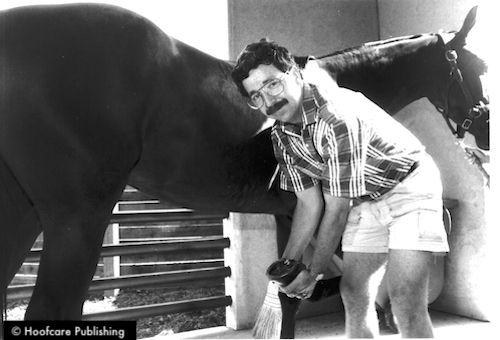
Dr. David Hood, director of The Hoof Project, at a recent seminar.


News from Texas is that the new Hoof Project Clinic and research center in Bryan, near College Station, is humming with activity. The clinic is open for the treatment of laminitic horses, and David Hood DVM, PhD is actively directing a team of researchers involved in 14 different studies related to laminitis.

Dr. Hood reports that 35 horses are in residence at the center, either in treatment or for use in studies, which include biomechanics, circulation, metabolism/nutrition, and laminitis pathology. Studies are particularly interested in the pain experienced by horses suffering from laminitis; Hood hopes to not just find ways to relieve the pain but also to determine the nature and source of the pain in order to prevent it.

His previous studies documented that horses with lamintiis suffer from secondary sources of pain. Changes in stance, posture, and gait affect tendons and ligaments in the legs, and joint angles may be altered, leading to arthritis. Even back and neck pain can develop in horses that are standing in abnormal positions for long periods of time. The fact that a horse has chronic laminitis may predispose it other co-existing lamenesses, such as ringbone, collateral ligament injuries, sheared heels, or navicular damage caused by long-term hoof capsule deformation and abnormally high heels.

Watch for announcements from The Hoof Project for the first series of seminars on hoof science to be held at the new facility.

Sunday, March 09, 2008

UPenn Laminitis Research Project Hopes to Clarify the Mechanism of Developmental Laminitis

Dr. Hannah Galantino-Homer, senior research investigator of the newly created laminitis research initiative at the University of Pennsylvania School of Veterinary Medicine, is beginning her research in 2008 with a grant from Grayson Jockey Club Foundation.

“Molecular and Cellular Level Studies of Laminitis” is the title of the project.

Currently, laminitis still is so baffling to scientists that researchers tend to be split into two camps (theories) as to cause of the problem — vascular and enzymatic.

“The lack of agreement about the basic pathophysiology of laminitis explains why standard guidelines for therapy are not yet available,” noted Dr. Galantino-Homer in her research statement.

If this project can identify which specific genes and proteins are up-regulated or down-regulated during the first phase of the disease — when identifiable symptoms are not yet manifested — it “will determine the pathways of the disease and allow institution of preventive or interventional treatments sooner,” according to Galantino-Homer.

The first phase of laminitis, the developmental phase, is followed, of course, by the acute phase. One of the frustrations of dealing with the disease is that often by the time it is diagnosed, the horse may be gravely threatened.

Galantino-Homer believes the study “will provide information that we and other investigators can use to verify or elaborate on existing theories about laminitis, explore previously unrecognized cellular and molecular events during laminitis, and validate in vitro models of laminitis.” The latter will facilitate research projects that do not require laminitic horses.

Click here for information about Galantino-Homer's appointment at PennVet.

Friday, March 07, 2008

"Lucky" Horseshoes in India Are Not So Lucky for the Horse

In India, shoes from black horses are considered lucky, meaning many horses are continually and carelessly re-shod by poor owners simply to feed the "lucky horseshoe" trade. Yes, it has to be a shoe from a black horse.

Vets from the international equine charity "The Brooke" (Brooke Hospital) in Delhi witnessed this in a black horse called Kalu, who was brought to them in pitiable condition. Kalu had overgrown, cracked and severely damaged hooves caused by years of re-shoeing (but not necessarily re-trimming) and was suffering chronic foot pain.

Brooke vets helped the horse and taught his owner, Bhoora, better shoeing skills, although he looks like he is pointing a very sharp object at Kalu's sole in this photo.

"Now Kalu is happy to be with me," says a grateful Bhoora.

Here's a link to a spiritual web site in India that will send you a horseshoe from a black horse in India for $6.95. They explain the legend, which is similar to the Western superstition about horseshoes. But they also claim that a horseshoe is good Feng Shui. A lot of Freisian and Percheron owners are doing the math...

The Brooke’s mobile vet teams and community animal health workers, and partner organizations worldwide provide free treatment to animals and train animal owners, local healers, farriers, saddlers, feed sellers, harness and cart makers. They currently operate across nine countries in Asia, Africa, Central America and the Middle East with over 750 highly-skilled staff working directly in the field.

The Brooke Hospital was organized in Cairo, Egypt in the 1930s to assist in the care of thousands of surviving American, Australian and British military horses that had been abandoned there at the end of World War I. Their reward for gallant service in war was a lifetime of hard labor on the streets of Cairo and as they aged, their health suffered terribly. However, the horses were so valuable to their owners' survival that the only humanitarian recourse was a campaign to improve their health. A first equine hospital was built...and the rest is history.

Please support the efforts of charitable organizations who put teams of professionals in the field and at disaster sites to help horses. Some day they might show up to help you.

Wednesday, March 05, 2008

The Evolution of the Horseshoe: Nail Holes of Antiquity


Would anyone care to comment on these 12th century horseshoes from the Museum of London? Yes, that's right: 12th century. That means these shoes were hammered out not long after the Battle of Hastings (1066) when the Normans beat the local Brits.

I have a terrific little booklet call "Old Horseshoes" by Ivan G. Sparkes, and it creates a timeline of horseshoe shapes and details, but it certainly doesn't have any nail holes like these shoes have, although he does reference wavy-rimmed shoes to the Saxon period of British history. (Horseshoes are mentioned in the Domesday Book of 1086.)

According to Sparkes, there is evidence that horseshoes were not deviced to protect horses' hooves, as is so often put forward. He claims that the nails were like keys, and were only nailed halfway into the hoof, in order to provide traction; the heel calks were built up to the same height as the protruding nail heads.

What you see in these nail holes is, of course, a spent hole that looks like it was made by a t-shaped punch, but an argument could be made for a t-shaped nail head wearing down into the soft iron of the shoe. If Sparkes' theory holds, the shoe would last much longer than the nails and go through a sequence of nails as they wore down.

If a modern design nail sat in that hole, you'd end up with a semi-fullered (creased) shoe. Various historical references quoted by Sparkes place the introduction of fullering in the mid-16th or 17th century.

Photo courtesy Museum of London.

Monday, March 03, 2008

The Circus Farrier

Check out this detail from an old photo for sale on eBay this week. It's from a collection of photos of the Ringling Brothers Barnum and Bailey Circus in the late 1930s or early 1940s. The credit is given to a photographer in Chicago.

The entire image includes a performer perched on the horse's back while he's being trimmed!


Leading Hoof Researcher Doug Leach Has Died

Dr. Leach leading a discussion group at the 1987 Bluegrass Laminitis Symposium

The leading contributing researcher and author on the equine hoof of the 20th century died on February 10th in Lexington, Kentucky.

Douglas H. Leach PhD authored major studies on the basic mechanics and anatomy of the hoof in the 1980s, and went on to write about racetrack surfaces, exercise physiology, equine locomotion and a dozen aspects of the hoof's physiology. His name is probably the most often seen in reference lists and research citations.

Leach believed that basic studies of the normal hoof were tantamount to studying laminitis or the function of certain shoes, so his papers created a very valuable base on which more specific studies could be built.

A native of Canada, Leach received his Bachelor and Masters of Science degrees at the University of Guelph and Ontario Veterinary College, then proceeded to the University of Saskatchewan to complete his PhD on the equine hoof, which he earned in 1980.

While at Saskatoon, he co-authored papers with Dr. Hilary Clayton, who was conducting research at the Equine Locomotion Laboratory there and also spent a sabbatical year at the Animal Health Trust in Newmarket, England, where he pursued studies of the function of the navicular bone with collaborating researchers Chris Colles and Sue Dyson there.


Leach was so intent on studying the hoof that he learned to read German so he could reference old shoeing and anatomy texts. He collaborated with researchers at Utrecht, Vienna and Uppsala and cheerfully corresponded with veterinarians and farriers from all over the world.

Dr. Leach played a major role in the First International Seminar on Navicular Disease in 1984 and authored a monograph summary of the papers presented there for Hoofcare and Lameness Journal. He was a key contributor to Hoofcare and Lameness in its early years.

In 1990, Leach was appointed to the John S. and Elizabeth A. Knight Professorship in Equine Veterinary Science at the University of Kentucky. The professorship was expressly created to study causes and prevention of equine lameness.

Soon after moving to Kentucky with his wife, Jane, and their three sons, Dr. Leach became ill and was ultimately diagnosed with Pick's disease, a rare and incurable degenerative brain condition.

Reading Dr. Leach's papers today, it is hard to believe that most are 20 years old. The best collection of his papers is in the University of Sydney's 1990 proceedings book Equine Lameness and Foot Conditions; it contains six of Leach's last papers, and a seventh on racetrack surfaces co-authored with Dr. Bill Moyer.

Dr. Leach was 56 years old when he died. There is no way to estimate how different veterinary medicine and farriery might be if he had been able to continue his study of the foot. What he accomplished in ten short years is an impressive mass of work that will be studied and referenced for years and years to come, but which was only the beginning of a brilliant career cut tragically short.

Friday, February 29, 2008

Laminitis Research from the Field to the Feed Room

Research by Bridgett Byrd (M.S., PhD candidate) at Virginia Tech, was used to create this graph. It shows that pastures at certain times of year have specific times of the day when plants contain high levels of non-structural carbohydrates (NSC). This is effectively mirrored by the insulin concentrations of the horses grazing on such pastures, in a similar way to the feeding of high starch and sugar diets. While this research has been available for the past few years, many horses owners have not been informed of the cumulative effects of long-term high-sugar diets on horses, particularly on sedentary recreational horses. (Graph and caption credit Virginia Tech.)

Remember the image in that graph. We have just turned the calendars to March, so spring will soon be here and the time is here to start planning how horses will be managed on spring grass.

This year, thanks to increased educational efforts, many horse owners are seeking advice on how to avoid laminitis caused by spring grazing. Many horses suffer annual bouts of laminitis that can adversely affect the horse’s soundness for months, or may develop into serious chronic laminitis with its many problems.

Nutritional experts, however, caution that laminitis and insulin resistance are year-round problems and that a horse's entire feeding program should be scrutinized, not just the turnout on pasture.

The Waltham® Equine Studies Group, led by Dr Pat Harris MA PhD, VetMB DipECVCN MRCVS, offers this summarized explanation: “Turning certain ponies out onto lush pasture in the spring and autumn is a common triggering factor for the development of laminitis. It is currently thought that high levels of water soluble carbohydrates, (which include simple sugars as well as Fructan – the more complex storage carbohydrate) – and/or starch may be involved in this process.

"Previous research carried out in collaboration with Virginia Tech by the Waltham® Equine Studies Group in 2004 confirmed a link between insulin resistance and laminitis. This work demonstrated that a high starch and sugar diet, that causes corresponding peaks and troughs in glucose and insulin, increases the degree of insulin resistance.

Dr Harris continues: “The new revelations linking pasture directly to the potential risk of insulin resistance have important consequences for certain horses and ponies prone to laminitis and tying up, as well as obese animals that will already have a greater degree of insulin resistance. For these animals it is likely to be safer to feed alternative sources of forage at key times of year.”

Last month, Florida-based Seminole Feeds announced that it would no longer be the US distributor for Spillers brand feed products, which are developed with Waltham research principles. “Happy Hoof”, a high-fiber alternative to high-sugar hay, was one of the products sold by Seminole in the USA. Seminole has launched a new line of low-starch feeds under its “Wellness” label.

Hoofcare and Lameness does not have much information at present for horse owners "orphaned" by the dearth of Spillers products in the USA.

Maine-based Lucerne Farms, makers of the Dengie product lines of alfalfa-based chopped hay in the USA, is now offering high-fiber, low-sugar products for horses at risk for laminitis. The company also offers excellent customer support.

Thursday, February 28, 2008

Farrier Convention Update: Competition Alive with New Faces

Farrier competition at Peterborough, England's Shire Horse Show painted by Michael Murfin graces the cover of out 2008 AFA Survival Guide. Everyone thinks it's a photo, but it's a painting!

My energy is fading after standing up for six hours in our booth at the trade show, but the American Farrier's Association today made some history that I thought I would share.

A big part of this convention is the forging and shoeing competition, which this year is being held at a remote location in the big arena at the Kentucky Horse Park, while the convention lectures and trade show are in downtown Lexington.

But you can almost hear the hammers across the miles.

Some joyous faces stopped at my booth tonight to say hello. Today was the preliminary forging (horseshoe making, no horses), which count towards a farrier's qualification (or disqualification) from the "live" shoeing finals tomorrow.

The happy faces belonged to supporters of the Japanese team. For the first time, two Japanese farriers made it to the finals. Also in the finals: two women (congratulations, Raleigh and Sarah!), one American and one Scottish. There is at least one British male in there too. There were lots of new names and faces on the list, which is encouraging.

Competition chairman Myron McLane also told me tonight that the contest went very well and he is looking forward to tomorrow. Sadly, one of the USA's top competitors, former World Champion Austin Edens of Texas, had to scratch today because of a back injury, but said he hopes to compete in just the draft horse class tomorrow.

The convention is an international event even moreso than usual this year. I saw a European plastic shoe company's booth located next to an Amish booth and wondered, as always, about the way that this event brings people from diverse backgrounds under one roof.

A special highlight last night comes to mind. How many conventions have a "jam session" night? So many musicians showed up to play that they didn't even all fit on the ballroom stage. And many of them were superb musicians. There's no group quite like farriers!