Wednesday, May 03, 2017

Shoeing for the Roses: Girvin's Kentucky Derby Quarter Crack and New Horseshoe Details


Photos and text © Fran Jurga and Dr. Raul Bras

Note: This story was updated to reflect the latest changes made on May 3.

There can be speed bumps on the road to the Kentucky Derby. There can be detours. And there can be road blocks.

The trick is being able to tell which one you're facing when a problem threatens to disrupt your colt's chances to run for glory on the first Saturday in May.


Sometimes a little detour can actually pay off, and one of this year's runners is out to prove that it pays off to take the scenic route.

Saturday, April 01, 2017

News: Priceless Fossil Rocking Horse, Once a Childhood Toy, Restored in Minnesota


GLOUCESTER, MASSACHUSETTS | 1 April 2017:
   The evolution of the horse (Order Perissodactyla) included modification of the foot from five distinct narrow hooves, decreasing temporarily to three and presently to what we consider the remaining "middle toe". The study of that evolution has many chapters, and if you read between the lines and follow the footnotes, many colorful characters.

An early ancestor of the modern horse, known as Mesohippus, stood about six hands high and roamed the Great Plains of North America. While it did have three toes, the middle toe was somewhat dominant and looks somewhat similar to the coffin bone in today's Equus caballus.

The evolution of the horse has been the center of controversy for centuries. While many once (and some still) insist on describing the horse's evolution by counting toes in reserve order, the pre-history of the horse is described to be more like a bush than as a straight-limbed tree. The late American evolutionary biologist Stephen Jay Gould warned his readers not to celebrate the evolution of the horse as the perfection of evolution; he likened the modern horse to a mere twig on a very non-linear bush.

Last year a museum in Minnesota unveiled an exhibit that will make you smile, and hopefully want to learn more about the evolution of the horse's foot. It is called Mesohippus Mirabilis, and it makes child's play of the serious and often misinterpreted subject of equine evolution.

British paleontologist Sir Richard Owen,
who was the first to group equidae with
the rhinoceros and tapir, based on foot
anatomy. He named the order 
Perissodactyla, otherwise known 
as the "odd-toed ungulates".
Minnesota sculptor Michael Bahl, credited with restoration of this amazing children's toy, described its origin:

"This specimen was transformed in Great Britain circa 1857 by Emily David, a protegee of Benjamin Waterhouse Hawkins, one of the early sculptors of life-sized prehistoric statuary. It is believed to have been made for a grandson of Sir Richard Owen, the foremost paleontologist of the period. 

"The rocking horse was kept at the family home in Sussex until 1914 when its history becomes clouded by the storms of The Great War. When, in 1933, the grandson passed away in Paris, no mention was made of the piece.

"Following World War II as new construction forced the relocation of many cemeteries throughout Europe, the horse was discovered in a private mausoleum near Warsaw. In the chaos and secrecy of the Cold War, it vanished once more, only to resurface in rural North Carolina where it was purchased for restoration."

But it is alive in our imaginations, thanks to the artist whose expertise at anatomy extends to knowing the exact location of the often-elusive human funny bone.

Mesohippus mirabilis is currently on display at the The Museum of Paleo-Osteological Interpretation in St. Paul, Minnesota, where artist Michael Bahl invites observers to exercise their own imaginations as they consider that these forms that they have always viewed as science might also be seen as works of art that can be enjoyed with unanticipated and even playful enthusiasm.

And perhaps they even were.

Thanks to photographer Lorie Shaul for the remarkable image of Michael Bahl's creative masterpiece.

Learn more about mesohippus (and its toes) at the website of the Florida Museum of Natural History. Also, Benjamin Waterhouse Hawkins is worth googling; he once held a dinner party inside the mold of one of his dinosaur skeletons in London's Crystal Palace. He really did work with Owen but moved to America to do extensive work for both the Smithsonian and Princeton University. His most famous work is believed to have been the victim of the notorious Mayor Tweed of New York City, who cancelled construction on a paleo museum; Hawkins' dinosaurs-in-progress are believed to still be buried in Central Park

And that's no joke.

(For international readers: April 1 is a special holiday in America, I hope you understand this article's intent!)


© Fran Jurga and Hoofcare Publishing; Fran Jurga's Hoof Blog is the news service for Hoofcare and Lameness Publishing. Please, no re-use of text or images on other sites or social media without permission--please link instead. (Please ask if you need help.) The Hoof Blog may be read online at the blog page, checked via RSS feed, or received via a headlines-link email (requires signup in box at top right of blog page). Use the little envelope symbol below to email this article to others. The "translator" tool in the right sidebar will convert this article (roughly) to the language of your choice. To share this article on Facebook and other social media, click on the small symbols below the labels. Be sure to "like" the Hoofcare and Lameness Facebook page and click on "get notifications" under the page's "like" button to keep up with the hoof news on Facebook. Questions or problems with the Hoof Blog? Send email to The Hoof Blog. 
 
Disclosure of Material Connection: The Hoof Blog (Hoofcare Publishing) has not received any direct compensation for writing this post. Hoofcare Publishing has no material connection to the brands, products, or services mentioned, other than products and services of Hoofcare Publishing. I am disclosing this in accordance with the Federal Trade Commission’s 16 CFR, Part 255: Guides Concerning the Use of Endorsements and Testimonials in Advertising.

Saturday, March 25, 2017

Underfoot in Dubai: World Cup Hooves, Shoes and Farriers for Thoroughbred Racing’s Superstars

horseshoes at the Dubai World Cup Thorougbred races

When the world’s best racehorses pack their bags for a trip to the golden global hotspot of Dubai to race in the World Cup, what do they pack? These days, trainers are sending more than coolers, halters and haynets with their horses.

They’re sending farriers, who in turn are shipping in a surprisingly diverse assortment of raceplates and nails. The flip side of the coin is that several of the top racehorses now don their shoes only on the morning of the race--and have them promptly removed the day after it's over.

Travel to Dubai with us, as we check in on an international troop of farriers, hard at work in the desert on some of the world's most valuable horses. What comes out of the desert may be headed for you.

Friday, January 27, 2017

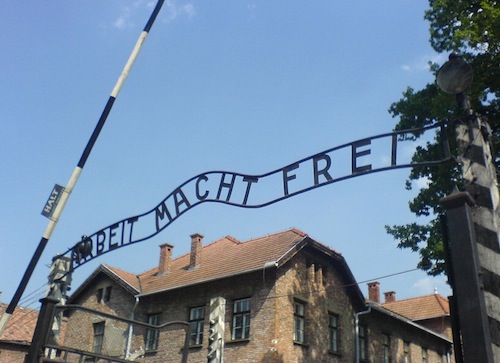
Hoofcare Holocaust History: Jan Liwacz, the Blacksmith of Auschwitz, and the Smell of Burning Hooves

blacksmith Jan Liwacz made arbeit macht free sign at Auschwitz
"Work will make you free" promises the sign above the gate at the entrance of Auschwitz in Poland, the site of one of the worst disasters in human history. It's one of the most famous signs, and symbols of suffering and evil, anywhere in the world. Did you ever wonder who forged it? Have you ever heard of Jan Liwacz, the blacksmith of Auschwitz? And did you know there is a touch of irony forged into the letters by a prisoner blacksmith? (Photo by "Neil" courtesy of Wikimedia.)

Tuesday, January 24, 2017

Thinking Outside the Flip Flop Box: Florida Farriers Find Flex-Step Free-Heel Hoof Pad Aids Problems in Sport, Racehorse Feet

Polyflex Horseshoe flip flop on sport horse
Polyflex Flex-Step flip flop pad
Far from the racetrack, a warmblood show horse sports the new high-tech Flex Step free-heel pad. The shoe is cut to the widest part of the foot, and rabbit ear drainage holes have been opened to allow sand, footing and water to drain out. Attentive show grooms maintain the pads by inserting the hose nozzle between the pad and the heel bulbs to make sure the sole isn't packed. Two small holes in the heels accommodate studs for traction, if needed, on some models. Copper rivets on the inside of the shoe's web attach the pad to the unheeled shoe. Made by Polyflex, a company known for its glue-on shoes, the pad is designed to be partially attached to the foot with nails and requires no adhesive or hoof packing.

Sometimes you wonder where things came from. Who was that first Standardbred farrier in Europe who cut the heels off a horse’s shoe, put a plastic pad against the foot, and nailed it on? You can hear it now: the horse walking down the barn aisle with a clumsy sounding “flap flap flap flap” sound from the loose pad against the heels. The farrier probably never counted on the noise. The trainer took some teasing, without a doubt. But that horse must have won, because they’re still around.

And no one laughs at you when your horse is winning.

USDA's new Horse Protection Act rules withdrawn from federal enactment.

A Tennessee Walking horse wearing stacked pads and bands. This horse was shod for demonstration purposes at a vet-farrier education event. The pads and shoe bands would have been banned under the unpublished rule announced last week. (Fran Jurga photo)

The Hoof Blog is issuing an unexpected post script to a widely circulated story published here on January 13, announcing that the US Department of Agriculture (USDA) was publishing its Executive Action rule changes to the Horse Protection Act with the Federal Register.

The article described the action as an 11th-hour "Hail Mary Pass" to stop Tennessee Walking horse soring abuse before the Obama administration's USDA appointees left office, to be replaced by Trump appointees.

And it almost worked.

Friday, January 20, 2017

Swedish research tests hoof sensor capable of predicting wall structural changes


An electronic sensor taped to a horse's hoof walls at Chalmers University in an earlier stage of research.
Chalmers University in Gothenburg, Sweden is entering a public testing phase for a new sensor that gauges the structural integrity of the equine hoof wall, with a goal of pinpointing cracks and wall damage before they are visible to the human eye.

Thursday, January 19, 2017

Lost to laminitis: UC Davis says good-bye to its famed and beloved breeding jack

laminitis x-ray donkey hoof
Action Jackson, the 29-year-old breeding jack at the University of California at Davis, suffered from laminitis. He was humanely euthanized last week. (UC Davis photo)

The Hoof Blog will often note the passing of a famous stallion, when laminitis claims a life. Those are sad stories to write.

Last week the world lost another famous breeding animal to laminitis, but he wasn't a horse. He didn't live behind white board fences in Kentucky. His offspring won't run in the Kentucky Derby. They (probably) won't compete in the Olympics, either (but you never know).

Friday, January 13, 2017

Hail Mary: USDA proceeds with last-ditch effort to end soring by imposing bans on Walking horse pads, action devices

USDA Soring Rule Change Bans Hoof Pads on Walking Horses

It's fourth down at the end of the fourth quarter. The clock is counting down. Do you punt or pass? The game's at stake. It's time to pull off a play they'll never forget. It's time to throw that Hail Mary pass. 
In the waning hours of President Obama’s administration’s days in Washington, his out-bound US Department of Agriculture says they are ready to drop a bombshell in the middle of the horse world.

The bombshell may well devastate a sector of the show horse industry, but there will be cheers, as well. It just depends which side you're on, and if you're willing to take the time to read the fine print.

Saturday, December 31, 2016

Wednesday, December 14, 2016

Australian Equine Laminitis Research Veterinarian Andrew van Eps Joins Penn Vet New Bolton Center

Australian laminitis researcher
Andrew van Eps, BVSc, 
PhD, MACVSc, 
DACVIM is moving to America. Dr. van
Eps is noted for his contributions related
to cryotherapy, or icing, of horses' lower
limbs to prevent laminitis, and recent
research on support limb laminitis. (Hoof
Blog/Laminitis Conference file photo)
Renowned for his research on equine laminitis, Dr. Andrew van Eps joined the faculty of Penn Vet’s New Bolton Center in December as Associate Professor of Equine Musculoskeletal Research.

Van Eps has spent the majority of his career at The University of Queensland in Australia, most recently as Director of the Equine Hospital and Associate Professor of Equine Medicine. The University is also his alma mater; he graduated with his veterinary degree (BVSc) in 1999 and his PhD in 2008.

The move marks a return to New Bolton Center, where he completed his residency in large animal internal medicine in 2008 and spent another year as a lecturer and clinician.

“We are fortunate to have attracted Dr. van Eps to Penn Vet,” said Dr. Gary Althouse, Chairman of the Department of Clinical Studies at New Bolton Center. “He comes to us both as a seasoned clinician and an equine researcher of international caliber.”

Tuesday, December 13, 2016

Hoofmarks in Aleppo: Will the citadel's ancient inverted horseshoe curse save it again?

horseshoe gates at aleppo citadel in syria
Heels up or heels down in Aleppo, Syria tonight? These might have been the oldest and most historic horseshoes on earth. All but one of these horseshoes is a message of defiance to any who would attempt to conquer the city. But one--and only one--horseshoe is an ancient coded message to invaders should they get past these massive gates. It's a message that is 800 years old, will it be heard again tonight?


Just when you think it can't get any worse, it looks like time may have run out for the ancient Syrian city of Aleppo. There is no cavalry coming to the rescue. There are no white knights on the horizon. For most, there is no more hoping-against-hope that the world will hear their pleas.

It's time for one last footnote from history, one last snapshot from the past. And, one last chance for a horseshoe legend to save its city, as it was designed to do 800 years ago.

Thursday, December 08, 2016

Research: Hoof Conformation and Flat Feet in New Zealand Thoroughbred Racehorses


In a previous article, the Hoof Blog described a study conducted in New Zealand to survey the way sport horses in that country are shod, and what management aspects may affect the condition of feet. (Please see the article "Research: farriery and hoof care trends for dressage, showjumping sport horses in New Zealand".) Now the New Zealand hoof researchers move on to the racetrack.

Research: Farriery and Hoof Care Data Collected for Dressage, Showjumping Sport Horses in New Zealand

Not too long ago, a sport horse at an international show could trot by and you could tell what nation he was from by the way he was shod. Those days are gone, but there are still distinct differences in some parts of the world. We'd do well to document them, while we still can. And in at least one country, they have.


There was once a time when you could look at a foot and practically see the national flag. Those big, broad Dutch toe clips. The heel-to-heel fullered shoes of the British. The daring of an American rider to compete in a heart bar shoe. The way farriers of all nations displayed subtle national preferences in how and where they drew their clips or executed a nailing pattern or finished their heels or chose where to position their stud holes, or even how many stud holes they drilled.

Wednesday, November 09, 2016

Diamond's Back! Questions and Answers About the "New" Diamond Horseshoes and Tools


In 2015 the Royal Kerckhaert Horseshoe Company purchased Diamond Horseshoes and Tools.  What had once been the widest-selling shoe and tool line in America (and far beyond) has been getting a new look and, for many products, a new feel and new features. How are things going for the brand, now that the transition to the new owner is complete? Hoofcare and Lameness posed some questions to Farrier Product Distribution (FPD), which we hope will be helpful to everyone who uses--or whose horses wear--the Diamond brand of shoes and tools.

Political Cartoons: Public opinion was forged with humor from the blacksmith shop


How would Joe Biden look at the anvil? Traditionally, political cartoons have portrayed US Presidents as blacksmiths and, sometimes, farriers. Here you see President Woodrow Wilson portrayed in 1917 as a striker, not the smith. Uncle Sam is the smith, and he is urging Wilson to swing and hit, while the iron is still hot. The shoe has "crisis" written on it; it probably refers to the hesitation of the United States under Wilson to abandon isolationism and enter World War I on the side of the Allies. This old political cartoon by William Allen Rogers is from the archive of the Library of Congress's Cabinet of American Illustration.


Saturday Night Live notwithstanding, there hasn’t been much to laugh about when it comes to US politics lately. And ever since former-farrier Lincoln Chafee dropped out of the Democratic primaries back in 2015, there have been almost no tie-ins at all to hoofcare, horseshoes or even horses.

Tuesday, November 01, 2016

Shane Westman Joins the University of California at Davis as Large Animal Clinic Farrier

Shane Westman recently was appointed Large Animal Clinic Farrier at the University of California at Davis School of Veterinary Medicine. (Image courtesy of UC Davis)

Congratulations to the University of California at Davis and to Washington farrier Shane Westman on Shane's official appointment as farrier at the UC Davis Large Animal Clinic. Shane is embarking on a new career path that will see him following in the rather large hoofprints of that university's famous longtime farrier, Mr. Charles Heumphreus and, more recently, another longlasting farrier, Bill Merfy.

Monday, October 24, 2016

Career Opportunity: New Arizona Equine Podiatry Center Seeks Farrier


Arizona Equine Medical & Surgical Centre seeks an American Farrier's Association certified JOURNEYMAN FARRIER  (or equivalent qualification) for our newly developed Arizona Equine Podiatry Center.   

Evidence-Based Farriery: Plan to Attend Myhre Equine Clinic's 29th Annual Farrier/Veterinarian Conference with Dr. Andy Parks


It's that time of year: let's all drive to New Hampshire and enjoy the 29th Annual Myhre Equine Clinic Farrier/Veterinarian Conference in Rochester, New Hampshire. This article will include as many details as possible for you to make your plans.

Hosted by Dr. Grant Myhre, the big two-day event will be held later this week, October 28-29.

Saturday, October 22, 2016

Video: British Racing Farriers, Thoroughbred Hoofcare Featured on CNN Special Segment

CNN racing reporter Aly Vance interviewed Newmarket farrier William (Billy) Mulqueen, DipWCF about the importance of farriery to racehorses for an extended segment on stable staff working for British Thoroughbred trainer William Haggas.

October 22, 2016 was a great day for everyone who works behind the scenes with (and for) racehorses. CNN aired a "Winning Post" edition on the people behind the horses, including a three-minute special feature on the importance of farriers.

Filmed in Newmarket, England at the racing yard of trainer William Haggas, the show, which is distributed internationally (except to the United States), featured CNN's Aly Vance learning about the Somerville Lodge stable lads, equine physiotherapist, veterinarian and a crew of farriers from Mulqueen Farriery Consultancy in nearby West Row in the county of Suffolk.

The videos are posted below, in two parts, courtesy of CNN.