
Sunday, May 25, 2008
Quarter Crack Repair: What Lies Ahead for Big Brown?
This video by Ian McKinlay explain the steps he goes through to "patch" a quarter crack so a horse can continue to train and race. Hit the "play" icon to watch the video; it is almost ten minutes long.
This video is part 2 of the first video we posted about quarter cracks back before the Derby, when there was confusion between wall separations and quarter cracks. We all thought Big Brown had quarter cracks until Ian clarified the situation. The first part of the video can be viewed here but it does not much, if any, narration.
The steps you see here are the final ones in the process. First the horse needs to be wrapped for a few days to draw out any infection and let the crack drain. Once the crack is clean, the repair process begins.
THE HORSE IN THIS VIDEO IS NOT BIG BROWN. This horse is being repaired for a chronic, pre-existing quarter crack that had become infected, not a fresh one like Big Brown's, but this will give you an idea of what process Ian McKinlay normally uses.
You will hear Ian comment on the prevalence of hoof injuries at Belmont this year.
By the way, Ian McKinlay is scheduled to be demonstrating his Yasha shoes at the University of Pennsylvania's Technical Horseshoeing Conference next weekend. Click here to go to yesterday's post about the conference.

Friends at Work: Lauren Carey Aces Farrier Apprenticeship, Wins Worshipful Company's Essay Contest

Lauren Carey DipWCF is a rookie farrier in England. She's just completed her four-year apprenticeship, as required by the Farriers Registration Act, and is launching her own business in Peterborough, a city north of London.
What sets Lauren apart is that she has excelled in her training and recently was named the national first place winner in the Worshipful Company of Farriers' essay competition.
Farrier instructor Alan Woodyatt said of Lauren: "I have been involved with the Diploma exam students for 18 years and she was very nearly the best student I have taught for the anatomy written paper and 'hands-on' horse assessments."
And that is very high praise, indeed!
Congratulations, Lauren!
Read all about Lauren and how she earned her rewarding new career in this British newspaper article.
PS It's interesting to see that Lauren is shown working with the horse's foot on an American-style hoofstand. Not too many years ago, when Welshman Tommy Williams ran the farriers college program in the UK, hoof stands were banned and he used to rant and rave about how farriers shouldn't learn to shoe with a stand. They weren't allowed in farrier competitions, either. Things must be changing (in a few small ways) in England!
UPenn Technical Horseshoeing Symposium at New Bolton Center Announcement: Late Registration Opportunity
 The forge at the University of Pennsylvania was originally in downtown Philadelphia and was one of the first buildings constructed on the campus when the school began. This photo was taken in the late 1800s; notice the bellows in the ceiling. (Double click on photo to view larger image; I believe that's a woman in the long apron down at the end of the room. Notice that the "students" are not wearing aprons; I bet they were proud of the cinder burns in their nice clothes.)
Event: Technical Horseshoeing Symposium at Penn Vet/New Bolton Center
Date: Saturday May 31 and Sunday June 1, 2008
Location: Woerner Amphitheatre in the George C. Widener Large Animal Hospital at the University of Pennsylvania School of Veterinary Medicine at New Bolton Center, Kennett Square, PA (near Philadelphia and Wilmington, Delaware).
Wet labs will be held in the Outpatient Clinic of the Hospital, the Farrier Shop and the Pathology Lab.
Cost: Saturday or Sunday only $150, Saturday and Sunday $225
Highlights:
• Jeff Thomason lecture on functional anatomy of the limb, as well as hoof deformation and ground force interaction
• Bryan Fraley lecture on managing problems- from laminitis to hoof cracks to “hoof first-aid” (dealing with emergency hoof traumas).
• Jim Orsini will be updating the Laminitis Institute and the research projects underway at Penn
• Andrew Van Eps will discuss laminitis, cryotherapy and the effectiveness of commonly utilized techniques for cooling feet.
• Sunday’s wet labs include:
• Dissection of the equine limb with regard to biomechanics and anatomy by Jeff Thomason
• Shoeing lab with Bryan Fraley
• Bruce Daniels will discuss the Podological Museum of the University of Pennsylvania
• Trevor Sutherland will demonstrate forging techniques and shoe building
PLUS demonstration by hoof repair specialist Ian McKinlay (featured on the Hoof Blog for his work with the Yasha glue-on shoe customized for champion racehorse Big Brown in the 2008 Triple Crown races)
Conference Format
Saturday, May 31, 2008- Lectures 8AM- 5PM
Sunday, June 1, 2008- Lectures 9AM- 11AM; Demonstrations 12PM -3PM
Hotel list available; nearest airport is Philadelphia.
More details: http://www.vet.upenn.edu/nbc/equine/farrier-symposium.htm
If you attend, please mention that you learned about the event on the Hoof Blog.
 (Double click on page images to view and print full page flyer and registration form.)
Saturday, May 24, 2008
New York Vet Injured While Treating Horse, Remains in Coma
Theriogenologist John Steiner DVM, Dip. ACT is hospitalized in Albany, New York this weekend after being injured in the head during a procedure on a Morgan stallion.
Dr. Steiner is in a medically-induced coma, according to local newspaper reports, with severe brain injuries. He is reported to be in critical condition.
This news brings home the message to all professionals that working around horses can be (and is) a dangerous job and that every precaution should be taken while on the job.
Dr. Steiner was a very experienced veterinarian and certainly this was a freak accident.
He is known for his work for many years in the field of equine reproduction while on staff at the Hagyard Equine Medical Institute in Lexington, Kentucky and had recently moved to New York where he joined the Rhinebeck Equine group practice in the very horsey Dutchess County area, outside New York City.
A statement from his family said that notes and cards may be sent in care of the Rhinebeck Equine Clinic at 26 Losee Lane; Rhinebeck, NY 12572 or to the New York State Veterinary Medical Society.
(By the way, a theriogenologist is someone who specializes in reproduction.)
Kind, healing wishes to Dr. Steiner. And be careful out there, friends.
Dr. Steiner is in a medically-induced coma, according to local newspaper reports, with severe brain injuries. He is reported to be in critical condition.
This news brings home the message to all professionals that working around horses can be (and is) a dangerous job and that every precaution should be taken while on the job.
Dr. Steiner was a very experienced veterinarian and certainly this was a freak accident.
He is known for his work for many years in the field of equine reproduction while on staff at the Hagyard Equine Medical Institute in Lexington, Kentucky and had recently moved to New York where he joined the Rhinebeck Equine group practice in the very horsey Dutchess County area, outside New York City.
A statement from his family said that notes and cards may be sent in care of the Rhinebeck Equine Clinic at 26 Losee Lane; Rhinebeck, NY 12572 or to the New York State Veterinary Medical Society.
(By the way, a theriogenologist is someone who specializes in reproduction.)
Kind, healing wishes to Dr. Steiner. And be careful out there, friends.
Friday, May 23, 2008
Mike Wildenstein and Cornell Vet School Unveil Enlarged Farrier Shop; Dedication to Former Instructors Is Built In!
Cornell University’s College of Veterinary Medicine in Ithaca, New York has a newly enlarged farrier shop and teaching area at the large animal hospital. Thanks to farrier student Richard Mercer for his reporting of the completion of the project.
The enlarged shop will enable Adjunct Professor Michael Wildenstein FWCF (Hons) to increase the enrollment of students in the basic program and accommodate more working farriers and veterinarians who wish to study foot science and problems under his direction at Cornell.

Left to right above are current Cornell farrier students Ryan Poole, Chad Blasch, Jon Grigat, and Richard Mercer. Standing behind is instructor Mike Wildenstein. Notice the five draft horse shoes that Mike forged and laid when the concrete was poured, cementing the legacy of Cornell’s past resident farriers. Each shoe contains the name and years of service. Left to right Henry Asmus 1913-1939 (Asmus was also the school’s founder), Eugene Layton 1931-1965, Harold Mowers 1965-1976, Buster Conklin 1976-1991, Michael Wildenstein 1991-?. Mike’s previous class would not allow him to stamp an end date.

This long view shows the length of the shop with the new work stations for forging. Notice the shoe case on the wall above the Belgian; it contains specimen shoes made by German immigrant farrier Henry Asmus almost 100 years ago. Asmus is widely regarded as the most influential farrier in American history. He was a tireless educator whose heart lay both in the veterinary school and in the farms. He believed in educating farriers working in the field, and in helping horse owners learn more about proper hoof care. He was a visionary man with an extraordinary combination of intellect to understand lameness in horses and artistic skill in blacksmithing. He was the only professor of horseshoeing in the United States, until Mike Wildenstein's appointment in 2007, and was an adviser to the US Army and the US Department of Agriculture. Farriers who studied under him at Cornell received advanced rank when they enlisted in the military to serve in World War I. Asmus died in 1939.

The shoeing area is also enlarged; note another case of Henry Asmus’s shoes hangs in this area. The expanded shop has doubled in size, with six forging stations, and an expanded safer area for the horses. The school now takes four students for each semester (up from three, for the first time in the course's history) and has sufficient space for those wanting to take advanced classes or for visiting farriers.
To learn more about Cornell’s farrier school and farrier services, visit http://www.vet.cornell.edu/education/farrier/
Mark your calendar: Cornell will host the 25th Annual Farrier Conference on November 8-9, 2008. Confirmed speakers include British farrier instructor Mark Caldwell FWCF of Myerscough College and Neil Madden FWCF, formerly of the British Army farrier school. For information about attending or exhibiting at this excellent event, email Amanda Mottin the Office of Continuing Education or call (USA) 607.253.3200.
Special thanks to Mr. Dick Russell for handling "Belle" and to Debbie Crane for taking these pictures and for the use of "Belle" and "Fantasy".
Blogger’s note: I can’t believe how clean it is! And the designer dousing buckets must have a story behind them! For non-farriers: the metal contraptions on the counters are not robots from Star Wars, they are gas forges for making or heating steel horseshoes so they can be worked (shaped) while hot, making the steel more malleable. Obviously Cornell believes in the future of metal horseshoes!
If you double click on the photos, you should be able to see them at full size and look at more details. Thanks to Richard for sending high-res photos!
All HoofBlog text and images © Hoofcare Publishing 2008 unless otherwise noted. To learn more about new research, products, and treatments for the horse's hooves and legs as reported to veterinarians and farriers in the award-winning "Hoofcare & Lameness Journal", go to http://www.hoofcare.com Direct “subscribe now” link to Hoofcare & Lameness Journal: http://www.hoofcare.com/subscribe.html Contact Hoofcare Publishing anytime: tel 978 281 3222 fax 978 283 8775 email bloginquiry@hoofcare.com
The enlarged shop will enable Adjunct Professor Michael Wildenstein FWCF (Hons) to increase the enrollment of students in the basic program and accommodate more working farriers and veterinarians who wish to study foot science and problems under his direction at Cornell.

Left to right above are current Cornell farrier students Ryan Poole, Chad Blasch, Jon Grigat, and Richard Mercer. Standing behind is instructor Mike Wildenstein. Notice the five draft horse shoes that Mike forged and laid when the concrete was poured, cementing the legacy of Cornell’s past resident farriers. Each shoe contains the name and years of service. Left to right Henry Asmus 1913-1939 (Asmus was also the school’s founder), Eugene Layton 1931-1965, Harold Mowers 1965-1976, Buster Conklin 1976-1991, Michael Wildenstein 1991-?. Mike’s previous class would not allow him to stamp an end date.

This long view shows the length of the shop with the new work stations for forging. Notice the shoe case on the wall above the Belgian; it contains specimen shoes made by German immigrant farrier Henry Asmus almost 100 years ago. Asmus is widely regarded as the most influential farrier in American history. He was a tireless educator whose heart lay both in the veterinary school and in the farms. He believed in educating farriers working in the field, and in helping horse owners learn more about proper hoof care. He was a visionary man with an extraordinary combination of intellect to understand lameness in horses and artistic skill in blacksmithing. He was the only professor of horseshoeing in the United States, until Mike Wildenstein's appointment in 2007, and was an adviser to the US Army and the US Department of Agriculture. Farriers who studied under him at Cornell received advanced rank when they enlisted in the military to serve in World War I. Asmus died in 1939.

The shoeing area is also enlarged; note another case of Henry Asmus’s shoes hangs in this area. The expanded shop has doubled in size, with six forging stations, and an expanded safer area for the horses. The school now takes four students for each semester (up from three, for the first time in the course's history) and has sufficient space for those wanting to take advanced classes or for visiting farriers.
To learn more about Cornell’s farrier school and farrier services, visit http://www.vet.cornell.edu/education/farrier/
Mark your calendar: Cornell will host the 25th Annual Farrier Conference on November 8-9, 2008. Confirmed speakers include British farrier instructor Mark Caldwell FWCF of Myerscough College and Neil Madden FWCF, formerly of the British Army farrier school. For information about attending or exhibiting at this excellent event, email Amanda Mott
Special thanks to Mr. Dick Russell for handling "Belle" and to Debbie Crane for taking these pictures and for the use of "Belle" and "Fantasy".
Blogger’s note: I can’t believe how clean it is! And the designer dousing buckets must have a story behind them! For non-farriers: the metal contraptions on the counters are not robots from Star Wars, they are gas forges for making or heating steel horseshoes so they can be worked (shaped) while hot, making the steel more malleable. Obviously Cornell believes in the future of metal horseshoes!
If you double click on the photos, you should be able to see them at full size and look at more details. Thanks to Richard for sending high-res photos!
Thursday, May 22, 2008
Favorite Photos: Square Horseshoes and Shoeless Soles
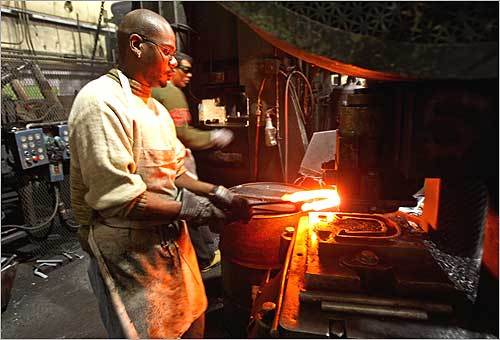 A few weeks ago, we showed a new design of horseshoe that is basically a square shape with rounded corners.
On Monday, the Boston Globe published its annual "Globe 100" report on business in our state, and included a feature on unusual things made in Massachusetts. Marshmallow "Fluff" and the game of Monopoly probably distracted a lot of people from finishing the article. I never even got to Fluff and Monopoly (not to mention Necco wafers and Nantucket Nectars) because the photo above caught my eye. It was taken in the forging room at the St. Pierre Horseshoe Company in Worcester, Massachusetts.
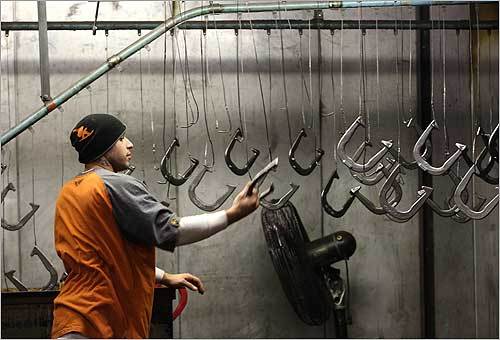 St. Pierre's squarish horseshoes won't see any hooves, though; they are pitching horseshoes. I guess the square toe and straight branch must help hook to the post. I've seen draft horse shoe shows of pretty much the same shape; maybe St. Pierre could add some nail holes and serve another market.
Also featured was the unlikely sounding but very credible Quabaug Corporation of North Brookfield. Turn your shoes over and you may see the little yellow "Vibram" logo, indicating that your shoe's sole was made in Massachusetts, by Quabaug. (They make all the soles of all the boots for the US Army...do that math!)
Quabaug is a funny sounding name for a very progressive company, and one of their newest products is a high tech hoof pad, which is reviving some interest in what pads can do in this age of hoof boots and bare hooves and how-clever-we-are custom treatments for laminitis and hoof injuries, as well as the classic use of pads for hoof protection with shoes.

I thought this photo interesting; Quabaug is making special shoes, or 3-D soles, for sports like martial arts and windsurfing. Imagine what they could do for and with the horse's hoof! Keep an eye on this company!
Thanks to my college pal and horseracing maven Karen Birch for finding these photos online after I had given up.
(Photos: Made in Massachusetts/Boston Globe)
Tuesday, May 20, 2008
Favorite Photo: The Hoof Goes Under the Leg

Wouldn't you love to see a radiograph of this horse's left front foot and lower leg? (the leg on the right in this photo) In what direction do you think the frog was pointing?
The photo was taken at the World Clydesdale Show in Wisconsin last fall.
Big Brown Arrives at Belmont with "Run Down" Problems from the Preakness
 Big Brown arrived at Belmont Park on New York's Long Island yesterday. The Belmont Stakes, the final leg of the Triple Crown for three-year-old Thoroughbreds, will be run on June 7th.(Yahoo News linked photo)
The Blood-Horse reported yesterday that Kentucky Derby and Preakness winner Big Brown was affected by run down problems on his hind legs and feet in the Preakness.
This prompted a rash of questions about this sort of injury. And "rash" is the right word. Rundowns are sort of like a bad road rash! And if you've ever fallen off a motorcycle, fallen on the street while rollerblading, or skiied over rough terrain in shorts in the spring, you know what I'm talking about. Ouch!
With horses, it is usually the back of the pastern and the heel bulbs that get rubbed or scraped, but it can go up the back on the cannon, too.
Rundown injuries usually clear up pretty easily but the question to be asked is why it happened in the Preakness, and if the horse changed his gait or running style. It could also have been the track. And it could have happened in other races, but the horse wasn't under such a microscope of scrutiny until the past few weeks.
Big Brown ran with front wraps in the Preakness because of Dutrow's desire to avoid hitting injuries (interference) although it is not clear if the interference was front left to right, front to hind, or diagonal. Horses have all sorts of hitting issues based on conformation, fatigue, pulling up sharply, accelerating out of the gate, clipping heels, etc. and this is probably not something to think of as a performance-limiting injury.
Horses only get rundown injuries on dirt tracks, although I don't know about artificial surfaces. It seems like they could be abrasive, too. The Dutrow team will just have to wrap his legs and pad his pasterns when he trains at Belmont, until this clears up. There are all sorts of wraps and boots and patches that can be used so he can train normally.
It's not likely that this will be a problem for Big Brown, but with any animal you don't want the possibility of an association between speed and pain, or going out on the track and pain. Big Brown seems like a tougher horse than that.
My fellow blogger Alex Brown, exercise rider for Steve Asmussen, has some more insight into rundowns in today's New York Times.
Friday, May 16, 2008
Big Brown's Big Switch: New Shoes, New Heels for Tomorrow's Preakness
 This morning, I stumbled out onto the lawn and grabbed the paper before the sea gulls could target it (or me). Once inside, I propped the paper up, set to peruse it with coffee in hand, when I sputtered in amazement: Hey! Hey! Hey!
There on the front page of the Boston Globe was not a photo of the Boston Celtics in their playoff bid for the NBA championship, nor a photo of the Red Sox, but rather a huge photo of Big Brown getting new shoes (and heels) yesterday at Pimlico in Baltimore, in preparation for tomorrow's Preakness Stakes, the second leg of the Triple Crown for three-year old Thoroughbreds.
(Sports, by the way, are front-page news here in Boston.)
I was surprised. Trainer Richard Dutrow obviously made a big change in plans here. Earlier this week, he said that Big Brown would not be re-shod for the Preakness, but that he would have Ian McKinlay work on the horse when he arrived in New York for the Belmont Stakes, the third race in the series.
Following the Kentucky Derby, farrier Tom Curl, who had worked on the horse through the winter in Florida, said that the feet came through the Derby very well and the adhesive wasn't cracked and the Yasha shoes were stable.
Obviously, they decided to give his feet a tuneup. The horse also went out for a light work over the Pimlico surface wearing bell boots to protect his new glue and a mud knot in his tail.
Other news this week was that Big Brown will not race as a four-year-old. He will go to stud sometime later this year. Also, if he does not win the Preakness tomorrow, he will not go on to the Belmont. But will he go on to Saratoga for the Travers and on to Santa Anita in the fall for the 2008 Breeders Cup?
Thanks to Yahoo.com sports desk for the following shots from a slide show of hoof repair specialist Ian McKinlay of New Jersey working on the Kentucky Derby winner.
Apparently, Ian drew quite a crowd yesterday, including Tom Hammond and Donna Brothers of NBC, so you may see Ian (or, more likely, the top of his head while he's working) on tomorrow's telecast of the race. Let's hope you see him in the winner's circle!
PS Friday Afternoon Update: Ian checked in and said that Big Brown's feet are "just fantastic", but that they had gotten a bit long. He just trimmed up the feet and reset the Yasha shoes and pads. He said that when he started, there was one guy standing around to watch and by the time he was into the job, the word was out and it "turned into a free-for-all".


Thursday, May 15, 2008
Favorite photo: How Big Was He?

Thanks to Janey M for sharing this photo of a farrier at the Colebrook Shire Horse Center in Cheshire, England. The photo was taken last week and she insists the farrier was not a small man. Sorry the farrier is not identified but he had a big, big job to do there!
Subscribe to:
Posts (Atom)