Monday, November 09, 2009

AQHA: Uniform Medication, Welfare Rules for Western Performance Across Breed and Sport Lines May Be Possible

9 November 2009 | Fran Jurga's Hoof Blog at Hoofcare.com

The American Quarter Horse Association reported today that western breed and sport industry alliance partners reached a general consensus involving humane treatment and equine welfare during a meeting October 20 and 21 at the American Quarter Horse Hall of Fame & Museum in Amarillo, Texas.

Attendees included representatives from the American Quarter Horse Association, United States Equestrian Federation, American Association of Equine Practitioners, National Cutting Horse Association, National Snaffle Bit Association, National Reining Horse Association, National Reined Cow Horse Association, United States Team Penning Association, American Paint Horse Association and Equine Canada.

“Never before have so many leaders in the performance-horse disciplines gotten together to seriously discuss medication and animal welfare in relation to our events,” said Gary Carpenter, AQHA's executive director of breed integrity and animal welfare. “In-depth discussions led to a good, overall agreement on these vital subjects and the direction we need to go in the future.”

Meeting participants discussed the merits of developing a uniform therapeutic medications program and humane treatment policies that could be adopted by all of the groups involved. Executive directors from these associations scheduled a follow-up meeting for January 2010.

© Fran Jurga and Hoofcare Publishing. No use without permission. You only need to ask. Fran Jurga's Hoof Blog is a between-issues news service for subscribers to Hoofcare and Lameness Journal. This blog may be read online at the blog page, checked via RSS feed, or received via a digest-type email (requires signup in box at top right of blog page). To subscribe to Hoofcare and Lameness (the journal), please visit the main site, www.hoofcare.com, where many educational products and media related to equine lameness and hoof science can be found. Questions or problems with this blog? Send email to blog@hoofcare.com.

Sunday, November 08, 2009

Breeders Cup Lowlight Video: Quality Road-eo Gate Panic Delays the Classic

8 November 2009 | Fran Jurga's Hoofblog at Hoofcare.com


All hail the supermare Zenyatta for her amazing, gutsy win of the Breeders Cup Classic yesterday. While her race will be replayed again and again for years to come, if you missed the race on television you didn't see the starting gate mishap that lead to Quality Road being scratched. Here's a YouTube.com clip of that portion of the race from the Partymanners racing archive. This footage would otherwise be lost to history, and includes an update from AAEP Veterinarian-on-Call Dr. Larry Blamlage of Rood and Riddle Equine Hospital in Lexington, Kentucky.

I hate to see a horse in such distress anytime, let alone on national television. The gate crew are well-schooled in handling these situations but this horse--whom many of you will remember for his famous quarter cracks--narrowly avoided hurting himself, his rider and people on the ground. I know he is a very big horse and I was happy to hear that he is ok today.

© Fran Jurga and Hoofcare Publishing. No use without permission. You only need to ask.

Fran Jurga's Hoof Blog is a between-issues news service for subscribers to Hoofcare and Lameness Journal. This blog may be read online at the blog page, checked via RSS feed, or received via a digest-type email (requires signup in box at top right of blog page).

To subscribe to Hoofcare and Lameness (the journal), please visit the main site, www.hoofcare.com, where many educational products and media related to equine lameness and hoof science can be found.

Questions or problems with this blog? Send email to blog@hoofcare.com.

Friday, November 06, 2009

Patchwork Network: Rip Van Winkle's Engineered Hooves Will Carry Him a Long Way from Tipperary to Breeders Cup on Saturday

Irish champion Rip Van Winkle may be a bionic horse. He will run in Saturday's Breeder Cup Classic in spite of a history of hoof problems that would have sidelined many. His trip to California from Aidan O'Brien's training center in Ireland is the culmination of a stellar performance record in recent months...and the result of a concentrated focus at managing hoof problems so that the horse can have a chance to prove his worth.

Traveling at the side of Rip Van Winkle is Ballydoyle training center farrier Michael O'Riordan. Eight horses made the trip from Tipperary, but it is Rip Van Winkle who occupies much of the farrier's time and concerns.

In an interview this week, O'Riordan described the process of monitoring the hoof health of the Ballydoyle group. He provided more details about the horse's problems in the past, which he believes are related to some sort of structural deficiency in the horse's hoof walls.

"He's a beautiful horse," O'Riordan told me. "He has near perfect conformation and is very free moving. He doesn't pound the ground when he runs so that's not it.

"His hoof walls are so thin. I believe it must be a mineral imbalance of some kind that has weakened the wall."

Rip Van Winkle's problems had O'Riordan on the problem-solving mission much earlier this year when he began using Yasha glue-on shoes on the horse for the quarter crack problems. When a wall separation compromised a hind foot, Ballydoyle brought in the Yasha shoe developer and quarter crack repair specialist Ian McKinlay, who traveled to Ireland to work on the hoof.

Wearing Yasha shoes on his patched feet, Rip Van Winkle was able to race this summer and win major stakes races. This fall, a quarter crack in the fourth foot was a shock as the Breeders Cup approached.

Over the past year, Rip Van Winkle has had his feet resected and rebuilt, his cracks laced. His feet have grown out and his hooves are now reinforced with acrylic. The new hind foot problem has been laced.

How will Rip Van Winkle like the Pro-Ride surface? O'Riordan said that training on it has gone well. At home, the horse canters on wood chips and works on grass, and his stakes races have been on grass.

Rip Van Winkle's Yasha shoes are cushioned Victory racing plates without toe grabs. O'Riordan said that most of O'Brien's horses had been switched to small toe grabs on their hind feet, but not Rip Van Winkle or Mastercraftsman. All the Yasha shoes have toe clips, front and hind. Rip Van Winkle has a normal size foot, a size 6 Victory plate.

Mastercraftsman is also wearing the Yasha shoes glued to all four feet, but O'Riordan said that the shoes were put on that horse for comfort and that the horse has no problems and is a nice mover. He feels that the soft heels on the Yasha shoes are kinder to the foot and don't wear down the heels.

O'Riordan's job this week is to keep an eye on the hooves of eight horses. He won't blink until Saturday's races are over. He'll head straight back to Ireland on Tuesday, but will hope that his trip includes the scenery of the winning circle at the culmination of the Breeders Cup Classic.

"We wouldn't be here without the Yasha shoes and Ian McKinlay's lacing technique," O'Riordan stressed.

"If you see paramedics in the winner's circle, you'll know they're reviving me," he joked.


© Fran Jurga and Hoofcare Publishing. No use without permission. You only need to ask.


Questions or problems with this blog? Send email to blog@hoofcare.com.

Thursday, November 05, 2009

Conference Will Present "2009 Spot Courage Award" to Molly the Pony's Caregiver Team for Exemplary Awareness and Prevention of Support-Limb Laminitis

5 November 2009 | Fran Jurga's Hoof Blog at Hoofcare.com

Molly the Pony will be an honored guest at the Laminitis Conference in Florida this weekend. Her caregiving and medical team will receive the Spot Courage Award for their diligent care of Molly with a goal of preventing laminitis in her "good" front leg. (Pam Kaster photo)

There's a saying that goes something like this: "There are two kinds of ponies. Those that have laminitis and those that will have laminitis." Add in a complex weightbearing overload and what would be the odds that laminitis would not cripple, if not kill, a three-legged hurricane-survivor pony? Well, read on! The following text is edited from a press release received today:

The Fifth International Equine Conference on Laminitis and Diseases of the Foot is pleased to announce that Molly the Pony will be receiving the Spot Courage Award at this year's event. Molly the Pony was rescued by Kaye and Glenn Harris after Hurricane Katrina, and is one of the world's only prosthesis-wearing ponies. The conference will be held November 6-8, 2009, at the Palm Beach County Convention Center in West Palm Beach, FL.

"One of the first questions I am usually asked is how is it possible that Molly does not have laminitis," said Kaye Harris, Molly the Pony's owner. "Laminitis was the major fear and the reason the doctors originally did not want to perform the operation, so I think it is very important that there is a conference that researches ways to treat and cure this disease. I'm very excited to be accepting this award on behalf of the team of people that have taken care of Molly, as well as on the behalf of Molly. Molly is a very courageous pony and I'm thrilled to be coming here and meeting this group of people."

Molly the Pony will be receiving the Spot Courage Award on Friday, November 6, at 1 p.m. during the Conference. Dr. Rustin Moore will present the award to Molly and her owner, Kaye Harris. Following the presentation of the award Harris will speak briefly until 2 p.m. about her experiences with Molly.

This photo shows what was left of Molly's right front leg after a pit bull attack and before Dr. Moore's surgical intervention. (Kay Harris photo)

Following Hurricane Katrina, Molly was abandoned by her owners and taken to a rescue shelter. During her time at the shelter a pit bull terrier attacked her and it caused severe damage to her right front leg. Harris was taking care of Molly at the time, and turned to the equine hospital at Louisiana State University (LSU) for help. Dr. Moore performed the rare and difficult surgery involving amputation and a prosthesis to offer Molly a new chance at life.

After her traumatic experience, Molly has gone on to be a symbol of hope for those in difficult situations. Molly the Pony is a children's book about the pony and her experience, providing inspiration for thousands. The book will be available for purchase during the Conference, and Molly the Pony will be making other appearances at local children's hospitals during her visit in Florida to spread her message.

The goals of the Fifth International Equine Conference on Laminitis and Diseases of the Foot are the better understanding, prevention, and treatment of laminitis and other diseases of the equine foot. The format includes scientific and practical tracks with topical sessions, followed by small group practical workshops providing information that attendees can incorporate into their daily routines.

When I visited Molly in New Orleans in June, I noticed lots of things. In particular: she lives on fine sand, as you can see here, and her good leg is judiciously supported by a sportsmedicine "suspensory" boot. She also wears a donated Soft Ride boot at times. I'd like to see what the bottom of her good foot looks like. She also spends time in a sling, especially when her hooves are being trimmed. (Fran Jurga photo)

The Fifth International Equine Conference on Laminitis and Disease of the Foot brings together the world's experts and visionaries on laminitis to create an innovative, educational, and entertaining program for conference attendees to help educate the public and further the fight against laminitis. The Laminitis Conference is led by its Director, Dr. James A. Orsini, DVM, DACVS, a faculty member at the University of Pennsylvania and Associate Professor of Surgery in the School of Veterinary Medicine.

For more about information about the Fifth International Equine Conference, please visit: http://www.laminitisconference.com.


© Fran Jurga and Hoofcare Publishing. No use without permission. You only need to ask. Fran Jurga's Hoof Blog is a between-issues news service for subscribers to Hoofcare and Lameness Journal. This blog may be read online at the blog page, checked via RSS feed, or received via a digest-type email (requires signup in box at top right of blog page). To subscribe to Hoofcare and Lameness (the journal), please visit the main site, www.hoofcare.com, where many educational products and media related to equine lameness and hoof science can be found. Questions or problems with this blog? Send email to blog@hoofcare.com.

Tuesday, November 03, 2009

Do You Speak Farrier? The 2010 New Dictionary of Farrier Terms Will Help!

3 November 2009 | Fran Jurga's Hoof Blog from Hoofcare.com


To order your copy, call 978 281 3222 or email books@hoofcare.com
Cost is $19 plus $4 postage in USA; $8 elsewhere.

This little slide show from author David Millwater gives a preview of the new edition of the outstanding reference, New Dictionary of Farrier Terms. We have always tried to make this book available over the years, but the book is now all grown up, with a spine, glossy cover and expanded listings.

I hope this book will become the accepted reference for defining farrier words so that authors and editors can all speak the same language. I don't always agree with Dave, but he is such a good writer and a diligent compiler of the lexicon of his profession that I don't mind losing out to him (sometimes).

Farriers will (or should) know all the terms in the book, but may be stuck sometimes to define what a London pattern anvil is or what "interdigitate" really means in the laminar bond. This book will help.

For everyone else, this book helps de-mystify the language of the back of that truck and the furthest corners of the smithy. It won't cure your horse or keep your shoes on, but it will help you sound like you might know what you're talking about. How you string the words together is up to you!

The New DFT belongs on the shelves of authors, editors, translators, veterinary hospitals, educators, lawyers, insurance companies, breeders, trainers, horseowners, merchants and, of course, libraries. Did I forget anyone?

I hope the sales from this spiffy new edition will encourage David Millwater to continue his calling as a word detective and delve more into the origins of farrier terms (one more time: why do they call it canker?) and that this project will flourish and my arguments with him never end.

Take my word for it: if we all agreed, Hoofcare's world would be a much less interesting place.

© Fran Jurga and Hoofcare Publishing. No use without permission. You only need to ask.

Fran Jurga's Hoof Blog is a between-issues news service for subscribers to Hoofcare and Lameness Journal. This blog may be read online at the blog page, checked via RSS feed, or received via a digest-type email (requires signup in b
ox at top right of blog page).

To subscribe to Hoofcare and Lameness (the journal), please visit the main site, www.hoofcare.com, where many educational products and media related to equine lameness and hoof science can be found.

Questions or problems with this blog? Send email to blog@hoofcare.com.

Dressage Hoofcare: Rob Renirie at Global Dressage Forum

3 November 2009 | Fran Jurga's Hoof Blog

Dutch team farrier Rob Renirie at the Athens Olympics (photo courtesy Anky.nl)

A funny thing happened on the way to the Forum.

The Forum, in this case, would be the Ninth Global Dressage Forum, held last week at the Academy Bartels training center in Hooge Mierde, the Netherlands. And the funny thing was that a farrier was a speaker at this event for the first time, and no one thought that unusual at all. What's more, they paid extremely close attention to his advice.

The farrier? I can only think of a few who can hold the attention of an arena full of dressage experts, many of whom would be testing their own opinions against the farrier/speaker's.

But no one can argue with this farrier's results. Horses from many countries shod and/or trimmed by Rob Renirie have won an amazingly consistent stream of Olympic, World, and European medals for the past ten years. He jokes about it, pokes fun at his clients, but has taken care of the horses they've asked him to keep in tune with the ground.

No, Hoofcare & Lameness was not lucky enough to be in Holland for Rob's lecture, but we have friends all over the world and some of them were very helpful at this event. Astrid Appels of EuroDressage.com has written an excellent summary of Rob's presentation on her web site, and I would encourage you to go there and read the entire article (and see the photos).

While Rob is best known for his Olympic gold medalist client Anky Van Grunsven, he cares for the hooves of many of Europe's top horses and travels with the Dutch team to international events. He also works with veterinarians on a regular basis, both on sport horse injuries and special clinical cases.

Here are some key points from Rob, as passed along by Astrid. Remember, English is not Rob's native language, although he speaks it very well:

"The frog is important for the blood supply and to absorb shocks. You have to leave it as big as possible and leave the bars in. The sole is as thick on the toe as on the heel. You have to leave the toe as thick as possible."

"The coronet band determines the shape of the shoe."

(Referring to Adelinde Cornelissen's successful European Championships dressage horse) "Parzival had flat underrun heels and the wrong shoes. He is wide in front and narrow in the heel. We worked on him a few times and the horse had a tremendous recover in his feet."

Rob restated his sentiment from lectures in 2007 at the laminitis conference in Palm Beach that side clips are undesirable and can distort the wall. "They get too tight on the feet."

"Do not correct the feet, but protect the feet."

"We keep our horses as prisoners in a stable, which is not good for the blood supply."

Rob restated that his own horses are not shod and that he feels that is the best way for a horse to be, qualifying that advice for horses that don't have hoof problems and are not moved between radically different surfaces.

After the lecture, a group of attendees had a special opportunity to enter the stables of Dutch team rider Imke Schellekens-Bartels, and review the hooves of some of the horses at hand.

Note: Rob has a web site, though there's not much on it. There is some nice music and some images of his work and especially his fabulous shoeing van and some scenes from his worldwide travels. Click here to go to Rob's web site; just click on the photos at the lower left and they should begin to change.
Thank you to Eurodressage.com

© Fran Jurga and Hoofcare Publishing. No use without permission. You only need to ask. Fran Jurga's Hoof Blog is a between-issues news service for subscribers to Hoofcare and Lameness Journal. This blog may be read online at the blog page, checked via RSS feed, or received via a digest-type email (requires signup in box at top right of blog page). To subscribe to Hoofcare and Lameness (the journal), please visit the main site, www.hoofcare.com, where many educational products and media related to equine lameness and hoof science can be found. Questions or problems with this blog? Send email to blog@hoofcare.com.

Saturday, October 31, 2009

Here Lies the Farrier...And There Goes Tam O'Shanter

by Fran Jurga | 31 October 2009 | Fran Jurga's Hoof Blog

Lichen covers this fascinating old gravestone in the Alloway kirkyard near Ayr, Scotland. Surely a farrier lies here. Was he the farrier who inspired the lines in the poem: "That every naig was ca'd a shoe on, The smith and thee gat roaring fou on"? (Tam and the smith had a drink for every shoe that was nailed on.) Or did he die earlier so it was part of this scene: "Coffins stood round like open presses / That shaw'd the dead in their last dresses /And by some devilish cantraip slight / Each in its cauld hand held a light."

Happy Halloween!

There are many farrier headstones in cemeteries around the world. Grand anvils and headstones sporting horseshoes decorate churchyards and forgotten family plots. But I think this one is suitable for Halloween!

You'll find this stone in the churchyard at Alloway, near Ayr in Scotland. Was this farrier also a pirate (note the skull and crossbones) and someone with royal ties (note the crown)?

This graveyard is not far from Closeburn, the home of the late famed farrier Edward Martin, and I must assume that Edward knew of this stone, though I don't recall him telling any stories about it--and this stone surely has a great story!

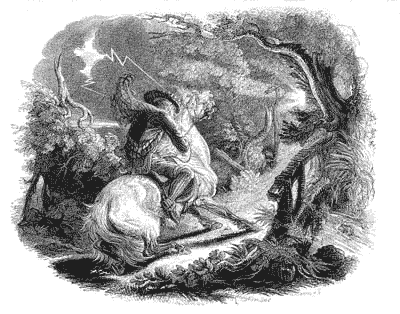
Alloway is the town of Robert Burns's birth as well as where he set his famous poem, Tam O'Shanter. This is the universal tale of a man who simply stayed too late at the pub one night, drinking with the smith (perhaps the one buried here?) and his other pals, and had to count on his good mare Meg to get him home in foul weather.
Tam was shocked to see half-dressed women from the village cavorting with the devil. But in his drunken state he called out in admiration to one attractive woman in a "cutty sark", which set them all in pursuit after him.


The poem is interpreted many ways when it comes to people's views on alcohol, witchcraft and lewd behavior. But there is never any doubt about the character of the horse involved.

Tam gives his mare Meg her head to find her way home and probably snoozed in the saddle. Passing through Alloway, he's startled awake to see the church ablaze, with witches dancing in every window as the devil plays the bagpipes and the graveyard's coffins open wide.


The Brig o'Doon, or bridge over the River Doon in Alloway. Apparently, a witch can't cross a running stream so Tam spurred his mare on. Once across, Tam O'Shanter would be safe from the witches, though he would still have to answer to his wife. But his horse would never be the same again.

I won't spoil the story for you. You can read the interpretation here. (It's a great tale!)

But let it be known that Meg the Mare takes care of her rider that night...though she spends the rest of her life as testimony that something did happen on the way home, even if it was the most elaborate and world-famous tale a husband ever made up for why he was late coming home from the pub. 

Spooky enough for Halloween, don't you think?

Halloween: The Original "Jack o'Lantern" Was a Grumpy Blacksmith with a Glowing Lump of Coal

by Fran Jurga | 31 October 2009 | Fran Jurga's Hoof Blog


So here's the way the story goes...I'll tell the short version because it's an Irish story and you know how long they can be.

There once was an Irish blacksmith named Jack. He was a miserable man, and he spent his nights in the pub trying to make everyone around him miserable, too.

One night he made a deal for one more drink, but he had no money so it had to be paid for by the Devil.

The devil demanded to be paid back, but Jack tricked the Devil. That's never a good idea. The Devil promised Jack that he'd take his soul.

When the blacksmith died, he was refused admission to heaven for all his evil, selfish deeds, and foul moods. He was sent straight to the gates of hell.

Whom do you think was waiting for Jack? 

The Devil was standing at the gates to Hell. He immediately recognized Jack as the Irish blacksmith who had cheated him. The devil crossed his arms and refused to let Jack into hell.

Where was Jack supposed to go? The Devil didn't care, but Jack had better get going. Jack pleaded for a coal from Hell's fires so he might see his way as he wandered out through the darkness.

The Devil granted his wish and squashed a glowing coal into a half-eaten turnip. He handed it to Jack with a smirk.

The grouchy old blacksmith wandered off and guess what? He wandered forevermore. He's still out there, they believe in Ireland.

It's said that Jack's piece of glowing coal in a turnip could be seen across the Irish countryside at night as he wandered aimlessly, the ultimate ghost.

And of course, as a smith, Jack would have had the skill to keep the coal ember going. He made the most of the devil's generosity.

Irish children began to imitate Jack's lantern and Irish-American children switched from turnips to pumpkins on this side of the Atlantic.

And so it is that so many of us still place glowing vegetables on our doorsteps on Halloween to scare away the haunted souls...like Jack, the grumpy, cheapskate, old blacksmith who is out there somewhere, tonight.

--Fran Jurga


Click here to add your email address to the Hoof Blog headlines list. You will receive an email, which you must click on to confirm you made this request. Thanks!


She Strolls Through the Horse Fair on Halloween...

by Fran Jurga | 31 October 2009 | Fran Jurga's Hoof Blog


I've been saving this picture for today. It's from a portfolio of images, mainly farriers, taken at the Smithfield Horse Market in Dublin, Ireland, one of the last urban horse sales in western Europe. The travelers bring horses and ponies and donkeys into the city the first Sunday of each month to sell or trade them. They've been doing it exactly this way, in the shadow of the Jameson's whiskey distillery, since 1665, as much as the city has tried to stop this chaotic manure-producing festivity. Dublin is one of the last cities where horses are kept within the city by private owners, many by young boys who tether them on any available greenspace.

One Dublin photographer, Teresa O'Brien, is especially taken with the farriers who skip church and show up to shoe the horses at the market before they are sold. But she only photographs their hands. I've never seen the rest of these men. Later, she moves through the crowd and her lens finds a hand on rusty hames or in this case the hand of a traveler (gypsy) matriarch's multi-ringed fingers.

Imagine this woman draped in her long dark hooded coat and leaning on her cane. She is walking among the horses on a chilly October morning. She speaks to no one. Is she buying or selling or is there something spooky going on here? Is she the ghost of horse markets past?


Click here to read a little more about and see a little more about Smithfield Horse Market.

Smithfield Horse Market and the gypsy horse fairs of Ireland and England are some of the last horse fairs. I grew up staring at a print of the painting The Horse Fair by Rosa Bonheur (above; the original painting is 16 feet long and hangs in the Metropolitan Museum of Art in New York City). It is still one of my favorite paintings because there is so much going on and the horses are so well-formed.


But if you think about it, what will go on this Sunday morning at Smithfield hasn't changed much from Bonheur's basic scene, which shows the horse market in Paris in the 1800s. Someone should document the few horse fairs that still exist. I know there are still big ones in India and Mongolia--where else are they still held?

Wednesday, October 28, 2009

From Sim to Mo-Cap to Slo-Mo: Have Another Look at the Horse in Motion

by Fran Jurga | 28 October 2009 | Fran Jurga's Hoof Blog

Today I hurt my eye and it made the world a different place. Depth perception was different, some things don't quite line up, and this computer screen is a little blurry so this post will be a media-rich one. I'll let the videos tell the story.

And the story is exactly what I have been experiencing: how do we look at things? You read research reports and case studies and observations on this blog all the time, but they are from the viewpoints of different original sources. Here are some examples of the sources the Hoof Blog uses.


This is a computer-generated leg model from the University of California at Davis. The model lives in a perfect world. Someone designed a limb with arbitrary (or perhaps intentional) conformation and measured the resulting tendon, ligament and muscle forces if this ideal limb was moving over a perfectly smooth, non-deforming surface.


This is what we now call "traditional" two-dimensional video analysis, often used for before-and-after shoeing and trimming evaluation.


This very brief clip is 3-D analysis. You might want to use the play button to start and stop it and see more detail.


Finally, here's high-speed video, or what you might call high-quality slow motion. This polo pony is exhibiting the same stride characteristic as the computer model at the top but wow! he is influenced by the weight and lean of his rider and the variable deformability of the field as well as, no doubt, probably some conformational traits that offset his limb alignment. This is the real world.

There are plenty of other ways to capture horses and model their movement to study and analyze them; the idea here is that when you read an article, the authors may be extrapolating data from a computer model or from subjective observation with no data collection. You have to read the fine print and always take into consideration how a study was conducted and how many horses were in a study.

Does the moving horse interest you? Cornell University will host a veritable festival of motion capture, slo-mo and gait analysis at the 26th Farriers Conference November 14-15 in Ithaca, New York at the College of Veterinary Medicine. The early registration deadline is Friday so get organized and save $50 over the on-site fees.

Speakers at Cornell include farriers Scott Lampert of OnTrack Equine in Minnesota and Mark Aikens from Anglia Equine in England, both of whom are leaders in using videography in analyzing how shoeing and trimming effect horses' movement. Dr. Jeremy Rawlinson of Cornell will demonstrate the use of Cornell's force plate system and de-mystify the concept of ground reaction forces.

Hoofcare & Lameness is thrilled to be a part of this event. For a full schedule and list of speakers, and to register online, click here or go directly to http://www.vet.cornell.edu/education/conferences/farriers/


© Fran Jurga and Hoofcare Publishing. No use without permission. You only need to ask.

Fran Jurga's Hoof Blog is a between-issues news service for subscribers to Hoofcare and Lameness Journal. This blog may be read online at the blog page, checked via RSS feed, or received via a digest-type email (requires signup in box at top right of blog page).

To subscribe to Hoofcare and Lameness (the journal), please visit the main site, www.hoofcare.com, where many educational products and media related to equine lameness and hoof science can be found.

Questions or problems with this blog? Send email to blog@hoofcare.com.