 |
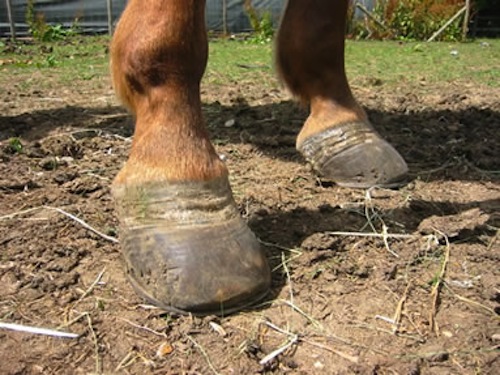
| This is the time of year when some nonpaying and unwanted boarders start moving into stables. The evidence isn't always as obvious as on this mule's foot. (Kurt Fisk photo) |

Sunday, October 20, 2013
Rats in the Stable? Check the Horses' Hooves and Your Grandfather's Stable Manual

Sunday, October 13, 2013

Thursday, October 03, 2013
"Future Forward" Poster Session Added for International Laminitis Conference Attendees in Florida

Lamina carefully revealed and photographed by Paige Poss
Sunday, September 29, 2013
Official National Results from Stoneleigh Team Competition: England Wins; USA 4th
 |
| Repeat winners Team England at the award ceremony of the 34th International Team Farrier Competition in Stoneleigh, England, hosted by the British Farrier and Blacksmith Association. Left to right: Matt Randles, Ben Taylor, Ben Casserly, presenter, Steven Beane, and Nigel Fennell. |
International Team Farriery Championships 2013
1st Place - England
2nd Place - Scotland
3rd Place - Ireland
4th Place - USA
5th Place - Wales
6th Place - Canada
7th Place - France
8th Place - Belgium
9th Place - Holland
10th Place - Norway
11th Place - Switzerland
12th Place - Catalonia
13th Place - British Army
14th Place - Sweden
England's victory was by the slim margin of 1.5 points.
Stephen Beane of England was the individual champion; 2013 world champion David Varini of Scotland was second. The pair finished 1-2 in the standings for specimen shoes, as well.
International Apprentice Team Championship 2013
1st Place - England
2nd Place - Scotland
3rd Place - Wales
4th Place - Switzerland
5th Place - France
The American Farriers Team, consisting of Lamar Weaver, Josh Stanley, Mark Schneider and Chris Gregory, finished in fourth place, 6.8 points ahead of Wales. Lamar Weaver finished 9th overall in the individual standings and was third in the best shod foot standings.
Canada's Dan Corkery won a class for team reserves.
According to the unofficial records kept by Hoofcare Publishing, the very respectable fourth-place finish by the American team is cause for celebration. The USA also finished fourth in 2007.
For the extensive and downloadable full results, please visit The Forge Magazine website and click on individual categories of awards or classes for full results.
Results and photo kindly shared by Forge Magazine: Thank you!
Meet Two Stoneleigh International Contenders: Canada's Aaron Steeves and England's Ben Taylor

It happens every year: dozens of nations send teams of farriers to the forge in Stoneleigh, England to compete in the 34th International Team Farrier Competition. In the farrier world, this is a very big deal: national honor is at stake and the dominance of certain countries over the history of event make this a proving ground for nations who want to show that they just might be able to beat the English, Welsh and Scots at their own game.
Come to think of it, the Welsh and Scots are trying to prove that they can beat the English, too. And some years, they do.
But this year is different. There are changes going on in British farriery at all levels, which will be explained in a later article. But even the British team has a rookie in its ranks.
If you were at Stoneleigh today, you would have seen the well-organized Canadian team, which enjoyed excellent post-Calgary publicity. Aaron Steves, the first team member from New Brunswick, was featured on Canadian Broadcasting Corporation's national radio and the Shaw television network, and we have a little clip to share. He's been kindly reporting on Facebook this weekend.
With Aaron in England are two veteran Canadian Team members, Tom Barnett and Randy Brassard, along with newcomer Travis Buck, all from Ontario. Alternate is Dan Corkery, also from Ontario.
The British team has possibly the greatest depth in the world. They can choose from world champions, national champions, European champions, and there is a long list of veterans who have been to Stoneleigh before and can stay calm in the face of defending the nation's honor.
So why would a farrier who has only been qualified for a year and a half earn a place on the team? He just must be that good.
Watch the Hoof Blog and the Hoofcare and Lameness Facebook Page for news on how all the nations--including the USA--do at Stoneleigh this year.

Follow Hoofcare + Lameness on Twitter: @HoofcareJournal
Read this blog's headlines on the Hoofcare + Lameness Facebook Page
Disclosure of Material Connection: The Hoof Blog (Hoofcare Publishing) has not received any direct compensation for writing this post. Hoofcare Publishing has no material connection to the brands, products, or services mentioned, other than products and services of Hoofcare Publishing. I am disclosing this in accordance with the Federal Trade Commission’s 16 CFR, Part 255: Guides Concerning the Use of Endorsements and Testimonials in Advertising.
Monday, September 23, 2013
Could You Carry Scotland's Smiddy Stane?
 |
| If your idea of fun is seeing how far you can carry a 363.8 pound stone, Scotland has an event for you. Just don't expect to tie up your horse to be shod at the smithy in town that day. (Photo of Airth, Scotland's "smiddy stane" contest courtesy of Ewan McTaggart) |
Thursday, September 12, 2013
Video: Just like the big guys, a half-pint horse works out in an underwater treadmill
Miniature horses get to have all the fun, sometimes. When "normal" horses use the underwater treadmill at Colorado State University's Orthopaedic Research Center, it's business as usual. But when little Booya steps onto the belt, it's time for a video shoot.
Wednesday, September 11, 2013
The Blacksmith of Brandywine: The Story of an American Legend Makes Sense on a Legendary Day
As we remember the attack on the World Trade Towers in New York that occurred 12 years ago today, it's easy to forget that this day has another memorable place in American history.
Today is also the anniversary of the Battle of Brandywine. It was fought near Chadds Ford in Pennsylvania, not far from the University of Pennsylvania's New Bolton Center. And yes, there was hoofcare involved.
Best Shod Horse at England's Burghley Horse Trials Wore Handmade Shoes by Steve Arnold
 |
| Four happy faces: Farrier Steve Arnold, event horse Let's Dance, rider Jeanette Brakewell, and owner Ruth Williams were celebrating in the mare's stall yesterday. Steve holds the rosette and plaque awarded by the Worshipful Company of Farriers for Let's Dance's selection as the Best Shod Horse at the 2013 Land Rover Burghley 4* Horse Trials in England. Many of the best event horses and riders in the world were competing, and farrier judge Andrew Casserly lifted all four feet of each of them to select Let's Dance as the winner. (Photo provided by Steve Arnold.) |
This article is a product of serendipity.
For many years, the Land Rover Burghley Horse Trials in England has awarded a "Best Shod" prize to one of the four-star horses entered in the event. The Worshipful Company of Farriers sends out a trained judge to the beautiful country house grounds, and the riders line up to have their horses' feet evaluated.
Monday, September 09, 2013
Maryland's Kathy Anderson DVM Will Be New American Association of Equine Practitioners Vice President
The American Association of Equine Practitioners has named Kathleen Anderson, DVM, owner of Equine Veterinary Care PC in Elkton, Maryland, as its 2014 vice president. Dr. Anderson will be installed during the December 10 President’s Luncheon at the 59th Annual Convention in Nashville, Tennessee, and will assume the role of AAEP president in 2016.
Friday, September 06, 2013
Goof-proof Hoofcare: “StayOns” Instant Hoof Poultice Wraps Simplify the Way You Wrap a Foot
Here’s a product that is worth its weight in baby diapers.
If there was ever a contest that farriers, vet techs and veterinarians should run, it would be to see who has the fastest two hands in the world for making a duct tape bootie to attach over a hoof wrapped in a disposable baby diaper.
 |
| How many times have you wrapped a hoof in duct tape, only to have the horse walk right out of it as he stepped off the mats? It happens, even to the pros. Now you can use StayOns prepared quilted “instant poultice” wraps, available in multiple formulas from Hamilton Biovet in Massachusetts. |
Every tack room in America seems to have some baby diapers stuffed in a cabinet, and they’re not for babies. We all have rolls of duct tape stashed around our barns, horse trailers and cars.
Poulticing is a messy job, but there’s always been a bit of a universal acceptance that foot wrapping was a skill that must be mastered.
But Hamilton Biovet launched a new product to the farrier market this summer that may take the “dread” out of “dreaded hoof abscess”. The product, called “StayOns”, is a quilted hoof wrap that contains “instant poultice”; you wet it, lay it over the hoof, and keep it on with a clever little foldable bootie.
That’s it: no duct tape, no diapers, no struggling, no mess, no cleanup chores. And it stays on because, unlike a diaper, it really is shaped to the horse’s foot. And the poultice mixture is pre-measured and pre-loaded; you just have to wet it and secure it over the hoof and secure it with a boot to hold it in place.
So just when you think there is nothing new under the sun, here’s a good old-fashioned clay and Epsom salt poultice. Or a bran and Epsom salt poultice. Or a plain Epsom salt poultice. Take your pick; the quilted booties come in three recipes.
The quilted pouches cover the enter foot, including the heel bulbs, where so many abscesses like to erupt, and all the way to the hairline, the other favorite eruption spot.
The best part of the StayOns may be when you take them off. There’s much less mess to clean! You can just hose it off.
 |
| There’s no question that traditional poulticing is a work-intensive endeavor, especially when it comes to the legs of sport and racehorses. You can make a mess twice, since the next morning, there’s a lot of post-poultice cleanup to be done, as well. (©Fran Jurga photo) |
This is efficient time use for the groom or owner, but it is even better for the horse, especially if there’s a problem in more than one foot, such as road founder after a horse has gotten loose or stinging soles at the tracks.
Wrapping a horse’s foot is tough; wrapping a horse’s lifted foot when the weightbearing foot is painful is even tougher.
Many horse owners can go years between an abscess, puncture wound or foot problem that requires poulticing. They may forget how to do it, or not remember how much poultice to pack in the foot. Stayons take the guesswork out of the equation, since the poultice is pre-measured. They can see the poultice in the transparent quilts.
 |
| Everyone has a signature way of wrapping a foot up with duct tape. But would anyone be sorry to learn a new and cleaner way to do it? (© Fran Jurga photo) |
The heyday of foot wrapping may have passed as people discover products that make it not just easier for caretakers, but safer for horses. A goof-proof product like StayOns insures that a horse’s foot gets treated and stays treated, until you take it off.
 |
| The StayOns hoof poultice wraps allow users to poultice the entire foot and heel bulbs as well as the bottom of the foot. The mess of the poultice stays in the moist quilted sacks. (Hamliton BioVet photo) |
- Horse owners should always ask a veterinarian for advice before poulticing a foot for a condition that includes broken or irritated skin.
- A foot poultice may not be advised for some foot infections.
- Seek the advice of a veterinarian before applying poultice--or any medicated products--to young horses and pregnant or lactating mares.
- Never apply poultice to inflamed or irritated heel bulbs.
- Keep poultice stored in a safe, dry place that is out of the reach of dogs, cats and children.

Follow Hoofcare + Lameness on Twitter: @HoofcareJournal
Read this blog's headlines on the Hoofcare + Lameness Facebook Page
Disclosure of Material Connection: The Hoof Blog (Hoofcare Publishing) received compensation for placement of this post. Hoofcare Publishing has no material connection to the brands, products, or services mentioned, other than products and services of Hoofcare Publishing. I am disclosing this in accordance with the Federal Trade Commission’s 16 CFR, Part 255: Guides Concerning the Use of Endorsements and Testimonials in Advertising.
Wednesday, September 04, 2013
St Nicholas Abbey Update: Healing Leg Fracture and the Origin of His Name
 |
| Champion racehorse St Nicholas Abbey in his stall at the Fethard Equine Hospital in Ireland, where he is recovering from a fractured pastern suffered while training at the nearby Ballydoyle training center of Coolmore's racing division head trainer Aidan O'Brien. |
"While still having a guarded prognosis St Nicholas Abbey has had his best week since his initial surgery!
Sunday, September 01, 2013
On the Case: Combined Contracture and Laxity Complicate Limb Deformity in an Irish Thoroughbred Foal
Kevin Corley, BVM&S, PhD. DACVIM, DACVECC, DECEIM, MRCVS of the Anglesey Lodge Equine Hospital in County Kildare, Ireland shared photos of a recent case. A 12-hour-old Thoroughbred foal intended for future racing needed a treatment or management plan for an unusual hind limb deformity.
 |
The foal’s foot was flat on the ground, but the pastern was vertical and the fetlock knuckled forward.
|
The Nobel Prize for Farrier Poetry: Looking Through Seamus Heaney's "Door into the Dark"
One of the world's greatest poets died on Friday. Ireland's Seamus Heaney was one of those people who bridged the past and the present with verse so deft you were never sure where time fit into the story or if time matters anymore. He grew up in Northern Ireland in the 1940s and went out into the world through his words, winning the Nobel Prize for poetry as he wandered.
Saturday, August 31, 2013
Case Follow-up: How's the Swiss Cheese Hoof Wall?
 |
| Do you recognize this foot? Califronia farrier R. T. Goodrich has an update on "the swiss cheese hoof wall" case. The mare continues to improve and the shoeing treatment has been simplified. |
On June 7, 2013, California farrier R.T. Goodrich innocently posted a photograph of a hoof on his farrier service's Facebook page. It wasn't a horse that belonged to any of his clients. He shod it for free, just to help the otherwise-helpless owner out. Her horse had received an unorthodox hoof wall dimpling treatment for laminitis.
Wednesday, August 28, 2013
Lost Shoes Solution: Shoe Secure Keeps Your Horse's Shoes On, World Champion Style
 |
Whether it’s linked to conformation or a gait abnormality or a swampy pasture, the shoe loss problem may have met its match in an odd-looking product from Scotland called ShoeSecure. Designed by an equestrian entrepreneur with the help of a world champion farrier, and used by a world champion reiner, the new product launched in the USA this summer with a star-studded resume.
SHOESECURE SPONSORED THIS ARTICLE. |
St Nicholas Abbey Fracture Fixation Pin Breaks
 |
| The horizontal steel pin (top of radiograph, red arrow) was designed to help the injured Thoroughbred bear weight in spite of the fracture in his pastern. This pin, as you can see, is broken and had to be removed. (photo provided by Coolmore Stud) |
Tuesday, August 06, 2013
Research Report: Dr James Belknap Summarizes Developments in Understanding Laminitis Funded by the Grayson-Jockey Club Research Foundation
The following report by Dr Belknap summarizes the sequence of his latest research on laminitis through funding supplied by the Grayson-Jockey Club Research Foundation and is reprinted with the Foundation's permission.
The funding by the Grayson-Jockey Club Research Foundation (GJCRF) and the NTRA (Barbaro Fund) of our last two projects on the efficacy of cryotherapy in laminitis has allowed us to bring to fruition a great deal of effort by many investigators over several decades. This has furthered our understanding of laminitis and to truly bring to the forefront the first laminitis therapy which has passed thorough scientific rigor as an effective therapy for laminitis.
Laminitis is a disease in which the hoof wall separates from the soft tissue attached to the distal phalanx (coffin bone), resulting in the distal phalanx undergoing a crippling displacement towards the ground surface of the hoof.
 |
| Dr. James Belknap of The Ohio State University |
Laminitis is a disease in which the hoof wall separates from the soft tissue attached to the distal phalanx (coffin bone), resulting in the distal phalanx undergoing a crippling displacement towards the ground surface of the hoof.
Friday, August 02, 2013
Vet Video: Fractured Pastern Surgically Repaired on Champion St Nicholas Abbey; Details on Work by Irish-American Surgical/Medical Team
A report on the injury, surgery, illness and recovery of Breeders Cup winner St Nicholas Abbey has been provided by Coolmore Stud, ten days after the initial injury, which happened at the training center in Ireland.
Equine Lameness: British Cavalry Horses Suffer Common Minor Hoof and Leg Problems Similar to Recreational Horses
 |
| British cavalry horses are large Irish-crossbred types and generally are selected because they have big enough feet, acceptable conformation and good bone. Their lameness problems tend to be less dramatic than you might think, and more in line with recreational horses than sport horses. |
Tuesday, July 30, 2013
Federal Court Rules Against Lawsuit: USDA's Tennessee Walking Horse Anti-Soring Regulations Are Not Unlawful

A U.S. District Court in Texas upheld federal regulations to prevent the practice of “soring,” in which trainers abuse horses to force them to perform an unnatural high-stepping gait for competitions. The U.S. Department of Agriculture regulations, which were adopted following a 2010 legal petition filed by The Humane Society of the United States (HSUS), require that USDA-certified horse industry organizations impose uniform mandatory minimum penalties for violations of the Horse Protection Act.
Tuesday, July 16, 2013
Hallmarq Standing MRI Presents: Navicular Disease Diagnosis, Then and Now


We have never really understood navicular disease, but maybe we're getting closer. Two horses would have identical lameness symptoms but the radiographs were clean on one, and clearly showed a bone lesion in the other. Some horses stayed lame for years and were never ridden again. Others took a year or so off and, to everyone’s surprise, returned to training.
Friday, July 12, 2013
British Laminitis Research: Tracking Normal Horses Who Later Develop Pasture Laminitis Vs Those Who Don't
 |
| Typical feet of a pony with pasture laminitis. Could laminitis be prevented by identifying likely-to-founder ponies early in their lives? A British research project aims to track normal ponies who, later in life, do and don't develop pasture-associated laminitis. (Nicola Menzies-Gow photo) |
Dr Nicola Menzies-Gow of the Royal Veterinary College has been awarded a grant of £42,000 (approximately $65,000US) by Great Britain's Animal Welfare Foundation to work on a study: "Markers of equine laminitis predisposition: Searching for potential future diagnostic test". The award was announced this week by the college.
Subscribe to:
Posts (Atom)