Saturday, May 09, 2009

Badminton 60th Anniversary Horse Trials: The View from Below

by Fran Jurga | 9 May 2009 | Fran Jurga's Hoof Blog

In England this weekend, the 60th galloping of the Mitsubishi Motors Badminton Horse Trials is well underway in Gloucestershire. The photos are a little slower than the news is getting to me, but when they get here, they're wonderful.

Badminton is the world's most prestigious three-day event, rate four-stars, and this year is even having decent weather, except for high winds during the dressage that ruined some people's well-laid plans.

These photos are from Wednesday, at the first vet inspection. In this photo, you see a horse's hooves being oiled to insure that the vet will not pick them up. But they'll look nice. Other horses looked to have a hard, high-sheen coating applied, rather than the classic oil. Whoever is at work here is a confident woman who doesn't fear getting hoof oil on her expensive bracelet. So it's true what they say about event riders being fearless.

The hooves of experience shown here are those of the famous Toytown, who has had such bad luck lately. The cowboy boots belong to Zara Phillips, granddaughter of Queen Elizabeth. The former World and European champion event horse under Phillips, Toytown's 16-year-old hooves look like they have been around the block, and he's had more than his share of lameness problems, including being knocked out of the Olympics last year. Sadly, he was retired on cross-country today after bobbling some fences and getting hung up. Zara did the right thing. Her second horse, Ardfield Magic Star, went lame on cross-country and was also retired. Zara's father, US eventing coach Captain Mark Phillips, won Badminton four times.

Here's Emily Llewellyn with Society Spice, who made it through cross-country. I went through all the preliminary horse inspection photos and it looks like a much smaller percentage of horses is shod with toe clips this year, although it seemed that most of the horses in the top 20 after cross-country were predominantly shod with toe clips, which is interesting in itself. There looked like some glue-ons, too and lots of very highly manicured hooves for the inspection--I wonder what they look like now. Last year's best-shod horse, Valdemar, did not pass the first inspection.

The fashions that some of the riders don for the horse inspection are pretty wild (but fun). Both of these riders chose clothing that, when you look closely at their horses' legs, which is what the ground jury will do, their clothing does not distract from the horses' action or coloring. Smart move.

Check back on Sunday (or maybe Monday, depending on when they supply the news) for announcements about the Best Shod Award and the ultimate winner.

Note: These three photos are provided by ©Kit Houghton/Mitsubishi Motors. Thanks to Kit for not cropping the feet out of the photos.

© Fran Jurga and Hoofcare Publishing. No use without permission. You only need to ask.

Fran Jurga's Hoof Blog is a between-issues news service for subscribers to Hoofcare and Lameness Journal. This blog may be read online at the blog page, checked via RSS feed, or received via a digest-type email (requires signup in box at top right of blog page).

To subscribe to Hoofcare and Lameness (the journal), please visit the main site, www.hoofcare.com, where many educational products and media related to equine lameness and hoof science can be found.

Questions or problems with this blog? Send email to blog@hoofcare.com.

Friday, May 08, 2009

Pioneer Equine Hospital: Bigger and Better Things in Store for Lameness Referral Practice in Calfornia

by Fran Jurga | 9 May 2009 | Fran Jurga's Hoof Blog


One of the leading veterinary referral hospitals in the United States is stretching its legs in its new building. Pioneer Equine Hospital in Oakdale, California has moved to a new building that gives them plenty of space for their lameness specialty practice and the surgery procedures that are their specialty.

Dr. Brad Jackman is now the owner of Pioneer Equine Hospital; former owner Dr. Jerry Black also still practices from the clinic. Behind Dr. Jackman you can see his pride and joy: the new hospital's high field MRI, Pioneer will be only the second hospital in the United States to offer MRI with a 1-tesla super conducting electromagnet from Oni Medical Systems.

The practice was featured in a newspaper article in yesterday's Modesto Bee, which you can read by clicking here. The Bee made a special video format for The Hoof Blog to be able to host the little video clip of a horse's plantar digital neurectomy (roughly translated: transection of the nerve to the back part of one hind foot) that I thought you all might find interesting, as well as the familiar face of Dr. Brad Jackman.

The neurectomy was performed by Dr. David MacDonald on a 20-year-old Warmblood-Thoroughbred cross with a history of chronic foot pain.

As to who's manning (or womanning) the farrier shop that has been built at the new facility? The hospital's web site lists longtime Pioneer consulting farrier Rocky Armitage and Rob Dugo. The one at the old hospital was built for and by our friend the late Emil Carre, who provided farrier services for the hospital in its early days. I still miss him, and I'll always wish Dr. Jackman and the hospital well.

All photos and the video accompanying this article are the work of Brian Ramsay at the Modesto Bee and are mirrored from that site. Thanks very much to Brian and the Bee for working with The Hoof Blog to bring you inside the new Pioneer Equine Hospital. 


© Fran Jurga and Hoofcare Publishing. No use without permission. You only need to ask.
Fran Jurga's Hoof Blog is a between-issues news service for subscribers to Hoofcare and Lameness Journal. This blog may be read online at the blog page, checked via RSS feed, or received via a digest-type email (requires signup in box at top right of blog page).
To subscribe to Hoofcare and Lameness (the journal), please visit the main site, www.hoofcare.com, where many educational products and media related to equine lameness and hoof science can be found.
Questions or problems with this blog? Send email to blog@hoofcare.com.

Thursday, May 07, 2009

Hoof Research Road Show Premieres This Weekend: Pollitt-Hampson Laminitis and Wild Horse Hooves Headline in Australia

by Fran Jurga | 7 May 2009 | Fran Jurga's Hoof Blog

Dr. Pollitt is known for his hoof-related research but part of his ability to get people to listen is his dazzling imagery. These images are from a series of CT scans of a foot. (©Chris Pollitt/AELRU image)

A couple of weeks ago, there was a street scene here in Boston that was wilder than anything since the Red Sox won the World Series. U2 was in the town. That's not so unusual in itself--the band might play Fenway Park or some other huge venue and sell it out for three or four nights of legendary concerts.

But this was different. They secretly booked a tiny concert hall in the suburb of Somerville.

I can remember, vaguely, that the Rolling Stones did something similar years ago. They wanted to play a small, intimate little theater where they could see the audience and judge how the music was received.

The same thing is going on this weekend in the southern end of Australia, where Dr. Chris Pollitt and his PhD candidate assistant Brian Hampson are quietly opening a new series of lectures on laminitis and hoof research. They'll be at the University of Melbourne Friday, and in Tasmania Sunday.

Dr. Pollitt's been lecturing about laminitis for years, but his work now has the added synergy of the brumby (wild horse) research component, which in turn has been energized by some out-of-the-box thinking about domestic vs wild horses that will have all of us scratching our heads when we finally hear these lectures.

Dr. Pollitt's model foot begins with a MIMICS image, created in collaboration with Dr Simon Collins, Animal Health Trust, Newmarket, UK

There were gasps of apprehension when Dr. Pollitt stepped down as professor at the University of Queensland vet school, but the research world was pleased. Freedom from teaching would surely allow him to dedicate full time to his directorship of the Australian Equine Laminitis Research Unit, the world's leading center for laminitis research at the University of Queensland.

To everyone's surprise, something else happened. In addition to charging forward on the laminitis front with a collaboration with the Laminitis Institute at the University of Pennsylvania, he started a second research center, the brumby unit, designed to study the hooves of Australian wild horses so that he could finally come to understand how a normal foot is supposed to function.

For years, Dr Pollitt has said that his hands have been tied in laminitis research because he is trying to understand a disease mechanism in the foot without being able to compare it to the normal functioning foot because we simply don't have a good model of the normal foot.

So Pollitt and his research associate, Brian Hampson, and most recently with sidekick American veterinarian Dr. Donald Walsh of Missouri, have been trekking through the outback of Australia studying wild horses in wet, dry, rocky, sandy and even flooded terrain. They watch, they film, they tag, they camp, they bring volunteer research assistants, and they've collect data--volumes of it, none of which has been shared except in tantalizing tidbits until now.

Donald Walsh DVM of Missouri, president of the Animal Health Foundation in Pacific, Missouri, has been conducting laminitis research in Australia but rode out on brumby research expeditions with Pollitt and Hampson. Walsh has been studying wild horse feet in the USA; the Animal Health Foundation helps fund Pollitt's laminitis research. (Brumby Research Unit Photo)

Marg Richardson, a research team member of the Australian Brumby Research Unit, is one of the hosts for the lecturers this weekend and has organized the warmup tour.

She is particularly excited to be introducing Brian Hampson in his first official speaking tour. At the Australian Brumby Research Unit, Hampson is undertaking world-leading research by capturing and sedating brumbies, attaching GPS collars, tracking their movement and then recording the relevant data for herd groups. This includes what they are eating, the condition of their hooves and how much they are moving.

One of the marketing projects launched by the Australian Brumby Research Unit is making freeze-dried brumby feet available to other researchers.

Maybe, it turns out, to understand a lot about hooves we need to learn to a little bit about behavior. “Never has the saying of ‘No Foot No Horse’ been more obvious, when you see how much these horses move,” Hampson says. “We have tracked the movement of domestic horses in a variety of settings from the racing environment (to) five-acre paddocks (and) up to 10,000 acre paddocks to see the variation of movement and it has been quite staggering. Old brood mares turned out in paddocks are moving more over a 24-hour period than our elite race horses."

Dr. Pollitt's presentations will center on using computed tomography imagery to share the inside view of what happens to the hoof in laminitis and other hoof diseases, compared to normal hooves. Digital images from the CT scans, arranged in 3-D will also allow manipulation of the model to observe whatever tissue is of interest. Models will be shown for laminitis, side bone and normal feet.

A world tour is planned, of course; Dr Pollitt plans to speak at the 5th International Equine Conference on Laminitis and Diseases of the Foot in West Palm Beach, Florida, to be held November 6-8. See you there.

It sounds like Brian Hampson is ready for a world tour of his own.

I am not positive that places are still open in the lectures, but you can inquire. Please email Marg Richardson or phone (in Australia) 64 272255 or 0419 572255. Click here for a press release and links to flyers from the Equine Veterinarians Australia web site.

To learn more, visit both The Australian Equine Laminitis Research Unit and the Australian Brumby Research Unit.

© Fran Jurga and Hoofcare Publishing. No use without permission. You only need to ask. Fran Jurga's Hoof Blog is a between-issues news service for subscribers to Hoofcare and Lameness Journal. This blog may be read online at the blog page, checked via RSS feed, or received via a digest-type email (requires signup in box at top right of blog page). To subscribe to Hoofcare and Lameness (the journal), please visit the main site, www.hoofcare.com, where many educational products and media related to equine lameness and hoof science can be found. Questions or problems with this blog? Send email to blog@hoofcare.com.

Wednesday, May 06, 2009

Laminitis: Obese Horses and Ponies in Greater Danger

by Fran Jurga | 7 May 2009 | Fran Jurga's Hoof Blog

A British study has examined the factors that affect the likelihood of recovery from grass-related laminitis, and concluded that obese horses are more likely to die.

In the study, members of the British Equine Veterinary Association (BEVA) documented cases over four years and found that when overweight horses develop grass-related laminitis, they tend to have more severe signs than those of optimal weight.

Reporting on the study conclusions, principal investigator and veterinary surgeon Celia Marr said “When (grass-related) laminitis does occur, overweight animals are more likely to die of the disease than their thinner counterparts. The animals with the best outcome tended to be those that had received acepromazine, a drug that improves the blood supply to the feet and relaxes the animal."

Marr's advice to horse owners: "Horse owners and vets are encouraged to ensure that horses and ponies are not allowed to become excessively fat as this can have a significant effect on their health, as we have seen in this study.”

Summary points of the study:

1. 107 cases of acute pasture-associated laminitis were recruited from first-opinion veterinary practices to study factors associated with clinical severity, survival and return to ridden exercise.

2. Of the horses in the study, 83 percent were overweight and there was a trend towards severe laminitis cases having a higher Body Mass Index (BMI).

3. Eight weeks after disease onset, 95% were alive.

4. Lower body weight, optimal body condition, mild rather than severe laminitis and acute/chronic founder were significantly associated with survival.

5. The clinical outcome was judged by a panel of three veterinarians as good in 72% of cases.

6. The clinical outcome was significantly associated with horse type; outcome was bad in none of the small horses compared with 34.1 percent of large ponies/cobs, 32.4 percent of small ponies and 30.0 percent of large horses.

The study was sponsored by the British Veterinary Association Animal Welfare Foundation (BVA AWF) and Merial Animal Health.

Hoof Blog note: Please remember that this study relates only to horses with pasture-type laminitis. There are several types of laminitis and perhaps one thing this study does is accentuate the differences in expectations that horse owners may have in their horses' recovery chances.

© Fran Jurga and Hoofcare Publishing. No use without permission. You only need to ask. Fran Jurga's Hoof Blog is a between-issues news service for subscribers to Hoofcare and Lameness Journal. This blog may be read online at the blog page, checked via RSS feed, or received via a digest-type email (requires signup in box at top right of blog page). To subscribe to Hoofcare and Lameness (the journal), please visit the main site, www.hoofcare.com, where many educational products and media related to equine lameness and hoof science can be found. Questions or problems with this blog? Send email to blog@hoofcare.com.

Best of 2009: Mini-Documentary Records a Farrier's Reflection on His Career Choice

29 December 2009 | Fran Jurga's Hoof Blog at Hoofcare.com Note: get ready for a "Best of 2009" blog-a-thon over the next few days! Some special stories and media will be posted to celebrate the end of a great year and a landmark for The Hoof Blog and Hoofcare & Lameness! It's the end of the year, and the end of a decade. The urge to put an end on things, and to wrap them up in tidy packages, is irresistible. To reflect, to rebuild, to re-evaluate. Today I'd like to share a video that I've been saving for the end of the year, because it does all those things. You might want to watch it more than once. The first time I watched it, I was distracted by the horses, the tools, the hoof, the truck, and especially the dogs. I missed a lot of what Joel said, and that's the important part of this video. Joel Sheiman is a farrier, and glad of it. You can tell he's thought it over, and in this short documentary-style film, the California farrier thinks it over again, out loud. Many, many videos about farriers pass through this office. Almost all are third-person accounts, presenting the contemporary farrier as an interesting anomaly, a blast from the past, a man (or woman) of steel, or a whisperer to horses. We get to see videos of the oldest, the youngest, the shoers of famous horses or the farriers at famous farms. Rarely do the farriers in those videos get to say more than a few disjointed sentences edited from a longer interview. The videos pump up the audio of hammers hitting steel, sizzling shoes, neighing horses. You are there! but you never really got to know the star of the show. How different, then, is this video, where the farrier does all the talking. If he seems relaxed in front of the camera, it may be because the videographer was his son, Danny, who made this little documentary during his classwork as a film major at the University of California at Santa Cruz. What are you reflecting on during these last days of 2009? Was the year all you expected? What (or whom) did you lose and what (or whom) did you gain? What choices did you make, and would you make them again? You have a chance to start fresh on Saturday; what are your plans and dreams for 2010? What would you say if someone switched on the microphone in front of you now, the way Danny did to Joel? Joel Sheiman lives in Orinda, (outside Berkeley) California, and shoes everyday with his assistant of eight years, Alvaro Pelayo. Since this video was made, Joel's dog Nora was injured; sadly, the dogs aren't traveling with him to shoe horses while she recovers. If you click on the "YouTube" logo on the video screen, you can watch this video in "high quality" mode, and in a larger format. (Thanks, Danny and Joel!) © Fran Jurga and Hoofcare Publishing. Please, no use without permission. You only need to ask. Fran Jurga's Hoof Blog is a between-issues news service for subscribers to Hoofcare and Lameness Journal. This blog may be read online at the blog page, checked via RSS feed, or received via a digest-type email (requires signup in box at top right of blog page). To subscribe to Hoofcare and Lameness (the journal), please visit the main site, www.hoofcare.com, where many educational products and media related to equine lameness and hoof science can be found. Questions or problems with this blog? Send email to blog@hoofcare.com.

Friends at Rest: Benjamin Franklin Talbert Shod the First Winner of the Triple Crown

by Fran Jurga | 5 May 2009 | Fran Jurga's Hoof Blog

An anvil marks the grave of someone named Benjamin Franklin Talbert in Pennville, Indiana. In case you are having trouble reading the lettering it says "Here lies an old horse shoer. Maybe not the best, but as good as the rest." (Daniel Lillard photo.)

Before the 2009 Kentucky Derby recedes in our memories (well, not much chance of that), I'd like to remind readers of my desire to construct a list of horseshoers who shod Kentucky Derby winners. If you know who shod which winner, please send an email to hoofblog@gmail.com. Any help would be wonderful--do not assume that I already know the obvious ones.

All that is by way of introducing today's photo. It's a pretty unique gravestone that you will find if you snoop around the cemetery in Pennville, Indiana. Thanks to Pennville's super historian, and my fellow blogger, Daniel Lillard, I can share some information about this grave with you.

The anvil and its self-effacing plaque mark the grave of Benjamin Franklin Talbert, a Pennville native who started out learning to shoe horses there in the 1880s, when he was paid a dollar a day. But Talbert thought he could do better, and lit out for the Oklahoma oil territory, where he met a rich oilman who needed someone to shoe his racehorses.

If Talbert wanted to see the world, he got his wish. He started to tour on the racetrack circuit from Cuba to Canada--and everywhere in between--for the next 30 years. Eventually he landed the job as the contract farrier for the stable of Joseph E. Widener, the wealthy art collector who owned Belmont Park and was the developer of the winter racing mecca at Hialeah in Florida.

Talbert shod the great racehorse Sir Barton, who was the very first winner of the Triple Crown, back in 1919; Sir Barton was yet another of those great racehorses troubled by sore feet. There's an excellent description of Sir Barton's brittle hoof walls and shelly feet in the wonderful book Man o' War by our friend Dorothy Ours. She did some thorough research and said that Talbert used piano felt to line Sir Barton's shoes but that they still wouldn't stay on and often flew off during races.

He also shod Zev, the winner of the 1923 Kentucky Derby and Belmont Stakes. The list of stakes winners he shod goes on and on. Widener's stable and his Elmendorf Farm in Kentucky were world-renowned.

During World War II, two events happened that must have deeply affected Talbert. First his employer Widener died, so he may have technically been out of a job; then the US government closed all the racetracks in support of the war effort. A government memo suggested that the horseshoers would be well-suited to work in welding shops and shipyards; they were better off than than the jockeys, who were urged to enlist for duty in the noses of bomber planes, where their small size would make them an asset.

So Talbert, who was getting on in years anyway, moved home to Pennville in 1944, and opened a blacksmithing and welding shop where he worked until his death in 1959.

Oh, the stories I bet he could tell in that little town. Now all that's left is an anvil in the ground, a man who has lived all over Europe and remembers it in a blog he writes about growing up in Indiana, and a hoof blog that is trying to find people like Benjamin Franklin Talbert.

If you go: Pennville is a town of 700 people in Jay County, Indiana. Click here to read Daniel's excellent blog about the little town that has never really left him, though he has traveled far and wide, much like Benjamin Franklin Talbert. Will Daniel ever find his way home again? I guess I'll have to keep reading his blog to find out.

CLICK HERE TO FOLLOW FRAN JURGA and the HOOF BLOG ON TWITTER.

© Fran Jurga and Hoofcare Publishing. No use without permission. You only need to ask.
Fran Jurga's Hoof Blog is a between-issues news service for subscribers to Hoofcare and Lameness Journal. This blog may be read online at the blog page, checked via RSS feed, or received via a digest-type email (requires signup in box at top right of blog page).  Questions or problems with this blog? Send email to hoofblog@gmail.com.

Monday, May 04, 2009

Holy Horseshoes! Bob Baffert's Bold Backstretch Blacksmith Burn-On

by Fran Jurga | 4 May 2009 | Fran Jurga's Hoof Blog

"Hey, dude, you're setting my horse's foot on fire!" Trainer Bob Baffert watched closely as Tom Doolan hot-seated Pioneerof the Nile's feet before the Kentucky Derby on Saturday. The horse finished second. For a bigger view of this photo, double-click on the image.

Needless to say, this is a story that racing fans would read only on the Hoof Blog.

Bob Baffert must have been holding his breath Saturday morning as he watched horseshoer Tom Doolan hotseating Pioneerof the Nile's hooves before nailing on new shoes for the Kentucky Derby.

In case you are not familiar with this process: "Hot seating" is as old as the hills...or maybe older, but you don't see it much around the racetrack anymore. When pleasure horses are shod with heavier steel shoes, the shoes are still heated in a forge and shaped and reflattened to fit the foot.

Then, before nailing on, the hot shoe is held against the trimmed foot to make sure that the foot is trimmed flat and that the shoe has been hammered flat and that everything is where the shoer wants it. Along the way, some shoers notice that the feet that are "burnt on" tended to be healthier and there are actually some studies going on to see what is the optimum time to hold the hot shoe against the foot.

You can't heat up an aluminum race plate so Baffert's farrier, Massachusetts native Tom Doolan, used Dan Burke's forge to heat a steel shoe to use for the hot seating of Pioneerof the Nile's feet, then he just nailed on the cold aluminum plate.

Hot seating or fitting also causes a loud sizzle and then releases a plume of sulfurous smoke that has a special way of clinging to your hair and clothes: it's all very medieval and magical the first time you witness it! Bob Baffert has been around long enough to have witnessed it many times, but the sheriff's deputies and security guards who crowded around probably wondered why people wrinkled their noses at them the rest of the day.

Many shoers believe that a foot that has been hot-seated also holds a shoe better and that the process somehow seals the horn tubules and helps keep bacteria out of the hoof wall. Saturday's wet track conditions may have inspired Doolan, or weakened Baffert's resistance to allowing his very valuable horse's feet to be set almost set afire a few hours before the race. Or, it may have been Baffert's idea in the first place when he saw the weather report.

Note: Hot seating has nothing to do with any sort of a lameness condition; it is routinely done on sound horses perhaps even more often than on lame horses. There is no indication at all that anything is wrong with Pioneerof the Nile's feet, although we can't see his feet through the flames!

They say the Kentucky Derby is all about tradition, and this little ancient backstretch ritual certainly proved that.

Tom Broadus worked out of the Farrier Product Distribution vintage Chevrolet pickup with its state-of-the-art Stonewell farrier box body to prepare shoes for Papa Clem on Derby morning. The fully-equipped classic rig was parked at Churchill Downs for the week in case any of the visiting shoers needed help.

Thanks to Dan Burke for the photos!


"Follow" Hoof Blog headlines anytime on the web or on your mobile phone via Twitter: www.twitter.com/franjurga

© Fran Jurga and Hoofcare Publishing. No use without permission. You only need to ask. Fran Jurga's Hoof Blog is a between-issues news service for subscribers to Hoofcare and Lameness Journal. This blog may be read online at the blog page, checked via RSS feed, or received via a digest-type email (requires signup in box at top right of blog page). To subscribe to Hoofcare and Lameness (the journal), please visit the main site, www.hoofcare.com, where many educational products and media related to equine lameness and hoof science can be found. Questions or problems with this blog? Send email to blog@hoofcare.com.

Sunday, May 03, 2009

Texas Horses at the Derby: The Club-Footed Comet Won the Triple Crown

by Fran Jurga | 3 May 2009 | Fran Jurga's Hoof Blog

On Wednesday, The Hoof Blog wrote about The California Cripple, a.k.a. Swaps, the winner of the 1955 Kentucky Derby. Today we'd like you to meet The Club-Footed Comet, the unflattering nickname for Assault, winner of the 1946 Kentucky Derby, and the entire Triple Crown.

Poor Assault was plagued with health problems and it almost seemed like his mashed up hoof was the least of them. But he was lucky enough to be born in Texas on the expansive King Ranch, where he would receive the best care and be sent to the great trainer Max Hirsch. Mr. Kleberg, owner of King Ranch, believed that his million acres of Texas was the ideal place to raise racehorses both because of the climate and because the feet could develop naturally.

According to the archives of the New York Times, Kleberg's theories of raising horses would be in line with the natural horsemanship theories of today. He did not think young horses' hooves would develop correctly if foals were kept in stalls. Unfortunately, the wide open spaces backfired on his most talented colt.

The story is that Assault stepped on a stake while turned out as a foal and that his foot was not actually deformed but that he did walk with a limp that would make you think he could never run. But run was about the only thing he could do. If Assault was around today he would probably never make it past the regulatory vet.

The nature of his injury is vague and radiographs were not available back in the 1940s, but perhaps he lost part of his coffin bone; it really could have been any sort of a traumatic injury. The official King Ranch biography of Assault tells us that the injury caused the foot to "become infected and the damaged hoof to be cut almost entirely away.

He wore a special shoe on that foot for the rest of his life and limped at a walk or a trot...It is incorrect to say that he was club-footed; when he was in a standing position, the misshapen foot showed no discernible defect."

One writer described the frog as looking like a block of wood. John Dern was Assault's horseshoer and it was always said that his shoe for Assault was a secret design, but it is described in the Assault's biography from the Blood-Horse's "Legends" book series as being nailed at the heels and having a very broad toe clip or perhaps even being a rockered toe, to aid in keeping the shoe on. No photos of the bottom of Assault's foot are ever shown; it's likely that the deformity showed loud and clear on the bottom, even if the hoof capsule looked pretty normal in shape and size.

Max Hirsch recalled, "He never showed any signs that it was hurting him... I think that when the foot still hurt him, he got in the habit of protecting it with an awkward gait, and then he kept it up. But he galloped true. There wasn't a thing wrong with his action when he went fast."

Assault had some unorthodox training under Hirsch, who took several months off from racing each winter and shipped his clients' horses to the fair grounds in Columbia, South Carolina for the winter. They stayed in training, but all had their shoes pulled. Whether he made an exception for Assault or not is not known.

Hirsch claimed that that particular training track had the best soil in America and that he had never seen a horse break down there. At that time, many northern trainers wintered at Aiken, Camden or Columbia while others ran horses year-round by wintering at Hialeah. Hirsch chose not to race in the winter. Hirsch said that none of the trainers at the Columbia track shod their horses but said shoes would be needed as soon as they returned to the sandy tracks of New York. The archives of the New York Times are full of great articles about Assault. Even his name suggests the upbeat end-of-the-war attitude and recent memories of any number of assaults in Italy, Normandy, the Pacific...and lots of places in between. Racing was shut down in the United States until VE day in 1945. Assault won the first post-war Kentucky Derby and for him to go on and win the Triple Crown was just what American sport needed. In August 1947, a match race worth $100,000 to the winner had to be cancelled between the also-timely-named Armed of Calumet Farm and Assault when Assault's foot pain flared up. Hirsch was quoted in the Times as saying, "The soreness developed in the foot that has been slightly deformed since Assault was a baby. Every time he is shod, it is like performing a delicate operation. It may be that the soreness is due to a nail that touches a tender spot in his hoof when I set him down for a hard effort. Under these circumstances it would not be fair to the public or to my great horse to run the match." Assault had fertility problems and returned to racing after his initial retirement, only to retire again. He ended his life as he began it, turned out in the wide open spaces of King Ranch in Texas and lived to be 28. Assault's biography is one of the most interesting and unusual you'll find. I wonder who has his shoes! To learn more: The photo of Assault is from the King Ranch web site, which has a nice biography of him and lots more information about the Ranch's champion horses, both Thoroughbreds and Quarter horses. © Fran Jurga and Hoofcare Publishing. No use without permission. You only need to ask. Fran Jurga's Hoof Blog is a between-issues news service for subscribers to Hoofcare and Lameness Journal. This blog may be read online at the blog page, checked via RSS feed, or received via a digest-type email (requires signup in box at top right of blog page). To subscribe to Hoofcare and Lameness (the journal), please visit the main site, www.hoofcare.com, where many educational products and media related to equine lameness and hoof science can be found. Questions or problems with this blog? Send email to blog@hoofcare.com.
x

Saturday, May 02, 2009

Here's Your Derby Winner: Mine That Bird

by Fran Jurga | Kentucky Derby Day | Fran Jurga's Hoof Blog


Mine That Bird, originally uploaded by Rock and Racehorses.

Mine That Bird was very much overlooked by the mainstream media in the pre-Derby coverage and he wiggled under the radar for a dramatic win with the Calvin Borel's skillful ride.

The champion two-year-old of Canada, Mine That Bird is a gelding and was last on national television in the Breeders Cup Juvenile at Santa Anita last fall--this is no homegrown desert flower! His pedigree reveals that is by Birdstone, the Belmont Stakes and Travers winner who spoiled Smarty Jones' Triple Crown bid in 2005.

That was an exciting two minutes of television and this horse and his crew deserve a lot of respect.

The fact that MTB currently hails from Texas should not make anyone blink. Triple Crown winner Assault was from Texas; someone go whisper that in Mine That Bird's ear.

I don't know anything about who shod this horse, or even in what state he was shod, but he is co-owned by Dr. Leonard Blach of Buena Suerta Equine Cllnic in Roswell, New Mexico. (Yes, that Roswell!)

Congratulations to everyone connected to this horse! And thanks to Sarah for the photo taken this week at Churchill Downs.

Friesan Fire's New Shoes on Derby Morning

by Fran Jurga | Kentucky Derby Day | Fran Jurga's Hoof Blog

Dan Burke emailed this photo taken in the pre-dawn backstretch flurry of activity this morning at Churchill Downs. I believe that is trainer Larry Jones with his back to the camera, holding his horse, Friesan Fire, the current favorite for the 135th Kentucky Derby while Todd Boston adjusts his front shoes. Thanks, Dan!


© Fran Jurga and Hoofcare Publishing. No use without permission. You only need to ask. Fran Jurga's Hoof Blog is a between-issues news service for subscribers to Hoofcare and Lameness Journal. This blog may be read online at the blog page, checked via RSS feed, or received via a digest-type email (requires signup in box at top right of blog page). To subscribe to Hoofcare and Lameness (the journal), please visit the main site, www.hoofcare.com, where many educational products and media related to equine lameness and hoof science can be found. Questions or problems with this blog? Send email to blog@hoofcare.com.

Horseshoer Handicapping: Whose Workmanship Do You Like in the Derby?

by Fran Jurga | Kentucky Derby Day | Fran Jurga's Hoof Blog

Fran Jurga's Hoof Blog
Kentucky Derby Tip Sheet

Post No. | Horse | Shoer | Shoer's History | Shoer's Location | Horse's Shoes

1. West Side Bernie | Steve Norman (Alysheba, Go for Gin, Curlin, War Emblem) | Kentucky | 4K

2. Musket Man | Bruce Anderson | Florida and New Mexico | 4K

3. Mr Hot Stuff | Tom Doolan (Colonel John) | Massachusetts now in California | 4k

4. Advice | Steve Norman (Alysheba, Go for Gin, Curlin, War Emblem) | Kentucky | 4K

5. Hold Me Back | Jimbo Bayes | Kentucky and Saratoga

6. Friesan Fire | Todd Boston (Eight Belles) | Kentucky/Saratoga/Gulfstream | 2K

7. Papa Clem | Pat Broadus (Lemons Forever) | Mississippi now Kentucky, Chicago, Louisiana, Saratoga | currently 4K (may be re-shod by brother Tom on Saturday)

8. Mine That Bird | horseshoer unknown Friday

9. Join in the Dance | Steve Norman (Alysheba, Go for Gin, Curlin, War Emblem) | Kentucky | 4K

10. Regal Ransom | Todd Boston (Eight Belles) | Kentucky/Saratoga/Gulfstream | (2k?)

11 Chocolate Candy | horseshoer unknown Friday

12. General Quarters | Sam Greenslate | Kentucky

13. I Want Revenge | SCRATCHED 9 a.m. day of race (shod by Todd Boston)

14. Atomic Rain | Steve Norman (Alysheba, Go for Gin, Curlin, War Emblem) | Kentucky | 4K

15. Dunkirk | Ray Amato (Rags to Riches; Ray is Todd Pletcher's long-time east coast farrier) | New York | 2k hind

16. Pioneerof the Nile | Tom Doolan (Colonel John) | Massachusetts now in California | 4K (will be shod Saturday morning)

17. Summer Bird--horseshoer unknown Friday

18. Nowhere to Hide | Todd Boston (Eight Belles) | Kentucky/Saratoga/Gulfstream | 2K

19 Desert Party | Todd Boston (Eight Belles) | Kentucky/Saratoga/Gulfstream | 2k

20 Flying Private-horseshoer unknown Friday

Every year, I hear people tell me that they bet decent amounts of money on the Kentucky Derby because they like the sound of a horse's name, they remember the trainer won ten years ago, or they always bet the six horse.

So why not bet the horseshoer?

On the other hand, I know people who study the minutiae of horse equipment and notice if a jockey changed boots between races and wonder whether that will affect his ride. You know who you are. A quarter-crack story breaks in the Daily Racing Form and you suddenly remember why you have my number on speed dial....but forget that I don't keep racetrack hours.

So this year I decided that the Derby was a pretty muddy field, probably in more ways than one. There are several horses who might be legitimate favorites and some we don't know much about, but they have names like Zito and people like high school principals attached to them.

With the help of Dan Burke of Farrier Product Distribution who keeps track of things like this, we have made it possible for you to add to your Derby betting arsenal of information with heretofore unavailable data: the horseshoer's name, a sample of some of his stellar past winners (if I could find them), his migratory pattern, and what shoes the horse will (probably) be wearing. I stumbled at the last one except for what Dan could supply: The letters 4K after a horse mean that he is wearing four Kerckhaert raceplates. Most of the other horses are wearing at least two Kerckhaerts, some with toe clips, on the hind feet. Toe clips on hind feet is a relatively new style innovation on the racetrack.

As the weather pattern changes over Kentucky, the shoes may also be changed, so don't hold me to the shoeing details. Some trainers are still making their minds up about whether to add bends or not.

Horses not shod with the European Kerckhaert plates would be shod with American plates probably made by Victory or Thoro'Bred or a Euro-style plate made by St Croix. Shoers may sometimes mix American and Euro style shoes on the fronts and hinds, which was the case with Street Sense but they will almost always put shoes on in pairs unless they are treating a hoof problem and need to put a different sized shoe on, or cut part of a shoe off ("three-quartering").

That may be the case with Dunkirk today, who may have a wedge shoe on the fronts with Kerckhaerts behind. Don't be alarmed that Dunkirk is shod differently; that is standard for Ray Amato and it's certainly worked well. Just look at Pletcher's record and you won't argue with Ray's shoeing. In his career, Ray has shod for most of the Hall of Fame trainers...but, like Todd Pletcher, has never had his work actually cross the finish line first in the Derby. Maybe today will be the day.

This list is not an ad; Dan just happened to be the only shoe manufacturer to supply this information. In previous years, other companies have come forward. I would love it if some other shoe salesmen called! (Hint to Dave, Joe, and Stacy!)

I'll update this during the day on Saturday as I compile more data. I am sure that all of these farriers have shod plenty of well-known stakes horses. They're all at the top of the game. If you see any mistakes, let me know!

Thanks to Dan Burke for helping with this. Everyone watch for Dan's 1958 Chevrolet pickup truck on the backside during the telecast, either on ESPN or NBC; he has a custom Stonewell farrier rig built into the back and it will be put to good use when Pioneerof the Nile gets hot-seated. I can imagine that that will attract a few camera crews...and possibly a fire truck or two! It's not something you see at the racetrack anymore, but on a muddy day like today is shaping up to be, it's not a bad idea. Pioneerof the Nile may be from California and not know what mud is, but his shoer is from Boston, and he knows very well what mud is and will take care of his horse.

© Fran Jurga and Hoofcare Publishing. No use without permission. You only need to ask. Fran Jurga's Hoof Blog is a between-issues news service for subscribers to Hoofcare and Lameness Journal. This blog may be read online at the blog page, checked via RSS feed, or received via a digest-type email (requires signup in box at top right of blog page). To subscribe to Hoofcare and Lameness (the journal), please visit the main site, www.hoofcare.com, where many educational products and media related to equine lameness and hoof science can be found. Questions or problems with this blog? Send email to blog@hoofcare.com.

Friday, May 01, 2009

It's Good for You! Kentucky Derby Contender Swears By His Guinness

by Fran Jurga | 1 May 2009 | Fran Jurga's Hoof Blog


How long does it take a pint of Guinness to leave a horse's bloodstream?

I have a feeling that Derek Ryan, the Irish-born trainer of Musket Man, has that all figured out. The winner of the Illinois Derby was exposed today when the New York Times wrote about his unusual diet, which includes a daily Guinness and raw egg--shell and all.

Musket Man goes to the post tomorrow with the best wishes of his horseshoer, Bruce Anderson who normally shoes in the Tampa, Florida area or in New Mexico. We believe he is wearing Kerckhaert Kings Plates all around (thanks to some detective work by Dan Burke of Farrier Product Distribution).

Thanks to Sniper Photography for catching Musket Man sniffing out his favorite beverage on the backside at Churchill Downs.

But wait, there's more: A p.r. rep named Veronica who works for Guinness sent me an email tonight (you never know who is reading this blog) to let me know that the brewery has donated a supply of the new, limited-edition Guinness 250th Anniversary Stout to Derek Ryan and/or Musket Man.

Once this blog post gets around, Veronica is going to hear from every ex-pat Irish horse trainer in America...and there's a lot of them!

Click here to read the New York Times story about the trainer's unorthodox ideas about how to feed a racehorse. Considering that the colt was bought for $15,000 and has won over $500,000, I would not change a thing.

I fully expect to see Musket Man's photo framed and hung on the wall among all the Guinness and racing memorabilia in Saratoga Springs when we return in August. He'll fit right in.

Laminitis Tragedy: Australian Champion Mare Sunline Euthanized

by Fran Jurga | 1 May 2009 | Fran Jurga's Hoof Blog

She won two Cox Plates (1999, 2000), two Doncaster Handicaps (1999, 2002), two Coolmore Classics (2000, 2002) and the 2000 Hong Kong Mile; there were a total of 13 Group 1 victories and $11,351,607 in prize money in a 48 start career.

But she couldn't beat laminitis.

The great Australasian race mare Sunline has been battling laminitis for nine months, and every once in a while I'd hear a rallying cry that she was improving, then silence. Today, the Australian press is announcing that US laminitis expert Dr. Ric Redden of Versailles, Kentuckkyk traveled to New Zealand to assist on Monday, but adviced that there was no hope, and the 13-year-old mare has been put to sleep.

Sunline will be buried at Ellerslie racecourse in New Zealand and a memorial will be erected there in her honor.

© Fran Jurga and Hoofcare Publishing. No use without permission. You only need to ask. Fran Jurga's Hoof Blog is a between-issues news service for subscribers to Hoofcare and Lameness Journal. This blog may be read online at the blog page, checked via RSS feed, or received via a digest-type email (requires signup in box at top right of blog page). To subscribe to Hoofcare and Lameness (the journal), please visit the main site, www.hoofcare.com, where many educational products and media related to equine lameness and hoof science can be found. Questions or problems with this blog? Send email to blog@hoofcare.com.

Thursday, April 30, 2009

Familiar Feet in the Derby Week Crowd?

by Fran Jurga | 30 April 2009 | Fran Jurga's Hoof Blog

The Onion website is reporting that 2008 Kentucky Derby winner Big Brown has come out of retirement and will look great in a pinstripe sheet as an ESPN commentator for Saturday's pre-race coverage. The same publication announced a year ago that the same Mr. Brown signed a $90 million athletic shoe endorsement with Nike. Humor is The Onion's business and they do it (and Photoshop) very well. I think they miss Big Brown almost as much as I do.

© Fran Jurga and Hoofcare Publishing. No use without permission. You only need to ask. Fran Jurga's Hoof Blog is a between-issues news service for subscribers to Hoofcare and Lameness Journal. This blog may be read online at the blog page, checked via RSS feed, or received via a digest-type email (requires signup in box at top right of blog page). To subscribe to Hoofcare and Lameness (the journal), please visit the main site, www.hoofcare.com, where many educational products and media related to equine lameness and hoof science can be found. Questions or problems with this blog? Send email to blog@hoofcare.com.

Double click on cover image for a larger view of the artwork.

Kentucky Derbies Past: Shoe Your Own Derby Winner


Meshach Tenney at the stalljack in Swaps's stall before the 1955 Kentucky Derby. For the uninitiated, Tenney is shaping the heel of an aluminum raceplate in an indentation on a tool called a stalljack, which is a very lightweight replacement for an anvil that has a stake on the end and can be driven into the floor of a stall or shedrow. I didn't know they had them back then; they are very much in use today. Raceplates still come in boxes like the one you see in the straw, and farriers use tool boxes somewhat like the one in the foreground, but more likely in aluminum.


The year was 1955 and a young Mormon horseshoer/trainer/owner from out of the west threw down his bedroll and his shoeing tools in the straw of a stall on the backside of America's most famous racetrack. Meshach Tenney had come to do a job: to take care of his horse and to make sure it won the Kentucky Derby.

Perhaps the most famous and dominant racehorse ever to come out of California, Swaps was another of the great champions who was plagued by foot problems. He developed an infection in the sole of his right front foot after he won the San Vincente Stakes in January of his three-year-old year. Tenney made a leather pad for him--unheard of for a racehorse at the time--and in spite of the layup, sent him out to win the Santa Anita Derby as his only Kentucky Derby prep race.

An ultra-fit chestnut trained by Tenney's scientific principles, Swaps came east to challenge the royally-bred pride-of-the-East, the mighty Nashua, trained by Sunny Jim Fitzsimmons for Belair Stud. It was Seabiscuit vs War Admiral, East vs West all over again.

Just before leaving for the paddock, Tenney looked at the skies and added calks to Swaps' shoes as lightning crackled through the post parade and spooked the horses. But the biggest lightning was inside his horse with the padded and calked foot, who led almost the entire race before drawing away from the best horse in the East.

They hadn't even thought to nominate the horse for the other Triple Crown races. The two former cowboys who owned him thought only as far ahead as winning the Kentucky Derby and giving ten percent of the winnings to their church.

That night, Tenney rewarded himself by sleeping in the backseat of a car instead of in the stall with his horse.
Later that year, Nashua beat Swaps in a match race, but Swaps had re-injured his foot the day before. One observer said, "He was so sore he didn't know where to put that foot down." Swaps underwent hoof surgery after the race.

Tenney was smart to keep his shoeing tools close at hand; Swaps was plagued with foot problems throughout his career. From the vague way that reports are written, it sounds like he had recurrent sole abscesses in the same foot, but it is hard to be sure. At four, he popped a quarter crack in the same foot. He earned the nickname "The California Cripple", but he kept coming back.

Later in his career, Swaps was in training at Garden State Race Track when he suffered one of the most highly-publicized broken legs in horseracing history. Like a foreshadowing of the Barbaro saga to come, Swaps was diagnosed with what was then called dual linear fractures of his cannon bone in one hind leg. He was fitted with a cast, but hated it, and kicked his stall's wall, making the fracture worse. A more involved cast with metal rods extending under the foot was built for him.

Swaps was insured for $1 million, so there was a lot at stake. A sling was rigged in his stall and Swaps was hung from the ceiling for six weeks. Oddly enough, the sling was loaned to Tenney by his arch-rival, Sunny Jim Fitzsimmons, the trainer of Nashua. Probably thanks in large part to Tenney's hands-on care and companionship, Swaps never suffered any ill effects from being nonweightbearing for so long. He walked out of the sling and was shipped home to California, where he began his stud career.

Thanks to the annals of Sports Illustrated and The Blood-Horse, which were used in compiling this hoof-centric account of Swaps' career. Both photos are from Life Magazine's coverage of the 1955 Kentucky Derby.

© Fran Jurga and Hoofcare Publishing. No use without permission. You only need to ask. Fran Jurga's Hoof Blog is a between-issues news service for subscribers to Hoofcare and Lameness Journal. This blog may be read online at the blog page, checked via RSS feed, or received via a digest-type email (requires signup in box at top right of blog page). To subscribe to Hoofcare and Lameness (the journal), please visit the main site, www.hoofcare.com, where many educational products and media related to equine lameness and hoof science can be found.

Wednesday, April 29, 2009

Black Bag Vet: ESPN Writer Follows the Races, Pens the Tragic Final Furlong As Seen Through Vet's Eyes

by Fran Jurga | 29 April 2009 | Fran Jurga's Hoof Blog

We're well into Derby Week now and I think the 135th Kentucky Derby will go down in history as the one with the most words written about it. And they're the same words written over and over, just to appear in different places: in newspapers, in magazines, on blogs, on web sites, on Facebook and this year we're also writing them on Twitter, the 2009 phenomenon of internet communication that squashes your message to the world into a 140-character one-liner.

Everyone is racing to be the first to tell you who has scratched (or, in my case, who has cracked) or which jockey has switched horses but no one that I have read seems to be putting much effort into great writing.

No one except someone I found tonight.

I hope Seth Wickersham wins an Eclipse Award for his article in this week's ESPN Magazine. In The Final Furlong, he rides along with veterinarian Lauren Canady as she trails the field in the first race at The Fair Grounds in New Orleans. He witnesses a catastrophic breakdown immediately.

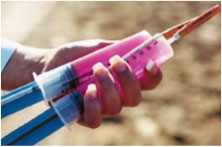
Wickersham's attention to detail is admirable, as is his historical research into the transition from death by gunshot to death by pink syringe...and why many veterinarians wish that a gunshot was still the way to go.

Veterinarians have been getting a bad rap lately. Most of the vets I know work very hard and do care about horses, and they care very much. The job of the track regulatory vet on a week day at the racetrack is so far from the romantic dream of a high school girl who wants to go to vet school to save all the beautiful horses that it makes a perfect premise for a narrative magazine article during Derby week.

When the idealistic girl grows up and carries a pink syringe between her manicured nails, the story takes on quite an edge.

Unfortunately, it is also true, and a real racehorse died that day.

I don't think that this story is anti-racing. It will take you somewhere at the track that you would otherwise never go and it may help you see the track vets in a new light.

We need more stories like Seth's, and fewer Tweets. A horse's life--or, in this case, death--just doesn't fit into 140 characters.

Click here to read The Final Furlong. It should also be on the newsstands by now, as it is in the May 4 edition of ESPN Magazine.


© Fran Jurga and Hoofcare Publishing. No use without permission. You only need to ask. Fran Jurga's Hoof Blog is a between-issues news service for subscribers to Hoofcare and Lameness Journal. This blog may be read online at the blog page, checked via RSS feed, or received via a digest-type email (requires signup in box at top right of blog page). To subscribe to Hoofcare and Lameness (the journal), please visit the main site, www.hoofcare.com, where many educational products and media related to equine lameness and hoof science can be found. Questions or problems with this blog? Send email to blog@hoofcare.com.

Monday, April 27, 2009

Quality Road's Derby Withdrawal: What Did Others Do?

by Fran Jurga | 27 April 2009 | Fran Jurga's Hoof Blog


For better or worse, quarter cracks have altered the course of horse racing history. Fortunes have been won and lost because of them. Many top breeding stallions have been plagued by them, and their progeny repeat their sires' painful steps. 

This quarter crack on a horse about to undergo treatment at Cornell University College of Veterinary Medicine is atypical in that it affects the lateral ("outside") hoof wall of a horse instead of the medial ("inside") wall. Trace the crack to the coronet and you will see that it follows a line of general stress that is not exactly parallel with the hoof angle. 

While most people focus on the larger part of the crack, toward the ground surface as it widens, the area of focus for judging the success of any  treatment will be the barely visible origin of the crack at the hairline. 

Florida Derby winner Quality Road sported a new patch on his new quarter crack when he galloped on Sunday, and plans called for a serious work today (Monday) at his home track of Belmont Park in New York before shipping to Louisville for Saturday's Kentucky Derby.

He stayed in his stall this morning: not a good sign.

Quarter crack specialist Ian McKinlay called on Sunday to say that he was disappointed that the crack's location, right at the hairline, meant that when he inserted the drain and tightened the sutures before applying the patch, there was a tiny drop of blood at the hairline.

“This is live tissue – we’re not changing a flat tire, so there are a lot of judgment calls," McKinlay told The Hoof Blog by phone. “Everything had been stabilized and when I changed the wires today, the crack opened up. There was a bit of sensitive tissue aggravated during the process. Hopefully, there won’t be a tinge of blood tomorrow (Monday) when he breezes.”

Trainer Jimmy Jerkens said Sunday that he was planning to treat the hoof with “Thrush Buster” as a drying agent and also with Animalintex poultice. “He’s got 24 hours to get better,” said Jerkens on Sunday. “I would have liked to have seen no blood, but it didn’t surprise me because he was still tender. He’s sound, he galloped the way he usually does, but I would have been more optimistic without blood.”

When Monday rolled around, the stall door did not open wide. No big colt came striding out.

Before you write this colt off, read your history. Today's leading sire A. P. Indy sat out both the 1992 Kentucky Derby and Preakness while recovering from a quarter crack, which popped the day before the Derby, and came back to win the much longer Belmont Stakes and Breeders Cup before entering stud.

And who could forget another leading sire, Unbridled's Song, whose owner (the now infamous Ernie Paragallo, currently accused of neglecting almost 200 horses on his farm in upstate New York), sent his colt to the post in the 1996 Kentucky Derby in spite of a quarter crack and bar shoe, only to have him finish fifth. Unbridled's Song missed the Preakness and the Belmont.

And don't forget one of the most underrated racehorses in American history: the great three-year-old campaign of Buckpasser, who won 14 stakes races with a gaping quarter crack that was often unpatched.

The crack did keep him out of the Triple Crown, but he came back to win the Travers...and everything else. I think he won something like 14 stakes races in quick succession, within a year, in spite of his re-cracking hoof. His jockey, Braulio Baeza, said he ran on his heart, not his hooves.

Buckpasser's three-year-old quarter crack was infected; the Phipps Stable brought in Standardbred quarter crack expert Joe Grasso to patch him and the crack recurred when he was four.

Buckpasser is one of the most interesting horses, hoof-wise, in recent American history. The Phipps Stables is said to have tested experimental European raceplates on him. He retired with a record of 31-25-4-1. That's right: he started 31 times in three years, almost all of which were stakes races.

In 1964, Northern Dancer (who looms in Quality Road's pedigree) won the Flamingo and Florida Derby prep races, as well as the Derby, while recovering from a quarter crack, but the crack would have been quite grown out by the Derby. Northern Dancer wore the vulcanized patch by Bill Bane at Santa Anita.

Just to muddy this whole situation, a horse can have a quarter crack, a Quarter Crack, or a QUARTER CRACK. It sounds like Quality Road has a quarter crack, but it is in a very sensitive spot, and his decisionmakers aren't taking any chances.

That translates to one less reason to hold your breath for two minutes on Saturday.

And that's ok.

Read The Hoof Blog's 2008 article on the history of quarter crack patches and horses who benefited from them.

© Fran Jurga and Hoofcare Publishing. No use without permission. You only need to ask. Fran Jurga's Hoof Blog is a between-issues news service for subscribers to Hoofcare and Lameness Journal. This blog may be read online at the blog page, checked via RSS feed, or received via a digest-type email (requires signup in box at top right of blog page). To subscribe to Hoofcare and Lameness (the journal), please visit the main site, www.hoofcare.com, where many educational products and media related to equine lameness and hoof science can be found. Questions or problems with this blog? Send email to blog@hoofcare.com.