Tuesday, June 24, 2008

Beating a Dead Horse(shoe): Big Brown's Loose Shoe, Revisited


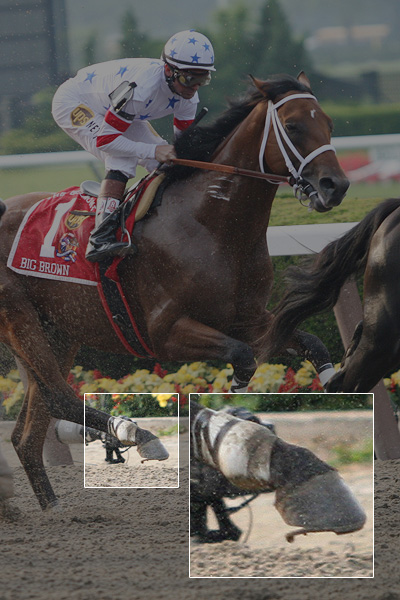
Photo links to ESPN's article on hind shoe revelation.


In the hours after Big Brown failed to win, or even really finish, the Belmont Stakes two weeks ago, majority owner Michael Iavorone of IEAH told the Blood Horse:

"His feet are ice cold, quarter crack not an issue. He had a very loose hind left shoe, but that’s not an issue."

Now we are left to wonder: did anyone check the right hind?

This week's Blood-Horse shows a loose shoe on what looks to be Big Brown's right hind foot...and the photo was snapped early in the race.

Please read the article on ESPN.com, and also go back and re-read the Hoof Blog's original post about the loose shoe. The Blood-Horse expose of the loose shoe is in the mail and will probably show up on their web site at some point.

The report of a loose shoe was a grave concern to me when I heard about it; some of the farriers I talked to were also quick to state that that might have been a problem, particularly with traction in the deep track. They were more concerned by a loose hind shoe than by a patched front foot.

But the Big Brown camp dismissed hind shoes as having played any role in Big Brown's uncharacteristic performance in the race of his life.

I know that someone out there will say that the closeup photo is showing a turndown style of hind shoe, but turndowns are not allowed in New York racing rules and the horse would have been spun before he even got to the paddock.

I also interviewed farrier Tom Curl, who rebuilt Big Brown's fickle feet in Florida this winter. Tom was with the horse after the Belmont. He did not consider the loose shoe to have been a performance limiting mishap when asked about it.

Of course, we'll never know what happened to Big Brown that day. The colt's not talking.

Monday, June 23, 2008

HOOF the Play: Barefoot Hoofcare Takes the Stage in London This Summer

Each year, planeloads of American tourists land at London's Heathrow Airport and head off on their pre-packaged tours of the London sights. A tour of the Tower, a peak at Buckingham Palace, a stare at Big Ben as he chimes the hour.

And in the evening, there's the obligatory tickets to the great theaters of London's West End, where plays like Phantom of the Opera got their starts. The theater district that brought us (for better or worse) Andrew Lloyd Weber, and where theater is...well....theatre. They even spell it differently. It's the real thing.

Tomorrow the Americans will board tour buses and head off to Stratford Upon Avon or Windsor Castle, but tonight, playbills clutched in hand, they settle in their sacred seats to the best London thespians have to offer. They've paid through the nose, so this better be good.

And this year it's...Hoof.

No. Not "Hair" but "Hoof".

The new play at the Lyric is described thusly: "A pony’s owner is growing up fast and TV has taken over from riding. When the remote control is unexpectedly dropped within hoof-reach, the horse’s lonely life takes a new tack. Her secret, night-time viewing reveals cowboy films and amazing adventures. She begins to realise she’s not just a dumb animal and a quest for a herd, humour and a life without shoes begins…"

The pony's story is enhanced with puppets, tap dancing hooves and nostalgic TV clips of Black Beauty and Champion the Wonder Horse.

That's right, barefoot hoofcare promoted from the stage in London.

Tap dancing without horseshoes might not have the same effect.

Note: there's also an improv theater company in Liverpool called Hoof! so this can be confusing!

If anyone has seen this play, please check in!

Big Brown's Part Owners Pledge Drug-Free Stable After October 1st

Here's a statement issued today by International Equine Acquisitions Holdings (IEAH), the partnership that is part owner of Kentucky Derby and Preakness winner Big Brown. The statement comes on the heels of a Congressional hearing held Thursday in Washington DC in which House committee members were highly critical of lax drug policies (among other things) in US horse racing.

This is the first announcement of this sort that has been issued, although there are probably racing stables and/or trainers who have similar policies without stating them. Remember that medication rules vary by state. For many years, New York had a much tougher medication policy than other states. Today, it is legal to race horses on steroids and other medications in most states.

The Jockey Club has been promoting a nation-wide ban on steroids by the end of this year, by the issuance of a model rule that would be adopted by individual states. They also have issues a model rule change outlawing any traction devices or toe grabs on front shoes. However, no one has the power to force a state to change its drug or horseshoe regulations.

From IEAH's statement:

"In an effort to re-build confidence and the integrity to the great sport of Thoroughbred horse racing in North America, IEAH Stables is proud to announce effective October 1 all horses in training and racing in IEAH silks will run only with Lasix. No other medication, drugs, or steroids will be administered.

"While regulatory standards and indeed legislation may be required to resolve most of the controversial issues surrounding our sport, we believe our announcement today is a step in the right direction. To the best of our knowledge, we are the first racing stable in North America to make this commitment. We encourage others to follow our lead.

"We have selected an effective date of October 1 as the official "free-of-medication" withdrawal date because our horses should be clear of all substances by that time. As of October 1, we will request all tracks at which our horses run to perform pre-race and post-race testing at our expense. These procedures have proven effective under racing conditions outside North America.

"Moreover, in the interest of fairness to the wagering public, we will request and strongly urge that race programs include data indicating which horses will run with medication, which will run free of medication. The programs should also indicate which owners/trainers decline to divulge this information.

"As a further test of our commitment, beginning October 1, if any of our runners test positive for medication other than Lasix, we pledge to donate our share or purse money to charities related to thoroughbred horse racing. We will specify those charitable organizations at a later date.

"We believe this change is for the betterment of our sport. In the long run, it will benefit all involved in the game -- the tracks, horsemen and most of all the fans."

(end quote)

(Note: Lasix, the one drug that IEAH says it will allow, is a diuretic anti-bleeding medication.)

An interesting footnote to this story is that Benny the Bull, owned by IEAH, won the Golden Shaheen, a tough international race in Dubai this fall. Dubai racing has a zero tolerance for medication and the Dutrow-trained horse managed to win impressively in spite of the drug ban, international travel, and searing desert heat, as did 2007 Horse of the Year Curlin.

IEAH's October 1 deadline means that their horses, if entered, would not run on medication for the 2008 Breeders Cup to be held in California later that month.

Wednesday, June 18, 2008

Jockey Club Calls for Ban of All Traction Devices on Front Shoes of Racehorses

A press release from the Jockey Club yesterday calls for immediate action to change front shoe regulations of racehorses immediately. The edict was a result of research completed in the past few weeks by the newly appointed Thoroughbred Safety Committee.
Recommendations from the Committee will be reviewed by individual state racing commissions, who have the authority to adopt, adapt or reject the recommendations.

Specifically, the committee calls for:

  • An immediate ban on toe grabs (other than 2-millimeter wear plates), turn downs, jar calks, stickers and any other traction devices worn on the front shoes of Thoroughbred horses while racing or training on all racing surfaces.
  • The Association of Racing Commissioners’ International (RCI) and all North American racing authorities to implement this ban by rule as soon as possible, but no later than December 31, 2008, and for all racetracks to consider immediately implementing this ban by “house rule” in the interim.
Previous recommendations from the Grayson Jockey Club's Welfare and Safety Summit had included a model rule banning toe grabs greater than 4 mm; this recommendation was developed and passed at at the Racing Commissions International (RCI) Convention in April 2007, but is subject to adoption by individual states. Several states, including California, adopted that recommendation.

The new policy advisory is much stronger, since it lowers the toe grab from 4 millimeters to effectively eliminating it except for the wear plate seen in the toes of most flat shoes and outlaws the use of mud calks, jar calks, and stickers.

Turndowns and bends (angling the heels of the shoe toward the ground) are normally seen on the hind feet, as are most toe grabs and traction devices.

The Jockey Club policy advisory only addresses traction on front shoes.

Additional advisories recommend elimination of steroid anabolic medications in the race training and racing of Thoroughbreds no later than December 31, 2008.

The Thoroughbred Safety Committee includes chairman Stuart S. Janney III, and members John Barr, James G. (Jimmy) Bell, Dr. Larry Bramlage, Donald R. Dizney, Dell Hancock and Dr. Hiram C. Polk Jr. Each is a member of The Jockey Club.

The Welfare and Safety Summit includes a Shoeing and Hoof Care Committee, chaired by Bill Casner of WinStar Farms. The committee has been actively working on creating more information about racehorse shoes and their effects on horses and their interaction with different surfaces.

Read Tuesday's complete press release here.

Sunday, June 15, 2008

Friends at Work: Father's Day Off

Today is Father's Day in the USA, and perhaps other places in the world. By coincidence, I think, I received an email today from my friend Uwe Lukas in Germany. Uwe is the author of the great new book (in German only, sadly, but the photos are great) Gesunde Hufe, Kein Zufall. Uwe has a long list of impressive credentials in the farrier and sport horse world, but today his top credential is as a proud father. In the photo, you see his six year old daughter Leonie trimming her pony. (Where did she get a farrier's apron to match her hair????)

Uwe writes by email today, "Now i have a little bit for smile. My daugther is 6 years old and she trims her pony self. I give her only supporting how much and where she trims. She knows, she will be a Farrier and a Vet in the future. I think it's changing sometime more."

If the stable in the background looks a little elaborate, the Lukases liven in Warendorf, home of the state stud for the Westphalian breed and the national equestrian federation. A lot of Olympic gold medals have gone home to Warendorf.

Uwe's English is a lot better than my German, but I am sure you can get the idea of what he's saying.


I think I have some matchmaking to do. On this side of the Atlantic, we have Robbie Pethick, the handsome son of New Jersey farrier Bob Pethick, who has taken on trimming a horse, not a mere pony. Robbie will be six in August.

They already have something in common--note that they are both using HoofJack hoof stands!

Both of these youngsters also have a great advantage if they learn from their expert farrier dads, each of whom shoes some of the very top dressage and sport horses in their respective countries.

Father's Day for me was tinged by the memorials on television here in the USA this morning for the superb television journalist/interviewer and one of my professional heroes, NBC's Washington bureau chief Tim Russert. Tim was much more than a reporter and host of the "Meet the Press" tv show, as evidenced by his larger-than-life camera presence and his recent stints on the bestseller list with his book Big Russ and Me, about growing up under his father's influence in the gritty US city of Buffalo, New York. Tim died suddenly this week.

I was hoping to quote from the book here but when I went looking for an excerpt I ended up on the book's web site and I found a letter from Tim on the front page. I'll reproduce a little passage from it here, and hope that if you haven't read this book, you will, no matter who your dad was or is, or what your relationship is like. Tim writes:

In the spring of 2004, I published a book about my father--about the lessons I have learned from him, the way he has influenced me, and my enormous love and respect for this steady, hardworking, and modest man. My publisher sent me on a publicity tour in the hope that people around the country would see the book as an ideal Father's Day gift.


Early in the tour I was in Chicago, where to my great relief, customers were lining up to buy the book and have me autograph it. What happened next really surprised me.

"Make it out to Big Mike" somebody told me, which was followed in rapid succession by, "This is for Big Mario"..."Please inscribe it out to Big Manuel."..."For Big Irv."..."Big Willie"..."Big Stan"

I had expected that my book would appeal to readers in my home town of Buffalo, New York, but I didn't know whether the story of a young man coming of age in a blue-collar Irish-Catholic neighborhood, whose father was a truck driver and a sanitation man, would strike a cord with a wider audience.

I (soon) discovered there were many Big Russes out there--good, industrious, and patriotic men who have a lot in common with my dad, even if they didn't share his religion or his heritage. By writing a book about my father, I was affirming not only his life, but the lives of many other fathers as well.
(end quote)

I am sorry that I never had a chance to ask Tim to inscribe a copy to Big Joe.

If you have a few minutes, click on this link and listen to Tim reading the intro to Big Russ and Me. Link to Tim Russert reading

Saturday, June 14, 2008

Another Country Heard From: Meet the Hooves of Japan's Casino Drive


Casino Drive's Feet, originally uploaded by Rock and Racehorses.

Racing is full of "What ifs" and there were probably echoing off Casino Drive's stall walls when Big Brown failed to fire a week ago in the Belmont Stakes.

Casino Drive was visiting from Japan with the sole purpose of stealing the Belmont from Big Brown. He certainly stole the Peter Pan in a very dramatic run for the finish line a few weeks earlier, but a bruised foot caused his connections to be cautious and skip the Belmont instead of poking and prodding and poulticing and patching the colt's foot.

Meanwhile, my friend Sarah Andrew (a.k.a. "Rock and Racehorses") tracked the poor horse down to take photos of his feet for this blog. I wonder what the Japanese team thought of her pointing the camera not at his handsome head but at his feet and knees?

Casino Drive is out of the same mare who foaled the winners of the 2006 and 2007 Belmont Stakes. What if....

(Casino drive and his long feet have gone back to Japan, promising to return for November's Breeders Cup, which will be raced on an artificial track surface for the first time. I hope he can stay sound and healthy and show up with his race face--and feet--on.)

Can someone tell me about this shoe?

My friend Xavier took this photo...it was on a display board and is not an antique shoe out of a museum.

I have a theory, what's yours?

And can someone explain why and when you'd want to double-fuller like that? It would be a good forging test to get the arcs parallel; this farrier did a good job. A smooth arc on a single crease is an art...but parallel ones?

Maybe one of the British farriers can tell us if there is a name for double fullering. However, this is not a British shoe, as far as I know.

Leaving a comment to explain your theory about this shoe is easy: scroll to the bottom of this post and click on the word "Comments". A new window will open. Type your comment in the box on the left. On the right, click on "name/url" and a little box drops down. (Or at least it does on my Mac with a Firefox browser.) Type your name or nickname in the box marked "name".

Then hit either "preview" to look over what you typed in the big box, followed by "publish comment". And you're done!

If that's too much to ask, you can email your comment to me and I will post it for you.

If you have a Google or Gmail account and are signed in, you can ask the blog to automatically email other comments about this shoe to you so you can respond to people who respond to you.

The Hoof Blog has a new policy of moderating comments, by the way, since some people have been getting a little edgy and maybe a little too presumptuous of my laissez-faire attitude, so it may take a little while before your comment shows up on the blog until I approve it.

And if you don't like horseshoes, please don't feel obliged to preach to those who do. Just wait til there is a subject you do like. Let's accentuate the positive, my friends. There's plenty of hoof to go around.

Thursday, June 12, 2008

Big Brown's Trainer Called to Testify Before Congressional Investigative Committee

The New York Times is reporting this morning that Rick Dutrow, the trainer of Kentucky Derby and Preakness winner Big Brown, will testify before the United States Congress next Thursday when a special House of Representatives Subcommittee on Commerce, Trade and Consumer Protection hearing on “Breeding, Drugs, and Breakdowns: The State of Thoroughbred Horseracing and the Welfare of the Thoroughbred Racehorse” will be held.

The Subcommittee is investigating the reasons for the deaths of so many racehorses recently, spurred by the double-breakdown of the filly Eight Belles who finished second in the Kentucky Derby and was euthanized on the track.

Others who will testify, according to the New York Times, are Richard Shapiro, the chairman of the California Horse Racing Board; Arthur Hancock III, the owner of Stone Farm outside Lexington, Ky.; Jess Jackson, the owner of Stonestreet Stables; Randy Moss, the ESPN analyst; Alan Marzelli, president of the Jockey Club; and the trainer Jack Van Berg.

Additional witnesses may include Susan Stover, the director of a veterinary research laboratory at the University of California at Davis; Larry Soma, a professor at the University of Pennsylvania’s New Bolton Center; Dr. Mary Scollay, the Florida state veterinarian who has been hired as the equine medical director of the Kentucky Horse Racing Authority; Dr. Wayne McIlwraith of the College of Veterinary Medicine at Colorado State; and Alex Waldrop, the chief executive of the National Thoroughbred Racing Association.

Dutrow is likely to face questions about the use of steroids in racehorses. He recently admitted that Big Brown, like all his horses, was given monthly injections of a steroid called Winstrol. Dutrow reportedly said he didn’t know what the drug was or what it did. He told the Times that he might take his veterinarian to the hearing with him.

Let’s hope the hearings are on C-Span. Audio web-casting will be available if you have a Windows Media Player installed in your computer.

Monday, June 09, 2008

MSNBC Salutes Molly, the Three-Legged, Dog-Bitten, Katrina-Surviving Wonder Pony!


To launch the video, just click on the "play" icon. It will play right in the blog window.

As marketer of the book MOLLY THE PONY, Hoofcare and Lameness is tuned in to the story of the spunky little New Orleans pony who survived being abandoned in a collapsed barn during Katrina, didn't die after an attack by pitbulls, and finally, made a huge comeback from rare amputation surgery that left her hobbling around the bayou on three legs.

Molly has a safe new home now, and a new job in life as a therapy pony visiting hospitals and schools.

And we have a hit book on our hands!

Enjoy this little video about Molly, and thanks to everyone out there who helps ponies and horses like her! Molly is giving back a lot to the world that saved her life, more than once.

Thanks also to the Soft Ride hoof boot company, for their donation of a support boot for her "good" front leg. So far, Molly has not developed laminitis in the 18 months since her surgery, but we do want to keep it that way. Donations of products and techniques to keep her comfy or offer support are most welcome; Molly now has her own tax-deductible charity, called "Kids and Ponies".

To order a copy of Molly's book, go to Molly's web page on hoofcare.com.

Quarter Crack Repair: The Lost History of Hoof Patches

This story was updated in 2022

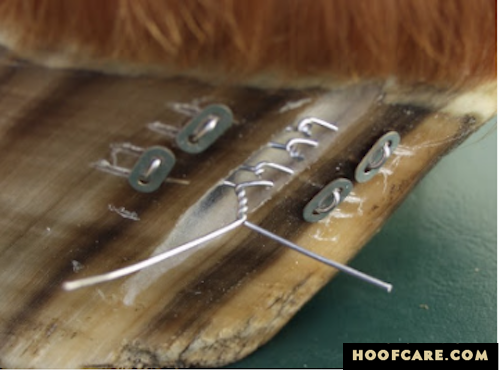
quarter crack repair by stainless steel lacing
This is an example of a quarter crack repair by lacing technique, using stainless steel sutures threaded through tiny and shallow guide holes drilled with a very fine drill bit. The idea is not to shut the crack but to hold it open and stabilize it so that any infection or "heat" can dissipate before a patch is applied. Quarter cracks have varying risks for infection and may or may not be associated with an abscess somewhere else under the hoof wall. The new complete hoof wall grows down from the hairline, much as you grow a new fingernail. (Ian McKinlay photo)


Did you know it’s been more than 50 years since the “invention” of the modern quarter crack patch?

Farriers have been stitching and clamping quarter cracks together for well over 100 years now, but a unique “modern” quarter crack patch was patented in 1964 by an enterprising Los Angeles racetrack horseshoer named William R. Bane. 

At first, Bane offered to patch horses for free, just to get the word out.  Bane's first patch was on the Thoroughbred Destructor, trained by John Nerud.

A horseshoer based at southern California tracks, Bane enjoyed early success with a champion Thoroughbred aptly named "Prove It." Once patched, Prove It won six stakes races in a row, including the Hollywood Gold Cup.

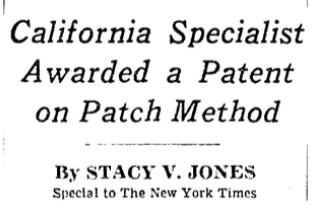
Bill Bane quarter crack patch headline in New York Times
In January of 1964, the US Patent Office awarded him patent number 3118449, to protect his secret method for repairing cracked hooves of Thoroughbred and Standardbreds so they could race again--and win.

It was enough of a big deal to be written up as a headline story in the New York Times.

Bane’s plan had been to train others at racetracks around the country, much like a franchise, but he ended up spending a lot of time on airplanes because owners and trainers wanted him to personally patch their horses. 

Bane’s patented secret turned out to be to cover the cleaned crack with a synthetic rubber called Neolite, a material very popular in the early 1960s for rubber-soled shoes, which were quite a sensation at the time. 
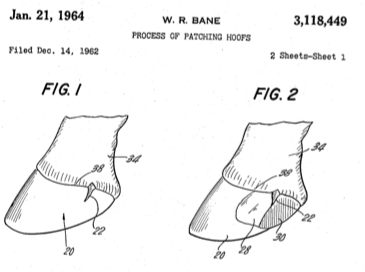
Bill Bane patent for quarter crack patch


In 1962, Bane was called east to work on Su Mac Lad, who at that time was the world’s all-time high-money winning trotter. It took Bane eight hours to patch that crack for trainer Stanley Dancer, but Su Mac Lad was training the next day and raced a week later. He went on to be United States Harness Horse of the Year, with a patched hoof. He raced an impressive 151 times in his life; Bane patched him six times. The 1960s were the heyday of harness racing in the United States, and Su Mac Lad is still revered for his racing record.

Bane charged $250 for his patches in 1962, plus his travel expenses.

The steps listed for Su Mac Lad’s eight-hour ordeal were:

1. remove some of the wall behind the crack
2. reshoe the horse;
3. apply the rubber;
4. apply plastic cement;
5. wrap with tape;
6. heat treatment for an unspecified time;
7. remove the tape;
8. finish the patch to conform to hoof wall contour.

Fiberglas eventually gained popularity over Bane's rubbery patch, and then in the 1990s, two-part polymethylmethacrylate (PMMA) adhesives came along for rebuilding walls, shoring up weak heels, and covering cracks after they were dry.

According to newspaper reports of the day, Bane was also called in to patch Northern Dancer, who won the Kentucky Derby and Preakness while wearing a Bane patch.

But no horse is more associated with Bane--and with quarter cracks in general-- than the great Buckpasser, who sat out the 1966 Kentucky Derby and Preakness while newspapers chronicled his crack woes, and what Bill Bane thought and did. Or didn't do.

Eventually, Buckpasser came back to racing and won just about everything, with 15 consecutive victories, setting track records and earnings records as he went, in spite of a recurring crack.
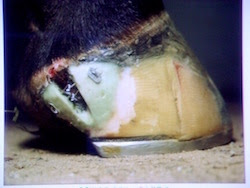
Big Brown Triple Crown quarter crack
Kentucky Derby and Preakness winner
Big Brown in 2008; his cracks had cracks.
(© Ian 
McKinlay  photo)
I should mention that 13 (by my count) of those victories where in the second half of 1966 alone. Many horses today may not have that many starts in a lifetime, let alone do it on a cracked foot.

Buckpasser was never actually patched by Bane. He did fly from California to Florida to examine the horse days after the crack was noticed following the colt's victory in the Flamingo in March. Bane determined that the crack was infected and should not be patched right away. He stayed and checked the foot repeatedly, waiting for it dry up. He refused to patch it until he deemed it free of infection.

Bane also told the press that the crack was far back in the heel area, a difficult area to work on. Without a patch, the horse couldn't train.

A week later, a New York paper announced that the trainer admitted that Bane had not patched the horse, perhaps because of the unfortunate location or perhaps because of the persistent infection--or both. The world waited to see the great horse return to racing.

Newsday (New York) headline

Bane went back to California. Buckpasser ended up eventually being "patched" by Louis Grasso, an auto-body mechanic and sometimes harness horseshoer from The Bronx, who had some success patching Standardbreds. 

Grasso's high-tech materials were actually variations of auto body repair materials, which he described as more of a coating than a patch, when applied to a cracked hoof. He called his material "Nu-Hoof".

Ultimately, the crack bothered the horse enough to warrant his retirement after one of the most successful US racing careers in history, including setting track records, in spite of the crack. His jockey, Braulio Baeza, told the trainer that the horse had had enough and was running on heart alone, not hooves.
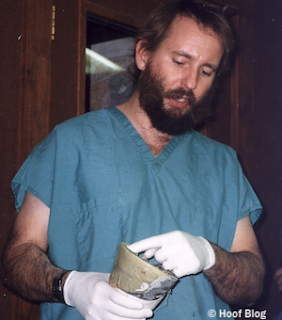
Penn Vet farrier Rob Sigafoos pioneered
multiple applications for polymers on the hoof.
In the 1980s, the great Standardbred Nihilator raced with quarter cracks that were patched by farrier Joey Carroll. His heel was basically removed, and he wore a z-bar shoe. 

In 1992, Carroll was in the news again, putting a patch on A.P. Indy before the Belmont Stakes that year, after the great horse sat out the Derby and Preakness, much like Buckpasser, while his foot healed. 

Before the 1992 Belmont, the New York Racing Association had to issue a press release denying that A.P. Indy was lame. Conspiracy theories sprang up when he was secretly vanned to a different racetrack to train without an audience. When Joey removed A.P. Indy's bar shoe before the race, and replaced it with a regular plate, it was news. (And he won.)

Buckpasser's quarter crack experience in the mid-1960s came at the same time that researchers Jenny and Evans at the University of Pennsylvania's New Bolton Center were publishing papers in the Journal of the American Veterinary Medical Association on their experiments with acrylics for hoof repair. 

Twenty years later, Penn Vet farrier Rob Sigafoos continued their research with acrylics and polymers to not only patch hooves: Sigafoos had the first widely-recognized success with glueing cuffed shoes to the foot by using the hoof wall as the attachment site instead of the bottom of the foot.
William Moyer, DVM
Professor Bill Moyer (file photo)
Penn Vet's Dr Bill Moyer claimed to have worked on 74 different cases of quarter cracks in one year. That would average out to more than six per month. He said that most were Standardbreds; Moyer received funding from Standardbred leader Billy Haughton to study crack repair. He loaded feet in a vise and found that the crack closed when the horse was weightbearing, and sometimes even overlapped, which would pinch tissue and cause a horse a lot of pain.

Sigafoos and Moyer even collaborated on an instructional book.

The study of the hoof wall received a major boost in 1980, with the publication of Doug Leach's doctoral thesis at the University of Saskatchewan. "The structure and function of equine hoof wall" Importantly, in 1987, Canadian researchers Bertram and Gosline at the University of British Columbia delved into the structural properties of the hoof wall, as well as of keratin and the effects of moisture on wall strength.

Quarter crack repair is still a task best left to the experts. Done incorrectly, a well-meaning lacing and/or patching job done at the wrong stage of crack therapy can seal in infection so that a major problem erupts. 

Or, it could impede normal growth from the coronet, causing a hoof deformity or a growth defect in that area. The goal of repair is a clean, dry crack growing out under the protective patch so that the horse is sound and pain-free.

Today, equine podiatry has advanced to the placement of drainage tubes under patches, as well as antibiotic-impregnated hoof repair materials. We still need a way to evaluate weightbearing in field and clinic conditions, before and after patching and during the rehabilitation period, to prevent subtle gait changes or imbalances that will affect healthy wall growth around the entire circumference of the coronet.

I am fortunate to have a great library of new and old books, as well as files that bulge with notes and proceedings from the hundreds of meetings I've attended, and (most of all) input from farriers and vets who generously share their cases, experiences, videos, and photos. 

How different things were in Bill Bane's day. But one thing has not changed: Quarter cracks are still a challenge to a horse and everyone who tries to help.
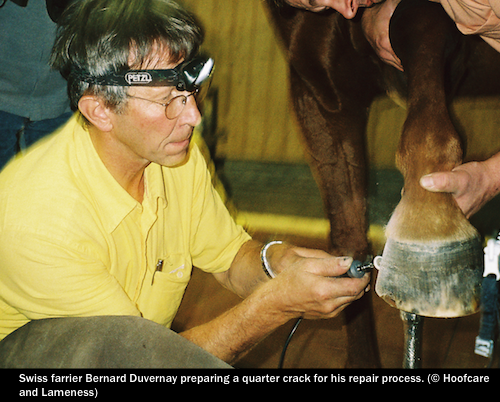
Swiss farrier Bernard Duvernay

In spite of the availability of skilled practitioners, in spite of advances in technology, and in spite of advanced medications and therapeutics, quarter crack recovery is still compromised by owners and trainers who fail to act quickly to intervene and who fail to appreciate the need for continued care and monitoring.  A quarter crack is not a "fix it and forget it" problem for a horse; it can be a bump in the road for an equine athlete or a prolonged, painful lameness issue that limits a horse's career, value, and welfare. 


Click here for free signup for Hoof Blog newsletter updates.


© Fran Jurga and Hoofcare Publishing; Fran Jurga's Hoof Blog is the news service for Hoofcare and Lameness Publishing. Please, no use without permission. You only need to ask. This blog may be read online at the blog page, checked via RSS feed, or received via a headlines-link email (requires signup in box at top right of blog page). Questions or problems with this blog? Send email to
hoofblog@gmail.com.
  

Read this blog's headlines on the Hoofcare + Lameness Facebook Page
 
Disclosure of Material Connection: The Hoof Blog (Hoofcare Publishing) has not received any direct compensation for writing this post. Hoofcare Publishing has no material connection to the brands, products, or services mentioned, other than products and services of Hoofcare Publishing. I am disclosing this in accordance with the Federal Trade Commission’s 16 CFR, Part 255: Guides Concerning the Use of Endorsements and Testimonials in Advertising.