Tuesday, January 26, 2010

Not Even Martha Stewart Has A Recipe to Fix Chronic Lameness

by Fran Jurga | 26 January 2010 | Fran Jurga's Hoof Blog


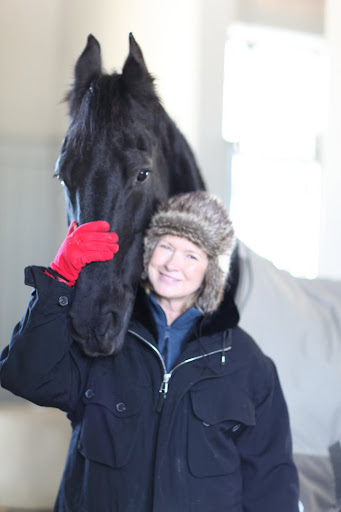
Once again, celebrity horse owner Martha Stewart invited her readers into her barn in New York recently, through her blog. The photos were published over a period of a couple of weeks.
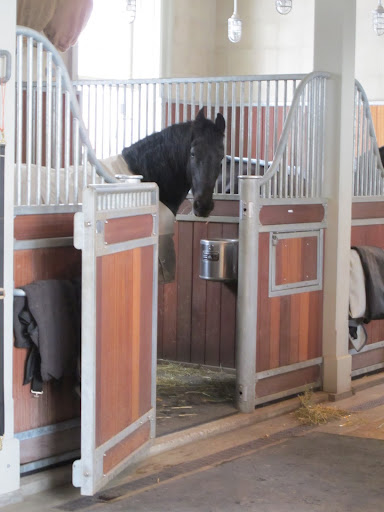
Martyn is a 17-year-old Dutch Friesian. Martha has been documenting his lameness problems for a while now on her blog, but her holiday message about the horse sounded quite discouraging. Martyn can no longer safely be turned out with the other horses during the winter, Martha wrote. The barn doors were kept closed and his stall door open, giving him the freedom of the huge stone barn.
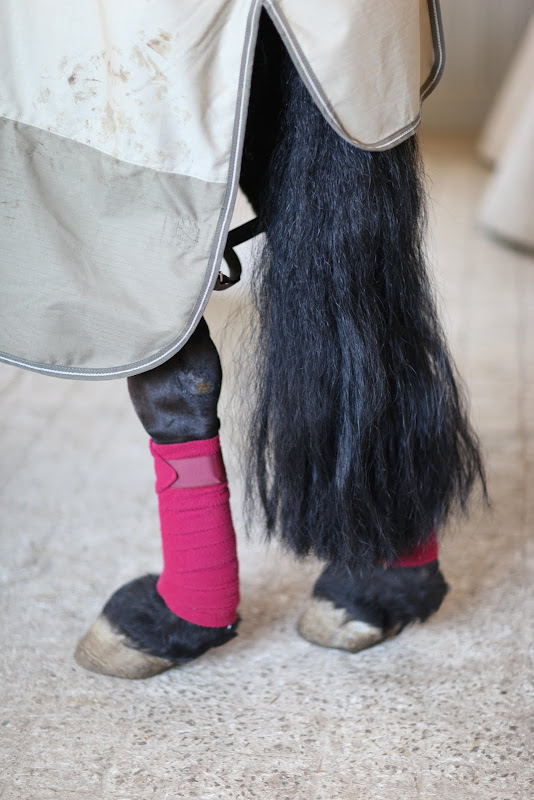
Martha describes his problems as multiple, but chose to photograph the pasterns and fetlocks of his hind legs. Readers will probably "diagnose" this part of Martyn's problem. I don't know what else may have been diagnosed for the horse.

Soon after these photos were taken, the horse was euthanized. I can't remember another time when a celebrity figure detailed the health problems of a horse and its death on such a personal level.

A few months earlier, actress Glenn Close sent a video message to the
Fifth International Equine Conference on Laminitis and Diseases of the Foot
in West Palm Beach, Florida. She had been given an award for her role in a documentary about laminitis. In the video message, she mentioned her personal war with laminitis as she struggled to save her Morgan mare, Rosie, who was euthanized.

Lameness and laminitis can happen to any horse, but for these two women to speak out and show emotion over the loss of their horses is something new in the horse world. It can't change how a horse is doing, but perhaps it can help some owners stick with the program, or decide to get some tests done. Maybe it's the Internet, or maybe it's the age of accepting animals as family members, but it's a different world out there and owner emotions--positive and negative--are part of the equation of every horse's care and health.


© Fran Jurga and Hoofcare Publishing. Please, no use without permission. You only need to ask.

Fran Jurga's Hoof Blog is a between-issues news service for subscribers to Hoofcare and Lameness Journal. This blog may be read online at the blog page, checked via RSS feed, or received via a digest-type email (requires signup in box at top right of blog page).

To subscribe to Hoofcare and Lameness (the journal), please visit the main site, www.hoofcare.com, where many educational products and media related to equine lameness and hoof science can be found.

Questions or problems with this blog? Send email to blog@hoofcare.com.

Thursday, January 21, 2010

Virginia Tech Hires Full-Time Farrier for Veterinary College Post

20 January 2010 | Fran Jurga's Hoof Blog at Hoofcare.com

Travis Burns will leave his employment with the multi-farrier practice Forging Ahead in Round Hill, Virginia to become the full-time farrier at the veterinary college at Virginia Tech. He's shown here with one of his favorite horses, a big-footed barefoot fellow named Gumpy. (Hoofcare & Lameness photo)

This announcement was received this week from the
Virginia-Maryland Regional College of Veterinary Medicine
at Virginia Tech University in Blacksburg, Virginia; thanks to Drs. R. Scott Pleasant (far left) and David Hodgson (near left) for their assistance. (University announcement text in red)

We are very pleased to announce that Travis Burns, of Marshall, Virginia, has joined the Virginia-Maryland Regional College of Veterinary Medicine at Virginia Tech as a full-time farrier.

Burns’ arrival in February will allow the College to provide complete equine podiatry services through the Veterinary Teaching Hospital. In his position, Travis will assist the equine faculty in building on the service, education, and community engagement strengths of the College. We believe that Travis’s special skills, knowledge, and experience will be a great resource for our students and regional horse owners, farriers, and veterinarians.

Proper management and care of a horse’s hooves is essential to the overall health of the animal, according to Dr. David Hodgson, head of the Department of Large Animal Clinical Sciences. “Properly trimmed and balanced hooves and correctly fitting shoes are essential to preventing lameness and other maladies in horses,” said Hodgson. “The addition of Travis to our department and hospital further enhances the overall preventive healthcare package we are able to offer our patients, clients and referring veterinarians. We are very pleased to welcome him and plan for him to enhance our ties to the local community of farriers. Travis will be working closely with Dr. Scott Pleasant and other members of our veterinary team. Dr. Pleasant is one of the leading veterinary exponents for the advancement of hoof care in horses. ”

Travis’s interest in horseshoeing began at an early age while working with horses at his uncle’s riding stable in North Carolina. He attended farrier school in the winter of 2002 and then continued to shoe horses while attending college. He graduated from North Carolina State University in 2006 with a Bachelor’s degree in Animal Science. In 2007, Travis was accepted into a one-year internship program at Forging Ahead, an elite multi-farrier practice in Northern Virginia. Upon completion of the internship program, based on his outstanding ability, Travis was retained at Forging Ahead as an associate farrier.

Travis recently achieved Certified Journeyman Farrier certification by the American Farrier's Association, the highest level of certification granted by the organization.

(end of Virginia Tech document)

Hoofcare and Lameness would like to congratulate both Travis Burns and Virginia Tech for the new directions each of them is taking (and taking together). While Travis is heading into a new area, there is no doubt he gives a lot of credit to the formal internship program that he completed at Forging Ahead; he was later hired on as an associate farrier there. The fact that he would be an AFA Journeyman and be considered for this position at the vet school so early in his career is testimony to the program that Paul Goodness has designed at Forging Ahead for farriers who want to seriously accelerate their careers working on top sport horses or specializing in lameness. While not everyone can be an intern at Forging Ahead, the program can be emulated by others, and hopefully more internships for working professional farriers will be offered in the future.

How does Paul Goodness feel about losing his protege? "I think it's so great," he said in a phone interview this morning, "that Virginia Tech would choose a young, talented farrier like Travis. He'll go far in this industry. They are starting with a clean slate, by hiring someone who wants to help horses and make a positive difference on many fronts. This is a step forward for the farrier-vet world. I will be able to stay in touch with Travis and send him cases from Leesburg. (Note: Marion duPont Scott Equine Medical Center in Leesburg, Virginia, which is affiliated with Virginia Tech and where Paul is the farrier).

"It's not a crisis here at Forging Ahead. It's true, 2009 wasn't the best year for us, and I'm sure not the best year for most farrier businesses," he continued thoughtfully. "But we've already picked up new clients this month and I don't feel like I need to be running back and forth to Florida. Scott and I have full books, all day, just here at the shop with haul-ins. We're predicting a big year and an influx of foreign riders to the area to train and compete before heading to Kentucky for WEG in the fall. The farrier business should be just fine, as should be the lameness referrals."

Here's a re-post of the NBC News segment taped at Forging Ahead about the internship program during the run-up to the Kentucky Derby last April:


, ,Please allow time for NBC's "Thank Goodness" video to load. Click the play icon to begin.


Links to more articles about Forging Ahead:
Link to Internship Program Announcement in 2007
Link to "Friends at Work" About Forging Ahead in 2009
Link to Forging Ahead web site

In 2009, Travis attended the Fifth International Equine Conference on Laminitis and Diseases of the Foot in West Palm Beach, Florida and the North East Association of Equine Practitioners Conference in Ledyard, Connecticut. He also was a guest presenter at one of our Hoofcare@Saratoga evenings last August in Saratoga Springs, New York, where he presented Forging Ahead's clever reverse Mustad glue-on shoe for laminitis therapy.

While I was working on this announcement, several people forwarded to me links to a story that was published around the country today, via Associated Press, and most notably on the ABC News and National Public Radio web sites. The article features Jason Wilson-Maki, farrier at Texas A&M University, along with a brief mention of Michael Wildenstein, farrier at Cornell.

There are many hardworking farriers at vet schools around North America, including Jason and Michael, whether full-time employees or contract service providers. I'm sorry to say that I don't know who they all are, so if you work for or with a vet school, please contact The Hoof Blog so we can keep a list.

And today we can add Travis Burns to that list of farriers...and Virginia to the list of vet schools that has one.

© Fran Jurga and Hoofcare Publishing. Please, no use without permission. You only need to ask.

Fran Jurga's Hoof Blog is a between-issues news service for subscribers to Hoofcare and Lameness Journal. This blog may be read online at the blog page, checked via RSS feed, or received via a digest-type email (requires signup in box at top right of blog page).

To subscribe to Hoofcare and Lameness (the journal), please visit the main site, www.hoofcare.com, where many educational products and media related to equine lameness and hoof science can be found.

Questions or problems with this blog? Send email to blog@hoofcare.com.

Saturday, January 16, 2010

USEF Reduces Medications Levels: Only One NSAID Allowed in Competition Horses After This Year

16 January 2010 | Fran Jurga's Hoof Blog at Hoofcare.com

Horses showing in USEF-sanctioned horse shows will be subject to new drugs and medications policies beginning at the end of 2010 as more than 30 years of permissive use of pain medication is being restricted under a more conservative rule. Even with half the medication formerly allowed, US horse shows still have a very liberal policy compared to most countries.

Big news from Louisville, Kentucky tonight: At the annual convention of the United States Equestrian Federation (USEF), the governing body of most equestrian sports in the United States, a significant rule change is being agreed upon which will reduce the number of medications that a horse can have in its system when competing.

Various committees within USEF have been working toward a compromise on this issue throughout the convention, which began on Wednesday. Current USEF rules allow two non-steroidal anti-inflammatory medications to be used simultaneously; that policy has been in place for more than 30 years.

The change was not without its opponents; the US Hunter Jumper Association's Open Hunter Task Force had filed for a rule change (GR410.1) that would have allowed two medications if written notification was given, but then withdrew its proposal on December 9.

Some breed and sport representatives felt that limiting medication is a penalty to older horses or to lower-level shows that do not have the best footing. Perhaps some horses will now show in fewer shows, or be entered in fewer classes. Some arguments were made that the current low value of horses makes it a hardship to sideline horses that could be competing if medicated. It remains to be seen if the new rule will affect horse show revenue; it is not expected to take effect until December 2010.

In most European countries, no medications are allowed; no medications are allowed in competitions sanctioned by the Federation Equestre International (FEI), the world governing body of horse sports. A recent vote to change the FEI medication policy caused an international uproar.

There is a lot to this story, and more will emerge in the days and weeks to come as the official final wording of the rule and dates are made public. One thing is known, and that is that the push to make the change came from veterinarians, who are often accused of promoting drug use in show horses.

Dr. Kent Allen, longtime chair of the Drugs and Medications Committee for USEF, commented on the obvious rise in joint injection that may be the result of a limit on medication. In a document available on the USEF website he offered this insight: "First, it is important to understand that a joint injection properly performed in experienced veterinary hands is the single most effective anti-inflammatory treatment we have for (an) equine joint.

"Secondly, there are numerous medications to inject into joints. Often it is hyaluronic acid in combination with a variety of cortisones, or bioregenerative therapies such as IRAP. Some of these medications are extremely safe and all of them will significantly reduce joint inflammation.

"On the question of 'are joint injections going to be overused', the answer is that is already happening today! In some cases joint injections are being used as treatments in 4, 6 or 8 joints without a diagnosis of joint inflammation ever being established. This is dangerous not only from the standpoint of increasing the number of joint injections in the horse and potential side effects but you may or may not be treating the real problem. Accurate diagnosis, including lameness examination, nerve blocks, joint blocks and diagnostic imaging is the most effective method of determining what the problem is and if the horse needs joint injections. This also has the benefit of reducing the cost to owners as well as the risk to the horse."

USEF approved the use of Surpass, a topical anti-inflammatory recently; there's no prediction so far if there will be a trend to more specific treatments rather than generalized medication for pain, stiffness or soreness.

While rumors of a compromise were circulating today, equestrian journalist Nancy Jaffer broke the news tonight in her column for the Star-Ledger in New Jersey that the new medication policy would be adopted. More insight into the process of the rule change can be found in Nancy's article.

The new rule will affect most breed shows, including Arabians, Saddlebreds and Morgans, plus USEF-sanctioned hunter-jumper, dressage, driving, endurance and eventing competitions and individual breeds and sports who are under USEF's umbrella. It will not affect Quarter horse, Paint, Tennessee Walking horse or Appaloosa shows, as well as many other breeds, or the sports of reining, cutting and barrel racing, unless they are held at a USEF event or as part of a USEF-member breed show.

The medication policy change is endorsed by the American Association of Equine Practitioners, the American Veterinary Medical Association and by the Humane Society of the United States.

USEF assembled an impressive bank of articles and information on medications in sport and performance horses for the delegates to the convention. Since medication policy is sure to be a topic of conversation throughout the coming months, you might want to save some of those documents for reference.

© Fran Jurga and Hoofcare Publishing. Please, no use without permission. You only need to ask.

Fran Jurga's Hoof Blog is a between-issues news service for subscribers to Hoofcare and Lameness Journal. This blog may be read online at the blog page, checked via RSS feed, or received via a digest-type email (requires signup in box at top right of blog page).

To subscribe to Hoofcare and Lameness (the journal), please visit the main site, www.hoofcare.com, where many educational products and media related to equine lameness and hoof science can be found.

Questions or problems with this blog? Send email to blog@hoofcare.com.

Wednesday, January 06, 2010

Winter Is Here! So Are Studded Hoof Boots

6 January 2010 | Fran Jurga's Hoof Blog at Hoofcare.com
This art is from an ad for ice calks that was in the Horseshoers Journal 100 years ago; courtesy of Cornell University's Flower Sprecher Veterinary Library.

Ten years ago I wrote an article on winter hoofcare. It began:

"Does the sound of sleigh bells set your nerves on edge, because you are anticipating a wreck on the next icy patch down the road? Do you dream of the day next spring when you will be able to see your horse below his knees? Do you lie awake at night designing heating wires that can be implanted in horseshoe pads to melt the ice balls?"

Funny how things don't change much around here. Winter still makes me nervous. The fresh snow is beautiful for a week at the most. Then it either melts or solidifies into an ice field, especially any place the ground is level.

Right about the time that happens for the first time each winter, horse owners start to panic, especially if they haven't had their horses shoes adapted for winter or pulled. Flat shoes on ice induce unanticipated equine acrobatics and an immediate call to the farrier. Sometimes, unfortunately, the call is to the vet clinic.

Today I found out that Cavallo is now offering studs for their hoof boots. Studded hoof boots are becoming a more universally-available traction option for winter riding or driving on horses that are barefoot or seasonally shoeless.

These photos, courtesy of Cavallo, show how simple it is to drill the hole for the stud and then use the drill to insert it. I'm assuming that the same drill is reversible and will remove the stud as well. You'd have to be very careful not to drill through the sole of the boot and you will notice in these photos that they are drilling into a brand new boot. If you are drilling into an older boot that has a lot of wear on the "tread", the placement of the studs would be critical, and the whole process might require more thought and accuracy. As always, check with the manufacturer of the boots for their experiences. Most horse owners would want to leave this drilling task to their farriers. If you make a mistake, you've ruined an expensive piece of equipment.

This is a pretty big difference from the insertion and removal of studs in a horseshoe that is attached to the horse, where a stud wrench is required. I think there would be a danger that horse owners would be tempted to leave the studs in the boots all winter and never take them out, or ride in them when they aren't needed. They'd also need to remember to plug the holes when the studs are removed. Just as with shoe calks, owners or grooms would need to keep the stud holes clean, check the studs for cracks and wear, and make sure the holes aren't fatigued. Horseshoes are replaced periodically, but a hoof boot is built to last for quite a while, so the stud hole will need to be checked to make sure it has a good grip on the neck of the stud.

There must be 101 ways to winter-shoe a horse, with a variety of rim and full pads, hard surfacing puddles, nuggets, pin studs, screw-in studs, ice/frost nails, etc. This draft horse is an extreme example; he is shod to work in the woods and pull a sleigh. Notice how much the special ice nails protrude from the shoe. (Michael Wildenstein photo)

Now, won't someone design a simple velcro strap-on device with pre-installed permanent studs? (One that stays put and doesn't shift under the horse as it walks, please.) Ice-studded strap-ons could be handy for very temporary use, and you would want to be able to put them on one horse, take them off, and put them on the next, so they should be adjustable in size. Another idea: Some sort of super-gritty (on the ground side), anti-slip sole packing material might be a godsend, just the thing for boarding barns that won't allow horses to wear winter shoes or hind shoes if they are turned out.

It's always important to remember that horses can massacre their pasterns and coronets with studs and that horses that interfere when tired can and will cut their legs or bandages. And that you should obviously be consistent in the placement of studs in boots. Logic says don't use the horse with just one studded boot on and be very careful about turning horses out with boots on. And remember that if they step on you with a studded boot on, it will hurt!

The biggest caveat of all in using studded boots would have to be that the boots fit well and the horse moves well in them. An icy day is not the time to try boots on a horse for the first time. Studded boots are not a replacement for shoes but rather safety and traction equipment for an unshod horse. Nothing is more upsetting than seeing a horse slip and slide across a paddock; it's even more upsetting to be on top of a sliding horse.

Even with studded hoof boots, a horse won't turn into one of those tolting Icelandics who race on the ice. They wear special shoes to be able to do that.

It's not too late to get a horse set up for this winter. It's never too late to take the best care you can to prevent injuries and stress. How great it is that horses have so many options these days. It means that people care and that clever-minded companies are recognizing a need and serving up new ideas to try.

Note: Horse owners should check with hoof boot manufacturers for individual recommendations not only of how to install studs, but what studs to install. Some hoof boot manufacturers include Stride Equus (Marquis), Delta-Mustad, Easy Care, Theo, Swiss Horse Boot, and Renegade, in addition to Cavallo, who just started selling their new boot-specific studs today. A little homework goes a long way.

© 2010 Fran Jurga and Hoofcare Publishing. Please, no use without permission. You only need to ask.

Fran Jurga's Hoof Blog is a between-issues news service for subscribers to Hoofcare and Lameness Journal. This blog may be read online at the blog page, checked via RSS feed, or received via a digest-type email (requires signup in box at top right of blog page).

To subscribe to Hoofcare and Lameness (the journal), please visit the main site, www.hoofcare.com, where many educational products and media related to equine lameness and hoof science can be found.

Questions or problems with this blog? Send email to blog@hoofcare.com.

Tuesday, January 05, 2010

Friends at Work (Long Ago) in Suffolk, England


Smith, originally uploaded by KindredSpiritUK.

Here's a snappy little pony getting some tuning up done at an unrecorded location in Suffolk, England in the 1920s or 1930s. I thought there were several interesting things about this photograph and hope you agree.

First, I wondered about a farrier working on a slope so perhaps these two fellows were making a call to a stableyard to replace a lost or twisted shoe on this nice pony.

I also wondered about the strap around the pony's neck; it looks like the leadline is attached to it, rather than putting a halter over the bridle, or removing the bridle. Or maybe it is someone's belt!

Notice the tail. Great Britain passed legislation banning tail docking of military horses in the late 1800s, and a national law in 1949 called the Docking and Nicking of Horses Act; Germany banned docking in 1933. Sharon Cregier from the University of Prince Edward Island in Canada has written extensively about tail docking in horses.

What do you see in this photo?

Thanks to the Kindred Spirits UK Archive of David Kindred's old photos for making this image available.

Thursday, December 31, 2009

The Place to be Tonight

by Fran Jurga | 31 December 2009 | Fran Jurga's Hoof Blog


Here's a peek inside the Smiddy in Dundonnell, Scotland, which is almost as far north as you can go. It's past Inverness, and looks west toward the Outer Hebrides. It's a smiddy no more, but a mountaineering hut where up to ten hikers can rest for the night. But the forge fire blazes and the tools are still there and here's a fellow to serenade us on the accordion.

The red dot on the map at left locates Dundonnell on a map of Scotland. The islands to the left are the Outer Hebrides.

Auld Lang Syne is, after all, a Scottish tune penned by the great poet Robert Burns. But you knew that.

Here's the Dundonnell smiddy from the outside.

I can't think of anyone I'd rather spend an evening by the fire with than the readers of this blog. Of course I'm not really in Scotland, except maybe in a flight of imagination.

Thanks to Dundee, Scotland photographer Robbie Graham for the loan of this photo. Robbie asked for a "wee credit", but I'd give him a lot of credit. His photographs are extraordinary; take a "wee" tour of Scotland with Robbie with this set of images of the country he obviously knows and loves so well.

Happy new year from the Hoof Blog as I turn off the Big Mac for the year! May Auld Lang Syne's cup of kindness find you all often in 2010.

2009: Thanks for reading The Hoof Blog

31 December 2009 | Fran Jurga's Hoof Blog at Hoofcare.com


Thank you for reading and watching and listening to this blog, and for sharing it with others, and for your support of all the projects, products and events associated with Hoofcare & Lameness.


© Fran Jurga and Hoofcare Publishing. Please, no use without permission. You only need to ask.


Saved the Best for Last: Paul Williams and Pearl and the Rest of the Story

by Fran Jurga | 31 December 2009 | Fran Jurga's Hoof Blog at Hoofcare.com This is the story that stopped me in my tracks and I wonder what it will mean to you. Please watch these videos but understand that they are only the beginning of this very special end-of-the-year story. The television crews showed up when the deed was done, and the film footage showed only the wreckage of a burned-out horse barn. You heard only the testimony of onlookers. Yet something about this little story from a small town outside Pittsburgh, Pennsylvania piqued my curiosity. There had to be more to it. And there is. The fireman who rushed into the burning barn at Greenmoor Commons Equestrian Center in Cecil Township, Pennsylvania was not just a local volunteer fireman. He was a farrier. And he was rushing in to save a horse he knew very well. Paul Williams knew exactly where Pearl's stall was, and though he said that she didn't seem to recognize him, we can only wonder about that. Others had tried to get her out but failed. Water from the fire hoses was filling her stall. She was standing in a foot of water. "It was her blanket that saved this mare's life," Paul told me. "She was completely soaked. The blanket was saturated." That saturated blanket and the deep pool in the stall meant that the sparks and embers falling from above were doused as they entered the stall. Pearl was safe, for the most part, though. "And the wind direction was in her favor, too, " Paul recalled. "But it was that thick blanket that saved her." The story doesn't stop there. "I was at the station when the call came in, and I heard a horse was trapped," Paul told me. Paul has been through special large animal rescue training and he is dedicated to educating horse owners and firemen about fire safety and horse rescue, along with a fellow firefighter who is a horse owner, Ed Childers. And Paul does it all as a volunteer fireman, in addition to his farrier work, and the training of his horses. His fire department has only expertise, not equipment; they use an old bedliner out of a pickup truck as a glide for an injured horse. They have no slings or straps or pulleys. They rely on just their common sense, and (most of all), their horse sense. Just ten days before Pearl's heroic rescue, Paul had been personally touched by fire. He trains Standardbreds, and had been looking into buying back one of his former trainees, a mare named Dancing Cassidy. She was stabled in southern Ohio at Lebanon Raceway. On the morning of December 5th, two men and 43 horses died in a barn fire at Lebanon Raceway. One of those who died was Paul's mare, Dancing Cassidy. "She won the night before," Paul said, still proud of her. "I wanted to get her out of there and bring her home but I never got the chance." You may have noticed in the video that Paul has an accent. "People ask me if I'm from Boston," he laughed. He moved to the USA 15 years ago from Brecon in South Wales, but the musical Welsh accent has stuck. Paul rode National Hunt races back home in the winter; when he came to America, he set up his farrier business and started training Standardbreds and Thoroughbreds; he lives three miles from The Meadows racetrack. He estimates there are close to 3500 active riding and race horses in his county, and that he's picked a good place to shoe and live the life that suits him.
The horse rescue work is unfunded but Paul said that the day after the fire, an anonymous check for $500 arrived at the firehouse, and he was delighted. If you'd like to help Paul help more horses, I'd recommend that you learn what you can about fire prevention and emergency care of horses. And if you have a few dollars left at the end of year (or anytime), I know a donation would be put to good use if it was sent to the North Strabane Fire Department Large Animal Rescue Unit, 2550 Washington Rd., Canonsburg, PA 15317-5224 USA. I'm sure Paul would also travel to give talks on rescue and safety.
The fundraising t-shirt for the North Strabane Large Animal Rescue team.
When I asked Paul about being a farrier and rescuing horses and how the two jobs fit together, he quickly said, "Well, who better than us?" And that's, as they say, the rest of this great story. If you live near Pittsburgh and would like to learn more about large animal rescue and fire safety, Paul and Ed will give their next seminar on January 9th. There's lots more info at the North Strabane Volunteer Fire Department web site. I'd like to thank Jim Durkin and everyone at WPXI-TV in Pittsburgh for making a special effort to release the video of Paul and Pearl, and uploading it so we could show it on this post. It is not that station's policy to allow their news footage to be used by outside web sites, and I know they made a special exception in this case for this special story, knowing that Hoof Blog readers would like to see the footage. Thanks too to CNN, who have had quite a few horse-related video clips open for use on the blog lately. © Fran Jurga and Hoofcare Publishing. Please, no use without permission. You only need to ask. Fran Jurga's Hoof Blog is a between-issues news service for subscribers to Hoofcare and Lameness Journal. This blog may be read online at the blog page, checked via RSS feed, or received via a digest-type email (requires signup in box at top right of blog page). To subscribe to Hoofcare and Lameness (the journal), please visit the main site, www.hoofcare.com, where many educational products and media related to equine lameness and hoof science can be found. Questions or problems with this blog? Send email to blog@hoofcare.com.

Monday, December 28, 2009

The Three Smiths of Helsinki

27 December 2009 | Fran Jurga's Hoof Blog


Three blacksmiths, originally uploaded by digikuva.

What a well-traveled group of readers checked the Hoof Blog today!

Our "Where in the world?" question asked for the location of the Three Smiths sculpture by Felix Nylund. I thought it would be a stumper, but a flurry of correct answers quickly came in from around the world!

The winner was farrier Jonathan Oehm of Queensland, Australia who, like so many Aussies, has been around the world and back again.

Close behind was farrier/doctor Mike Miller of Alabama and veterinarian Hank Greenwald of Washington. Then a three-way tie almost to the minute between "CJ" and Cynthia Dekker (locations unknown) and Sandy Johnson of Florida, who remembered the statue from her time in Helsinki shoeing at the FEI World Cup Finals in 1998.

The most recent winner is Frederick Marmander, a farrier from Sweden.

I had never seen the sculpture before and I was really excited to find these photos. Something unique about this statue is that it was damaged by bombing during World War II, and the anvil has a hole in it where shrapnel hit it.

As with so many artistic representations of smiths and farriers or anvils and hammers, the statue is said to be a celebration of the laborer, but the coordinated forging between the three men symbolizes the need to cooperate peacefully to get jobs done, according to the art museum in Helsinki.

Smiths are often depicted unclothed in classical art, but it seems a bit cruel of the artist for a city with the climate of Helsinki!

Thanks to everyone who answered or at least thought about where in the world this statue might be! What a worldly readership this blog has!

Where in the world?


IMG_1898, originally uploaded by venlalaland.

Who knows where this photo was taken? The name of the sculpture is The Three Smiths, and the name is also given to the square in the famous city where they stand, 365 days of the year.

Be the first person to correctly identify the location and you'll win a copy of the New Dictionary of Farrier Terms (2010 edition) by David Millwater.

Send an email to threesmiths@hoofcare.com if you think you know where this sculpture is.

Friday, December 25, 2009

Christmas Around Here...

25 December 2009 | Fran Jurga's Hoof Blog at Hoofcare.com

What's Christmas like in your part of the world? Here's a glimpse at our town, the famous fishing port of Gloucester, Massachusetts. Most people visit in the summer months when the harbor is full of sailboats and whale-watching cruises. As soon as summer fades, the harbor seems much bigger. The tourists may leave but the seals come.

Christmas is a very special time in this community and a foot of snow the week before only enhanced the spirit this year.


In this video of still images by local photographer Jay Albert, you can see the Christmas tree up the hill from the Hoofcare & Lameness office. It is believed to the largest construction of lobster traps into the form of a Christmas tree in the world, and uses 400 traps! The buoys were painted by local schoolchildren. The effect is magical, although I can't decide whether I like it better at night, when it is lit, or during the day, when I can see the construction.


The U.S. Coast Guard stations are very important anchors in the seaside communities up and down the coast. In this video, you can see the lighthouse crew from Brant Station on Nantucket working on one of their annual Christmas traditions, a wreath for a lighthouse at the harbor entrance. I think the cross pieces on the wreath may be representing harpoons; Nantucket was the world's foremost whaling port. Remember Moby Dick?

This year was the 80th anniversary of "Flying Santa". I've been around a few times over the years when a helicopter would land next door at the Coast Guard station and Santa Claus could hop out! A non-profit group flies Santa up and down the coast to visit the children of lighthouse keepers and Coast Guardsmen every year.

Merry Christmas...from Hoofcare's little corner of the world!

Wednesday, December 23, 2009

Friends (Still) at Work: Noni Harland

by Fran Jurga | 22 December 2009 | Fran Jurga's Hoof Blog


Life Data Labs in Cherokee, Alabama is such a nice place to work that no one wants to retire. That's the gist of an article in an Alabama newspaper today, which cited the supplement manufacturer for its high percentage of workers who are working beyond retirement age...because they want to.

But Noni Harland wins the prize. She is 91, and still comes to work every day.

The day I visited, Noni was keeping an eagle eye on the vaccum-sealed bags of supplements as they were packed for shipping. Hard work runs in her family; Noni's daughter Linda is president of Life Data Labs.

I remember visiting the plant a while ago, and there she was, just as bright and friendly as can be, although that could be said of all the employees. I think it is hard for some people to reconcile the "big company" status of Life Data: they dominate the hoof supplement race, do their own research with a PhD/DVM on hand every day, and run a research farm that would be the envy of any big feed company. And the horses that run in the fields there would be the envy of many Thoroughbred breeders.

So you think their corporate headquarters is in a skyscraper somewhere, don't you? Or in a glass and steel temple in an upscale corporate office park? Think again. Corporate offices are a few steps from the entrance to the spotless mill where the supplements are made. And the massive warehouse is just beyond that.

Dr. Frank Gravlee took some time off to show me around the warehouse. I think he might be researching anti-aging supplements for humans on the side.

From my experience, I'd say that Noni and Dr. Frank and others at Life Data Labs keep working into their senior years because there's no place they'd rather be but keeping that company at the forefront. Their hard work put Farriers Formula on top, and my guess is that they plan to keep it that way.

To read more about the unique age group of employees at Life Data Labs, read the article in the Muscles Shoals Times Daily. The Life Data Labs web site is always worth a visit too, as is their new YouTube channel. You can subscribe to their channel and you'll receive email notifications when new videos are posted by Life Data Labs on youtube.com.

And the next time you open a bucket of Farriers Formula, and you see that little brochure in there on top of the pellets, you can stop and smile. Noni's been hard at work to get it ready for you.

© Fran Jurga and Hoofcare Publishing. Please, no use without permission. You only need to ask. Fran Jurga's Hoof Blog is a between-issues news service for subscribers to Hoofcare and Lameness Journal. This blog may be read online at the blog page, checked via RSS feed, or received via a digest-type email (requires signup in box at top right of blog page). To subscribe to Hoofcare and Lameness (the journal), please visit the main site, www.hoofcare.com, where many educational products and media related to equine lameness and hoof science can be found. Questions or problems with this blog? Send email to blog@hoofcare.com.

Friday, December 18, 2009

Introduction to Hoof Anatomy: Dermal and Epidermal Structures

18 December 2009 | Fran Jurga's Hoof Blog at Hoofcare.com


Time for an anatomy review? The exterior of the horse's hoof is pretty familiar territory to anyone reading this blog, but sometimes the anatomical reference terms used in this article are all new to someone from outside the hands-on world of horses, or maybe some blog readers get confused about the terms in the English language, since, according to the statistics I've been checking, this blog is read by people from just about every country on the planet!

This simple video reviews the structures of the hoof capsule with an emphasis on dermal vs epidermal (inner vs outer, in plain language; sometimes referred to as sensitive vs insensitive in older terminology that described the laminae and sole).

If an anatomist was comparing the hooves of several mammals, he or she would use the terminology you will hear in this video. Everything has a noun to identify and an adjective to modify or locate it. The most common ones you'll hear are directional--medial or lateral, dorsal or palmar, but listen for things described as epidermis and corium, and for the characteristics of the layers of tissue in the coronary band. It's nice that the narrator speaks so slowly.

I apologize if this is too basic for you, but maybe you'll watch it anyway, and pass it on to someone who would like to study anatomy.

Lately it seems like some people don't study anatomy as much as they interpret it, according to their theories of the function of the hoof, but that seems backwards to me. I think my own theory on this is based on years of marveling at the hoof and hearing the most learned scholars marvel too at the complexity of the hoof's design and yet the efficiency of its functions.

I don't think we've cracked the case yet, but when we do, I believe it really will be like finishing a jigsaw puzzle: you just can't have any leftover unexplained anatomy pieces lying off to the side when you're done with your explanation of the foot. Everything that is there, is there for a reason and is doing something. All the parts work together. All the parts are important. That's the beauty of it...and the mystery of it, as well.

Thanks to mido851114 , an Egyptian vet who obviously found this video helpful, and posted it on YouTube so I could embed it here for you. The video was originally made for a set of comparative species dissection narrations at the Ohio State University College of Veterinary Medicine in 1995 with credits to Drs. Nongnuch Inpanbutr and Maureen Caito. Dr. Inpanbutr is from Thailand. And so the world gets smaller and smaller...

© Fran Jurga and Hoofcare Publishing. Please, no use without permission. You only need to ask. Fran Jurga's Hoof Blog is a between-issues news service for subscribers to Hoofcare and Lameness Journal. This blog may be read online at the blog page, checked via RSS feed, or received via a digest-type email (requires signup in box at top right of blog page). To subscribe to Hoofcare and Lameness (the journal), please visit the main site, www.hoofcare.com, where many educational products and media related to equine lameness and hoof science can be found. Questions or problems with this blog? Send email to blog@hoofcare.com.

Thursday, December 17, 2009

Video: Watch Another World Record in Dressage Freestyle for the Dutch Black Stallion Totilas

by Fran Jurga | 16 December 2009 | Fran Jurga's Hoof Blog at Hoofcare.com


Everyone in the horse world will be talking about this little video...and if they aren't, show it to them! At the FEI Dressage World Cup Qualifier tonight at London's Olympia Horse Show, European champion Moorlands Totilas broke his own world record for highest score ever given. He racked up 92.30%. Ridden by Edward Gal of The Netherlands, Totilas has a specific goal: to come to America next fall and win the gold medal at the Alltech FEI World Equestrian Games in Kentucky. That's still 282 days away but this horse is the one everyone will come to see, assuming he can stay sound and healthy. And until that day, he will be the one everyone analyzes. Watch the way he downshifts from a canter to a tight pirouette around the middle of the test and comes out of it. This horse knows where his feet are. And where to put them next. He's the one to watch.


© Fran Jurga and Hoofcare Publishing. Please, no use without permission. You only need to ask. Fran Jurga's Hoof Blog is a between-issues news service for subscribers to Hoofcare and Lameness Journal. This blog may be read online at the blog page, checked via RSS feed, or received via a digest-type email (requires signup in box at top right of blog page). To subscribe to Hoofcare and Lameness (the journal), please visit the main site, www.hoofcare.com, where many educational products and media related to equine lameness and hoof science can be found. Questions or problems with this blog? Send email to blog@hoofcare.com.

Wednesday, December 16, 2009

Danny Ward Teaches Horseshoeing as a Sound Survival Skill for a Lame Economy

16 December 2009 | Fran Jurga's Hoof Blog at Hoofcare.com

Danny Ward's Horseshoeing School is featured on Blue Ridge Public Television this month.

Virginia's Blue Ridge Public Television made a field trip recently to a place many of us know very well: Danny Ward's Horseshoeing School in Martinsville, Virginia. But this time the reason wasn't the huge gathering of the farrier clan held there every November, or the visit of a horseshoeing guru from abroad, but an economic sidebar on the value of becoming a farrier as a second career in the stressed economy that is making finding a job difficult for many people who want to work.

Danny's school has been there since 1964, when his father, Smoky Ward, began teaching his skills, and it has weathered all sorts of economic boom and lean times in those 45 years. Danny just keeps on doing what he does. The world keeps beating a path to his iconic forge's door. It's kind of comforting to know he's there.

It's amazing to hear the optimism in his students' voices. I hope there is plenty of work for them out there. And I hope they are listening to every word Danny says, and staying up late practicing because they will need that sort of dedication to make it in the real world, no matter what shape the economy is in.

Thanks to Blue Ridge Public Television, JobQuest, and Carol Jennings for sharing this video.

© Fran Jurga and Hoofcare Publishing. Please, no use without permission. You only need to ask.

Fran Jurga's Hoof Blog is a between-issues news service for subscribers to Hoofcare and Lameness Journal. This blog may be read online at the blog page, checked via RSS feed, or received via a digest-type email (requires signup in box at top right of blog page).

To subscribe to Hoofcare and Lameness (the journal), please visit the main site, www.hoofcare.com, where many educational products and media related to equine lameness and hoof science can be found.

Questions or problems with this blog? Send email to blog@hoofcare.com.

Friends at Work: Colten Preston, Australian Farrier Apprentice of the Year

16 December 2009 | Fran Jurga's Hoof Blog at Hoofcare.com

Queensland's Colten Preston has been named Farrier Apprentice of the Year in Australia. Colten is 19, and works for racehorse farrier Mark O'Leary on the Gold Coast. He won a competition for apprentices in Victoria recently, but competition is nothing new to him; he is a serious polocrosse rider and has represented Australia internationally in that sport. Colten is just completing the Australian three-year TAFE training program, which includes college courses, and will work for Mark for one more year. Click here to read the nice article about Colten in today's Courier-Mail from Brisbane; photo courtesy of the Courier-Mail.

© Fran Jurga and Hoofcare Publishing. Please, no use without permission. You only need to ask. Fran Jurga's Hoof Blog is a between-issues news service for subscribers to Hoofcare and Lameness Journal. This blog may be read online at the blog page, checked via RSS feed, or received via a digest-type email (requires signup in box at top right of blog page). To subscribe to Hoofcare and Lameness (the journal), please visit the main site, www.hoofcare.com, where many educational products and media related to equine lameness and hoof science can be found. Questions or problems with this blog? Send email to blog@hoofcare.com.

Tuesday, December 15, 2009

The Farrier's Portrait: No Chestnut Trees in Sight

15 December 2009 | Fran Jurga's Hoof Blog at Hoofcare.com


A friend asked me yesterday who my favorite photographer of farrier subjects was, and I couldn't answer. I've been thinking about it ever since. My friend is an aspiring photographer who wants to capture the world of farriery right down to its most intimate gestures of tongs or rasp or nipper.

I guess my answer is that I'm just incredibly curious how people take pictures of the horse's hoof and, secondarily, its attendant humans and environment. I've looked at probably millions of photos and I am just amazed when I keep seeing a point of view or a subject that I hadn't seen covered before. The possibilities are endless.

Take, for instance, this self-portrait of British farrier Gary Huston. He put the camera on the ground at the base of his hoofstand and got an ant's eye view of the horseshoer at work. His face is distorted, but that's gravity and focal length at work.

Sometimes a portrait doesn't even show the person's face. It might be straight-on shot of something you see of that person every day; it can be magic if the colors are right and the shutter speed cooperates. Daniele Voltattorni from Italy captured every move farrier Giordano Gidiucci made while shoeing his show jumper Nelson. He did a great job with this one, and some lovely metal-on-metal portraits of his Delta nails and tools as well. I thought maybe he was their ad agency in Italy! But he just likes the color and texture and light characteristics of metal. There's no one element in this photo that competes with the sparks, they all compliment the flying colors and the light on the farrier's hands. You don't need to see his face.

It's really pretty hard getting a good portrait image of a farrier. They either have caps on, or the light is bad, or you can't see their faces. The talented New York photographer Sarah Jean Condon solved that problem for farrier Kaytlin Bell by using the horse's comfy topline as a prop. All you see of her is her face, and one gloved hand. The Hoof Blog won the American Horse Publications first place award for this photo back in June. Remember this one the next time a photographer comes around (and you have a gray horse handy).

These are just a couple of shots that come to mind for me; it's all about how you look at things, and how/when/if that little crack of light sneaks in and lights things up. I think a good photographer always knows that there is a crack where some light will get in, in every good shot. That's where they start, and build the photo around the light, which might be just a speck...or the whole side of a horse.

I don't think that there could be a more interesting subject to photograph than horses' feet, farriers, veterinarians and all the barns and driveways and dark smithies and brightly lit clinics each present special challenges. When you get a really good image, you know you've earned it.

Many thanks to Gary, Daniele and Sarah for allowing their images to be shown on this blog.


PS: Farriers might be curious about the weird inner rim on Gary's shoe in the first image. I certainly was. It's not part of the shoe, it's the base of his hoofstand. He uses this plate (above) which he says is cut out to fit the size frog of most of the horses he shoes, and when the horse puts his foot on the plate, it locks in for Gary to rasp away on or clinch. Here's the plate all by itself; Gary took this photo just to explain it to me because I was a little slow to catch on to the concept.

© Fran Jurga and Hoofcare Publishing. Please, no use without permission. You only need to ask.

Fran Jurga's Hoof Blog is a between-issues news service for subscribers to Hoofcare and Lameness Journal. This blog may be read online at the blog page, checked via RSS feed, or received via a digest-type email (requires signup in box at top right of blog page).

To subscribe to Hoofcare and Lameness (the journal), please visit the main site, www.hoofcare.com, where many educational products and media related to equine lameness and hoof science can be found.

Questions or problems with this blog? Send email to blog@hoofcare.com.

FEI Veterinarians Form International Association for Sport Horse Competition Work

15 December 2009 | Fran Jurga's Hoof Blog at Hoofcare.com

The specialized responsibilities of veterinary care and management of international competition sport horses should see some improvements in the future; a group of international treating, consulting and regulatory veterinarians have formed a new association.

According to its founders, the goal of the fledgling International Sport Horse Veterinarians Association will be to create educational opportunities for treating veterinarians associated with international-level horses and events and to improve communication among these veterinarians in matters relevant to their management of these horses within international regulations.

Sport-horse veterinary specialists from all over the world gathered informally one evening during the convention of the American Association of Equine Practitioners, held in Las Vegas, Nevada, last week; their agenda: to establish this new association.

I had a chance to speak with the USA's Timothy R. Ober DVM (right), who was credited with running the meeting, when he stopped by my booth in the trade show. He was enthusiastic about the number of US and international veterinarians who had gathered and was optimistic that better communication could improve some of the logistics and questions that treating veterinarians had in the past when preparing horses for international travel and competition. Dr. Ober also said that the organization will work to develop an exchange of information and cooperation with the Veterinary Department of the Fédération Equestre Internationale (FEI).

Some of the international veterinarians who specifically mentioned their attendance at the meeting included show-jumping and eventing specialist Julian Willmore of Australia, and Jan-Hein Swagemakers, head veterinarian for the German showjumping team. Both foreign vets were enthusiastic about the new association and its goals.

A complete list of members of the new association is not yet available.

I was struck throughout the week by how many sport-horse specialist veterinarians from so many countries were in attendance at the convention, where a concurrent specialty program was offered by the United States Equestrian Federation. USEF's FEI Veterinarian Course was open to FEI-licensed veterinarians for continuing education credit and to licensed veterinarians interested in becoming FEI vets.

The course was directed by Great Britain's John McEwen MRCVS and the USA's Kent Allen DVM, Chair and Vice-Chair, respectively, of the FEI Veterinary Committee. Special seminars in rules, medications and infectious diseases were dovetailed with specific offerings from the main AAEP program to offer a complete curriculum for veterinarians whose work includes attending to international-level horses or officiating at FEI events. USEF also offered a second course for aspiring horse show veterinarians for USEF events.

© Fran Jurga and Hoofcare Publishing. Please, no use without permission. You only need to ask. Fran Jurga's Hoof Blog is a between-issues news service for subscribers to Hoofcare and Lameness Journal. This blog may be read online at the blog page, checked via RSS feed, or received via a digest-type email (requires signup in box at top right of blog page). To subscribe to Hoofcare and Lameness (the journal), please visit the main site, www.hoofcare.com, where many educational products and media related to equine lameness and hoof science can be found. Questions or problems with this blog? Send email to blog@hoofcare.com.