Thursday, July 10, 2008

Invitation: Join Hoofcare@Saratoga at Professionals' Preview Evening for the New RIDE ON Exhibit at the National Museum of Racing in Saratoga, NY


"Ride on! Rough-shod if need be; Smooth-shod if that will do,
but ride on! Ride on over all obstacles, and win the race! "--Charles Dickens

You are invited to a special preview night for professionals to RIDE ON!

Hoofcare@Saratoga, Hoofcare and Lameness Journal
and the National Museum of Racing and Hall of Fame
invite you to attend a special evening

--Tuesday, July 29, 2008--

at the National Museum of Racing and Hall of Fame
109 Union Avenue in Saratoga Springs, New York
(directly opposite the main entrance to the racetrack)

6:30 - 8:30 p.m. in the Hall of Fame Theater

Program highlights beginning at 6:30 p.m.:
Equine Laminitis Update
Research Update and Field Practice Notes by Donald Walsh DVM of the Animal Health Foundation. Dr Walsh will survey current research accomplishments and treatment innovations from research funded by AHF at the Australian Equine Laminitis Research Unit and other research centers. Dr. Walsh's work on behalf of laminitis research is featured in the RideOn! exhibit.

Followed by
Thoroughbred Hooves: The Inside Story
Professional anatomical specimen creator Allie Hayes of HorseScience and Horsescience.com will compare and contrast Thoroughbred feet with other breeds and share a haunting collection of the preserved feet and limbs of Thoroughbreds, including breakdown victims and laminitis sufferers. Allie's educational anatomical specimen are featured in the RideOn! exhibit.

Remarks and short presentations by Thoroughbred trainer and footing expert Michael Dickinson and Cornell vet school farrier professor Michael Wildenstein FWCF (Hons).

7:30 p.m.
Exhibit Viewing
Doors open for a private viewing of RIDE ON! The Museum's new exhibit on advancements in the health and soundness of racehorses. Enjoy the exhibit and share your observations and experiences with our special guest, curator of collections Beth Sheffer of the National Museum of Racing and Hall of Fame.

About the New Exhibit:
The new exhibit focuses on colic, leg fractures, breakdowns, hoof and limb anatomy and laminitis. Artifacts in the exhibit include shoes, braces, and hoof-related equipment handcrafted and provided or loaned by contributors and editors of Hoofcare and Lameness Journal. The main part of the Museum will be closed on Tuesday night but will be open on Tuesday afternoon and on Wednesday. Tuesday night attendees will be able to see the Hall of Fame and the Ride On! exhibit.

About Hoofcare@Saratoga's Plans for August:
Hoofcare and Lameness Journal will host four Tuesday events in Saratoga Springs during the 2008 summer race meet, beginning on Tuesday, July 29 at the Museum. Confirmed speakers for August 5, 12, and 19 include (in alphabetical order) Bill Casner, Michael Dickinson, Ian McKinlay, Steve Norman, Mick Peterson, Conny Svensson, Mitch Taylor, Michael Wildenstein and others to be announced.

The series is made possible by generous support from LIFE DATA LABS, makers of Farriers Formula, as well as the National Museum of Racing, the Grayson Jockey Club Foundation, the Animal Health Foundation and the Van Lennep Equestrian Center at Skidmore College.

The series is presented with the help of CCE Equine and Equilite, maker of Sore No More liniment products.

Hoofcare@Saratoga would not happen without two special friends of the hoof in Saratoga, Frieda Garrison and Jim Santore, and our friends at the wonderful Parting Irish Pub. Join us for one program, or come for them all. Events are free, thanks to our generous sponsors.

HOTEL ACCOMMODATIONS: For the July 29 event only, hotel rooms are available at the spectacular new Hampton Inn on Lake Avenue in downtown Saratoga (directly opposite the Parting Glass Pub) for $159 per night. Call for reservations: 518 584 2100. A special rate of $159 per night is available for the entire Hoofcare@Saratoga series at the Comfort Inn, conveniently located at Exit 15 on the edge of town. Call 518 587 6244. You must request the "Hoofcare" rate. $159 is a very reasonable price during the race meet.

Saratoga Springs is a few hours due north of New York City, and 30 or so minutes north of Albany, where the closest major airport is located. Home of the longest-running Thoroughbred racing season in America, the town is also alive with major Standardbred racing, polo, and all sorts of pleasure and sport horse activities.

For more information, please email saratoga@hoofcare.com

Reservations are not necessary but an RSVP would be appreciated for planning purposes at the Museum. Please email saratoga@hoofcare.com. Do NOT call the Museum or the Parting Glass.

Watch this blog for more announcements of Hoofcare@Saratoga events or call the Hoofcare and Lameness office: 978 281 3222. The office will be closed Monday through Wednesday during the Saratoga event series.

"We Lost Kevin": North Carolina farrier Kevin Fahey has died


Kevin Fahey was excited when Chris Pollitt's book came out in 1995. He grabbed the first copy from me and turned right to the heart bar shoe section. He probably never read anything else in the book. He was focused.

"We lost Kevin". That's what Danny Ward's message on my voice mail said. How could you lose Kevin Fahey, I wondered? You always knew when Kevin was around. Did he hike up a mountain? Did he get caught in a spiraling tangle of interstate interchanges somewhere or...did we "lose" him, in the most dreaded sort of a way?

It turns out the last one is what happened. Kevin Fahey, a.k.a. "Kev the Farrier", has died.

You probably don't think you know Kevin Fahey, and you'd be just like the rest of us, because he was a hard person to get to know. In a nutshell, he was a Boston-born Irishman with a distinguished background as a United States Marine. He tended to lock into ideas and people with an intensity that scared some people away. He left Boston one day to attend horseshoeing school at Donald Jones's North Carolina School of Horseshoeing...and he stayed in North Carolina for decades. But he never lost his Boston accent. That was how he talked and he was always going to talk that way.

Kevin showed up 31 years ago to help Danny Ward host his first big farrier event at his school in Martinsville, Virginia, and he came back 31 more times, making him the only person besides Danny to attend every event...and helping Danny grow the event into what people call "Woodstock for Farriers". It's the most fun time you can have, and Kevin helped make it that way.

When Kevin met laminitis expert farrier Burney Chapman in the 1980s, he locked into the heartbar shoe theory and the fact that, using it, he could help a lot of horses with laminitis. So that became his specialty. He only wanted to work on foundered horses. If you had a sound horse, you didn't need Kev. He also locked into a long, loyal friendship with Burney, and helped him when he was dying of brain cancer.

At some point, Kevin learned to make jewelry and he must have made hundreds and hundreds of horseshoe belt buckles in his spare time. He told me once that he would start out making other shoes, but somehow most of them turned into heart bars.

Kevin was a longtime veteran of Dr Ric Redden's Bluegrass Laminitis Symposiums, where he would sell his heart bar jewelry in the trade show and intensely study the disease that fascinated him so much.

Kevin had beaten cancer a few years ago, or so we all thought. But when it came back, and he was told that he only had a few months to live, Kevin did a very "Kevin" thing. And it would be the last Kevin thing he would do: He got behind the wheel of a camper, sick as he was, and he drove across the United States from his home in Colorado. He made a beeline for Martinsville, Virginia, the place he had gone back to time and time again in his life: to Danny Ward's horseshoeing school. My guess is that he didn't stop much along the way and he didn't look left or right. And Kevin Fahey didn't need a GPS.

Kevin made it to Danny's, but without much time to spare.

If you walk around a horse show or a racetrack or a farrier event and you see someone with a shiny horseshoe belt buckle, chances are you're looking right at Kevin. Especially if it's a heart bar.

Whenever you see him, say hello for me.

Do you have a favorite memory of Kevin? Are you wearing one of his belt buckles right now? Hit the comments button and leave a note to him and to his friends, or email it to fran@hoofcare.com and I'll make sure it is posted here.

Monday, July 07, 2008

Who's in Port Tonight?

Here's the web cam from our building, looking out over the docks. It updates every few minutes, so you can see what's going on here. The harbor has been very quiet this summer, as many of the pleasure boaters stay dockside rather than make too many trips to the gas dock. But you will see the working boats on the water. And if you visit the blog at night...you'll see a dark square.

There's a condensation spot between the layers of glass in the window, so it looks like there's a smudge on the image. (Sorry!)

Hoofcare Publishing's office is on a tumbledown old dock in the tumbledown old fishing port of Gloucester, Massachusetts, about 28 miles northeast of Boston. We like being tumbledown, for the most part, around here. If this place ever gets fixed up, we'd have to find a new office.

Visitors are always welcome, and we have quite a few each summer. Please call ahead if you are planning to be in the area (or already are), and bring your own lifejacket! Hope you like fish...

If you ever come to visit by sea, this is the Hoofcare neighborhoof; the office is in the reddish building on the left.

Dutch Study Uses Special Shoes to Analyze Gait in Water-Based Treadmill Therapy

Via press release from the Society for Experimental Biology. This research was presented today at the Society for Experimental Biology's Annual Meeting at Marseille, France.


A team of scientists from Wageningen University, led by Professor Johan van Leeuwen, has carried out studies both into the benefits of a method of equine rehabilitation. By using computer modeling and specialist horseshoes to measure acceleration, these investigations suggest that aqua-training rehabilitation is beneficial to horses due to lower impact accelerations.

Rehabilitation after equine joint and muscle injuries, including those of the back, shoulders and legs, now often involves 'aquatraining', whereby horses move in water-filled treadmills. Depending on the condition of the horse, different workloads can be obtained by regulating water level and walking velocity. Due to buoyancy, this treatment is currently thought to reduce weight-bearing forces, which can otherwise have detrimental effects on joints, but to date there has been a virtual absence of studies into the magnitude of these benefits.

Professor van Leeuwen's team has used special horseshoes to measure accelerations of horses undergoing aquatraining, as well as walking normally, which provide a good indication of the impact forces involved. "Our results, based on data from seven horses, show the accelerations are significantly lower during 'aquatic walking'," he asserts. "We will be carrying out further experiments to confirm these results, but at this stage, it appears that aquatraining may indeed be beneficial for rehabilitation after joint injury."

This work involved collaboration with the Department of Equine Sciences at Utrecht University, the Mary Anne McPhail Equine Performance Center at Michigan State University and the Dutch Equestrian Centre.

(end press release)

Here's a short video clip of a horse on an aqua treadmill. There are several units such as this one on the market, showing this video is not meant as an endorsement, nor do I know what manufacturer's treadmill was used in the Dutch study.

Sunday, July 06, 2008

Irish Farrier Claims World Championship at Calgary Stampede

We were all betting on a kilt. Did the winner wear one? It's sort of hard to tell!

Paul Robinson from Northern Ireland is standing in front of about 20,000 cheering people right now in the rodeo arena at the Calgary Stampede, where he earned the title of 2008 World Champion after five days of fierce competition.

It's a little confusing, from this distance, because I know that Paul Robinson was on the Irish team at Stoneleigh last year, but Calgary has his residence listed as AYR, for Ayrshire, which is, of course, in Scotland. David Varini of Scotland was in second place, and hooray! for oldtimers, Grant Moon, representing Wales, was third!

Perhaps the biggest news is that five out of the top ten finishers were from the United States: (5) Jim Quick; (7) Bill Poor; (8) Chris Madrid; (9) Jake Engler; and (10) Troy Price.

If Paul Robinson really has switched over to the Scots, then Grant Moon was the only farrier in the Top Ten not from Scotland or the USA. You have to go all the way to 15th place, where you'll find Ireland's Paul Duddy, to find someone not from Scotland or the USA besides Grant.

Click here to see a photo of Paul with his $10,000 check for winning.

Click here to go through a gallery of many pages of photos from the competition. Just click on any thumbnail image to see a bigger view, but these are low-resolution proofs and not as sharp as you might like to see.

Congratulations to Paul! I bet the Guinness or perhaps the single-malt, depending on which country Paul Robinson is from this week, is flowing in Calgary tonight!

Calgary Stampede: Where the Competition is Hot This Weekend for Farriers from Around the World

Former World Champion David Wilson of Balmullo, Scotland has been the judge of the 2008 World Championship Blacksmiths Competition at the Calgary Stampede this week.

David, who is 71, was invited to judge for the fourth time in his career; no other farrier has judged the prestigious Calgary event so many times. He was the World Champion in 1985; I remember him on the stage in front of the entire rodeo audience receiving his award...dressed in a beautiful kilt.

The bronze sitting on David's anvil in the photo is the coveted trophy he won as World Champion at the Calgary Stampede.

According to an article in a Scottish newspaper last week, David has won 13 gold medals for draft horse shoemaking at the Royal Highland Show and has been show champion eight times, also receiving a special honor in 2005 to mark his 50th Highland Show. He also won the North American Challenge Cup Futurity in 1988. In 1983 Queen Elizabeth presented David with the British Empire Medal for services to farriery.

Word is that entries from Scotland were especially high this year, so there may be an entire flock of kilts on the stage tonight when the awards are presented.

Click here to read more about David Wilson, who will celebrate the 50th anniversary of his marriage to Mari this summer.

One person that David was judging in Calgary is Ben Yeager, who lives near Victoria, British Columbia. Ben is the current Canadian champion and was scheduled to compete in Calgary along with three teammates from the Vancouver area. They will also compete in the international team competition in England later in the summer.

Here's a little video clip from last year's Calgary Stampede shoeing events, courtesy of the Stampede:


I don't know for certain who the winner was tonight. I do know that former World Champion Grant Moon did come out of retirement and competed at Calgary this week.

Favorite Video: Elephant on a Trampoline


It's Sunday, it's hot, but for a few minutes, all my cares melted away while I watched this tiny bit of film. One of my all-time favorite videos, "7Tonnes2", is posted here for you, courtesy of the magic of YouTube.

Just click on the "play" icon (horizontal triangle) and you'll be as hypnotized as I was!

Kudos to creator/animator Nicolas Deveaux and Cube, the special effects studio in Paris who created this.

Feel free to believe that this is real. I do!

Sunday, June 29, 2008

This Could be Really Good News Or....


Here I am, originally uploaded by Cpt<HUN>.

Oh, baby! Have we got plans for you! Dressage shows with "breed" or "in-hand" classes are finding new popularity in the young horse divisions, thanks to some national year-end awards, and classes for foals means that babies' feet and legs and gaits will be under scrutiny this summer.
And just last week, Dressage at Devon, the penultimate competition for warmblood and dressage-aspiring breeds and individual competitors, announced the addition of an in-hand (obviously) championship for foals.

The division championship, sponsored by Hassler Dressage, will be a part of the event’s extensive breed division, which takes place September 23-25 in Devon, Pennsylvania.

Dressage at Devon markets itself as "the highest rated international dressage competition and most complete breed show outside of Europe". Olympic medalist Robert Dover calls Dressage at Devon “the standard by which all American horse shows should be judged.” There is no question that a ribbon won at the show is a gold star on a horse's resume, to say nothing of potentially adding to a price tag.

Weanlings have been shown previously at the event, but there was no specific championship for foals. In 2007, the prize list had 20 fillies and 35 colts listed as entries; there are classes for yearlings too, of course. There was a winning colt and a winning filly, but the champion young horse award meant that the babies had to compete against older horses.

The organizers and sponsor say they want to be more like the Germans.

Showing a foal in Germany is serious business, all part of the overall marketing emphasis of the breeding industry there. The foals are prepped to showcase their gaits, and promote the stallions who fathered them.

We will just have to wait and see if there is a big demand for Equinalysis or OnTrack gait analysis of foals, and if trainers become obsessive about trimming tiny feet. Yes, show-quality foals have trainers, or at least professional handlers on show day, as a rule.
Dressage at Devon will attract the very best dressage-bred foals in the United States. The question is: Will this top show's increased spotlight on foals feed a surge of interest around the country in micromanaging the feet and legs of warmblood foals, and analyzing their gaits, so they look good in the ring as weanlings...or so they move better and stay sounder as adults? Are the two mutually exclusive?
Time for a commercial! Speaking of foals: Hoofcare and Lameness's special "Baby Boom" back issue is one of the very best collections of articles ever published on foal conformation and foot/limb disorders in foals. We can dig one out of the vault and send it to you; cost is $15 each plus $5 post for 1-3 copies to USA addresses; rest of the world, add $10 additional postage. Email books@hoofcare.com with your name, address, phone, email and Visa or Mastercard information or fax to 01 978 283 8775.

Track Vets Irritated by Congressional Hearing Charges; Protest Lack of Reprsentation on Panel


Veterinarian Phil Tripp, left, with assistant Alfonso Quintero, work at the Churchill Downs racetrack in Louisville, Kentucky. Photo by Bill Luster, The Courier-Journal; story link below.

"Ouch!" "Zing!" "Wham-o!"

Racetrack veterinarians were under the gun last week at the Congressional sub-committeee hearing on racetrack drug abuse and breakdowns. Reading the transcript makes it clear that owners and trainers were seeking to place some of the blame for the problems in horse racing on the shoulders of racetrack vets.

To paraphrase one recent comment by a racetrack old-timer: "Years ago we had twice the horses and half the vets. Now we have half the horses and twice the vets."

Racetrack veterinarians have always had a separate reality. Unlike most veterinarians, they are bound by laws and rules and have to be pharmacologists to know how long a medication will remain in a horse's system, what the allowed levels are, and what the implications may be of a horse shipping to a different state where laws may not be the same. Ever wonder how it's possible to stable fillies and colts next to each other on the shedrow? Ask the vet.

There are two types of veterinarians at the track: practicing vets and regulatory vets, who are employed by the racing jurisdiction, usually the state. In addition to tasks related to testing horses for illegal or excessive medication, veterinarians inspect horses before races, interact with stewards, and work double-duty when an outbreak of herpes virus or strangles shuts down a track.

Consider this quote from the Washington hearing: owner Jess Jackson told the subcommittee that in Seabiscuit's day there were three veterinarians at Santa Anita and all drove Chevrolets, compared with perhaps 26 today who "all drive BMWs and Cadillacs now". (I didn't realize Mr. Jackson was old enough to remember Seabiscuit.)

Veterinarians at Churchill Downs in Louisville, Kentucky found a willing ear in reporter Jenny Rees of the Louisville Courier-Journal. Her compilation of their comments and more hits against track vets formed a feature story in today's paper. Read it here.

It seems like blame for everything in the horse world is like a big game of Tag. This month, track vets are It. Tomorrow it could be you, or me. Big Blame keeps getting passed around and around; where it stops, nobody knows.

Friday, June 27, 2008

Favorite Photos: Which Way'd He Go?


horse hoofs, originally uploaded by Miss-D80.

(I don't know that the horse had five legs; the one of the left is probably from a teammate. And a family member, by the looks of it.)

Which side of the right front shoe do you think he wears down most? I bet most Hoofcare and Lameness readers could draw a picture of what the bottom of this horse's right front looks like.

Draft horses are amazing. I think this is a draft horse, or possibly a Friesian. They often endure bad shoeing, no shoeing, lousy confirmation, cracked feet, ringbone, sidebone...and just keep going.

Thanks to Miss D80 for the loan of her photo!

Wednesday, June 25, 2008

Favorite Photo: The Magnificent Shire of Shoes

Now here's something I haven't seen before. This Shire is crafted from hundreds of horseshoes by retired Yorkshire, England businessman Donald Punton. Click here to learn more about him and the horses he builds. I think the blaze and feathers paint is really clever, although I am not sure if the body and legs are painted or just rusted!

Bring on the Bulldozers: Santa Anita Will Install Brand New Artificial Surface for Breeders Cup in October

The continuing education of racetrack management continues this summer, as a full card of bulldozers will break through the gate of lovely Santa Anita racetrack in Arcadia, California. The learn-as-you-go plan is to completely replace the year-old Cushion Track artificial surface with a brand new Pro-Ride surface from Australia.

The Cushion Track surface was installed over questionable drainage systems and malfunctioned this winter, cancelling racing on several days when the winter rains hit the track east of Los Angeles.

Santa Anita Park announced today that its main track will undergo a complete overhaul beginning July 14, and will be reconstituted with a mixture of Pro-Ride synthetic. The project will include completely removing the existing asphalt base, adding a new grid base material, and treating the entire track with binder and fiber. It is anticipated the complete project will take six weeks to complete. During this period of construction, there will be no training at Santa Anita.


Santa Anita’s new Pro-Ride synthetic surface will debut with the beginning of the Oak Tree at Santa Anita meeting on Sept. 24. The 25th Breeders Cup will be run at Santa Anita October 24-25; it will be the first time that the Breeders Cup has been run on an artificial surface.


Racing officials and hierarchy are putting lots of faith eggs in the artificial surface basket, with permanent installations completed this year at all major California tracks, joining Keeneland and Turf Paradise in Kentucky and other tracks around the country in the experimental switch from dirt to fiber. The hope is that the surface will be safer for horses and more consistent.


Several Breeders Cup races are run on the turf and will not be affected by the surface switch.

Tuesday, June 24, 2008

Hoof-La Update from Dutrow: "It Still Wasn't the Loose Shoe"

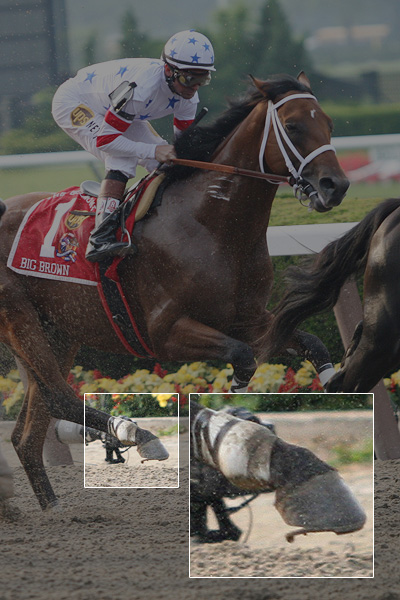
Smoking Gun? The article in this week's Blood-Horse about Big Brown's loose shoe in the Belmont, shown in this closeup from a Russ Melton photo, has now been posted on the web; you can read the entire article by clicking here.

Big Brown trainer Rick Dutrow is sticking to his guns: the "loose shoe" is not the smoking gun in his horse's failure to capture the 2008 Triple Crown on June 7th. He was interviewed by the Blood-Horse when they decided to publish the photo you see with this post. (See following posts for more on loose shoes.)

Dutrow added that the shoe appeared to have spread and that it was pulled, along with his other shoes, the next day. His horseshoer still had to use his pulloffs to get the shoe off, so "loose" is a relative term. He also said that there was no pain reaction when the foot has worked on.

Dutrow also verified farier Tom Curl's report that Big Brown is now shoeless and jogging at Aqueduct, presumably enjoying a rest from all the hoof-la that attended his Triple Crown lameness issues.

Also, the toe grab in this photo is completely legal in New York. No states that I know of have banned toe grabs on hind feet. The Jockey Club's model rule change suggests toe grabs other than wear plates be eliminated on front shoes but there are no rule changes suggested for hind shoes, where toe grabs are standard equipment.

What Can a Loose Shoe Do? Remember Longfellow!


There's an expression, "Safe and Sound" that can be extended to the work that horseshoers do for their four-legged clients. They believe that they put on shoes to help horses run faster, jump better, raise their knees more (or keep them lower), to get traction on ice or on a smooth turf-y jump course.

But they also do their very best to make them safe. They check the nails. They check for loose clinches. They come back for a hot nail. They rasp off any sharp edges. You might think they are making it look pretty, but what they are really doing is keep that sound horse safe out there on the road, track, course, field, or arena.

One of the very most famous stories of a horse with a loose shoe in a race goes back to 1872. The great champion Longfellow was to run in the 2.5 mile Saratoga Cup against a longtime rival, a horse called Harry Bassett.

The 1872 New York Times record of the race begins with this dramatic sentence: SARATOGA, July 16. Never, perhaps, in the racing history of the Saratoga or any other track has such a scene been witnessed as took place today the scene attending the race between Longfellow and Harry Bassett.

On the way to the post, Longfellow's shoe came loose. The race was off, and at the halfway point, he lagged uncharacteristically behind. His jockey went to the whip; it was the first time the champion had ever felt its sting. He accelerated and almost caught his rival; he lost by only a length, and the record was broken for that distance.

When Longfellow pulled up, it was on three legs. The loose shoe had bent over double and was embedded in his frog. One report said he had puled off the heel of his foot. He had kept on running, and almost won. But he never raced again.

Of course, Longfellow's shoes were steel and Big Brown's are a very lightweight aluminum alloy. But that story does drive home the lesson that a loose shoe is a dangerous situation.

Big Brown's shoe was obviously loose...but not that loose. He was lucky. And today, a jockey would be wont to pull up a horse before the damage was done, but go to the whip as they did in 1872.

Beating a Dead Horse(shoe): Big Brown's Loose Shoe, Revisited


Photo links to ESPN's article on hind shoe revelation.


In the hours after Big Brown failed to win, or even really finish, the Belmont Stakes two weeks ago, majority owner Michael Iavorone of IEAH told the Blood Horse:

"His feet are ice cold, quarter crack not an issue. He had a very loose hind left shoe, but that’s not an issue."

Now we are left to wonder: did anyone check the right hind?

This week's Blood-Horse shows a loose shoe on what looks to be Big Brown's right hind foot...and the photo was snapped early in the race.

Please read the article on ESPN.com, and also go back and re-read the Hoof Blog's original post about the loose shoe. The Blood-Horse expose of the loose shoe is in the mail and will probably show up on their web site at some point.

The report of a loose shoe was a grave concern to me when I heard about it; some of the farriers I talked to were also quick to state that that might have been a problem, particularly with traction in the deep track. They were more concerned by a loose hind shoe than by a patched front foot.

But the Big Brown camp dismissed hind shoes as having played any role in Big Brown's uncharacteristic performance in the race of his life.

I know that someone out there will say that the closeup photo is showing a turndown style of hind shoe, but turndowns are not allowed in New York racing rules and the horse would have been spun before he even got to the paddock.

I also interviewed farrier Tom Curl, who rebuilt Big Brown's fickle feet in Florida this winter. Tom was with the horse after the Belmont. He did not consider the loose shoe to have been a performance limiting mishap when asked about it.

Of course, we'll never know what happened to Big Brown that day. The colt's not talking.

Monday, June 23, 2008

HOOF the Play: Barefoot Hoofcare Takes the Stage in London This Summer

Each year, planeloads of American tourists land at London's Heathrow Airport and head off on their pre-packaged tours of the London sights. A tour of the Tower, a peak at Buckingham Palace, a stare at Big Ben as he chimes the hour.

And in the evening, there's the obligatory tickets to the great theaters of London's West End, where plays like Phantom of the Opera got their starts. The theater district that brought us (for better or worse) Andrew Lloyd Weber, and where theater is...well....theatre. They even spell it differently. It's the real thing.

Tomorrow the Americans will board tour buses and head off to Stratford Upon Avon or Windsor Castle, but tonight, playbills clutched in hand, they settle in their sacred seats to the best London thespians have to offer. They've paid through the nose, so this better be good.

And this year it's...Hoof.

No. Not "Hair" but "Hoof".

The new play at the Lyric is described thusly: "A pony’s owner is growing up fast and TV has taken over from riding. When the remote control is unexpectedly dropped within hoof-reach, the horse’s lonely life takes a new tack. Her secret, night-time viewing reveals cowboy films and amazing adventures. She begins to realise she’s not just a dumb animal and a quest for a herd, humour and a life without shoes begins…"

The pony's story is enhanced with puppets, tap dancing hooves and nostalgic TV clips of Black Beauty and Champion the Wonder Horse.

That's right, barefoot hoofcare promoted from the stage in London.

Tap dancing without horseshoes might not have the same effect.

Note: there's also an improv theater company in Liverpool called Hoof! so this can be confusing!

If anyone has seen this play, please check in!

Big Brown's Part Owners Pledge Drug-Free Stable After October 1st

Here's a statement issued today by International Equine Acquisitions Holdings (IEAH), the partnership that is part owner of Kentucky Derby and Preakness winner Big Brown. The statement comes on the heels of a Congressional hearing held Thursday in Washington DC in which House committee members were highly critical of lax drug policies (among other things) in US horse racing.

This is the first announcement of this sort that has been issued, although there are probably racing stables and/or trainers who have similar policies without stating them. Remember that medication rules vary by state. For many years, New York had a much tougher medication policy than other states. Today, it is legal to race horses on steroids and other medications in most states.

The Jockey Club has been promoting a nation-wide ban on steroids by the end of this year, by the issuance of a model rule that would be adopted by individual states. They also have issues a model rule change outlawing any traction devices or toe grabs on front shoes. However, no one has the power to force a state to change its drug or horseshoe regulations.

From IEAH's statement:

"In an effort to re-build confidence and the integrity to the great sport of Thoroughbred horse racing in North America, IEAH Stables is proud to announce effective October 1 all horses in training and racing in IEAH silks will run only with Lasix. No other medication, drugs, or steroids will be administered.

"While regulatory standards and indeed legislation may be required to resolve most of the controversial issues surrounding our sport, we believe our announcement today is a step in the right direction. To the best of our knowledge, we are the first racing stable in North America to make this commitment. We encourage others to follow our lead.

"We have selected an effective date of October 1 as the official "free-of-medication" withdrawal date because our horses should be clear of all substances by that time. As of October 1, we will request all tracks at which our horses run to perform pre-race and post-race testing at our expense. These procedures have proven effective under racing conditions outside North America.

"Moreover, in the interest of fairness to the wagering public, we will request and strongly urge that race programs include data indicating which horses will run with medication, which will run free of medication. The programs should also indicate which owners/trainers decline to divulge this information.

"As a further test of our commitment, beginning October 1, if any of our runners test positive for medication other than Lasix, we pledge to donate our share or purse money to charities related to thoroughbred horse racing. We will specify those charitable organizations at a later date.

"We believe this change is for the betterment of our sport. In the long run, it will benefit all involved in the game -- the tracks, horsemen and most of all the fans."

(end quote)

(Note: Lasix, the one drug that IEAH says it will allow, is a diuretic anti-bleeding medication.)

An interesting footnote to this story is that Benny the Bull, owned by IEAH, won the Golden Shaheen, a tough international race in Dubai this fall. Dubai racing has a zero tolerance for medication and the Dutrow-trained horse managed to win impressively in spite of the drug ban, international travel, and searing desert heat, as did 2007 Horse of the Year Curlin.

IEAH's October 1 deadline means that their horses, if entered, would not run on medication for the 2008 Breeders Cup to be held in California later that month.

Wednesday, June 18, 2008

Jockey Club Calls for Ban of All Traction Devices on Front Shoes of Racehorses

A press release from the Jockey Club yesterday calls for immediate action to change front shoe regulations of racehorses immediately. The edict was a result of research completed in the past few weeks by the newly appointed Thoroughbred Safety Committee.
Recommendations from the Committee will be reviewed by individual state racing commissions, who have the authority to adopt, adapt or reject the recommendations.

Specifically, the committee calls for:

  • An immediate ban on toe grabs (other than 2-millimeter wear plates), turn downs, jar calks, stickers and any other traction devices worn on the front shoes of Thoroughbred horses while racing or training on all racing surfaces.
  • The Association of Racing Commissioners’ International (RCI) and all North American racing authorities to implement this ban by rule as soon as possible, but no later than December 31, 2008, and for all racetracks to consider immediately implementing this ban by “house rule” in the interim.
Previous recommendations from the Grayson Jockey Club's Welfare and Safety Summit had included a model rule banning toe grabs greater than 4 mm; this recommendation was developed and passed at at the Racing Commissions International (RCI) Convention in April 2007, but is subject to adoption by individual states. Several states, including California, adopted that recommendation.

The new policy advisory is much stronger, since it lowers the toe grab from 4 millimeters to effectively eliminating it except for the wear plate seen in the toes of most flat shoes and outlaws the use of mud calks, jar calks, and stickers.

Turndowns and bends (angling the heels of the shoe toward the ground) are normally seen on the hind feet, as are most toe grabs and traction devices.

The Jockey Club policy advisory only addresses traction on front shoes.

Additional advisories recommend elimination of steroid anabolic medications in the race training and racing of Thoroughbreds no later than December 31, 2008.

The Thoroughbred Safety Committee includes chairman Stuart S. Janney III, and members John Barr, James G. (Jimmy) Bell, Dr. Larry Bramlage, Donald R. Dizney, Dell Hancock and Dr. Hiram C. Polk Jr. Each is a member of The Jockey Club.

The Welfare and Safety Summit includes a Shoeing and Hoof Care Committee, chaired by Bill Casner of WinStar Farms. The committee has been actively working on creating more information about racehorse shoes and their effects on horses and their interaction with different surfaces.

Read Tuesday's complete press release here.

Sunday, June 15, 2008

Friends at Work: Father's Day Off

Today is Father's Day in the USA, and perhaps other places in the world. By coincidence, I think, I received an email today from my friend Uwe Lukas in Germany. Uwe is the author of the great new book (in German only, sadly, but the photos are great) Gesunde Hufe, Kein Zufall. Uwe has a long list of impressive credentials in the farrier and sport horse world, but today his top credential is as a proud father. In the photo, you see his six year old daughter Leonie trimming her pony. (Where did she get a farrier's apron to match her hair????)

Uwe writes by email today, "Now i have a little bit for smile. My daugther is 6 years old and she trims her pony self. I give her only supporting how much and where she trims. She knows, she will be a Farrier and a Vet in the future. I think it's changing sometime more."

If the stable in the background looks a little elaborate, the Lukases liven in Warendorf, home of the state stud for the Westphalian breed and the national equestrian federation. A lot of Olympic gold medals have gone home to Warendorf.

Uwe's English is a lot better than my German, but I am sure you can get the idea of what he's saying.


I think I have some matchmaking to do. On this side of the Atlantic, we have Robbie Pethick, the handsome son of New Jersey farrier Bob Pethick, who has taken on trimming a horse, not a mere pony. Robbie will be six in August.

They already have something in common--note that they are both using HoofJack hoof stands!

Both of these youngsters also have a great advantage if they learn from their expert farrier dads, each of whom shoes some of the very top dressage and sport horses in their respective countries.

Father's Day for me was tinged by the memorials on television here in the USA this morning for the superb television journalist/interviewer and one of my professional heroes, NBC's Washington bureau chief Tim Russert. Tim was much more than a reporter and host of the "Meet the Press" tv show, as evidenced by his larger-than-life camera presence and his recent stints on the bestseller list with his book Big Russ and Me, about growing up under his father's influence in the gritty US city of Buffalo, New York. Tim died suddenly this week.

I was hoping to quote from the book here but when I went looking for an excerpt I ended up on the book's web site and I found a letter from Tim on the front page. I'll reproduce a little passage from it here, and hope that if you haven't read this book, you will, no matter who your dad was or is, or what your relationship is like. Tim writes:

In the spring of 2004, I published a book about my father--about the lessons I have learned from him, the way he has influenced me, and my enormous love and respect for this steady, hardworking, and modest man. My publisher sent me on a publicity tour in the hope that people around the country would see the book as an ideal Father's Day gift.


Early in the tour I was in Chicago, where to my great relief, customers were lining up to buy the book and have me autograph it. What happened next really surprised me.

"Make it out to Big Mike" somebody told me, which was followed in rapid succession by, "This is for Big Mario"..."Please inscribe it out to Big Manuel."..."For Big Irv."..."Big Willie"..."Big Stan"

I had expected that my book would appeal to readers in my home town of Buffalo, New York, but I didn't know whether the story of a young man coming of age in a blue-collar Irish-Catholic neighborhood, whose father was a truck driver and a sanitation man, would strike a cord with a wider audience.

I (soon) discovered there were many Big Russes out there--good, industrious, and patriotic men who have a lot in common with my dad, even if they didn't share his religion or his heritage. By writing a book about my father, I was affirming not only his life, but the lives of many other fathers as well.
(end quote)

I am sorry that I never had a chance to ask Tim to inscribe a copy to Big Joe.

If you have a few minutes, click on this link and listen to Tim reading the intro to Big Russ and Me. Link to Tim Russert reading

Saturday, June 14, 2008

Another Country Heard From: Meet the Hooves of Japan's Casino Drive


Casino Drive's Feet, originally uploaded by Rock and Racehorses.

Racing is full of "What ifs" and there were probably echoing off Casino Drive's stall walls when Big Brown failed to fire a week ago in the Belmont Stakes.

Casino Drive was visiting from Japan with the sole purpose of stealing the Belmont from Big Brown. He certainly stole the Peter Pan in a very dramatic run for the finish line a few weeks earlier, but a bruised foot caused his connections to be cautious and skip the Belmont instead of poking and prodding and poulticing and patching the colt's foot.

Meanwhile, my friend Sarah Andrew (a.k.a. "Rock and Racehorses") tracked the poor horse down to take photos of his feet for this blog. I wonder what the Japanese team thought of her pointing the camera not at his handsome head but at his feet and knees?

Casino Drive is out of the same mare who foaled the winners of the 2006 and 2007 Belmont Stakes. What if....

(Casino drive and his long feet have gone back to Japan, promising to return for November's Breeders Cup, which will be raced on an artificial track surface for the first time. I hope he can stay sound and healthy and show up with his race face--and feet--on.)