 |
| Suds stream down the hooves of American Pharoah's legs during a bath at Belmont Park last week. How can such an extraordinary horse run so brilliantly on ordinary horseshoes, you ask. Maybe they only look ordinary, is the answer. (© Associated Press photo by Julie Jacobsen, used with permission) |

Monday, June 08, 2015
Hoofcare Confidential: American Pharoah’s Subtle Triple Crown Horseshoe by Wes Champagne

Wednesday, May 20, 2015
Badminton Horse Trials Farriers Prize 2015: Instant Replay for Best-Shod Four-Star Eventer Hooves
 If you think you've heard this one before, stop me. But some things are worth repeating, and history has repeated itself. So have a farrier, a horse, a rider, an owner, and a judge at the world's premier three-day event. Re-meet the winner of the 2015 Badminton Horse Trials Farriers Prize. |
Wednesday, May 13, 2015
Lost Shoes, Caught Shoes and Twisted Shoes: Drama on the Hoof
 |
| It happens. But it rarely happens when you are pointing a camera at a horse. This image begs the question: Did one of these horses lose the shoe a second before the photo was taken, or was the shoe buried in the arena footing and springboarded into the air when one of them stepped on it? Definitely one for the Lost Shoe Hall of Fame by Santa Cruz, California photographer Eleanor Anderson. (Image © Eleanor Anderson) |
Lost shoes were in the news this week, and it turns out that the tribunal in Ireland didn't feature the only lost shoes in the news. Each of us has a favorite lost shoe photo, video or story.
Tuesday, May 12, 2015
All for Want of a Shoe: Lost Horseshoes Subject of Nine-Hour Irish Turf Tribunal and Australian Rule Change

One of horse sports' great wild cards has always been the lost shoe. Some horses lose a shoe and stop in their tracks. Some keep running and jumping--even winning. Sometimes the shoe sparkles in the sun. Sometimes it's never found.
Some people just shrug it off. Some people want to do something about it. And sometimes it's just a mystery.
Sunday, May 10, 2015
Case Notes: Inside Bal a Bali’s Laminitis Recovery

Thanks to an interview today with Rood and Riddle Equine Hospital’s Vernon Dryden, DVM, some of the details of Bal a Bali’s nine-month ordeal can now be shared. Dr. Dryden acknowledges the willingness of the colt’s owners, Sienna Farm and Foxhill Farm, to share information that might benefit another horse suffering from a similar problem.
Brazil's Bal a Bali Comes Back from Laminitis to Win Santa Anita Stakes Race

Every once in a while, a bad news story takes a turn for the good. This one took a turn for the great.
Yesterday in California, a horse from Brazil made his first start in the United States. Bal a Bali holds a world record and won Brazil's Triple Crown. He was purchased by American investors, and flown north to join trainer Richard Mandella's stable at Santa Anita Park in California.
But that was almost a year ago. This horse's health took a detour when something went wrong. Very wrong. Laminitis-level wrong.
But that was almost a year ago. This horse's health took a detour when something went wrong. Very wrong. Laminitis-level wrong.
Finally, yesterday he showed what he can do. And what he can overcome to do it.
Thursday, April 30, 2015
Why They Run: The Hoof of Fire Horse Number 12
 |
| A team of fire horses speeding to the famous Triangle Shirtwaist Fire in New York City in 1911. When they got there, the firemen could do little, as the employees had been locked into their work stations on the upper floors of the building. Many seamstresses jumped out windows to their deaths; 146 employees, mostly women, died that day. Ladders couldn't reach them. Notice theses horses wear no blinders on their bridles; this was customary for fire horses. |
Not all running by horses is done on the racetrack. It's not always done for prize money or glory in front of a cheering crowd. Sometimes horses run because they know that is what they are supposed to do.
And that's exactly what Horse Number 12 did.
Shoeing for the Roses: Shoe-Shy Mubtaahij's Barefoot Hoofcare for Kentucky Derby

That's because Mubtaahij, the highly-regarded invader from Dubai, is a little different.
Friday, April 10, 2015
Dr. William Moyer Retires from Texas A&M College of Veterinary Medicine
 |
| Dr. William Moyer retired last month after 22 years of service to the Texas A&M College of Veterinary Medicine. His writing and speaking on the subject of equine lameness in sport and racehorses, and in particular his interest in the equine foot have made him a frequent subject of Hoofcare and Lameness articles since early days. (TAMU photo) |
Texas A&M University in College Station, Texas recently honored William Moyer, DVM with a retirement party. The Hoof Blog pairs some photos from the party with the University's official farewell to Dr. Moyer, who also recently served as president of the American Association of Equine Practitioners and is a popular lecturer on equine lameness.
Friday, April 03, 2015
Ageless Tahoe Warrior Runs Again: In Shoes, This Time, for Keeneland's New Dirt Track

At some point today, someone in the stands at Keeneland Racecourse is sure to read the fine print in the program and notice that in the second race, there's a 12-year-old horse running in his 96th lifetime start. And if he or she is a savvy horseplayer, they'll put a few dollars on Tahoe Warrior, and cheer him home.
Today is opening day at Lexington, Kentucky's magnificent Keeneland Racecourse. It's raining, and 61 degrees. The track is listed as sloppy and at least some of the turf races are moved to the dirt track.
Yes, to the dirt track.
Wednesday, April 01, 2015

Saturday, March 28, 2015
Dubai World Cup: Will the Dirt Track Renaissance Affect the Shoeing for the World's Richest Race?
It's early morning in Dubai. Meydan Racecourse is preparing for a big day culminating in the world's very richest race. And the favorite is an American horse.
Normally, there wouldn't be anything unusual about that. The race has been won by American stars like Cigar, Silver Charm and Animal Kingdom. But last year, no American contenders were in the race.
Many people believe California Chrome is the favorite because his feet are used to flying through dirt. The other horses' hooves haven't done it, nor have the horses had dirt kicked in their faces. Could they be right?
Tuesday, March 24, 2015
Silent Anvil With Much More to Say: Hank McEwan, Horseshoer, Horseman, Friend

You probably thought you'd be reading the Hoof Blog's tribute to Hank McEwan by now. Words don't come easily, but Wednesday should be the day.
Monday, March 23, 2015
Michael Wildenstein All-Day Lecture in Vermont on Saturday, March 28

The Vermont Farriers Association invites you to an all-day lecture with farrier educator Michael Wildenstein, CJF, FWCF (Hons) on Saturday, March 28 in the Old Chapel at Castleton State College in Castleton, Vermont.
Thursday, March 12, 2015
Chain Reaction Traction: Anti-slip Horseshoe Chains Took the Farrier Out of the Equation 100 Years Ago

This is the latest chapter in the Hoof Blog's series on the history of hooves vs. snow and ice. To read other articles in this series, scroll to the bottom of this article for links.
When Harry Weed invented snow chains for automobile tires in 1904, he was just following a trend. He had seen people wrap grapevines and ropes around their tires. There was a lot of snow where he lived in Canastota, New York and Harry understood that for people to use cars year round there, they needed more traction. He patented his invention and, as they say, the rest is history. Steel tire chains based on his principles are still in use today.
When Harry Weed invented snow chains for automobile tires in 1904, he was just following a trend. He had seen people wrap grapevines and ropes around their tires. There was a lot of snow where he lived in Canastota, New York and Harry understood that for people to use cars year round there, they needed more traction. He patented his invention and, as they say, the rest is history. Steel tire chains based on his principles are still in use today.
And when horsemen saw automobile owners wrap Harry's steel chains around their car tires, they thought it should work if they wrapped smaller chains around their horses' hooves on snowy, icy roads. A clever Massachusetts veterinarian was waiting in the wings with a hoof strap that held chain links to the bottom of a hoof. You could strap it on and take it off without removing the shoe. It promised to keep horses on their feet and working, no matter the weather.
But would it? And what would horseshoers think of it?
But would it? And what would horseshoers think of it?
Wednesday, March 11, 2015
Traction History: Non-Skid Over-Shoes Were the Humane Society's Gift to the Horses of New York City

"Here come the hoof boot angels." That's what the people of New York might have said back in 1919, and for many years after that, when they saw Harry Moran from the Humane Society or Mrs. James Speyer from the Women's League for Animals coming down the street. He had a bag full of canvas winter hoof boots for horses with him; they were called simply "non-skids". She would have boots made of carpet, or chain treads that clipped over a horse's hooves.
Both organizations gave safety hoof gear away for free to drivers and helped put them on over the horses' calked shoes. And then they went on to the next street to help more horses get through the a slippery, snowy winter on the streets of New York.
Tuesday, March 10, 2015
Vet School Rankings: University of California at Davis Takes Number One Spot for US Colleges

Monday, March 09, 2015
Sire De Grugy's Sporty White Horseshoes Go Beyond Fashion for Cheltenham Festival Jump Race
 |
Sire De Grugy, 2014 British Jumps Horse of the Year, won his last race wearing Ezy-Fit white polyurethane shoes with steel cores and is expected to continue to wear them when he defends his Cheltenham Festival title in the Queen Mother Champion Chase this week. (Shane Francis photo)
|
He'll just do it with a little flash, and a lot less pain.
Thursday, March 05, 2015
Horses and Traction: Why Did Cities Have Cobblestone Streets? Why Did Traction Matter?
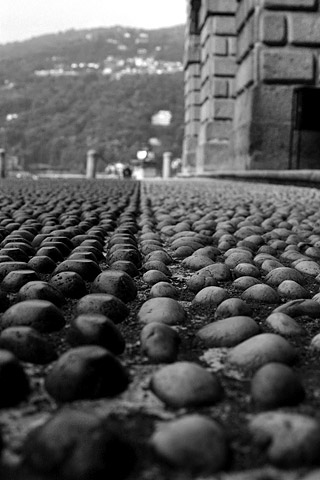 |
A cobblestone street in Italy is paved with round stones; some sources say that a "cobble" originally meant a round stone. These look like old cannon balls. Were they put there to keep horses off the plaza or to help them?
|
When newcomers get off the ferry on Nantucket Island and settle into a car, they are soon shaken up. They're expecting an idyllic entry to the old New England whaling town and tourist center. Instead, they rattle across a rough cobblestone street that will shake the fillings right out of your teeth.
And the islanders like it that way.
Even though they seem slick and tricky for today's horses, "modern", or flat, cobblestoned streets were a godsend to horses. And, as you might suspect, there's a hoof connection that holds this whole story together.
Wednesday, March 04, 2015
Dudley’s New Leg: Gentle Barn Charity Follows “Worthy” Horse Leg Surgery with Prosthesis for a Bovine Amputee
You hear about a lot of rescue organizations and charities operating around the United States. It seems like one will have a “Hail Mary” pass moment and make the headlines. They’ll have their fifteen minutes of well-deserved fame.
Tuesday, March 03, 2015
First-Person Research: The Paleopathology of Laminitis in Horses with Lane A. Wallett, DVM
Lane A. Wallett, DVM is a Doctoral Candidate at the University of Florida in Gainesville. She presented an abstract on her paleontology research related to laminitis in the fossil evidence related to horses at the 2013 International Equine Conference on Laminitis and Diseases of the Foot. Everyone wanted to know how she came to research such a subject, and The Hoof Blog is very happy to share her story, in her own words.

Monday, March 02, 2015
Laminitis Research: Milk Thistle Tested in Laboratory for Possible Endotoxin Neutralization

Researchers in Vienna, Austria have conducted in vitro studies of the
milk thistle plant to determine its effect on laminar tissue during
separation caused by endotoxin introduction.
Sunday, March 01, 2015
Horseshoe Biomechanics by Dr. Jenny Hagen for Werkman: Side-Wedge Shoe for Medial-Lateral Imbalance
Click on the triangular "play" icon (bottom left) to start Dr. Hagen's video.
This video picks up from the previous videos from Dr. Hagen and Werkman (biomechanics of egg bar, heart bar, wide toe, wide-branch (asymmetric), and open toe shoes) posted in October and January.
Wednesday, February 11, 2015
Grayson-Jockey Club Foundation and Starlight Racing Reach $150,000 Laminitis Research Goal

News release:
Grayson-Jockey Club Research Foundation (GJCRF) announced today that it had reached the target in fund raising prompted by Starlight Stable’s challenge to raise $75,000 for laminitis research. Starlight issued the challenge last year in memory of Intense Holiday, a stakes-winning colt that seemed headed for additional success until he suffered a condylar fracture.
Following one of the most frustrating scenarios associated with laminitis, expert veterinary care was able to deal with Intense Holiday’s injury, but the added pressure on the opposing limb brought on laminitis and the horse could not be saved.
Wednesday, February 04, 2015
Pythagoras at the Anvil: How Did an Ancient Mathematician Use Hammer Strikes on an Anvil to Decode Music?

Music was born in a forge. The Greek philosopher and mathematician Pythagoras decoded, or invented, the musical scale. He came up with it after discerning the relative musical tones of different blacksmiths' hammers, based on each hammer's relative weight.
Tuesday, February 03, 2015
Polyflex Horseshoes Hosts Informational Farrier Session with VEPG Chair Mark Silverman at Palm Beach Farrier Supply

On Saturday, January 31, Polyflex Horseshoes hosted an informational session for farriers with Mark Silverman, MS, DVM, owner of Sport Horse Veterinary Services in Rancho Santa Fe, California. He is also a partner in Southern California Equine Podiatry with farrier Ernest Woodward.
Mark Silverman is chair of the new Veterinary Equine Podiatry Group (VEPG), Inc., an initiative by a group of veterinarians who would like to see a veterinary specialization established for equine podiatry. The group is just beginning on this effort and is probably years from establishing a recognized and credentialed program.
Subscribe to:
Posts (Atom)