 Maybe you could take a minute and think a few kind thoughts for a very strong man who is in a very helpless place tonight. He'd do that--and more--for you.
Wednesday, February 17, 2010
The Strong Man Hangs On
17 February 2010 | Fran Jurga's Hoof Blog at Hoofcare.com
 Maybe you could take a minute and think a few kind thoughts for a very strong man who is in a very helpless place tonight. He'd do that--and more--for you.
Maybe you could take a minute and think a few kind thoughts for a very strong man who is in a very helpless place tonight. He'd do that--and more--for you.
Sunday, February 14, 2010
Video Humor: David Letterman Shoes a Horse with Farrier Ada Gates Patton
14 February 2010 | Fran Jurga's Hoof Blog at Hoofcare.com
Here's my Valentine to the hoof world: the ultimate weekend humor video. I'll never top this one.
Where were you the night when farriers stayed up late to watch one of their own on the big stage in New York City? The night one of their own upstaged the great David Letterman? The night David Letterman lost control of his own show?
 Ada Gates Patton is in a league of her own. The fact that she was the first woman licensed to shoe horses at a racetrack in the United States is only the beginning of the story.
A few years ago, we were in Kentucky for a convention and she made a special trip to Three Chimneys Farm to visit Wild Again, one of the horses on her list back in the 1980s, when he won the Breeders Cup Classic.
Ada was international horsemen's liaison for the Breeders Cup in California, and coordinated farrier services for the 1984 Olympics in California.
She tells wonderful stories about being shunned by trainers from the British Isles during the Breeders Cup; they went looking for a man to shoe their horses. When the call came for shoes from a French trainer, Ada picked up her shoeing box and headed over, expecting the worst.
Instead, the Frenchman had the opposite reaction and welcomed her as if she had been sent by the gods.
Ada Gates Patton is in a league of her own. The fact that she was the first woman licensed to shoe horses at a racetrack in the United States is only the beginning of the story.
A few years ago, we were in Kentucky for a convention and she made a special trip to Three Chimneys Farm to visit Wild Again, one of the horses on her list back in the 1980s, when he won the Breeders Cup Classic.
Ada was international horsemen's liaison for the Breeders Cup in California, and coordinated farrier services for the 1984 Olympics in California.
She tells wonderful stories about being shunned by trainers from the British Isles during the Breeders Cup; they went looking for a man to shoe their horses. When the call came for shoes from a French trainer, Ada picked up her shoeing box and headed over, expecting the worst.
Instead, the Frenchman had the opposite reaction and welcomed her as if she had been sent by the gods.
 Ada is originally from New York; she is a descendant of Henry Burden, a Scottish immigrant who invented the first machine to manufacture horseshoes. His machines are credited with helping the North win the Civil War; his factories stretched forever along the banks of the Hudson River in Troy, New York and Burden horseshoes supplied the US cavalry for decades. Henry would never have dreamed that women would someday shoe horses, let alone one of his descendants, but Ada made the history books too.
Today, Ada owns and runs Harry Patton Horseshoeing Supplies near Santa Anita, and serves farriers all over California. The business was started by her late husband, the famous racetrack shoer Harry Patton, and she has built it into a multi-store retail chain, with business partner Michael De Leonardo in northern California.
Ada is originally from New York; she is a descendant of Henry Burden, a Scottish immigrant who invented the first machine to manufacture horseshoes. His machines are credited with helping the North win the Civil War; his factories stretched forever along the banks of the Hudson River in Troy, New York and Burden horseshoes supplied the US cavalry for decades. Henry would never have dreamed that women would someday shoe horses, let alone one of his descendants, but Ada made the history books too.
Today, Ada owns and runs Harry Patton Horseshoeing Supplies near Santa Anita, and serves farriers all over California. The business was started by her late husband, the famous racetrack shoer Harry Patton, and she has built it into a multi-store retail chain, with business partner Michael De Leonardo in northern California.
 Ada stares up at the derelict but grand church built by her great-great-grandfather so that horseshoe factory workers had a place to worship. She saved the church from demolition through a loophole in the deed that made a provision for a descendant of the founder to lay claim. What would Henry Burden think of one of his descendants selling horseshoes?
Ada is originally from New York, and she is the great great grand-daughter of Henry Burden, the inventor of the horseshoe-making machine. We reconnected her with her roots a few years ago by explaining that her family's church would be torn down if she didn't claim the deed and save it--which she did, and subsequently opened the beautiful old church and invited our Hoofcare@Saratoga tour group of farriers in for lunch as part of one of our tours of the Burden Iron Works.
Ada stares up at the derelict but grand church built by her great-great-grandfather so that horseshoe factory workers had a place to worship. She saved the church from demolition through a loophole in the deed that made a provision for a descendant of the founder to lay claim. What would Henry Burden think of one of his descendants selling horseshoes?
Ada is originally from New York, and she is the great great grand-daughter of Henry Burden, the inventor of the horseshoe-making machine. We reconnected her with her roots a few years ago by explaining that her family's church would be torn down if she didn't claim the deed and save it--which she did, and subsequently opened the beautiful old church and invited our Hoofcare@Saratoga tour group of farriers in for lunch as part of one of our tours of the Burden Iron Works.
 Last year Ada was honored in her family's church by the Burden Iron Works Museum and its preservation efforts. The image at right is the outline of the Burden horseshoe company's office building, which now houses the museum. The museum and Ada found each other through Hoofcare & Lameness Journal and our Hoofcare@Saratoga program and tour of the museum. The museum is dedicated to preserving the history of horseshoe manufacturing in Troy, New York.
Today, Ada is busy selling shoes. But she recently "joined up" with one of her old shoeing clients, California horseman Monty Roberts, and the two made a DVD together on hoofcare and horsemanship for hard-to-shoe horses. She teaches simple hoof balance principles at horse owner events and markets a hoof ruler to help them keep track of changes in their horses' hooves' dimensions. Horse Illustrated profiled Ada's pioneering career spirit in this tribute article. Ada is one person who never forgot where she came from, and is not done getting to where she's going. She's still giving us all a lot of laughs along the way, and digging this video up out of the 1990s will insure that more people around the world join in.
Last year Ada was honored in her family's church by the Burden Iron Works Museum and its preservation efforts. The image at right is the outline of the Burden horseshoe company's office building, which now houses the museum. The museum and Ada found each other through Hoofcare & Lameness Journal and our Hoofcare@Saratoga program and tour of the museum. The museum is dedicated to preserving the history of horseshoe manufacturing in Troy, New York.
Today, Ada is busy selling shoes. But she recently "joined up" with one of her old shoeing clients, California horseman Monty Roberts, and the two made a DVD together on hoofcare and horsemanship for hard-to-shoe horses. She teaches simple hoof balance principles at horse owner events and markets a hoof ruler to help them keep track of changes in their horses' hooves' dimensions. Horse Illustrated profiled Ada's pioneering career spirit in this tribute article. Ada is one person who never forgot where she came from, and is not done getting to where she's going. She's still giving us all a lot of laughs along the way, and digging this video up out of the 1990s will insure that more people around the world join in.  Monitor Hoofcare News on Twitter.com! Follow @hoofcarejournal!
 Ada Gates Patton is in a league of her own. The fact that she was the first woman licensed to shoe horses at a racetrack in the United States is only the beginning of the story.
A few years ago, we were in Kentucky for a convention and she made a special trip to Three Chimneys Farm to visit Wild Again, one of the horses on her list back in the 1980s, when he won the Breeders Cup Classic.
Ada was international horsemen's liaison for the Breeders Cup in California, and coordinated farrier services for the 1984 Olympics in California.
She tells wonderful stories about being shunned by trainers from the British Isles during the Breeders Cup; they went looking for a man to shoe their horses. When the call came for shoes from a French trainer, Ada picked up her shoeing box and headed over, expecting the worst.
Instead, the Frenchman had the opposite reaction and welcomed her as if she had been sent by the gods.
Ada Gates Patton is in a league of her own. The fact that she was the first woman licensed to shoe horses at a racetrack in the United States is only the beginning of the story.
A few years ago, we were in Kentucky for a convention and she made a special trip to Three Chimneys Farm to visit Wild Again, one of the horses on her list back in the 1980s, when he won the Breeders Cup Classic.
Ada was international horsemen's liaison for the Breeders Cup in California, and coordinated farrier services for the 1984 Olympics in California.
She tells wonderful stories about being shunned by trainers from the British Isles during the Breeders Cup; they went looking for a man to shoe their horses. When the call came for shoes from a French trainer, Ada picked up her shoeing box and headed over, expecting the worst.
Instead, the Frenchman had the opposite reaction and welcomed her as if she had been sent by the gods.
 Ada is originally from New York; she is a descendant of Henry Burden, a Scottish immigrant who invented the first machine to manufacture horseshoes. His machines are credited with helping the North win the Civil War; his factories stretched forever along the banks of the Hudson River in Troy, New York and Burden horseshoes supplied the US cavalry for decades. Henry would never have dreamed that women would someday shoe horses, let alone one of his descendants, but Ada made the history books too.
  Ada stares up at the derelict but grand church built by her great-great-grandfather so that horseshoe factory workers had a place to worship. She saved the church from demolition through a loophole in the deed that made a provision for a descendant of the founder to lay claim. What would Henry Burden think of one of his descendants selling horseshoes?
 Last year Ada was honored in her family's church by the Burden Iron Works Museum and its preservation efforts. The image at right is the outline of the Burden horseshoe company's office building, which now houses the museum. The museum and Ada found each other through Hoofcare & Lameness Journal and our Hoofcare@Saratoga program and tour of the museum. The museum is dedicated to preserving the history of horseshoe manufacturing in Troy, New York.
  Monitor Hoofcare News on Twitter.com! Follow @hoofcarejournal!
© Fran Jurga and Hoofcare Publishing. Please, no use without permission. You only need to ask. Fran Jurga's Hoof Blog is a between-issues news service for subscribers to Hoofcare and Lameness Journal. This blog may be read online at the blog page, checked via RSS feed, or received via a digest-type email (requires signup in box at top right of blog page). To subscribe to Hoofcare and Lameness (the journal), please visit the main site, www.hoofcare.com, where many educational products and media related to equine lameness and hoof science can be found. Questions or problems with this blog? Send email to blog@hoofcare.com.
Saturday, February 13, 2010
Friends at Work: Hoof Knives Hand-Made in Vermont by Farrier Jim Hurlburt
13 February 2010 | Fran Jurga's Hoof Blog at Hoofcare.com
Texas doesn't have to worry about Vermont beating them in the number of horses in a single state, but the number of horses per square mile, or per capita, must be right up there.
For as long as I can remember, Vermont has been famous for having more cows than people--it is, after all, the home of Ben and Jerry's ice cream--but lately a lot of dairy farms have been converted to horse farms. And a lot of veterinarians and farriers and hoof trimmers have moved to the Green Mountain State to serve those horses. Some were even born and raised there.
The Vermont Farriers Association was formed about five years ago, has an active educational program and was one of the first farrier associations to openly welcome non-shoeing trimmers to its membership and its events. They'll host a seminar with veterinarian Tracy Turner of Minnesota next month.
The winters are long in Vermont, and most of the people are involved in some sort of craft or hobby or a second job during the dark snowy months. Farrier Jim Hurlburt of Stowe drives right by the famous ski lifts of his hometown to pursue his work with horses, and comes home at night to work on his hoof knives, which he sends all over the world.
That's the kind of place that Vermont is. Out in any back barn you can find almost anything being made, designed or invented on a cold February day. The roads may not be paved, but somehow FedEx and UPS find the most out of the way cabins and farmhouses and the labors of Vermonters get shipped no matter how deep the snow is.
Enjoy this little video about Jim Hurlburt and his knives, courtesy of WCAX-TV in Burlington, Vermont. I hope no one on the tv crew cut themselves while making this video. Jim's knives are sharp!
 © Fran Jurga and Hoofcare Publishing. Please, no use without permission. You only need to ask.
Fran Jurga's Hoof Blog is a between-issues news service for subscribers to Hoofcare and Lameness Journal. This blog may be read online at the blog page, checked via RSS feed, or received via a digest-type email (requires signup in box at top right of blog page).
To subscribe to Hoofcare and Lameness (the journal), please visit the main site, www.hoofcare.com, where many educational products and media related to equine lameness and hoof science can be found.
Questions or problems with this blog? Send email to blog@hoofcare.com.
Please wait patiently for this video from WCAX-TV in Vermont to load.
Vermont is one of the horsiest states in the USA, although you might not know that unless you went there and drove the back roads. As a former dairy farmer friend remarked to me recently, "Horses are the new cows."Texas doesn't have to worry about Vermont beating them in the number of horses in a single state, but the number of horses per square mile, or per capita, must be right up there.
For as long as I can remember, Vermont has been famous for having more cows than people--it is, after all, the home of Ben and Jerry's ice cream--but lately a lot of dairy farms have been converted to horse farms. And a lot of veterinarians and farriers and hoof trimmers have moved to the Green Mountain State to serve those horses. Some were even born and raised there.
The Vermont Farriers Association was formed about five years ago, has an active educational program and was one of the first farrier associations to openly welcome non-shoeing trimmers to its membership and its events. They'll host a seminar with veterinarian Tracy Turner of Minnesota next month.
The winters are long in Vermont, and most of the people are involved in some sort of craft or hobby or a second job during the dark snowy months. Farrier Jim Hurlburt of Stowe drives right by the famous ski lifts of his hometown to pursue his work with horses, and comes home at night to work on his hoof knives, which he sends all over the world.
That's the kind of place that Vermont is. Out in any back barn you can find almost anything being made, designed or invented on a cold February day. The roads may not be paved, but somehow FedEx and UPS find the most out of the way cabins and farmhouses and the labors of Vermonters get shipped no matter how deep the snow is.
Enjoy this little video about Jim Hurlburt and his knives, courtesy of WCAX-TV in Burlington, Vermont. I hope no one on the tv crew cut themselves while making this video. Jim's knives are sharp!
 © Fran Jurga and Hoofcare Publishing. Please, no use without permission. You only need to ask.
Fran Jurga's Hoof Blog is a between-issues news service for subscribers to Hoofcare and Lameness Journal. This blog may be read online at the blog page, checked via RSS feed, or received via a digest-type email (requires signup in box at top right of blog page).
To subscribe to Hoofcare and Lameness (the journal), please visit the main site, www.hoofcare.com, where many educational products and media related to equine lameness and hoof science can be found.
Questions or problems with this blog? Send email to blog@hoofcare.com.
Wednesday, February 03, 2010
Racetrack Surface Research Video: Building a TTD for the Track in a Box at the University of California
3 February 2010 Fran Jurga's Hoof Blog at Hoofcare.com
(Caution: You might want to turn down the volume on your computer before you play this video. The soundtrack is loud!)
This video shows the development and constrution of the University of California, Davis, J.D. Wheat Veterinary Orthopedic Research Laboratory track-testing device (TTD). The TTD is instrumented with a load cell, accelerometer, and laser displacement sensor, and is used to compare the dynamic properties of Thoroughbred racehorse racetrack surfaces as part of the lab's "Track in a Box " project to simulate racetrack conditions in the laboratory.
The "box" in the lab acan be filled with layers of dirt, stones, asphalt and racetrack surface materials that could include wax, fibers or other materials. A drainage system allows the effects of rain to be testing. The spring-loaded mechanism simulates the impact of pounding hooves up to 100 times the force of gravity while measurements are taken to characterize surface behavior.
 The finished TTD positioned over the box
The "Track in a Box" project is the work of Jacob Setterbo, a PhD candidate in the Biomedical Engineering Graduate Group, and Dr. Susan Stover, director of the school’s JD Wheat Veterinary Orthopedic Research Laboratory. The project is funded by the Grayson Jockey Club, the Southern California Equine Foundation, and the Center for Equine Health with funds provided by the State of California pari-mutuel fund and contributions by private donors.
I asked Jacob Setterbo about the fact that the TTD contained everything exect a shoe, and wondered about adding a shoe to the TTD, or even using it to test how different shoes load in different footing. Setterbo and Stover worked on a sensor shoe for racetrack testing which was featured on the hoof blog in an article last fall.
(Caution: You might want to turn down the volume on your computer before you play this video. The soundtrack is loud!)
This video shows the development and constrution of the University of California, Davis, J.D. Wheat Veterinary Orthopedic Research Laboratory track-testing device (TTD). The TTD is instrumented with a load cell, accelerometer, and laser displacement sensor, and is used to compare the dynamic properties of Thoroughbred racehorse racetrack surfaces as part of the lab's "Track in a Box " project to simulate racetrack conditions in the laboratory.
The "box" in the lab acan be filled with layers of dirt, stones, asphalt and racetrack surface materials that could include wax, fibers or other materials. A drainage system allows the effects of rain to be testing. The spring-loaded mechanism simulates the impact of pounding hooves up to 100 times the force of gravity while measurements are taken to characterize surface behavior.
 The finished TTD positioned over the box
The "Track in a Box" project is the work of Jacob Setterbo, a PhD candidate in the Biomedical Engineering Graduate Group, and Dr. Susan Stover, director of the school’s JD Wheat Veterinary Orthopedic Research Laboratory. The project is funded by the Grayson Jockey Club, the Southern California Equine Foundation, and the Center for Equine Health with funds provided by the State of California pari-mutuel fund and contributions by private donors.
I asked Jacob Setterbo about the fact that the TTD contained everything exect a shoe, and wondered about adding a shoe to the TTD, or even using it to test how different shoes load in different footing. Setterbo and Stover worked on a sensor shoe for racetrack testing which was featured on the hoof blog in an article last fall.
"That is a possibility we considered," Setterbo answered. "So the TTD was designed so that a new interface to the load cell can be machined so that a shoe can be added, and things such as toe grabs can be compared. Because we first need to establish the functionality of the TTD we decided to first start with a simple impacting part, which is an aluminum piece which is approximately the same area of the hoof. But the answer is yes, it is possible to modify the TTD to test different shoes." © Fran Jurga and Hoofcare Publishing. Please, no use without permission. You only need to ask. Fran Jurga's Hoof Blog is a between-issues news service for subscribers to Hoofcare and Lameness Journal. This blog may be read online at the blog page, checked via RSS feed, or received via a digest-type email (requires signup in box at top right of blog page). To subscribe to Hoofcare and Lameness (the journal), please visit the main site, www.hoofcare.com, where many educational products and media related to equine lameness and hoof science can be found. Questions or problems with this blog? Send email to blog@hoofcare.com.
Monday, February 01, 2010
Hoofcare Scholar: Design a Foot with Professor Robert Full
by Fran Jurga | 1 February 2010 | Fran Jurga's Hoof Blog
Caution: Don't start watching this video unless you have 19 minutes and 24 seconds to watch the whole thing through. And then you might want to watch it all over again. Professor Robert Full is Director of the Poly-PEDAL Laboratory in the Department of Integrative Biology at the University of California at Berkeley. This video, which is now five years old, was always too long to post on the blog, but now it is possible...so here you go. If you like this, you'll enjoy a few more scholarly (but not too scholarly) videos that we've been preparing for you.
 Dr. Full may work with cockroaches and crabs and centipedes and geckos, and he may be trying to build a better robot, not fix a lame horse, but this video can make you think about what a foot is and what it can and should do. And what you can add to a foot to achieve different goals, i.e. move across different surfaces.
Many of the concepts will be everyday to you. And maybe some of the exercises that Professor Full reviews will lead you to some brand new thoughts...or a brand new way of thinking.
Happy 19 minutes and 24 seconds!
And thanks to Robert Full and the TED conference for making this clip available! PS The impetus for this research is a robot that would be useful for first responders in emergency and disaster scenarios. Apparently some search-and-rescue robots have been used in Haiti during the earthquake response, but Professor Full might need to add digging to the task list of his robotic feet when it comes to quake rubble. Bare human hands apparently did most of the work, and search dogs were found to be very helpful. Texas A&M University is home to CRASAR, the Center for Robot-Assisted Search and Rescue.
© Fran Jurga and Hoofcare Publishing. No use without permission. You only need to ask. Fran Jurga's Hoof Blog is a between-issues news service for subscribers to Hoofcare and Lameness Journal. This blog may be read online at the blog page, checked via RSS feed, or received via a digest-type email (requires signup in box at top right of blog page). To subscribe to Hoofcare and Lameness (the journal), please visit the main site, www.hoofcare.com, where many educational products and media related to equine lameness and hoof science can be found. Questions or problems with this blog? Send email to blog@hoofcare.com. For more news, follow @hoofcarejournal on www.twitter.com.
Caution: Don't start watching this video unless you have 19 minutes and 24 seconds to watch the whole thing through. And then you might want to watch it all over again. Professor Robert Full is Director of the Poly-PEDAL Laboratory in the Department of Integrative Biology at the University of California at Berkeley. This video, which is now five years old, was always too long to post on the blog, but now it is possible...so here you go. If you like this, you'll enjoy a few more scholarly (but not too scholarly) videos that we've been preparing for you.
 Dr. Full may work with cockroaches and crabs and centipedes and geckos, and he may be trying to build a better robot, not fix a lame horse, but this video can make you think about what a foot is and what it can and should do. And what you can add to a foot to achieve different goals, i.e. move across different surfaces.
Many of the concepts will be everyday to you. And maybe some of the exercises that Professor Full reviews will lead you to some brand new thoughts...or a brand new way of thinking.
Happy 19 minutes and 24 seconds!
And thanks to Robert Full and the TED conference for making this clip available! PS The impetus for this research is a robot that would be useful for first responders in emergency and disaster scenarios. Apparently some search-and-rescue robots have been used in Haiti during the earthquake response, but Professor Full might need to add digging to the task list of his robotic feet when it comes to quake rubble. Bare human hands apparently did most of the work, and search dogs were found to be very helpful. Texas A&M University is home to CRASAR, the Center for Robot-Assisted Search and Rescue.

© Fran Jurga and Hoofcare Publishing. No use without permission. You only need to ask. Fran Jurga's Hoof Blog is a between-issues news service for subscribers to Hoofcare and Lameness Journal. This blog may be read online at the blog page, checked via RSS feed, or received via a digest-type email (requires signup in box at top right of blog page). To subscribe to Hoofcare and Lameness (the journal), please visit the main site, www.hoofcare.com, where many educational products and media related to equine lameness and hoof science can be found. Questions or problems with this blog? Send email to blog@hoofcare.com. For more news, follow @hoofcarejournal on www.twitter.com.
Sunday, January 31, 2010
Weekend Humor: A Desperate Polo Widow and High Hoofcare Fashion News
31 January 2010 | Fran Jurga's Hoof Blog at Hoofcare.com
It's Sunday, time to relax and have some hoofcare- or lameness-related humor. This week our humor comes from South America: what happens when the worlds of polo and fashion collide below the hock in Argentina?
I have to thank my friend Molly Knott of DappledGrey.com out in Oregon for that video. If you are interested in equestrian fashion or know anyone who is, Molly's web site is the place to find out about the newest and most stylish English gear and clothing for horses and humans.
 The polo wrap boots from the video are an actual item--they really are for sale! What's more, they are a fundraiser for Ethiopian children with the foot disease Podoconiosis, an infection caused by a fungus in the soil there.
 And from the runways of European fashion boots come hoof boots for humans, all part of the hot new equestrian look. Christian Dior last week showed models in veiled hats and side-saddle attire, and here we have boots that make women's feet and legs look like hooves, with just little black bases sticking out at the bottom.
 Wait, there's more! I made a new friend this fall, San Francisco fashion designer Trace Cohen of Bind. Trace was interested in farrier aprons.
He added both a farrier apron and a tanner's apron to his line of super-hip men's clothing, so if you're walking around New York or LA or Milan and see someone walking down the sidewalk wearing a farrier apron...it might just be an expression of high fashion, not a horseshoer. The high-fashion farrier aprons come in black for winter.
Do you think that New England deep-winter barn clothes will ever have a high-fashion value? Two fashion shoots I've often thought someone should do were women from Maine in their favorite barn clothes and (more seriously) Saratoga's early-a.m. exercise rider colony, who have quite a style all their own.
That wraps up the fashion report, I hope it made you smile! It's all true!
 © Fran Jurga and Hoofcare Publishing. Please, no use without permission. You only need to ask. Fran Jurga's Hoof Blog is a between-issues news service for subscribers to Hoofcare and Lameness Journal. This blog may be read online at the blog page, checked via RSS feed, or received via a digest-type email (requires signup in box at top right of blog page). To subscribe to Hoofcare and Lameness (the journal), please visit the main site, www.hoofcare.com, where many educational products and media related to equine lameness and hoof science can be found. Questions or problems with this blog? Send email to blog@hoofcare.com.
It's Sunday, time to relax and have some hoofcare- or lameness-related humor. This week our humor comes from South America: what happens when the worlds of polo and fashion collide below the hock in Argentina?
I have to thank my friend Molly Knott of DappledGrey.com out in Oregon for that video. If you are interested in equestrian fashion or know anyone who is, Molly's web site is the place to find out about the newest and most stylish English gear and clothing for horses and humans.
The polo wrap boots from the video are an actual item--they really are for sale! What's more, they are a fundraiser for Ethiopian children with the foot disease Podoconiosis, an infection caused by a fungus in the soil there. And from the runways of European fashion boots come hoof boots for humans, all part of the hot new equestrian look. Christian Dior last week showed models in veiled hats and side-saddle attire, and here we have boots that make women's feet and legs look like hooves, with just little black bases sticking out at the bottom.
 Wait, there's more! I made a new friend this fall, San Francisco fashion designer Trace Cohen of Bind. Trace was interested in farrier aprons.
He added both a farrier apron and a tanner's apron to his line of super-hip men's clothing, so if you're walking around New York or LA or Milan and see someone walking down the sidewalk wearing a farrier apron...it might just be an expression of high fashion, not a horseshoer. The high-fashion farrier aprons come in black for winter.
Do you think that New England deep-winter barn clothes will ever have a high-fashion value? Two fashion shoots I've often thought someone should do were women from Maine in their favorite barn clothes and (more seriously) Saratoga's early-a.m. exercise rider colony, who have quite a style all their own.
That wraps up the fashion report, I hope it made you smile! It's all true!
 © Fran Jurga and Hoofcare Publishing. Please, no use without permission. You only need to ask. Fran Jurga's Hoof Blog is a between-issues news service for subscribers to Hoofcare and Lameness Journal. This blog may be read online at the blog page, checked via RSS feed, or received via a digest-type email (requires signup in box at top right of blog page). To subscribe to Hoofcare and Lameness (the journal), please visit the main site, www.hoofcare.com, where many educational products and media related to equine lameness and hoof science can be found. Questions or problems with this blog? Send email to blog@hoofcare.com.
Saturday, January 30, 2010
Jumper Recovers from Laminitis to Win First "Pfizer HITS Million" Qualifier
30 January 2010 | Fran Jurga's Hoof Blog at Hoofcare.com

The HITS Pfizer $1 Million Grand Prix is the talk of the East Coast show circuit this year, but when the first qualifier was held last weekend in Ocala, Florida, the prize money may have been upstaged a bit by the comeback story of the winner. Allison, an 18-year-old Rhinelander mare from New Jersey ridden by Callan Solem, has returned to the show circuit after recovering from severe illness that included laminitis and no prediction that she could ever even be ridden again, much less jumped at the highest level. Allison lived at Mid-Atlantic Equine Medical Center in Ringoes, New Jersey for two months while recovering from laminitis in all four feet. You'll want to be reading more in Nancy Jaffer's coverage of Allison's unbelievable story while I try to find out more about the laminitis. (NJ.com/Nancy Jaffer photo)

The HITS Pfizer $1 Million Grand Prix is the talk of the East Coast show circuit this year, but when the first qualifier was held last weekend in Ocala, Florida, the prize money may have been upstaged a bit by the comeback story of the winner. Allison, an 18-year-old Rhinelander mare from New Jersey ridden by Callan Solem, has returned to the show circuit after recovering from severe illness that included laminitis and no prediction that she could ever even be ridden again, much less jumped at the highest level. Allison lived at Mid-Atlantic Equine Medical Center in Ringoes, New Jersey for two months while recovering from laminitis in all four feet. You'll want to be reading more in Nancy Jaffer's coverage of Allison's unbelievable story while I try to find out more about the laminitis. (NJ.com/Nancy Jaffer photo)
Tuesday, January 26, 2010
Not Even Martha Stewart Has A Recipe to Fix Chronic Lameness
by Fran Jurga | 26 January 2010 | Fran Jurga's Hoof Blog
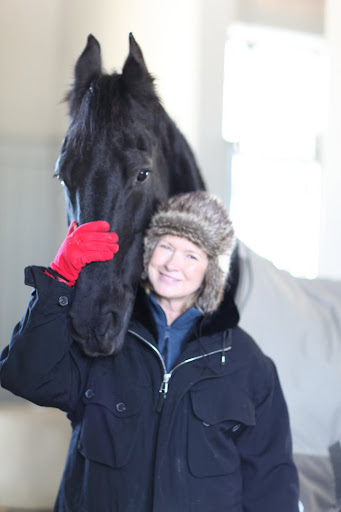
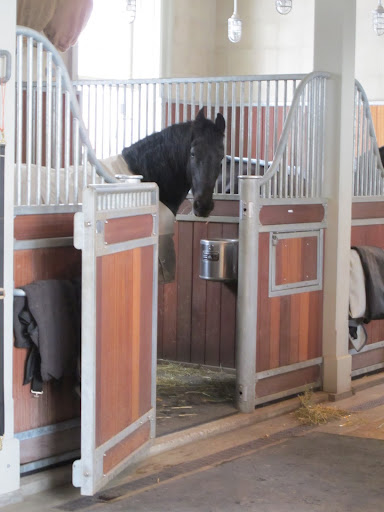 Martyn is a 17-year-old Dutch Friesian. Martha has been documenting his lameness problems for a while now on her blog, but her holiday message about the horse sounded quite discouraging. Martyn can no longer safely be turned out with the other horses during the winter, Martha wrote. The barn doors were kept closed and his stall door open, giving him the freedom of the huge stone barn.
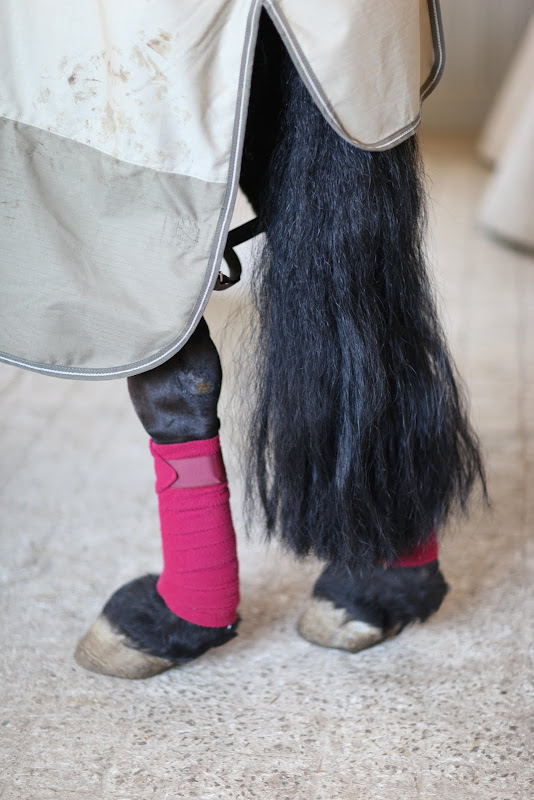 Martha describes his problems as multiple, but chose to photograph the pasterns and fetlocks of his hind legs. Readers will probably "diagnose" this part of Martyn's problem. I don't know what else may have been diagnosed for the horse.


Once again, celebrity horse owner Martha Stewart invited her readers into her barn in New York recently, through her blog. The photos were published over a period of a couple of weeks.
 Martyn is a 17-year-old Dutch Friesian. Martha has been documenting his lameness problems for a while now on her blog, but her holiday message about the horse sounded quite discouraging. Martyn can no longer safely be turned out with the other horses during the winter, Martha wrote. The barn doors were kept closed and his stall door open, giving him the freedom of the huge stone barn.
 Martha describes his problems as multiple, but chose to photograph the pasterns and fetlocks of his hind legs. Readers will probably "diagnose" this part of Martyn's problem. I don't know what else may have been diagnosed for the horse.
Soon after these photos were taken, the horse was euthanized. I can't remember another time when a celebrity figure detailed the health problems of a horse and its death on such a personal level.
A few months earlier, actress Glenn Close sent a video message to the
Fifth International Equine Conference on Laminitis and Diseases of the Foot in West Palm Beach, Florida. She had been given an award for her role in a documentary about laminitis. In the video message, she mentioned her personal war with laminitis as she struggled to save her Morgan mare, Rosie, who was euthanized.
Fifth International Equine Conference on Laminitis and Diseases of the Foot in West Palm Beach, Florida. She had been given an award for her role in a documentary about laminitis. In the video message, she mentioned her personal war with laminitis as she struggled to save her Morgan mare, Rosie, who was euthanized.
Lameness and laminitis can happen to any horse, but for these two women to speak out and show emotion over the loss of their horses is something new in the horse world. It can't change how a horse is doing, but perhaps it can help some owners stick with the program, or decide to get some tests done. Maybe it's the Internet, or maybe it's the age of accepting animals as family members, but it's a different world out there and owner emotions--positive and negative--are part of the equation of every horse's care and health.

Follow Hoofcare & Lameness Journal on Twitter.com
© Fran Jurga and Hoofcare Publishing. Please, no use without permission. You only need to ask.
Fran Jurga's Hoof Blog is a between-issues news service for subscribers to Hoofcare and Lameness Journal. This blog may be read online at the blog page, checked via RSS feed, or received via a digest-type email (requires signup in box at top right of blog page).
To subscribe to Hoofcare and Lameness (the journal), please visit the main site, www.hoofcare.com, where many educational products and media related to equine lameness and hoof science can be found.
Questions or problems with this blog? Send email to blog@hoofcare.com.
Fran Jurga's Hoof Blog is a between-issues news service for subscribers to Hoofcare and Lameness Journal. This blog may be read online at the blog page, checked via RSS feed, or received via a digest-type email (requires signup in box at top right of blog page).
To subscribe to Hoofcare and Lameness (the journal), please visit the main site, www.hoofcare.com, where many educational products and media related to equine lameness and hoof science can be found.
Questions or problems with this blog? Send email to blog@hoofcare.com.
Thursday, January 21, 2010
Virginia Tech Hires Full-Time Farrier for Veterinary College Post
20 January 2010 | Fran Jurga's Hoof Blog at Hoofcare.com

Links to more articles about Forging Ahead:
Link to Internship Program Announcement in 2007
Link to "Friends at Work" About Forging Ahead in 2009
Link to Forging Ahead web site
In 2009, Travis attended the Fifth International Equine Conference on Laminitis and Diseases of the Foot in West Palm Beach, Florida and the North East Association of Equine Practitioners Conference in Ledyard, Connecticut. He also was a guest presenter at one of our Hoofcare@Saratoga evenings last August in Saratoga Springs, New York, where he presented Forging Ahead's clever reverse Mustad glue-on shoe for laminitis therapy.
 © Fran Jurga and Hoofcare Publishing. Please, no use without permission. You only need to ask.
Fran Jurga's Hoof Blog is a between-issues news service for subscribers to Hoofcare and Lameness Journal. This blog may be read online at the blog page, checked via RSS feed, or received via a digest-type email (requires signup in box at top right of blog page).
To subscribe to Hoofcare and Lameness (the journal), please visit the main site, www.hoofcare.com, where many educational products and media related to equine lameness and hoof science can be found.
Questions or problems with this blog? Send email to blog@hoofcare.com.

Travis Burns will leave his employment with the multi-farrier practice Forging Ahead in Round Hill, Virginia to become the full-time farrier at the veterinary college at Virginia Tech. He's shown here with one of his favorite horses, a big-footed barefoot fellow named Gumpy. (Hoofcare & Lameness photo)


Virginia-Maryland Regional College of Veterinary Medicine at Virginia Tech University in Blacksburg, Virginia; thanks to Drs. R. Scott Pleasant (far left) and David Hodgson (near left) for their assistance. (University announcement text in red)
We are very pleased to announce that Travis Burns, of Marshall, Virginia, has joined the Virginia-Maryland Regional College of Veterinary Medicine at Virginia Tech as a full-time farrier.
Burns’ arrival in February will allow the College to provide complete equine podiatry services through the Veterinary Teaching Hospital. In his position, Travis will assist the equine faculty in building on the service, education, and community engagement strengths of the College. We believe that Travis’s special skills, knowledge, and experience will be a great resource for our students and regional horse owners, farriers, and veterinarians.
Proper management and care of a horse’s hooves is essential to the overall health of the animal, according to Dr. David Hodgson, head of the Department of Large Animal Clinical Sciences. “Properly trimmed and balanced hooves and correctly fitting shoes are essential to preventing lameness and other maladies in horses,” said Hodgson. “The addition of Travis to our department and hospital further enhances the overall preventive healthcare package we are able to offer our patients, clients and referring veterinarians. We are very pleased to welcome him and plan for him to enhance our ties to the local community of farriers. Travis will be working closely with Dr. Scott Pleasant and other members of our veterinary team. Dr. Pleasant is one of the leading veterinary exponents for the advancement of hoof care in horses. ”
Travis’s interest in horseshoeing began at an early age while working with horses at his uncle’s riding stable in North Carolina. He attended farrier school in the winter of 2002 and then continued to shoe horses while attending college. He graduated from North Carolina State University in 2006 with a Bachelor’s degree in Animal Science. In 2007, Travis was accepted into a one-year internship program at Forging Ahead, an elite multi-farrier practice in Northern Virginia. Upon completion of the internship program, based on his outstanding ability, Travis was retained at Forging Ahead as an associate farrier.
Travis recently achieved Certified Journeyman Farrier certification by the American Farrier's Association, the highest level of certification granted by the organization.
(end of Virginia Tech document)
Hoofcare and Lameness would like to congratulate both Travis Burns and Virginia Tech for the new directions each of them is taking (and taking together). While Travis is heading into a new area, there is no doubt he gives a lot of credit to the formal internship program that he completed at Forging Ahead; he was later hired on as an associate farrier there. The fact that he would be an AFA Journeyman and be considered for this position at the vet school so early in his career is testimony to the program that Paul Goodness has designed at Forging Ahead for farriers who want to seriously accelerate their careers working on top sport horses or specializing in lameness. While not everyone can be an intern at Forging Ahead, the program can be emulated by others, and hopefully more internships for working professional farriers will be offered in the future.
How does Paul Goodness feel about losing his protege? "I think it's so great," he said in a phone interview this morning, "that Virginia Tech would choose a young, talented farrier like Travis. He'll go far in this industry. They are starting with a clean slate, by hiring someone who wants to help horses and make a positive difference on many fronts. This is a step forward for the farrier-vet world. I will be able to stay in touch with Travis and send him cases from Leesburg. (Note: Marion duPont Scott Equine Medical Center in Leesburg, Virginia, which is affiliated with Virginia Tech and where Paul is the farrier).
"It's not a crisis here at Forging Ahead. It's true, 2009 wasn't the best year for us, and I'm sure not the best year for most farrier businesses," he continued thoughtfully. "But we've already picked up new clients this month and I don't feel like I need to be running back and forth to Florida. Scott and I have full books, all day, just here at the shop with haul-ins. We're predicting a big year and an influx of foreign riders to the area to train and compete before heading to Kentucky for WEG in the fall. The farrier business should be just fine, as should be the lameness referrals."
Here's a re-post of the NBC News segment taped at Forging Ahead about the internship program during the run-up to the Kentucky Derby last April:
Links to more articles about Forging Ahead:
Link to Internship Program Announcement in 2007
Link to "Friends at Work" About Forging Ahead in 2009
Link to Forging Ahead web site
In 2009, Travis attended the Fifth International Equine Conference on Laminitis and Diseases of the Foot in West Palm Beach, Florida and the North East Association of Equine Practitioners Conference in Ledyard, Connecticut. He also was a guest presenter at one of our Hoofcare@Saratoga evenings last August in Saratoga Springs, New York, where he presented Forging Ahead's clever reverse Mustad glue-on shoe for laminitis therapy.
While I was working on this announcement, several people forwarded to me links to a story that was published around the country today, via Associated Press, and most notably on the ABC News and National Public Radio web sites. The article features Jason Wilson-Maki, farrier at Texas A&M University, along with a brief mention of Michael Wildenstein, farrier at Cornell.
There are many hardworking farriers at vet schools around North America, including Jason and Michael, whether full-time employees or contract service providers. I'm sorry to say that I don't know who they all are, so if you work for or with a vet school, please contact The Hoof Blog so we can keep a list.
And today we can add Travis Burns to that list of farriers...and Virginia to the list of vet schools that has one.
 © Fran Jurga and Hoofcare Publishing. Please, no use without permission. You only need to ask.
Fran Jurga's Hoof Blog is a between-issues news service for subscribers to Hoofcare and Lameness Journal. This blog may be read online at the blog page, checked via RSS feed, or received via a digest-type email (requires signup in box at top right of blog page).
To subscribe to Hoofcare and Lameness (the journal), please visit the main site, www.hoofcare.com, where many educational products and media related to equine lameness and hoof science can be found.
Questions or problems with this blog? Send email to blog@hoofcare.com.
Saturday, January 16, 2010
USEF Reduces Medications Levels: Only One NSAID Allowed in Competition Horses After This Year
16 January 2010 | Fran Jurga's Hoof Blog at Hoofcare.com


Horses showing in USEF-sanctioned horse shows will be subject to new drugs and medications policies beginning at the end of 2010 as more than 30 years of permissive use of pain medication is being restricted under a more conservative rule. Even with half the medication formerly allowed, US horse shows still have a very liberal policy compared to most countries.
Big news from Louisville, Kentucky tonight: At the annual convention of the United States Equestrian Federation (USEF), the governing body of most equestrian sports in the United States, a significant rule change is being agreed upon which will reduce the number of medications that a horse can have in its system when competing.
Various committees within USEF have been working toward a compromise on this issue throughout the convention, which began on Wednesday. Current USEF rules allow two non-steroidal anti-inflammatory medications to be used simultaneously; that policy has been in place for more than 30 years.
The change was not without its opponents; the US Hunter Jumper Association's Open Hunter Task Force had filed for a rule change (GR410.1) that would have allowed two medications if written notification was given, but then withdrew its proposal on December 9.
Some breed and sport representatives felt that limiting medication is a penalty to older horses or to lower-level shows that do not have the best footing. Perhaps some horses will now show in fewer shows, or be entered in fewer classes. Some arguments were made that the current low value of horses makes it a hardship to sideline horses that could be competing if medicated. It remains to be seen if the new rule will affect horse show revenue; it is not expected to take effect until December 2010.
In most European countries, no medications are allowed; no medications are allowed in competitions sanctioned by the Federation Equestre International (FEI), the world governing body of horse sports. A recent vote to change the FEI medication policy caused an international uproar.
There is a lot to this story, and more will emerge in the days and weeks to come as the official final wording of the rule and dates are made public. One thing is known, and that is that the push to make the change came from veterinarians, who are often accused of promoting drug use in show horses.
Dr. Kent Allen, longtime chair of the Drugs and Medications Committee for USEF, commented on the obvious rise in joint injection that may be the result of a limit on medication. In a document available on the USEF website he offered this insight: "First, it is important to understand that a joint injection properly performed in experienced veterinary hands is the single most effective anti-inflammatory treatment we have for (an) equine joint.
"Secondly, there are numerous medications to inject into joints. Often it is hyaluronic acid in combination with a variety of cortisones, or bioregenerative therapies such as IRAP. Some of these medications are extremely safe and all of them will significantly reduce joint inflammation.
"On the question of 'are joint injections going to be overused', the answer is that is already happening today! In some cases joint injections are being used as treatments in 4, 6 or 8 joints without a diagnosis of joint inflammation ever being established. This is dangerous not only from the standpoint of increasing the number of joint injections in the horse and potential side effects but you may or may not be treating the real problem. Accurate diagnosis, including lameness examination, nerve blocks, joint blocks and diagnostic imaging is the most effective method of determining what the problem is and if the horse needs joint injections. This also has the benefit of reducing the cost to owners as well as the risk to the horse."
USEF approved the use of Surpass, a topical anti-inflammatory recently; there's no prediction so far if there will be a trend to more specific treatments rather than generalized medication for pain, stiffness or soreness.
While rumors of a compromise were circulating today, equestrian journalist Nancy Jaffer broke the news tonight in her column for the Star-Ledger in New Jersey that the new medication policy would be adopted. More insight into the process of the rule change can be found in Nancy's article.
The new rule will affect most breed shows, including Arabians, Saddlebreds and Morgans, plus USEF-sanctioned hunter-jumper, dressage, driving, endurance and eventing competitions and individual breeds and sports who are under USEF's umbrella. It will not affect Quarter horse, Paint, Tennessee Walking horse or Appaloosa shows, as well as many other breeds, or the sports of reining, cutting and barrel racing, unless they are held at a USEF event or as part of a USEF-member breed show.
The medication policy change is endorsed by the American Association of Equine Practitioners, the American Veterinary Medical Association and by the Humane Society of the United States.
USEF assembled an impressive bank of articles and information on medications in sport and performance horses for the delegates to the convention. Since medication policy is sure to be a topic of conversation throughout the coming months, you might want to save some of those documents for reference.
 © Fran Jurga and Hoofcare Publishing. Please, no use without permission. You only need to ask.
Fran Jurga's Hoof Blog is a between-issues news service for subscribers to Hoofcare and Lameness Journal. This blog may be read online at the blog page, checked via RSS feed, or received via a digest-type email (requires signup in box at top right of blog page).
To subscribe to Hoofcare and Lameness (the journal), please visit the main site, www.hoofcare.com, where many educational products and media related to equine lameness and hoof science can be found.
Questions or problems with this blog? Send email to blog@hoofcare.com.
 © Fran Jurga and Hoofcare Publishing. Please, no use without permission. You only need to ask.
Fran Jurga's Hoof Blog is a between-issues news service for subscribers to Hoofcare and Lameness Journal. This blog may be read online at the blog page, checked via RSS feed, or received via a digest-type email (requires signup in box at top right of blog page).
To subscribe to Hoofcare and Lameness (the journal), please visit the main site, www.hoofcare.com, where many educational products and media related to equine lameness and hoof science can be found.
Questions or problems with this blog? Send email to blog@hoofcare.com.
Subscribe to:
Posts (Atom)