Saturday, August 07, 2010

Lisa's Booby Trap: Sort Out the Feet, You've Got a Racehorse

Lisa’s Booby Trap Stays Perfect In Loudonville
Lisa's Booby Trap is a horse for anyone who has given up on horseracing. Or life. 
Photo courtesy of New York Racing Association.
Saratoga. Playground of the rich and famous. Well-bred people, better-bred horses. They check your pedigree at the city line.

But on Monday night, the best pedigree in the world couldn't get you to a new home; svelte yearling after svelte yearling went unsold at the Fasig-Tipton Select Sale, or sold at prices below what was expected, and hoped for.

The buyers turned up their noses at the yearlings. The hottest horse in town, instead, is none other than a $2000 freakishly-fast-finishing Florida-bred Finger Lakes filly who is trained by Tim Snyder, a guy from Maine who normally wouldn't be able to even get a stall at Saratoga.

The racing secretary at Saratoga does not have Tim Snyder on speed dial. The guy has one horse in his stable. But, this year is different in a lot of ways.

You see, Tim seems to think the horse may be the reincarnation of his wife, Lisa, who died of ovarian cancer in 2003 and vowed she'd "come back as a horse". And then this horse showed up in his life.

Lisa's Booby Trap. That's her name. The whole thing reads like a script for a video that plays inside a Hallmark card. Except it's really happening, right here in Saratoga, of all places. He was broke, and didn't even have a horse trailer to go pick her up when he bought her. She was club-footed, and only had one eye anyway. But, the way people tell me the story, she had not just a bad club foot but a flat pancake foot too and she needed someone to pay some attention to her hooves. According to NYRA, she wears a hind shoe on the flat front foot now. And she no longer hits herself when she runs. Tim found a horseshoer to get the job done. And now it is just a matter of waiting for Oprah to call.

Here's their story, though we don't know yet what her feet look like. (I'm on it, though.) This TVG segment was made when she had won her first three starts this spring and summer at Finger Lakes, which is sort of the "outback" of New York racing, out in the middle of the state.


So Tim must have borrowed a trailer or begged a ride for the filly across New York State to Saratoga. She made her workout debut during the morning trackside breakfast on the main track. The announcer didn't notice her streaking by, but the timer certainly did. That was a fast work. Lisa's Booby Trap had arrived.


Tim Snyder had never even entered a horse in a stakes race before. Not even at Finger Lakes. His filly was entered against a full card of Kentucky-breds. Two were conditioned by Hall of Fame trainer Todd Pletcher. One was owned by Stonestreet Stables, owners of 2009 Horse of the Year Rachel Alexandra. Speed demon Stormandaprayer is owned by chef Bobby Flay. And than there's Lisa's Booby Trap at 12-1, the only longshot on the program. Here's what happened:


According to NYRA and the Albany Times-Union, Lisa's Booby Trap will probably run next on Travers Day, which is Saturday August 28, in the Grade 3 Victory Ride.

I can't wait.

© Fran Jurga and Hoofcare Publishing. Please, no use without permission. You only need to ask. This blog may be read online at the blog page, checked via RSS feed, or received via a digest-type email (requires signup in box at top right of blog page). 
 
Join the Hoofcare & Lameness Facebook Page

Friday, August 06, 2010

Another Shed Row Heard From

Yesterday's blog story about the things that people see every day but don't stop to capture in photographs prompted Ada Gates to send in this photo from California. What do you see here? Two men in aprons. One working, one watching, right? "Here's my shed row picture," Ada wrote. "The apprentice learning from his boss farrier. I just thought it was sweet, and thankful the learning goes on." This is a timeless pose; apprentices have stood just like that with their hands on their knees for hundreds of years. Farrier apprentices aren't supposed to blink. Thanks, Ada!

Follow the Hoof Blog on Twitter: @HoofcareJournal
Join the Hoofcare & Lameness Facebook Page
 

Wednesday, August 04, 2010

Friends (Alone) at Work: An Anvil for a Foot Rest

Double-click on the photo for a larger view.
I've had this photo on my mind for a while, and I wanted to write a story to go with it. It seems to warrant one.  It's at the San Antonio Rose Palace in San Antonio, Texas. The way I see it, two things could be going on: the farrier is waiting for a customer who is late (you know the farrier isn't early), or that's not the farrier stretched out in that chair, that's the customer, and she's waiting for the farrier, who unhitched his truck from the trailer to go get some lunch and hasn't been heard from since (and that was a long time ago).

We always see photos of farriers working, bending, pounding, and clinching but rarely do we see them in one of those rare down-time moments. Even more rare is a completely still shot of a typical moment of a typical summer day at a showground that includes a farrier, since the farrier is usually in great demand and resembles a perpetual motion machine. 

People don't usually take pictures of the moments when nothing's going on. But that's the essence of a summer day: things just seem to stand still, if you let them. And summer lasts longer, if you do.

This is what you might see when you come around the corner of any barn aisle across the USA today, tomorrow, this weekend and for the next month or so until the start of school and the coming cold weather chases everyone back home, so they can rest up and do it again next year.

That's my story, what's yours? 

This quietest of all farrier scenes was captured by Houston-area photographer Louis Vest, who is more at home aboard a ship than on or under a horse, but anything that he points his camera at is better for it. Louis is a ship's pilot in the Houston Ship Channel and travels the world. He has an amazing array of photographs (especially if you like the sea, which I do) on display at his Flickr.com site. Thanks, Louis. 

© Fran Jurga and Hoofcare Publishing Fran Jurga's Hoof Blog is a between-issues news service for subscribers to Hoofcare and Lameness Journal. Please, no use without permission. You only need to ask. This blog may be read online at the blog page, checked via RSS feed, or received via a digest-type email (requires signup in box at top right of blog page). To subscribe to Hoofcare and Lameness (the journal), please visit the main site, www.hoofcare.com, where many educational products and media related to equine lameness and hoof science can be found. Questions or problems with this blog? Send email to blog@hoofcare.com.
Follow the Hoof Blog on Twitter: @HoofcareJournal
Join the Hoofcare & Lameness Facebook Page

Monday, August 02, 2010

Free Donkey Foot Care DVD for Farriers


The British-based Donkey Sanctuary has recently launched a new short film on DVD that provides visual and technical support for farriers about the fine points of donkey hoof care.
An Introduction to Donkey Foot Care is free to all farriers and their apprentices and has been produced by the donkey-welfare charity to pass on the latest advice based from the charity's own experiences in the care and management of donkeys. The film also identifies key differences between horses’ and donkeys’ feet.
There are four main chapters in the 15 minute film, including:
• the normal donkey foot
how to correctly trim a normal donkey foot
how to deal with seedy toe (a.k.a. "white line disease" in the USA); and
how to deal with trimming long feet.


Colin Goldsworthy trimming hooves
Colin Goldsworthy, who is one of the Sanctuary’s most experienced farriers and who demonstrates all farriery within the film, says: “If you are just starting out as a farrier or even if you’ve been in the trade for years, please do get in touch for a free copy of this DVD. The film has been produced for you and the advice within it has been derived from The Donkey Sanctuary’s vast experience, having cared for almost 14,500 donkeys over the past 40 years.”

The DVD is free on request only to qualified farriers and/or industry apprentices. To obtain a copy please send an email.

The Donkey Sanctuary also provides free information sheets and training to farriers.
 © Fran Jurga and Hoofcare Publishing Fran Jurga's Hoof Blog is a between-issues news service for subscribers to Hoofcare and Lameness Journal. Please, no use without permission. You only need to ask. This blog may be read online at the blog page, checked via RSS feed, or received via a digest-type email (requires signup in box at top right of blog page). To subscribe to Hoofcare and Lameness (the journal), please visit the main site, www.hoofcare.com, where many educational products and media related to equine lameness and hoof science can be found. Questions or problems with this blog? Send email to blog@hoofcare.com.

Friday, July 30, 2010

Vampires for Elephants: Robert Pattinson's Laminitis Experience in Film?

His most famous role was as a teenage vampire and now Hollywood's made Robert Pattinson into a Cornell vet student with a foundered horse to fix. Publicity photo from the Water for Elephants film.
 The horse world is due to get a shot in the arm--if not a bite in the neck--as production continues in and around Chattanooga, Tennessee on the film adaptation of one of my favorite novels, Water for Elephants, by Sara Gruen. The star of the movie is Twilight vampire heart throb Robert Pattinson, and this photo is from the movie's blog. Notice he is leading what appears to be either a Friesian or a Percheron from a circus train car.

Hollywood's Reese Witherspoon plays the role of the circus equestrian star and has an Oscar-worthy wardrobe. The horse and elephant scenes were shot in California; the train scenes are in production now in Chattanooga, Tennessee. This photo from California is from a series published in the Daily Mail from Great Britain.
Any film that is heavy on horses is good for all of us; it's good for horse sales, horse lessons, and our horse industry futures, especially when it stars the hottest celebrity in Hollywood. But this one makes me especially curious. It's a great story: Jacob, a vet student at Cornell during the Depression, succumbs to stress and suddenly walks out just before finals and wanders off into the night. On impulse, he hops a passing freight train. What he doesn't know is that it's no ordinary freight train, but a down-and-out circus train. He throws in his lot with the midgets and the clowns and the roustabouts but most of all with the draft horses ("baggage stock" in circus language), the Arabians and one special elephant when he is hired as the caretaker for the menagerie because of skills he claimed he learned in vet school.

One of the first challenges the management throws at him to earn his keep is a horse with laminitis. Can he fix him? In the book, the description of the horse's hoof looks and how the horse stands and what Jacob does to try to help it is very well done. Will laminitis make the silver screen or will it fall to the cutting room floor? Or did it make the script at all? Can they train a horse to act like it is foundered? Even a minute of laminitis awareness in a film like this would be great for public awareness of the disease. And yes, there are farriers in the book, too.


For those of you who haven't read the book: do it. Better yet, get to your library or local independently-owned bookstore and borrow or buy the cd-rom version and listen to the book, as it is very well read. You'll find yourself sitting in your driveway listening to just a little more...

Someone on YouTube.com made a slide show of old circus images to go with the soundtrack of the prologue from the cd-rom. I hope it hooks you, although this is just the first few pages of the book--the rest of it explains how Jacob got to that point of circus mayhem. And what happened next. What you're hearing is Jacob at age 90--or is it 93? he's not sure--in a nursing home, finally telling what happened that day. He'd kept someone's terrible secret for 70 years.

Water for Elephants, the film, is scheduled to be released on April 15, 2011.


© Fran Jurga and Hoofcare Publishing Fran Jurga's Hoof Blog is a between-issues news service for subscribers to Hoofcare and Lameness Journal. Please, no use without permission. You only need to ask. This blog may be read online at the blog page, checked via RSS feed, or received via a digest-type email (requires signup in box at top right of blog page). To subscribe to Hoofcare and Lameness (the journal), please visit the main site, www.hoofcare.com, where many educational products and media related to equine lameness and hoof science can be found. Questions or problems with this blog? Send email to blog@hoofcare.com.

Follow the Hoof Blog on Twitter: @HoofcareJournal
Join the Hoofcare & Lameness Facebook Page

Tuesday, July 27, 2010

War Horse History: Equine Ambulances Moved Wounded Horses During World War I

When a horse was wounded, it took at least one other horse to move it to a railroad stop or a field veterinary hospital. Here you see a tandem hitch hauling a horse from the front; the teamster would command these horses with voice controls. Image by the remarkable chronicler of horses in World War I through his art, John Edwin Noble.

Tiludronate (Tildren) Effective for Hind Limb Lameness Caused by Bone Spavin

Spavin is one of the most common causes of lameness in jumping horses.

Newly published trials from a study in England show that horses suffering lameness caused by bone spavin can show marked improvement following treatment with a Tiludronate (Tildren) infusion, when administered in combination with controlled exercise.

Friday, July 23, 2010

Silent Anvil: Jack Miller Has Died

Jack Miller gave me a wink. We were in Malibu, California, it was 1985, and Jack was in his prime. He's wearing the Texas flag as a bandanna around his neck. 
The hunter/jumper world will never be quite the same. Where will a trainer take a horse as a last resort, that horse who's just not going quite right under his feet?

Legendary horseshoer Jack Miller died after sunrise this morning in the Montgomery County, Maryland hospital where he had been a patient for several weeks undergoing treatment for multiple life-threatening problems. Jack had been in ill health for many years, but just kept on going.

A loyal legion of world-class farriers and horse show friends from all over America had traveled to Maryland this week to be with Jack.

Jack Miller created, defined and perfected a lifestyle of "vagabond horseshoeing" on the hunter/jumper horse show circuit where he made a living proving to people that his trademark mystique for being able to put difficult horses "right" through subtle hoof balance techniques was real. Unfortunately for the farrier world, he was never quite able to explain what he knew instinctively about how to help horses get over fences. He just did it. And shrugged.

Jack was from Texas and lived wherever he was that night. He was especially proud of his long role as the official farrier for the Washington (D.C.) International Horse Show. His clients over the years included many Olympic and champion riders, trainers, and their horses.

No one was more rightfully in the Hall of Fame than Jack Miller, nor more in a class of his own.

Note: Jack's friends can right-click on the photo above and save it for personal use. It's large format, low resolution. In the days since Jack's death I have learned how many friends Jack had. It has been amazing to hear from so many of them! I have posted an album of more old photos of Jack on the Hoofcare and Lameness Facebook page.

Fran Jurga's Hoof Blog at Hoofcare.com 
© Fran Jurga and Hoofcare Publishing 
Fran Jurga's Hoof Blog is a between-issues news service for subscribers to Hoofcare and Lameness Journal. Please, no use without permission. You only need to ask. This blog may be read online at the blog page, checked via RSS feed, or received via a digest-type email (requires signup in box at top right of blog page). To subscribe to Hoofcare and Lameness (the journal), please visit the main site, www.hoofcare.com, where many educational products and media related to equine lameness and hoof science can be found. Questions or problems with this blog? Send email to blog@hoofcare.com.

Tuesday, July 20, 2010

Is California Farrier Doug Roberts the Hardest Working Person in America?


Doug Roberts is a hard-working guy. He's been shoeing horses for 37 years, and he has no plans to quit. Ever.

But when the Livermore, California farrier heard about a contest to find the hardest working person in America, he figured there couldn't be many people who worked harder than he does. And the judges agreed, because today they announced that Doug is a finalist, one of ten people chosen as the hardest working people in America.

Mitchum, which manufactures what it calls the hardest working antiperspirant/deodorant, launched the promotional campaign in May 2010.

"Mitchum challenged regular people to create reality films telling their true stories of hard work, and the public responded in a strong way," said Alan T. Ennis, CEO of Revlon, Mitchum's parent company. "Mitchum is a brand that prides itself on working hard and these finalists have proven they do just that. Not only are they finalists, they are true Mitchum brand ambassadors. Through this contest, Mitchum and the public have the power to make a difference in someone's life."

Besides Doug Roberts, the finalists selected include a man who is cleaning up the nation's rivers; a U.S. Air Force Fighter pilot; an 88-year-old working mom; an elementary school custodial worker; the founder of First Response Team of America; a man helping young campers build character, respect and leadership;  an actor, trash-hauler, artist, silkscreener and landscaper; a construction worker and dad who moonlights as a college student; and an Army drill sergeant.

Beginning today, the public can log on to www.mitchumhardestworking.com and vote for the “Hardest Working Person in America”--as long as you promise to vote for Doug! The grand prize winner of the contest will receive a $100,000 cash prize and be the subject of a short film by legendary documentarian Albert Maysles and co-filmmaker Bradley Kaplan with a first-place winner also receiving a $20,000 cash prize. In addition, Mitchum will also present an “Audience Award” winner with a $5,000 prize and a “golden” Mitchum trophy for the video which received the most votes in the first round of the contest. Voting will close on August 15, 2010 and all three winners will be announced between August 16-23, 2010.

For contest rules or to view the hardest working films, television spots and finalist videos visit mitchumhardestworking.comwww.facebook.com/mitchum, or follow the campaign on Twitter at @MitchumTM (twitter.com/mitchumtm. Just be sure to vote for Doug as often as they'll let you!


© Fran Jurga and Hoofcare Publishing Fran Jurga's Hoof Blog is a between-issues news service for subscribers to Hoofcare and Lameness Journal. Please, no use without permission. You only need to ask. This blog may be read online at the blog page, checked via RSS feed, or received via a digest-type email (requires signup in box at top right of blog page). To subscribe to Hoofcare and Lameness (the journal), please visit the main site, www.hoofcare.com, where many educational products and media related to equine lameness and hoof science can be found. Questions or problems with this blog? Send email to blog@hoofcare.com.

Sunday, July 18, 2010

Overdose Is Back! Champion Euro Sprinter Wins After Laminitis Layup

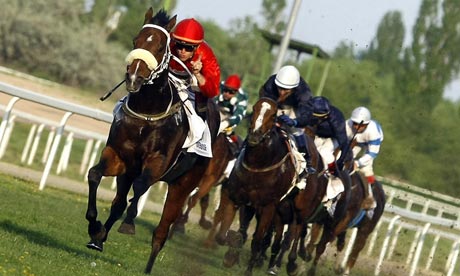
Great news from Bratislava, Slovakia this weekend: Champion Hungarian sprinter Overdose, a.k.a. "The Budapest Bullet", remained undefeated when he won a race. This was his first start since being sidelined for 15 months by laminitis. Overdose's recovery from laminitis was featured in the Hoof Blog in May. Should Overdose stay sound and fit, he is slated to run in England this summer.


© Fran Jurga and Hoofcare Publishing Fran Jurga's Hoof Blog is a between-issues news service for subscribers to Hoofcare and Lameness Journal. Please, no use without permission. You only need to ask. This blog may be read online at the blog page, checked via RSS feed, or received via a digest-type email (requires signup in box at top right of blog page). To subscribe to Hoofcare and Lameness (the journal), please visit the main site, www.hoofcare.com, where many educational products and media related to equine lameness and hoof science can be found. Questions or problems with this blog? Send email to blog@hoofcare.com.

Saturday, July 17, 2010

Is This What They Mean by "Loads Well"?


Is this what it means in the horses-for-sale listings when an ad says that a horse "loads well"? These two photos are from an amazing series taken in Poland this spring when the floods were so bad there. An amphibious military craft became a makeshift horse van. This draft horse is certainly being a good sport about climbing into the vessel. How many horses would even try? It obviously took a few attempts to get him on board. I guess the water was too deep to lower the ramp. This photo reminds me of all the natural horsemanship lessons of getting your horse to walk willingly onto a trailer. It's doubtful whether the fellow in the boat is a genius horse whisperer or this horse has been through a NH seminar but they eventually got him into the boat. The fellow in blue is doing a great job of staying out of the way. Photos from fOTOGLIF

Fran Jurga's Hoof Blog at Hoofcare.com © Fran Jurga and Hoofcare Publishing. Please, no use without permission. You only need to ask. Fran Jurga's Hoof Blog is a between-issues news service for subscribers to Hoofcare and Lameness Journal. This blog may be read online at the blog page, checked via RSS feed, or received via a digest-type email (requires signup in box at top right of blog page). To subscribe to Hoofcare and Lameness (the journal), please visit the main site, www.hoofcare.com, where many educational products and media related to equine lameness and hoof science can be found. Questions or problems with this blog? Send email to blog@hoofcare.com.

Thursday, July 15, 2010

America's Got Talent: Bike Riding Horseshoer Advances on Reality Show


He says he got his upper body strength from bucking hay bales. He lives in the loft of a barn. And he made it past the tough judges and through two big broadcasts of the NBC reality show America's Got Talent. Now he's on his way to the finals in Hollywood.

Jeremy Vanschoonhoven could probably shoe a horse while sitting on his bike. Why not? He can ride it across tightropes and scale uneven parallel bars on a stage in front of thousands of people. But the horseshoer from Talent, Oregon is going to need a lot of support from the horse world when he gets to the Hollywood finals.


You know he's practicing; he even builds his own sets. Keep an eye on the television listings and cheer Jeremy on! I think you can call in and vote for him , too--that's how the show works.

Here's a little video that Jeremy put together to showcase his talent off the stage.


Did you know you can...Join the Hoofcare & Lameness Facebook Group and "Friend" Fran Jurga to stay in touch on Facebook! The blog remains the main communication stream, however; you can receive the headlines by email or read the RSS feed in your MyYahoo or iGoogle feeds. Send an email if you need help setting up those services.


Fran Jurga's Hoof Blog at Hoofcare.com
© Fran Jurga and Hoofcare Publishing 
Fran Jurga's Hoof Blog is a between-issues news service for subscribers to Hoofcare and Lameness Journal. Please, no use without permission. You only need to ask. This blog may be read online at the blog page, checked via RSS feed, or received via a digest-type email (requires signup in box at top right of blog page). To subscribe to Hoofcare and Lameness (the journal), please visit the main site, www.hoofcare.com, where many educational products and media related to equine lameness and hoof science can be found. Questions or problems with this blog? Send email to blog@hoofcare.com.

Wednesday, July 14, 2010

Springs in the Bluegrass; Fine-tuning a Thoroughbred Yearling's Hooves 30 Days Before the Sale

A funny thing happened on the way to the airport.

I had a chance to look over the shoulder of Dr Scott Morrison of Rood and Riddle Equine Hospital's Podiatry Clinic, and who would turn that down? The patient was a perfectly healthy yearling colt being prepared for an August sale. But with 30 days left until the sale, the growing colt was showing a slight tendency to be "a bit upright" and some finetuning was in order.

Make no mistake: this colt’s hoof conformation wouldn’t be of much, if any, concern other than the fact that he’d be under the microscope at the sale and every detail has to be considered. Every detail, after all, can make the difference in a bidder's enthusiasm for a horse and where the colt would be ranked on a bidder's wish list. In the end, it comes down to dollars and cents but in the climate of recent yearling sales, it could be the difference between a sale and no sale.

Dr. Morrison’s solution to this horse’s problem was at once right out of the textbook and equally unorthodox in that it might have come out of two different textbooks. He arrived with two spring shoes, which would be on the menu of recommended shoes for a case like this. But the shoes for this horse were made of two different materials.

The solution to working on two front feet with different levels of contraction? 
Spring shoes made of two materials, one more flexible than the other. The aluminum 
shoe also had a hinge in the toe to open the right front more.
On the left front, which had the least amount of deviation, the horse now wears a Burns Polyflex shoe, into which Rood and Riddle added a spring wire, which is a v-shaped wire roughly the size and shape of the frog. The wire, however, does not touch the frog.


Polyflex spring shoe glued on, before cutting the horizontal keeper wire and adding
Equipak to fill the sole. The spring (frog-shaped wire) does not touch the frog.

The Polyflex shoe is made for glueing; it is composed of nearly-transparent polyurethane with a wire spine inside. The shoe was glued on with Equilox  hoof adhesive and then the sole was filled with Vettec’s Equipak, a clear cushioning urethane. Before pouring in the liquid padding, Morrison clipped the temporary horizontal keeper wire to release the spring action of the wire.

The Polyflex shoe did not have a hinge, but the spring action of the wire and the forgiving material of the shoe would help keep the foot open, Morrison believes.

Completed left front foot with polyurethane shoe after Equipak is solidified. Just to clarify: soft urethane-based Equipak fills and cushions the sole and frog; harder PMMA epoxy-type adhesive Equilox glues on the shoe.
On the right front, which was slightly more problematic, Rood and Riddle’s shoe fabrication specialist Manuel Cruz created an aluminum hinged shoe with a spring wire. The hinge was in the center of the toe, as typically described for hinge shoes to relieve club feet and contracted heels in more advanced cases. Equilox, the clipping of the horizontal keeper wire, and Equipak again followed.

Shoe fabrication specialist Manuel Cruz fabricates a vast repertoire 
of shoes and devices for the vets and farriers at Rood and Riddle.

Aluminum hinge shoe fabricated back at Rood and Riddle by Manuel Cruz. 
The spring is the same as in the Polyflex shoe, but the shoe has a 
hinge in the toe to open the foot. 


I asked Manuel about the discrepancy in thickness between the two shoes but he said that it was an illusion and that they were almost the same.

Morrison and McAninch tackled the application of these results-oriented horseshoes to the colt's front feet as if it was routine; with yearling sales season approaching, that may be the case. The organization at the clinic to prepare what's needed for supplies and to fabricate shoess must be impressive when you see how easily the work gets done without searching for things.

The case itself was intriguing but equally interesting was the process, especially the speed and efficiency with which Morrison and his technician Loryn McAninch completed the job. I know from my travels that this would have been a half-day job at most clinics but the feet had been traced and trimmed in advance, the shoes fabricated to the tracings, and the adhesive and support materials were ready to go.

Another good point about the way this case was handled, from an outside observation, was that the young horse had to stand for a minimal amount of time since the measuring, tracing and trimming had already been done. The unorthodox unmatching spring shoes may have been an insurance policy on this horse's value. We'll never know what his feet might have looked like without this intervention but prospective owners will appreciate the picture-perfect feet that they will see on this horse at the sale.

Thanks to Dr Morrison, Loryn, Manuel and the farm staff for allowing me to observe this procedure and photograph it. Good luck to the colt!

To learn more: A valuable detailed reference paper by Dr. Morrison, Foal Foot Care, is available for download from the Proceedings of the 2009 CanWest Veterinary Conference.

All photos © Fran Jurga | Hoofcare Publishing.


Fran Jurga's Hoof Blog at Hoofcare.com
© Fran Jurga and Hoofcare Publishing


Please, no use without permission. You only need to ask. Fran Jurga's Hoof Blog is a between-issues news service for subscribers to Hoofcare and Lameness Journal. This blog may be read online at the blog page, checked via RSS feed, or received via a digest-type email (requires signup in box at top right of blog page). To subscribe to Hoofcare and Lameness (the journal), please visit the main site, www.hoofcare.com, where many educational products and media related to equine lameness and hoof science can be found. Questions or problems with this blog? Send email to blog@hoofcare.com.

Monday, July 12, 2010

Equine Imaging: Hallmarq's Standing MRI Expertise Accessible Through Hoof Blog Alliance


This video, produced by Hallmarq Veterinary Imaging, details the procedure involved in preparing for and executing a standing MRI as practiced by Sarah E. Powell, MA, VetMB, MRCVS in the Hallmarq suite at Rossdales Equine Diagnostic Centre in Newmarket, England.


Get ready for some exciting new additions to the Hoof Blog. Over the next few weeks, the H-Blog will present information for and with the assistance of Hallmarq Veterinary Imaging, a company that is recognized as the worldwide leader in standing-MRI imaging of the horse's lower limb.

Now that 14 leading North American university and private equine hospitals are equipped with specialized Hallmarq magnetic resonance imaging (MRI) units for hoof imaging, there is a "need to know" in the horse owner, trainer, technician, therapist and farrier sectors about what this type of veterinary diagnostic imaging involves and what its value to the horse can be. Worldwide, almost 50 Hallmarq lower limb imaging suites are in use; images of almost 20,000 equine lameness cases have been archived in the company's central database. But what does that mean to a horse in my care, or in yours?

Why does a veterinarian need an MRI if a radiograph has already been taken? An MRI looks literally "into the foot" from different angles and reveals the condition of soft tissue structures, such as tendons, ligaments, and hard-to-view points like the navicular bursa. A radiograph's weaknesses are an MRI's strengths. MRI results are especially valuable for making a prognosis for a performance-related injury. (Hallmarq image)
With Hallmarq's expertise and vast database of images, we will be helping to de-mystify where, when and how MRI fits into the bigger picture of horse foot injury imaging and explaining specific foot problems that are especially well-suited for detailed soft-tissue analysis using MRI technology. Hallmarq's unit, as you will see in this video, also allows the horse to be imaged while standing, so that only sedation is required rather than subjecting the horse to the risks of general anesthesia.

That's the process, and while we all are interested in the end results, it's important to know what can be done to best prepare horses for an MRI appointment and to appreciate the valuable information that MRI might provide. Information from leading clinics and lameness specialists will provide insights and perhaps give insight to what the future may hold.

Watch for more in the Hallmarq-sponsored article series this summer, and check their social media system and especially their info-deep web site for lots more information.

To learn more about Hallmarq Veterinary Imaging and standing MRI technology for horses:

• Become a fan  of the new Hallmarq Equine MRI Facebook page;
• Follow @HallmarqMRI on Twitter;
• Subscribe to the hallmarqvetimaging channel on YouTube.com;
• Watch for a growing equine distal limb Hallmarq MRI image gallery on Flickr.com;
• Visit the Hallmarq.net web site. (Plan to spend some time there!)

--------

About Hoof Blog sponsored articles: From time to time, the HOOF BLOG publishes articles made possible by the sponsorship of industry partners and advertisers. These articles will always be clearly marked as sponsored content. They are developed and created by Hoofcare Publishing in collaboration with the sponsor. Only articles clearly marked as sponsored content have commercial affiliations. Sponsored content opportunities are available to companies whose programs, events or products are relevant to the educational mission of Hoofcare Publishing and the interests of its subscribers. Please email Hoofcare more information on sponsorship opportunities.

England's Steven Beane Repeats as Calgary World Champion

The Calgary Stampede put together this little video about the farrier competition.

"Beane" there, done that--Two years in a row!

Steven Beane of England, shown early in this video, was named the 2010 World Champion Blacksmith at the Calgary Stampede today.  That makes it two in a row for the Yorkshire farrier, who was also champion in 2009 and is currently reserve European champion for 2010.

According to the Calgary Stampede, Beane was virtually unbeatable when it counted Sunday, dominating the semifinal and final rounds under the Big Top to win his second consecutive World Championship Blacksmiths’ Competition title at the Calgary Stampede.

Beane, who hails from Northallerton, North Yorkshire, is the first backto-back WCBC champion since Billy Crothers of Wales won the second and third of his five Stampede crowns back in 1995 and 1996.

“It’s unbelievably hard to do that. Really, really hard,” said Beane, 31. “You’ve got so many good guys competing here . . . you’ve got to be on the top of your game, and I’m lucky I was on top of my game today.

“I’ve had a bad year up until now, to be honest,” added Beane, who said he competes at between 15 and 20 farrier competitions during a year. “I went to the European championships, where I’d won two years in a row, and I was second there. That was kind of hard to take. But I must admit that for the last couple of months, I’ve been focused on coming back here.”
During the 10-man semifinal, Beane opened up a 21-point lead on Jake Engler of Magnolia, Texas, and in the final, he increased that advantage, prevailing by 32 points over Engler in the end.

Beane finished with 147 points to Engler’s 115. As for the other finalists, Scotland’s Derek Gardner was
third with 115 (Engler won a tiebreaker on the fit of a horse’s shoe); fellow Scot David Varini was fourth with 94, and Texan Gene Lieser ended up fifth with 87.

Beane wins a cheque for $10,000, as well as a gold-and-silver Stampede championship buckle, a limited  edition bronze trophy, and a champion’s jacket. More than $50,000 in cash and prizes were handed out to WCBC competitors this weekend.

“It was pretty rough going for me today. Nothing was clicking,” said Engler. “Beane is always on the money, and he’s hard to beat. But I’m pretty happy with (second place). It can’t be too bad, since there’s  only one guy better than me.”

Congratulations to all the farriers who made the trip to Calgary and represented their countries.

Information and quotes provided by the Calgary Stampede were used in this report. Photo and video courtesy of the Calgary Stampede.

Fran Jurga's Hoof Blog at Hoofcare.com
© Fran Jurga and Hoofcare Publishing


Fran Jurga's Hoof Blog is a between-issues news service for subscribers to Hoofcare and Lameness Journal. Please, no use without permission. You only need to ask. This blog may be read online at the blog page, checked via RSS feed, or received via a digest-type email (requires signup in box at top right of blog page). To subscribe to Hoofcare and Lameness (the journal), please visit the main site, www.hoofcare.com, where many educational products and media related to equine lameness and hoof science can be found. Questions or problems with this blog? Send email to blog@hoofcare.com.

Sunday, July 11, 2010

Calgary Stampede Top Ten Announced

C A L G A R Y  2 0 1 0

Fifty-six competitors representing 12 countries have been pounding it out at Calgary, Alberta in Canada for the Calgary Stampede’s 31st annual World Championship Blacksmiths’ Competition (WCBC). Three former Stampede champions, including 2009 World Champion Stephen Beane of England, are competing this year.

At stake are $50,000 in cash and prizes, with the winner receiving a $10,000 check, a limited edition bronze trophy, a Stampede handcrafted buckle, and a champion’s jacket. But anyone will tell you that it's more about the title than the prizes.

Saturday night, after accumulating points in eight different forging and shoeing classes over three days, the top 10 competitors were announced for Sunday's semifinal under the Big Top. Squaring off will be Beane, Canada's Colain Duret, Scotland’s Ian Gajczak, Derek Gardner, and David Varini, and three Americans: Jake Engler, Gene Lieser, Chris Madrid, Tim McPhee, and Jim Quick.

The top five from the 10-man semifinal will return immediately for the WCBC’s final round. A World Champion should be announced later Sunday afternoon.

England’s Darren Bazin has won Calgary three times and been second once. “Being a world champion, you get to shoe better horses, and you work with better clientele,” Bazin, 39, of Kettering, Northamptonshire, told Stampede interviewers. Beane also competes in other world-class blacksmithing competitions such as the Royal Show, the International, and the European championships. “There’s a lot of good younger guys competing now, but I rely on experience, really, and there’s a lot of preparation that goes into a competition like this. You can’t just show up and compete--not at this level.”

“Last year, we brought attention to the (WCBC’s) 30th anniversary, and it was an opportunity for past world champions who hadn’t been here for a while to congregate for a special event,” says Blaine Virostek, chairman of the Stampede’s Blacksmiths committee. “But we do continue to see new, younger guys starting to compete at this level, so the talent pool has definitely been growing over the past six to eight years. That shows us we’re going in the right direction.”

Virostek also says this year’s 31st annual competition marks the beginning of a subtle change in proceedings, with a move toward a team concept.
“This year, for example, we’re introducing a two-man shoeing competition,” he says. “When you get back into the industry, farriers do work in teams. There’s a master-apprentice kind of relationship. It’s a real-world application.”

Fran Jurga's Hoof Blog at Hoofcare.com
© Fran Jurga and Hoofcare Publishing
Fran Jurga's Hoof Blog is a between-issues news service for subscribers to Hoofcare and Lameness Journal. Please, no use without permission. You only need to ask. This blog may be read online at the blog page, checked via RSS feed, or received via a digest-type email (requires signup in box at top right of blog page). To subscribe to Hoofcare and Lameness (the journal), please visit the main site, www.hoofcare.com, where many educational products and media related to equine lameness and hoof science can be found. Questions or problems with this blog? Send email to blog@hoofcare.com.