Monday, June 02, 2008

Event Wrapup: UPenn Technical Horseshoeing Symposium at New Bolton Center

2008 speakers at the University of Pennsylvania's Technical Horseshoeing Conference: (left to right) Course organizer and UPenn resident farrier Pat Reilly; Dr. Jeff Thomason from University of Guelph, Canada; equine podiatrist Bryan Fraley DVM from Kentucky; hoof repair specialist Ian McKinlay of New Jersey.

Technical horseshoeing covered a lot of ground at the University of Pennsylvania's New Bolton Center in Kennett Square on Saturday. From biomechanics to anatomy to podiatry and finally to 911-level hoof repair, speakers touched on many aspects of the scientific and practical bodies of information about the horse's hoof. Speakers zoomed in and out of the gray areas like the cars that would be passing me a few hours later on the way back to the Philadelphia airport.

The morning began with introductions and an overview of the new laminitis research center (tentatively called The Laminitis Institute) at the University of Pennsylvania. Dr. Jim Orsini, associate professor of surgery at New Bolton Center and director of the Institute, explained the exciting new concept to the audience. Click here to read more about the Institute.

Dr. Jeff Thomason lectured on the basics of foot biomechanics and the research undertaken in his laboratory at the University of Guelph in Canada. Included in his research was updated material on the finite element analysis modeling he has been working on, with beautiful graphic images. Later in the day, he spoke on the nuances of functional anatomy and the "design" of the horse's legs, with interesting images and challenges.
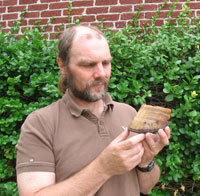
Thomason (shown at left, looking at a hoof capsule, in a University of Guelph photo) enlivened his presentations by standing on dinner plates (illustrating that weight alone won't fracture a fragile object), then smashing it with a hammer (showing the effect of force being much more destructive than mere weight). It's not easy keeping an audience awake during a biomechanics lecture, but smashing dinner plates with a rounding hammer definitely set a new standard.

Interestingly, Thomason's biomechanics research on vibrational properties of horseshoes found that unshod feet actually showed an increase in vibrationi over shod feet of about 25 percent, but he felt that it was statistically irrelevant, other than as an anecdote for those who use vibration as a criticism of horseshoes.

Conference leader Pat Reilly, who is now resident farrier at New Bolton Center, reviewed his use of high-tech measuring systems to question the probability factor of correcting what he feels are the universal malady of the horse's foot: underrun heels. According to a study quoted by Pat, as many as 60 percent of horses are affected by low-heel syndrome and he maintained that every foal he has seen has had underrun heels. He defines "underrun" at being as least five degrees lower than the toe angle, as set in stone by Tracy Turner DVM in published papers.

Reilly contends that underrun heels is an irreversible condition in many horses and a variation of normal hoof conformation.

Kentucky farrier Bryan Fraley DVM reviewed a deep file of cases related to puncture wounds, foot infections and cracks. He took the time to delve into the nuances of poulticing the foot, which many people skip right over. A number of his cases fell under the heading of "digital instability"--an apt moniker!

New Bolton Center has one of the best collections of antique horseshoes in the world. They were crafted in the 1800s by resident farrier and "professor of podology" Franz Enge, a German immigrant who was a disciple of the world-renowned Professor Lungwitz. At this end of the display are some modern braces and support devices for orthopedic cases.

On the second day, New Jersey farrier Bruce Daniels shared insights into the lovely antique shoes in the University's secret vault of farrier treasures and New Zealand native farrier Trevor Sutherland worked at the forge with attendees.

Man of the moment: Ian McKinlay (Pat Reilly photo)

Hoof repair specialist Ian McKinlay escaped from the mobs of press at Belmont Park, where he had been working on Triple Crown hopeful Big Brown, to drive down to Pennsylvania and speak at the University of Pennsylvania's Technical Horseshoeing Symposium on Saturday.

Yes, he did show Big Brown's week-old quarter crack, which is sutured (not patched over) in a way I had not seen before. Hopefully, I can post some photos soon.

McKinlay acknowledged that that farrier world "is trying to move forward" but gave evidence of progress on several fronts, such as the loosening of the Belmont track after Big Brown's trainer, Rick Dutrow, complained that it was too hard. "Times slowed down," McKinlay said, "and people were saying, 'Hey, nice cushion'!"

He asked the audience to help him list the disadvantages of glue on shoes and went on to explain more about Big Brown's abscesses and their consequences. He bemoaned the practice of leaving the bars lower than the walls, saying that this led to the prevalence of sore heels in racehorses.

This conference's goal, according to Pat Reilly is "to present scientific information relating to hoofcare"; "to describe techniques for managing hoof-related pathologies"; and to "create an atmosphere of open dialogue between New Bolton Center and the farrier/veterinarian community".

Those are all lofty and worthy goals. As with all such undertakings, the hardest step is the first one. By re-establishing this conference on the worldwide hoof science calendar, the University of Pennsylvania has the potential to add a valuable platter of substance to a table often overloaded with appetizers and desserts.

Canker: Seldom Seen But Important to Recognize


Canker in Hoof, originally uploaded by krissid2001.

I can almost smell this photo right through the computer screen. And it doesn't smell good.

Have you ever seen a horse with hoof canker? I've only seen it a few times, but it certainly made an impact. I know that this is becoming more of a problem in horses in the USA, and people are reporting more cases all the time.

The problem is that many owners don't recognize what it is and rarely contact a veterinarian until it is so advanced that you can see it (and smell it) from across the paddock.

Another problem is that it often strikes draft horses, like this Clydesdale or Shire, so the feathers cover it.

If you see something ugly growing on the bottom of a horse's foot, either in the cleft of the frog or the sulci or in the heel bulbs, don't just assume it is a bad case of thrush that will go away when the pasture dries up or when summer comes. Canker often requires the services of a consulting vet or farrier and horses are sometimes put down because of it. Medications and soaking and diligent cleaning are all on the list of treatments.

Thanks to Krissid2001 for allowing me to blog this photo for you all.

Wednesday, May 28, 2008

So Long, Wonder Pony: Theodore O'Connor 1995-2008


06_XC_Teddy5, originally uploaded by Squib Girl.

America's favorite pony was put to sleep today after an accident on the Team O'Connor eventing training center in The Plains, Virginia. Karen O'Connor's diminutive 14.1-hand Pan Am gold-medal winning sport pony (ArabxShetlandxThoroughbred) captivated eventing fans with his gravity-defying leaps and amazing athletic precision.

Teddy had been shortlisted for the upcoming Olympics this summer in Hong Kong.

Thanks to Squib Girl for this great photo of him in action. He was an action hero of the horse world, that's for sure.

Tuesday, May 27, 2008

New York Veterinarian Dead Following Head Injuries from Horse Mishap

,Veterinarian John Steiner has died in the hospital in Albany, New York. As reported here last week, he was injured while performing services at the Rhinebeck Equine practice in Rhinebeck, New York. Dr. Steiner suffered massive head injuries. Scroll down to read more about this tragedy in last week's posts.

Rhinebeck Equine has posted a biography of John Steiner. He had recently moved back to New York to his family's farm after many years living and working in Lexington, Kentucky as a reproduction-specialist veterinarian.

Monday, May 26, 2008

Triple Crown "Crack"down: Update from Ian McKinlay on Big Brown's Latest Hoof Malady

This device from Holland was marketed in Europe for stabilizing quarter cracks on Standardbreds. This photo shows clearly what a typical quarter crack would look like after being cleaned up. Notice where the start of the crack is at the hairline vs where the bottom of the crack is at the shoe. A quarter crack is a fissure in the hoof wall and is a reaction to stress so it will generally follow the angle of the horn tubules if the intertubular horn is weak, or the path of least resistance. Big Brown's crack is only 3/4" long, according to Ian, and is up at the top of the wall.

As promised yesterday, Hoofcare and Lameness caught up with hoof repair specialist Ian McKinlay today. Ian has promised a photo of Big Brown's new quarter crack on Wednesday of this week.

Ian was called to Belmont Park the other day when trainer Rick Dutrow noticed something wrong with the medial (inside) hoof wall on Big Brown's left front foot.

As avid Big Browners will recall, the left front foot is the site of the original wall separation that started the chain of hoof repair and layups for the champion colt over the winter months. Ian had removed the heel tissue on the inside heel of the left front, as detailed in previous posts and videos on this blog. The horse then shipped to Florida, where his right front inside heel was removed and repaired by Tom Curl.

Since then, Big Brown has been training and racing on a designer adaptation of a Thoro'Bred racaing plate that is glued on his foot without nails. The Yasha shoe system is like an orthotic insert between the shoe and the foot. One density of plastic, similar to the gasket that holds your truck's windshield in place, circuits the shoe and holds adhesive in place. Another density is a thick block pillow on which the remains of the heel sits as it grows out. Big Brown raced successfully in these shoes, winning the Florida Derby, Kentucky Derby and Preakness Stakes.


Note: in the "combi" Yasha paradigm, the plastic coats the foot surface of the shoe and acts like a dual-density rim pad. Some Yasha shoes have dual densities for different parts of the foot. Big Brown's shoes do not look like this.

"He doesn't even need the shoes anymore," McKinlay said today. "He could be in a regular shoe now."

My first thought was that a crack had developed at the hair line above the patch because of the stress from the material as the colt pounded down on the heel but Ian assured me that was not the case. "It's back around a little ways toward the heel," he said, "but not near that area. Besides that heel is all grown down now."

Many reports state that the crack has been "patched" but that is not the case. The crack has been cleaned up and treated with drying agents to dry it out and allow drainage of any infected area inside the crack. Then it was laced with the sutures as illustrated in the video posted on this blog last night (scroll down to May 25 video post to see that technique illustrated).

"As soon as I tightened it down, the foot started to cool out," Ian said. "Call me Wednesday to find out how it went."

Ian will check Big Brown again on Wednesday and decide what the next step will be in, in terms of replacing or relocating sutures, covering the crack with hoof wall adhesive, etc. The horse would then have nine days to train up to the mile-and-a-half Belmont.

In an email just received this evening, Ian gave an update: "By the way, his foot went cold within five hours of lacing him up, couldn't ask for more than that."


Sunday, May 25, 2008

Nike Signs Big Brown to $90 Million Horseshoe Contract: Onion Makes Light of the Triple Crown Hoof Madness

The article that was posted here on Sunday has been deleted because too many people took it too literally. Click here to read this article on THEONION.COM.

I'm sure that The Onion's writers thought they were making all this high-tech horseshoeing stuff up; little could they know that the technology they describe is available...yet Big Brown wears a stock out-of-the-box shoe that is customized into the "designer model" Yasha cushion-heel prototype.

For those of you who don't know, The Onion is the nation's leading humor/satire publication and one the most popular web sites on the Internet!

Not even dearly departed Barbaro escapes the mirth of The Onion. Click here to read about The Onion's report on the Ghost of Barbaro appearing on the anniversary of his death to teach the world the True Meaning of Barbaro Day...

Note: The Onion is not intended for readers under 18 years of age. If you go to the site, prepare to possibly be offended.

Big Brown Really Does Have a Quarter Crack This Time

According to Ian McKinlay on Sunday night, this horse's crack would be similar to the one that Big Brown has.

It's 12 days to the deciding race of the Triple Crown. We are on the verge of possibly the first Triple Crown winner since Affirmed in 1978. How wonderful it would be to have a new racehorse hero.

But...reports coming out of Belmont Park tell us that Big Brown has developed a quarter crack that is being disinfected and will be patched by specialist Ian McKinlay later this week when it is dry.

Hoofcare and Lameness received verification this evening from Ian McKinlay that the news is correct. Ian has posted some photos of the type of minor crack that Big Brown has on his web site for his Yasha shoes.

The irony here is that it was reported back in the winter months that Big Brown was suffering from quarter cracks on both front feet, when he actually had wall separations. This time, he really does have a quarter crack, apparently.

There are all sorts of hoof cracks and some quarter cracks are much worse than others. Some are painful for the horse while others are not.

A true quarter crack is a fracture in the hoof wall, much life a painful vertical split in your fingernail. Imagine how painful that split would be if you had to bear your weight on it!

The word "patch" or "repair" in conjunction with a quarter crack is a bit of a misnomer. The word "stabilize" would be more apt. The goal is to prevent shearing movement between the two parts of the hoof separated by the crack. Some people lace the crack to stay open a small bit so the coronet (hair line) stays at its normal angle while others lace it up very tightly to prevent any movement at all. Most decisions are based on two factors: the severity of the crack and the risk of infection.

In all cases, the horse is evaluated for its individual suitability to treatment. Some horses are very sensitive to hoof pain. Some have damage to the coronary band. Some have old chronic cracks that reappear. And some have infected quarter cracks, which cannot be patched until the infection is gone and the fissure is "dry". The age of the horse also affects the treatment plan.

Big Brown is in good hands and we all know that some horses have run--and won--with quarter cracks patched as little as a week before a big race.

Remember: Ferdinand won the 1987 Breeders Cup Classic with his foot patched for a quarter crack. He slipped by Alysheba to win.

Scroll down the blog to read some past stories about Big Brown and his special shoes and his famous wall separation problems.

And stand by for more news.

Quarter Crack Repair: What Lies Ahead for Big Brown?


This video by Ian McKinlay explain the steps he goes through to "patch" a quarter crack so a horse can continue to train and race. Hit the "play" icon to watch the video; it is almost ten minutes long.

This video is part 2 of the first video we posted about quarter cracks back before the Derby, when there was confusion between wall separations and quarter cracks. We all thought Big Brown had quarter cracks until Ian clarified the situation. The first part of the video can be viewed here but it does not much, if any, narration.

The steps you see here are the final ones in the process. First the horse needs to be wrapped for a few days to draw out any infection and let the crack drain. Once the crack is clean, the repair process begins.

THE HORSE IN THIS VIDEO IS NOT BIG BROWN. This horse is being repaired for a chronic, pre-existing quarter crack that had become infected, not a fresh one like Big Brown's, but this will give you an idea of what process Ian McKinlay normally uses.

You will hear Ian comment on the prevalence of hoof injuries at Belmont this year.

By the way, Ian McKinlay is scheduled to be demonstrating his Yasha shoes at the University of Pennsylvania's Technical Horseshoeing Conference next weekend. Click here to go to yesterday's post about the conference.

Friends at Work: Lauren Carey Aces Farrier Apprenticeship, Wins Worshipful Company's Essay Contest


Lauren Carey DipWCF is a rookie farrier in England. She's just completed her four-year apprenticeship, as required by the Farriers Registration Act, and is launching her own business in Peterborough, a city north of London.

What sets Lauren apart is that she has excelled in her training and recently was named the national first place winner in the Worshipful Company of Farriers' essay competition.

Farrier instructor Alan Woodyatt said of Lauren: "I have been involved with the Diploma exam students for 18 years and she was very nearly the best student I have taught for the anatomy written paper and 'hands-on' horse assessments."

And that is very high praise, indeed!

Congratulations, Lauren!

Read all about Lauren and how she earned her rewarding new career in this British newspaper article.

PS It's interesting to see that Lauren is shown working with the horse's foot on an American-style hoofstand. Not too many years ago, when Welshman Tommy Williams ran the farriers college program in the UK, hoof stands were banned and he used to rant and rave about how farriers shouldn't learn to shoe with a stand. They weren't allowed in farrier competitions, either. Things must be changing (in a few small ways) in England!

UPenn Technical Horseshoeing Symposium at New Bolton Center Announcement: Late Registration Opportunity

The forge at the University of Pennsylvania was originally in downtown Philadelphia and was one of the first buildings constructed on the campus when the school began. This photo was taken in the late 1800s; notice the bellows in the ceiling. (Double click on photo to view larger image; I believe that's a woman in the long apron down at the end of the room. Notice that the "students" are not wearing aprons; I bet they were proud of the cinder burns in their nice clothes.)

Event: Technical Horseshoeing Symposium at Penn Vet/New Bolton Center

Date: Saturday May 31 and Sunday June 1, 2008

Location: Woerner Amphitheatre in the George C. Widener Large Animal Hospital at the University of Pennsylvania School of Veterinary Medicine at New Bolton Center, Kennett Square, PA (near Philadelphia and Wilmington, Delaware).

Wet labs will be held in the Outpatient Clinic of the Hospital, the Farrier Shop and the Pathology Lab.

Cost: Saturday or Sunday only $150, Saturday and Sunday $225

Highlights:
• Jeff Thomason lecture on functional anatomy of the limb, as well as hoof deformation and ground force interaction
• Bryan Fraley lecture on managing problems- from laminitis to hoof cracks to “hoof first-aid” (dealing with emergency hoof traumas).
• Jim Orsini will be updating the Laminitis Institute and the research projects underway at Penn
• Andrew Van Eps will discuss laminitis, cryotherapy and the effectiveness of commonly utilized techniques for cooling feet.
• Sunday’s wet labs include:
• Dissection of the equine limb with regard to biomechanics and anatomy by Jeff Thomason
• Shoeing lab with Bryan Fraley
• Bruce Daniels will discuss the Podological Museum of the University of Pennsylvania
• Trevor Sutherland will demonstrate forging techniques and shoe building

PLUS demonstration by hoof repair specialist Ian McKinlay (featured on the Hoof Blog for his work with the Yasha glue-on shoe customized for champion racehorse Big Brown in the 2008 Triple Crown races)

Conference Format
Saturday, May 31, 2008- Lectures 8AM- 5PM
Sunday, June 1, 2008- Lectures 9AM- 11AM; Demonstrations 12PM -3PM

Hotel list available; nearest airport is Philadelphia.

More details: http://www.vet.upenn.edu/nbc/equine/farrier-symposium.htm
If you attend, please mention that you learned about the event on the Hoof Blog.

(Double click on page images to view and print full page flyer and registration form.)