Saturday, June 07, 2008

Big Brown Turns Beige, Never Fires in Belmont Stakes; No Triple Crown Winner for 2008


No Triple Crown This Year: Big Brown was eased to finish last after a bumpy, unhappy trip for the first mile or so of the Belmont Stakes. That's assistant trainer Michelle Nevin, his regular rider, who ran out on the track to take charge of the horse. Photo credited to TIMOTHY A. CLARY/AFP/Getty Images. 

Oh boy. They turned for home in the 2008 Belmont Stakes and there was he was: Big Brown, patched hooves flashing in the summer sun, rolling along on the outside, ready to make his move, just like he always does. Make his move. Make his move. Make his...

Jockey Kent Desormeaux stood up in the irons and pulled back and up. The race was over for his horse. They both knew it, apparently. He pulled up and cantered home last.

In an interview later he is quoted as saying (referring to the patched hooves), “There were no popped tires. He was just out of gas."

Did I miss it or were there no on-air post-race interviews with the IEAH power brokers who own Big Brown? Did they not congratulate the winners? I understand that it is the trainer's responsibility to be with the horse and make decisions about his health and care back at the barn.

Winning trainer Nick Zito, one of New York's most popular and successful trainers, won the race with a long shot who ran an incredible race and just kept going. He deserved to be congratulated.

Also to be congratulated: the Japanese connections of pre-race second favorite, the lightly raced Casino Drive, who is laid up with some sort of bruise on his foot. They chose not to poke holes in their horse's sole to drain the problem area. It probably could have been soaked, poked, and drawn out and then patched or glued. But kudos to them: they didn't take a chance with their horse.

Dutrow took all the chances. His horse has a patch on a patch on one foot, the remnants of a reconstructed heel made out of adhesive material on the other. His horse missed his monthly Winstrol (steroid) injection in the face of criticism over the medication, even though it is legal (whether right or wrong, it is legal). He was running without the turndowns that he sported on his hind feet in the Kentucky Derby (note that the jockey complained that the horse wasn't handling the track well) and he was coming back from rundown injuries on his hind pasterns and heel bulbs suffered in the Preakness.

And it was 93 degrees and humid. And his third race in five weeks.

Big Brown's trainer took all the chances. The jockey chose not to take a chance, not to whip and drive the horse to a middle of the pack finish over the line with possible dire consequences in the final furlong in front of the grandstand. He did not know what was wrong with his horse. He just knew he was out of horse.

Meanwhile, a horse we never heard of ran a great race for a great trainer at their home track in their home town.

Pop the champagne anyway. We've just come off three months of high-profile reporting about horses' hooves, injured hooves, and the people who are trying to help horses get sound and stay sound. Hoof repair specialist Ian McKinlay is still the man of the hour and has made a lot of friends in the media that will benefit the rest of the hoof world.

One more quote, again from the jockey, referring to Thoroughbreds of the past: “I cannot fathom what kind of freaks the Triple Crown champions were.”

So pop the champagne, and I'll do the same. Maybe stay home tonight and watch some archival video footage of Affirmed, Seattle Slew, Secretariat, Citation, Assault, Count Fleet, War Admiral, Gallant Fox, Omaha, Whirlaway and Sir Barton. Enjoy the freak show, it's as close as you're going to get, for now.

Wednesday, June 04, 2008

ESPN, CBS Hoof It with the Hoof Pros at New York's Belmont Park


ESPN spent a morning with Tim Shortell at Belmont Park this week. Tim, a horseshoer on the New York tracks, explained the difference between low-toes, XTs, mud calks, etc. and shod a horse for the camera. Click here to go to the ESPN site to watch the video; sorry I can't post it here. Tim looks more like Clint Eastwood every day.

Meanwhile, CBS News called Hoofcare and Lameness to track down Ian McKinlay, and once they found him, reporter Dr. Debbye Turner (she's also a veterinarian) did a weekend feature on the quarter crack specialist. They will be posting the video online. It's nice to know that CBS reporters and producers are reading this blog!

Monday, June 02, 2008

Event Wrapup: UPenn Technical Horseshoeing Symposium at New Bolton Center

2008 speakers at the University of Pennsylvania's Technical Horseshoeing Conference: (left to right) Course organizer and UPenn resident farrier Pat Reilly; Dr. Jeff Thomason from University of Guelph, Canada; equine podiatrist Bryan Fraley DVM from Kentucky; hoof repair specialist Ian McKinlay of New Jersey.

Technical horseshoeing covered a lot of ground at the University of Pennsylvania's New Bolton Center in Kennett Square on Saturday. From biomechanics to anatomy to podiatry and finally to 911-level hoof repair, speakers touched on many aspects of the scientific and practical bodies of information about the horse's hoof. Speakers zoomed in and out of the gray areas like the cars that would be passing me a few hours later on the way back to the Philadelphia airport.

The morning began with introductions and an overview of the new laminitis research center (tentatively called The Laminitis Institute) at the University of Pennsylvania. Dr. Jim Orsini, associate professor of surgery at New Bolton Center and director of the Institute, explained the exciting new concept to the audience. Click here to read more about the Institute.

Dr. Jeff Thomason lectured on the basics of foot biomechanics and the research undertaken in his laboratory at the University of Guelph in Canada. Included in his research was updated material on the finite element analysis modeling he has been working on, with beautiful graphic images. Later in the day, he spoke on the nuances of functional anatomy and the "design" of the horse's legs, with interesting images and challenges.

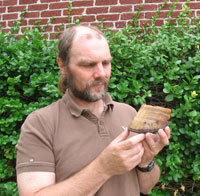
Thomason (shown at left, looking at a hoof capsule, in a University of Guelph photo) enlivened his presentations by standing on dinner plates (illustrating that weight alone won't fracture a fragile object), then smashing it with a hammer (showing the effect of force being much more destructive than mere weight). It's not easy keeping an audience awake during a biomechanics lecture, but smashing dinner plates with a rounding hammer definitely set a new standard.

Interestingly, Thomason's biomechanics research on vibrational properties of horseshoes found that unshod feet actually showed an increase in vibrationi over shod feet of about 25 percent, but he felt that it was statistically irrelevant, other than as an anecdote for those who use vibration as a criticism of horseshoes.

Conference leader Pat Reilly, who is now resident farrier at New Bolton Center, reviewed his use of high-tech measuring systems to question the probability factor of correcting what he feels are the universal malady of the horse's foot: underrun heels. According to a study quoted by Pat, as many as 60 percent of horses are affected by low-heel syndrome and he maintained that every foal he has seen has had underrun heels. He defines "underrun" at being as least five degrees lower than the toe angle, as set in stone by Tracy Turner DVM in published papers.

Reilly contends that underrun heels is an irreversible condition in many horses and a variation of normal hoof conformation.

Kentucky farrier Bryan Fraley DVM reviewed a deep file of cases related to puncture wounds, foot infections and cracks. He took the time to delve into the nuances of poulticing the foot, which many people skip right over. A number of his cases fell under the heading of "digital instability"--an apt moniker!

New Bolton Center has one of the best collections of antique horseshoes in the world. They were crafted in the 1800s by resident farrier and "professor of podology" Franz Enge, a German immigrant who was a disciple of the world-renowned Professor Lungwitz. At this end of the display are some modern braces and support devices for orthopedic cases.

On the second day, New Jersey farrier Bruce Daniels shared insights into the lovely antique shoes in the University's secret vault of farrier treasures and New Zealand native farrier Trevor Sutherland worked at the forge with attendees.

Man of the moment: Ian McKinlay (Pat Reilly photo)

Hoof repair specialist Ian McKinlay escaped from the mobs of press at Belmont Park, where he had been working on Triple Crown hopeful Big Brown, to drive down to Pennsylvania and speak at the University of Pennsylvania's Technical Horseshoeing Symposium on Saturday.

Yes, he did show Big Brown's week-old quarter crack, which is sutured (not patched over) in a way I had not seen before. Hopefully, I can post some photos soon.

McKinlay acknowledged that that farrier world "is trying to move forward" but gave evidence of progress on several fronts, such as the loosening of the Belmont track after Big Brown's trainer, Rick Dutrow, complained that it was too hard. "Times slowed down," McKinlay said, "and people were saying, 'Hey, nice cushion'!"

He asked the audience to help him list the disadvantages of glue on shoes and went on to explain more about Big Brown's abscesses and their consequences. He bemoaned the practice of leaving the bars lower than the walls, saying that this led to the prevalence of sore heels in racehorses.

This conference's goal, according to Pat Reilly is "to present scientific information relating to hoofcare"; "to describe techniques for managing hoof-related pathologies"; and to "create an atmosphere of open dialogue between New Bolton Center and the farrier/veterinarian community".

Those are all lofty and worthy goals. As with all such undertakings, the hardest step is the first one. By re-establishing this conference on the worldwide hoof science calendar, the University of Pennsylvania has the potential to add a valuable platter of substance to a table often overloaded with appetizers and desserts.

Canker: Seldom Seen But Important to Recognize


Canker in Hoof, originally uploaded by krissid2001.

I can almost smell this photo right through the computer screen. And it doesn't smell good.

Have you ever seen a horse with hoof canker? I've only seen it a few times, but it certainly made an impact. I know that this is becoming more of a problem in horses in the USA, and people are reporting more cases all the time.

The problem is that many owners don't recognize what it is and rarely contact a veterinarian until it is so advanced that you can see it (and smell it) from across the paddock.

Another problem is that it often strikes draft horses, like this Clydesdale or Shire, so the feathers cover it.

If you see something ugly growing on the bottom of a horse's foot, either in the cleft of the frog or the sulci or in the heel bulbs, don't just assume it is a bad case of thrush that will go away when the pasture dries up or when summer comes. Canker often requires the services of a consulting vet or farrier and horses are sometimes put down because of it. Medications and soaking and diligent cleaning are all on the list of treatments.

Thanks to Krissid2001 for allowing me to blog this photo for you all.

Wednesday, May 28, 2008

So Long, Wonder Pony: Theodore O'Connor 1995-2008


06_XC_Teddy5, originally uploaded by Squib Girl.

America's favorite pony was put to sleep today after an accident on the Team O'Connor eventing training center in The Plains, Virginia. Karen O'Connor's diminutive 14.1-hand Pan Am gold-medal winning sport pony (ArabxShetlandxThoroughbred) captivated eventing fans with his gravity-defying leaps and amazing athletic precision.

Teddy had been shortlisted for the upcoming Olympics this summer in Hong Kong.

Thanks to Squib Girl for this great photo of him in action. He was an action hero of the horse world, that's for sure.

Tuesday, May 27, 2008

New York Veterinarian Dead Following Head Injuries from Horse Mishap

,Veterinarian John Steiner has died in the hospital in Albany, New York. As reported here last week, he was injured while performing services at the Rhinebeck Equine practice in Rhinebeck, New York. Dr. Steiner suffered massive head injuries. Scroll down to read more about this tragedy in last week's posts.

Rhinebeck Equine has posted a biography of John Steiner. He had recently moved back to New York to his family's farm after many years living and working in Lexington, Kentucky as a reproduction-specialist veterinarian.

Monday, May 26, 2008

Triple Crown "Crack"down: Update from Ian McKinlay on Big Brown's Latest Hoof Malady

This device from Holland was marketed in Europe for stabilizing quarter cracks on Standardbreds. This photo shows clearly what a typical quarter crack would look like after being cleaned up. Notice where the start of the crack is at the hairline vs where the bottom of the crack is at the shoe. A quarter crack is a fissure in the hoof wall and is a reaction to stress so it will generally follow the angle of the horn tubules if the intertubular horn is weak, or the path of least resistance. Big Brown's crack is only 3/4" long, according to Ian, and is up at the top of the wall.

As promised yesterday, Hoofcare and Lameness caught up with hoof repair specialist Ian McKinlay today. Ian has promised a photo of Big Brown's new quarter crack on Wednesday of this week.

Ian was called to Belmont Park the other day when trainer Rick Dutrow noticed something wrong with the medial (inside) hoof wall on Big Brown's left front foot.

As avid Big Browners will recall, the left front foot is the site of the original wall separation that started the chain of hoof repair and layups for the champion colt over the winter months. Ian had removed the heel tissue on the inside heel of the left front, as detailed in previous posts and videos on this blog. The horse then shipped to Florida, where his right front inside heel was removed and repaired by Tom Curl.

Since then, Big Brown has been training and racing on a designer adaptation of a Thoro'Bred racaing plate that is glued on his foot without nails. The Yasha shoe system is like an orthotic insert between the shoe and the foot. One density of plastic, similar to the gasket that holds your truck's windshield in place, circuits the shoe and holds adhesive in place. Another density is a thick block pillow on which the remains of the heel sits as it grows out. Big Brown raced successfully in these shoes, winning the Florida Derby, Kentucky Derby and Preakness Stakes.


Note: in the "combi" Yasha paradigm, the plastic coats the foot surface of the shoe and acts like a dual-density rim pad. Some Yasha shoes have dual densities for different parts of the foot. Big Brown's shoes do not look like this.

"He doesn't even need the shoes anymore," McKinlay said today. "He could be in a regular shoe now."

My first thought was that a crack had developed at the hair line above the patch because of the stress from the material as the colt pounded down on the heel but Ian assured me that was not the case. "It's back around a little ways toward the heel," he said, "but not near that area. Besides that heel is all grown down now."

Many reports state that the crack has been "patched" but that is not the case. The crack has been cleaned up and treated with drying agents to dry it out and allow drainage of any infected area inside the crack. Then it was laced with the sutures as illustrated in the video posted on this blog last night (scroll down to May 25 video post to see that technique illustrated).

"As soon as I tightened it down, the foot started to cool out," Ian said. "Call me Wednesday to find out how it went."

Ian will check Big Brown again on Wednesday and decide what the next step will be in, in terms of replacing or relocating sutures, covering the crack with hoof wall adhesive, etc. The horse would then have nine days to train up to the mile-and-a-half Belmont.

In an email just received this evening, Ian gave an update: "By the way, his foot went cold within five hours of lacing him up, couldn't ask for more than that."


Sunday, May 25, 2008

Nike Signs Big Brown to $90 Million Horseshoe Contract: Onion Makes Light of the Triple Crown Hoof Madness

The article that was posted here on Sunday has been deleted because too many people took it too literally. Click here to read this article on THEONION.COM.

I'm sure that The Onion's writers thought they were making all this high-tech horseshoeing stuff up; little could they know that the technology they describe is available...yet Big Brown wears a stock out-of-the-box shoe that is customized into the "designer model" Yasha cushion-heel prototype.

For those of you who don't know, The Onion is the nation's leading humor/satire publication and one the most popular web sites on the Internet!

Not even dearly departed Barbaro escapes the mirth of The Onion. Click here to read about The Onion's report on the Ghost of Barbaro appearing on the anniversary of his death to teach the world the True Meaning of Barbaro Day...

Note: The Onion is not intended for readers under 18 years of age. If you go to the site, prepare to possibly be offended.

Big Brown Really Does Have a Quarter Crack This Time

According to Ian McKinlay on Sunday night, this horse's crack would be similar to the one that Big Brown has.

It's 12 days to the deciding race of the Triple Crown. We are on the verge of possibly the first Triple Crown winner since Affirmed in 1978. How wonderful it would be to have a new racehorse hero.

But...reports coming out of Belmont Park tell us that Big Brown has developed a quarter crack that is being disinfected and will be patched by specialist Ian McKinlay later this week when it is dry.

Hoofcare and Lameness received verification this evening from Ian McKinlay that the news is correct. Ian has posted some photos of the type of minor crack that Big Brown has on his web site for his Yasha shoes.

The irony here is that it was reported back in the winter months that Big Brown was suffering from quarter cracks on both front feet, when he actually had wall separations. This time, he really does have a quarter crack, apparently.

There are all sorts of hoof cracks and some quarter cracks are much worse than others. Some are painful for the horse while others are not.

A true quarter crack is a fracture in the hoof wall, much life a painful vertical split in your fingernail. Imagine how painful that split would be if you had to bear your weight on it!

The word "patch" or "repair" in conjunction with a quarter crack is a bit of a misnomer. The word "stabilize" would be more apt. The goal is to prevent shearing movement between the two parts of the hoof separated by the crack. Some people lace the crack to stay open a small bit so the coronet (hair line) stays at its normal angle while others lace it up very tightly to prevent any movement at all. Most decisions are based on two factors: the severity of the crack and the risk of infection.

In all cases, the horse is evaluated for its individual suitability to treatment. Some horses are very sensitive to hoof pain. Some have damage to the coronary band. Some have old chronic cracks that reappear. And some have infected quarter cracks, which cannot be patched until the infection is gone and the fissure is "dry". The age of the horse also affects the treatment plan.

Big Brown is in good hands and we all know that some horses have run--and won--with quarter cracks patched as little as a week before a big race.

Remember: Ferdinand won the 1987 Breeders Cup Classic with his foot patched for a quarter crack. He slipped by Alysheba to win.

Scroll down the blog to read some past stories about Big Brown and his special shoes and his famous wall separation problems.

And stand by for more news.

Quarter Crack Repair: What Lies Ahead for Big Brown?


This video by Ian McKinlay explain the steps he goes through to "patch" a quarter crack so a horse can continue to train and race. Hit the "play" icon to watch the video; it is almost ten minutes long.

This video is part 2 of the first video we posted about quarter cracks back before the Derby, when there was confusion between wall separations and quarter cracks. We all thought Big Brown had quarter cracks until Ian clarified the situation. The first part of the video can be viewed here but it does not much, if any, narration.

The steps you see here are the final ones in the process. First the horse needs to be wrapped for a few days to draw out any infection and let the crack drain. Once the crack is clean, the repair process begins.

THE HORSE IN THIS VIDEO IS NOT BIG BROWN. This horse is being repaired for a chronic, pre-existing quarter crack that had become infected, not a fresh one like Big Brown's, but this will give you an idea of what process Ian McKinlay normally uses.

You will hear Ian comment on the prevalence of hoof injuries at Belmont this year.

By the way, Ian McKinlay is scheduled to be demonstrating his Yasha shoes at the University of Pennsylvania's Technical Horseshoeing Conference next weekend. Click here to go to yesterday's post about the conference.

Friends at Work: Lauren Carey Aces Farrier Apprenticeship, Wins Worshipful Company's Essay Contest


Lauren Carey DipWCF is a rookie farrier in England. She's just completed her four-year apprenticeship, as required by the Farriers Registration Act, and is launching her own business in Peterborough, a city north of London.

What sets Lauren apart is that she has excelled in her training and recently was named the national first place winner in the Worshipful Company of Farriers' essay competition.

Farrier instructor Alan Woodyatt said of Lauren: "I have been involved with the Diploma exam students for 18 years and she was very nearly the best student I have taught for the anatomy written paper and 'hands-on' horse assessments."

And that is very high praise, indeed!

Congratulations, Lauren!

Read all about Lauren and how she earned her rewarding new career in this British newspaper article.

PS It's interesting to see that Lauren is shown working with the horse's foot on an American-style hoofstand. Not too many years ago, when Welshman Tommy Williams ran the farriers college program in the UK, hoof stands were banned and he used to rant and rave about how farriers shouldn't learn to shoe with a stand. They weren't allowed in farrier competitions, either. Things must be changing (in a few small ways) in England!

UPenn Technical Horseshoeing Symposium at New Bolton Center Announcement: Late Registration Opportunity

The forge at the University of Pennsylvania was originally in downtown Philadelphia and was one of the first buildings constructed on the campus when the school began. This photo was taken in the late 1800s; notice the bellows in the ceiling. (Double click on photo to view larger image; I believe that's a woman in the long apron down at the end of the room. Notice that the "students" are not wearing aprons; I bet they were proud of the cinder burns in their nice clothes.)

Event: Technical Horseshoeing Symposium at Penn Vet/New Bolton Center

Date: Saturday May 31 and Sunday June 1, 2008

Location: Woerner Amphitheatre in the George C. Widener Large Animal Hospital at the University of Pennsylvania School of Veterinary Medicine at New Bolton Center, Kennett Square, PA (near Philadelphia and Wilmington, Delaware).

Wet labs will be held in the Outpatient Clinic of the Hospital, the Farrier Shop and the Pathology Lab.

Cost: Saturday or Sunday only $150, Saturday and Sunday $225

Highlights:
• Jeff Thomason lecture on functional anatomy of the limb, as well as hoof deformation and ground force interaction
• Bryan Fraley lecture on managing problems- from laminitis to hoof cracks to “hoof first-aid” (dealing with emergency hoof traumas).
• Jim Orsini will be updating the Laminitis Institute and the research projects underway at Penn
• Andrew Van Eps will discuss laminitis, cryotherapy and the effectiveness of commonly utilized techniques for cooling feet.
• Sunday’s wet labs include:
• Dissection of the equine limb with regard to biomechanics and anatomy by Jeff Thomason
• Shoeing lab with Bryan Fraley
• Bruce Daniels will discuss the Podological Museum of the University of Pennsylvania
• Trevor Sutherland will demonstrate forging techniques and shoe building

PLUS demonstration by hoof repair specialist Ian McKinlay (featured on the Hoof Blog for his work with the Yasha glue-on shoe customized for champion racehorse Big Brown in the 2008 Triple Crown races)

Conference Format
Saturday, May 31, 2008- Lectures 8AM- 5PM
Sunday, June 1, 2008- Lectures 9AM- 11AM; Demonstrations 12PM -3PM

Hotel list available; nearest airport is Philadelphia.

More details: http://www.vet.upenn.edu/nbc/equine/farrier-symposium.htm
If you attend, please mention that you learned about the event on the Hoof Blog.

(Double click on page images to view and print full page flyer and registration form.)

Saturday, May 24, 2008

New York Vet Injured While Treating Horse, Remains in Coma

Theriogenologist John Steiner DVM, Dip. ACT is hospitalized in Albany, New York this weekend after being injured in the head during a procedure on a Morgan stallion.

Dr. Steiner is in a medically-induced coma, according to local newspaper reports, with severe brain injuries. He is reported to be in critical condition.

This news brings home the message to all professionals that working around horses can be (and is) a dangerous job and that every precaution should be taken while on the job.

Dr. Steiner was a very experienced veterinarian and certainly this was a freak accident.

He is known for his work for many years in the field of equine reproduction while on staff at the Hagyard Equine Medical Institute in Lexington, Kentucky and had recently moved to New York where he joined the Rhinebeck Equine group practice in the very horsey Dutchess County area, outside New York City.

A statement from his family said that notes and cards may be sent in care of the Rhinebeck Equine Clinic at 26 Losee Lane; Rhinebeck, NY 12572 or to the New York State Veterinary Medical Society.

(By the way, a theriogenologist is someone who specializes in reproduction.)

Kind, healing wishes to Dr. Steiner. And be careful out there, friends.

Friday, May 23, 2008

Mike Wildenstein and Cornell Vet School Unveil Enlarged Farrier Shop; Dedication to Former Instructors Is Built In!

Cornell University’s College of Veterinary Medicine in Ithaca, New York has a newly enlarged farrier shop and teaching area at the large animal hospital. Thanks to farrier student Richard Mercer for his reporting of the completion of the project.

The enlarged shop will enable Adjunct Professor Michael Wildenstein FWCF (Hons) to increase the enrollment of students in the basic program and accommodate more working farriers and veterinarians who wish to study foot science and problems under his direction at Cornell.


Left to right above are current Cornell farrier students Ryan Poole, Chad Blasch, Jon Grigat, and Richard Mercer. Standing behind is instructor Mike Wildenstein. Notice the five draft horse shoes that Mike forged and laid when the concrete was poured, cementing the legacy of Cornell’s past resident farriers. Each shoe contains the name and years of service. Left to right Henry Asmus 1913-1939 (Asmus was also the school’s founder), Eugene Layton 1931-1965, Harold Mowers 1965-1976, Buster Conklin 1976-1991, Michael Wildenstein 1991-?. Mike’s previous class would not allow him to stamp an end date.


This long view shows the length of the shop with the new work stations for forging. Notice the shoe case on the wall above the Belgian; it contains specimen shoes made by German immigrant farrier Henry Asmus almost 100 years ago. Asmus is widely regarded as the most influential farrier in American history. He was a tireless educator whose heart lay both in the veterinary school and in the farms. He believed in educating farriers working in the field, and in helping horse owners learn more about proper hoof care. He was a visionary man with an extraordinary combination of intellect to understand lameness in horses and artistic skill in blacksmithing. He was the only professor of horseshoeing in the United States, until Mike Wildenstein's appointment in 2007, and was an adviser to the US Army and the US Department of Agriculture. Farriers who studied under him at Cornell received advanced rank when they enlisted in the military to serve in World War I. Asmus died in 1939.


The shoeing area is also enlarged; note another case of Henry Asmus’s shoes hangs in this area. The expanded shop has doubled in size, with six forging stations, and an expanded safer area for the horses. The school now takes four students for each semester (up from three, for the first time in the course's history) and has sufficient space for those wanting to take advanced classes or for visiting farriers.

To learn more about Cornell’s farrier school and farrier services, visit http://www.vet.cornell.edu/education/farrier/

Mark your calendar: Cornell will host the 25th Annual Farrier Conference on November 8-9, 2008. Confirmed speakers include British farrier instructor Mark Caldwell FWCF of Myerscough College and Neil Madden FWCF, formerly of the British Army farrier school. For information about attending or exhibiting at this excellent event, email Amanda Mott in the Office of Continuing Education or call (USA) 607.253.3200.

Special thanks to Mr. Dick Russell for handling "Belle" and to Debbie Crane for taking these pictures and for the use of "Belle" and "Fantasy".

Blogger’s note: I can’t believe how clean it is! And the designer dousing buckets must have a story behind them! For non-farriers: the metal contraptions on the counters are not robots from Star Wars, they are gas forges for making or heating steel horseshoes so they can be worked (shaped) while hot, making the steel more malleable. Obviously Cornell believes in the future of metal horseshoes!

If you double click on the photos, you should be able to see them at full size and look at more details. Thanks to Richard for sending high-res photos!

All HoofBlog text and images © Hoofcare Publishing 2008 unless otherwise noted. To learn more about new research, products, and treatments for the horse's hooves and legs as reported to veterinarians and farriers in the award-winning "Hoofcare & Lameness Journal", go to http://www.hoofcare.com Direct “subscribe now” link to Hoofcare & Lameness Journal: http://www.hoofcare.com/subscribe.html Contact Hoofcare Publishing anytime: tel 978 281 3222 fax 978 283 8775 email bloginquiry@hoofcare.com

Thursday, May 22, 2008

Favorite Photos: Square Horseshoes and Shoeless Soles

A few weeks ago, we showed a new design of horseshoe that is basically a square shape with rounded corners.

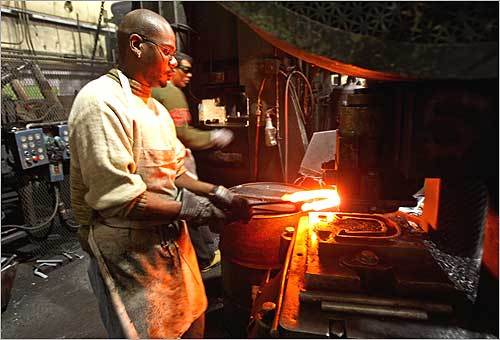
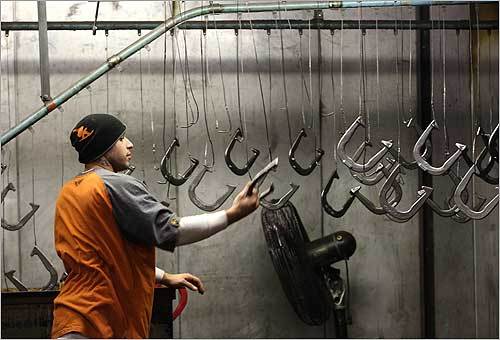
On Monday, the Boston Globe published its annual "Globe 100" report on business in our state, and included a feature on unusual things made in Massachusetts. Marshmallow "Fluff" and the game of Monopoly probably distracted a lot of people from finishing the article. I never even got to Fluff and Monopoly (not to mention Necco wafers and Nantucket Nectars) because the photo above caught my eye. It was taken in the forging room at the St. Pierre Horseshoe Company in Worcester, Massachusetts.

St. Pierre's squarish horseshoes won't see any hooves, though; they are pitching horseshoes. I guess the square toe and straight branch must help hook to the post. I've seen draft horse shoe shows of pretty much the same shape; maybe St. Pierre could add some nail holes and serve another market.

Also featured was the unlikely sounding but very credible Quabaug Corporation of North Brookfield. Turn your shoes over and you may see the little yellow "Vibram" logo, indicating that your shoe's sole was made in Massachusetts, by Quabaug. (They make all the soles of all the boots for the US Army...do that math!)

Quabaug is a funny sounding name for a very progressive company, and one of their newest products is a high tech hoof pad, which is reviving some interest in what pads can do in this age of hoof boots and bare hooves and how-clever-we-are custom treatments for laminitis and hoof injuries, as well as the classic use of pads for hoof protection with shoes.


I thought this photo interesting; Quabaug is making special shoes, or 3-D soles, for sports like martial arts and windsurfing. Imagine what they could do for and with the horse's hoof! Keep an eye on this company!

Thanks to my college pal and horseracing maven Karen Birch for finding these photos online after I had given up.

(Photos: Made in Massachusetts/Boston Globe)

Tuesday, May 20, 2008

Favorite Photo: The Hoof Goes Under the Leg

Wouldn't you love to see a radiograph of this horse's left front foot and lower leg? (the leg on the right in this photo) In what direction do you think the frog was pointing?

The photo was taken at the World Clydesdale Show in Wisconsin last fall.

Big Brown Arrives at Belmont with "Run Down" Problems from the Preakness

Big Brown arrived at Belmont Park on New York's Long Island yesterday. The Belmont Stakes, the final leg of the Triple Crown for three-year-old Thoroughbreds, will be run on June 7th.(Yahoo News linked photo)

The Blood-Horse reported yesterday that Kentucky Derby and Preakness winner Big Brown was affected by run down problems on his hind legs and feet in the Preakness.

This prompted a rash of questions about this sort of injury. And "rash" is the right word. Rundowns are sort of like a bad road rash! And if you've ever fallen off a motorcycle, fallen on the street while rollerblading, or skiied over rough terrain in shorts in the spring, you know what I'm talking about. Ouch!

With horses, it is usually the back of the pastern and the heel bulbs that get rubbed or scraped, but it can go up the back on the cannon, too.

Rundown injuries usually clear up pretty easily but the question to be asked is why it happened in the Preakness, and if the horse changed his gait or running style. It could also have been the track. And it could have happened in other races, but the horse wasn't under such a microscope of scrutiny until the past few weeks.

Big Brown ran with front wraps in the Preakness because of Dutrow's desire to avoid hitting injuries (interference) although it is not clear if the interference was front left to right, front to hind, or diagonal. Horses have all sorts of hitting issues based on conformation, fatigue, pulling up sharply, accelerating out of the gate, clipping heels, etc. and this is probably not something to think of as a performance-limiting injury.

Horses only get rundown injuries on dirt tracks, although I don't know about artificial surfaces. It seems like they could be abrasive, too. The Dutrow team will just have to wrap his legs and pad his pasterns when he trains at Belmont, until this clears up. There are all sorts of wraps and boots and patches that can be used so he can train normally.

It's not likely that this will be a problem for Big Brown, but with any animal you don't want the possibility of an association between speed and pain, or going out on the track and pain. Big Brown seems like a tougher horse than that.

My fellow blogger Alex Brown, exercise rider for Steve Asmussen, has some more insight into rundowns in today's New York Times.

Friday, May 16, 2008

Big Brown's Big Switch: New Shoes, New Heels for Tomorrow's Preakness

This morning, I stumbled out onto the lawn and grabbed the paper before the sea gulls could target it (or me). Once inside, I propped the paper up, set to peruse it with coffee in hand, when I sputtered in amazement: Hey! Hey! Hey!

There on the front page of the Boston Globe was not a photo of the Boston Celtics in their playoff bid for the NBA championship, nor a photo of the Red Sox, but rather a huge photo of Big Brown getting new shoes (and heels) yesterday at Pimlico in Baltimore, in preparation for tomorrow's Preakness Stakes, the second leg of the Triple Crown for three-year old Thoroughbreds.

(Sports, by the way, are front-page news here in Boston.)

I was surprised. Trainer Richard Dutrow obviously made a big change in plans here. Earlier this week, he said that Big Brown would not be re-shod for the Preakness, but that he would have Ian McKinlay work on the horse when he arrived in New York for the Belmont Stakes, the third race in the series.

Following the Kentucky Derby, farrier Tom Curl, who had worked on the horse through the winter in Florida, said that the feet came through the Derby very well and the adhesive wasn't cracked and the Yasha shoes were stable.

Obviously, they decided to give his feet a tuneup. The horse also went out for a light work over the Pimlico surface wearing bell boots to protect his new glue and a mud knot in his tail.

Other news this week was that Big Brown will not race as a four-year-old. He will go to stud sometime later this year. Also, if he does not win the Preakness tomorrow, he will not go on to the Belmont. But will he go on to Saratoga for the Travers and on to Santa Anita in the fall for the 2008 Breeders Cup?

Thanks to Yahoo.com sports desk for the following shots from a slide show of hoof repair specialist Ian McKinlay of New Jersey working on the Kentucky Derby winner.

Apparently, Ian drew quite a crowd yesterday, including Tom Hammond and Donna Brothers of NBC, so you may see Ian (or, more likely, the top of his head while he's working) on tomorrow's telecast of the race. Let's hope you see him in the winner's circle!

PS Friday Afternoon Update: Ian checked in and said that Big Brown's feet are "just fantastic", but that they had gotten a bit long. He just trimmed up the feet and reset the Yasha shoes and pads. He said that when he started, there was one guy standing around to watch and by the time he was into the job, the word was out and it "turned into a free-for-all".


Thursday, May 15, 2008

Favorite photo: How Big Was He?


farrier1, originally uploaded by Janey M.

Thanks to Janey M for sharing this photo of a farrier at the Colebrook Shire Horse Center in Cheshire, England. The photo was taken last week and she insists the farrier was not a small man. Sorry the farrier is not identified but he had a big, big job to do there!

Monday, May 12, 2008

Still Thinking About Eight Belles? Leading Vet Hogan Suggests That Thoroughbreds Could Learn A Lot From Standardbreds

Dr. Patty Hogan in surgery
Carol Hodes, former media relations director for the Meadowlands Racetrack in East Rutherford, New Jersey, has posted a terrific interview with one of my favorite sources, Patty Hogan VMD, ACVS of the new Hogan Equine Clinic LLC in Cream Ridge, New Jersey. Two years ago, it was Hogan who testified against her veterinary brethren in front of the US Congress, and explained why she was not aligning herself with AVMA and AAEP political positions regarding slaughter of horses for meat. She didn’t like the idea of the whole horse meat slaughter industry and she gave poignant compelling reasons why. Congress listened. So when Eight Belles died tragically on the track at the end of the Kentucky Derby, journalist Hodes turned to Hogan for insight. Hogan, after all, is often described as the veterinarian who saved Kentucky Derby winner Smarty Jones, and she is the AAEP’s “On Call” veterinarian for some harness races that are televised. Carol’s entire interview with Hogan is posted on the HarnessLink web site in New Zealand. I highly recommend you follow this link and read the entire interview, but here are a few savvy comments from one of the best industry’s most independent thinkers and leading surgeons. This fall, Hogan will take over as head surgeon of the new Ruffian Equine Medical Center at Belmont Park, owned by IEAH, who also own 2008 Kentucky Derby winner Big Brown. Hogan: “I’ve seen horses break both ankles, in fact I repaired one this past week that came to me with a fracture in one hind leg, and I repaired it. When he got up, the other leg was broken. He was a thoroughbred with bilateral injuries, similar to hers, but not so severe. But that’s so rare. “For it to occur at the end of the race is very unusual. She [Eight Belles] must have had enormous fatigue, and that’s just puzzling. I know she was very well taken care of. I don’t think there was any smoke and mirrors there. That trainer [Larry Jones] is very honest. I don’t think the jock [Gabriel Saez] deserves the criticism he’s received at all.” “I’m sure genetics has played a role because [catastrophic injury] has increased in recent years. A lot of horses that have retired to be bred are not necessarily the most durable horses. They’ve hurt themselves after one or two races, and then they are sent to be bred.” From there, the interview heads in a new direction: why don’t Standardbreds break down the way that Thoroughbreds do? Hogan’s practice is evenly divided between the two breeds. Hode digs for some answers and Hogan supplies some good ones: “(Standardbreds) are being bred for speed and they’re getting sore, but they don’t kill themselves. The horses that end up going to the breeding shed, at least with the stallions, they’re the ones that have performed incredibly well and raced well.” “The prognosis is always better for standardbreds than it is for thoroughbreds. They always come back from everything. I definitely have a different set of prognoses that I can give for a standardbred vs. a thoroughbred even if it is exactly the same injury. It’s rare for a standardbred to founder or have laminitis as a result of having an injury in the other leg. With a thoroughbred it’s a huge priority.” Thanks to HarnessLink.com and Carol Hodes for the good work on this interview.

Carbon-Fibre Hoof Supports Put Event Horse Back on Course


Vetcell’s Carbon Fibre Hoof Support Patches (HSP), have helped a flat-footed event horse in Great Britain, the company tell us. The HSP is a simple and affordable way to support and treat collapsed heels in competitive horses.

The patch was developed and patented by Peter Day DipWCF, farrier at the Royal Veterinary College in England and the RVC’s locomotor research group, two years ago.


According to Vetcell, Millie Tonks, competitor and British Eventing accredited trainer, was concerned when her seven-year-old thoroughbred x warmblood event mare became short-striding and uncomfortable when the ground became firmer during the early part of last year’s eventing season. The mare had previously suffered with collapsed heels and an intermittent lameness but radiographs had not revealed any specific problems.

Millie recalls: ”The mare was going really well at the beginning of the 2007 season and was being consistently placed. But when the ground started to get a little firm she became less extravagant with her jumping and was clearly not comfortable although she wasn’t actually lame.”

Millie’s vet, Susannah Reynoldson at Isle Valley Equine Clinic in Somerset continues: “The horse has typical flat Thoroughbred feet and had very little horn growth. She was tender in both feet and not truly comfortable in her stride. I had recently read about the HSP and thought it was worth a try. The results have been impressive.”

The HSP is a carbon fibre/resin composite sheet which is applied by the farrier to the hoof wall, using epoxy-type adhesive. Tests show that it increases the bending strength of the hoof wall by up to 40 percent, allowing the tubules within the heel to retain their strength, rather than collapsing, as the hoof grows, according to Vetcell. The goal is to prevent over-deformation of the compromised foot and thereby helps to maintain soundness.

Collapsed or under-run heels are one of the most important and common foot abnormalities faced by owners and trainers. The prevalence is so high in Thoroughbreds (reportedly affecting the majority of the breed in Britain) that it can lull individuals into thinking that the condition is a normal hoof variation rather than a serious pathological deviation.

The collapse of the heel is believed to contribute to many foot-related problems such as navicular syndrome, chronic heel pain (bruising), coffin joint synovitis, quarter cracks, heel cracks, and gait interference problems.

Despite its prevalence the condition often goes unaddressed until the horse actually becomes lame.

For further information please contact VetCell by email: info@vetcell.com.

Note: No, I don't know why the horse is nailed in the toe and yes, I agree, that this foot could use carbon-fibre support for its entire circumference. Barefoot advocates will say that this horse could be helped with a layup and rehab hoofcare, and that is true, but the owner was obviously determined to compete the horse. 

Question: What do you think is the effect of selective reinforcement of specific points on the circumference of a weakened foot? I want to see these patches on some horses and see what other applications people come up with for this interesting material.

Tuesday, May 06, 2008

Laminitis Product Receives Award from Queen of England


Not too long ago, people would call here and ask, “Is there anything I can safely feed my foundered horse?”

Now they call and ask, “Which one should I feed?”

The feed industry responded to the needs of foundered horses in a big way in the past few years, and things in the barn have changed, that’s for sure.

One of the things that has changed is the regimen for soaking beet pulp, a high-fiber replacement for cereal grains. You'd put it in a tub in the morning, and come home at night to a stringy seaweedy substance that horses can somehow chew (if they would eat it all ).

A British company, l’Anson Brothers of Yorkshire, figured out a way to bag and sell pre-soaked pulp, and “Speedi-Beet” is now sold around the world. Horse owners think it’s a great idea (and time/mess saver).

So does HRH, The Queen, who has just given l’Anson Brothers the 2008 Queen’s Award for Enterprise in the Innovation category.

The patented process used to produce Speedi-Beet was developed by I’Anson Brothers and turns sugar beet into a convenient quick-soak flake, which can absorb up to five times its weight of water in under 10 minutes

Speedi-Beet is the only sugar beet feed to be awarded the seal of approval by the Laminitis Trust, thanks to its low starch and high fibre content.

Saturday, May 03, 2008

A Toast! And Tears....Everyone's Dream; Everyone's Nightmare: Big Brown Wins Kentucky Derby on Heel-less Hooves, Gallant Eight Belles Right Behind...

Big Brown's all alone at the end of the Kentucky Derby. Notice his PMMA-adhesive adorned hooves. On the right front you can clearly see the repair to his wall separation. What you see on the outside of his left front is a reinforcing area of adhesive in the heel area. Both heel wall separations were on the inside.

Big Brown defied the odds today, when he broke from the 2oth post position and won the Kentucky Derby by several lengths. Favorites aren't supposed to win the Derby and it's been almost 100 years since anyone won from the outside post.

But most of all, horses aren't supposed to race in--let alone win--a Grade I race and the most famous race in the world, at that, with lumps of epoxy both filling cavities where his inside heels used to be and holding on shoes with rubber gaskets between the shoe and hoof wall.

Did he win in spite of his foot injuries or because of his designer shoes? We'll never know. Certainly he won because he was the dominant horse. The slightly other-worldly acceleration he showed as they rounded the turn was like a Hollywood special effect.

But charging gamely after him was the gallant filly Eight Belles, who galloped out, then collapsed on the track. Veterinarian Larry Bramlage reported on the telecast that she broke both front ankles and could not stand to be splinted and loaded into an ambulance. She was euthanized on the track. My guess is that she was pretty close to being in front of the main grandstand full of the second largest attendance in Kentucky Derby history.

What a tragic footnote to Big Brown's compelling and dominating performance. Bramlage said it was the first time he had heard of such an injury after the finish of a race.

Pulitzer Prize-winning novelist Jane Smiley offers some insights into Eight Belles' tragic demise in today's New York Times.


Memories of the 2008 Kentucky Derby will be a split screen. NBC's telecast minimized the breakdown of second-place finisher Eight Belles. The filly broke both front legs after crossing the finish line. She dumped her jockey and kept running until she collapsed, according to reports. NBC did not show her collapse but did offer veterinarian Larry Bramlage a comment/report opportunity. He seems to be on hand for the big breakdowns. (New York Times blog photo)

Friday, May 02, 2008

Derby Feet: Is Gayego Spanish for "Big Frog"?

When they were passing out frogs in the Kentucky Derby line, Gayego was first in line. Compare his frog to Visionaire's and Colonel John's and Big Brown's in the posts that follow this one.

Gayego, who won the Arkansas Derby, is available with pretty good odds, or at least they were good yesterday. Notice that his shoe has a toe clip. It's another Kerckhaert shoe, imported from Holland.

Gayego shipped east from California and is shod by Steve Norman. The colt is trained by Brazilian Paolo Lobo and his owners are Cuban-Americans. Talk about living the American dream!

Gayego had a quarter crack in one hind foot when his owners bought him for only $32,000 at the 2006 Keeneland September Yearling Sale. According to the Northwest Arkansas Democrat, the owners said that the horse went through the sale with a patch on the hoof and "there was electrical tape over it,” said Juelle, an accountant from Rolling Hills, California. “People started looking to the other side. They didn’t want to see the damaged horse. But the crack on the [hoof ] wasn’t a concern to us. It wasn’t a concern to our vet.” Juelle said Gayego was given about two months for the quarter crack to heal before being broken.

This horse is definitely one of my top picks. If you watch his videos on kentuckyderby.com you'll see why; he has the early speed needed to get out of the mess in the middle of the 20-horse pack. If his other performances are any indication, this horse could break free and the others will have to catch him. His work this week was on a wet track. If he does get to the front, I think he will find Big Brown there with him. The two of them are breaking from the 19 and 20 stalls so it's a logistics puzzle how they are going to get there. With three year olds, anything can happen out of the gate.

I will be doing my annual marathon holding-of-my-breath for roughly two minutes.

Z Fortune ran second to Gayego in Arkansas and is also in the Derby; I just learned that he is wearing Polyflex glue-on shoes, as is Steve Asmussen's other entry, Louisiana Derby winner Pyro.

Learn more about Gayego at http://www.gogayego.com/


Gayego looks out of his stall at Churchill Downs; his jockey will be Mike Smith. (USA Today photo by H. Darr Beiser)

Wednesday, April 30, 2008

Hoof do you like in the Derby? Shoewear of the Fast and Famous


A feet-first introduction: Meet Visionaire, trained by Michael Matz. He's wearing a Kerckhaert aluminum race plate, imported from Holland. Visionaire's farrier is Todd Boston.


One shoe is worth a thousand words for Kentucky's Colonel: Look at this shoe shape. It's the "Fast Break" raceplate from Kerckhaert, also imported from Holland. Notice how broad the toe bend is. Colonel John is owned by WinStar Farm and trained by Irishman Eoin Harty. His farrier is Steve Norman.

Blog readers must wonder if there are other horses entered in Saturday's Kentucky Derby besides Pyro and Big Brown. The blog has focused on the special footwear worn by those two...but the other 18 horses have feet and some special shoes, too!

Our friend Dan Burke of Farrier Product Distribution (FPD) must have some sort of a VIP backstage pass at the Derby. He seems to show up at the stakes barn every year and usually has some great photos to share.

Thanks to Dan for sharing these photos. I guess it is no coincidence that these two horses are wearing Kerckhaert plates, as was War Emblem a few years ago. Dan's company imports Kerckhaert shoes to the USA. Thanks, Dan!

PS For all the racing people checking in to this blog, especially the ones referred by the New York Times (thank you!): Look at these feet and you will see why we put so much store in the size, shape, and fine points of a horse's hooves. You can easily see that the frog (triangular tissue protruding on base of foot) is very different in each horse, as is the shape of the foot. There are always differences between front and hind shapes, and often between left and right, on the same horse, but the difference from horse to horse may not be obvious until you see two photos together, as we are showing you here. Unfortunately, the horse with the best feet is often not the fastest, or else we'd have cleaned up at the betting window years ago. However, the horses with better feet stand a chance of racing longer and staying sounder. If you are going to race a gelding, you want him to have great feet!

Big Brown: The Most Famous Feet in Derby History!

Big Brown's left front foot has a raceplate glued on with a PMMA epoxy type adhesive that is custom selected. The specs used are Lord 403 with a #19 accelerator. You can see a copper "clip" embedded in the glue; it is riveted to the shoe and is used only as a receptor for additional glue. The horse had wall separations on both front feet that required repair.

Racing fans, rejoice! I have finally obtained actual close-up photos of the feet of Kentucky Derby favorite Big Brown. The following photos were taken on or about April 11, 2008, when the horse's feet were re-glued and re-shod by farrier Tom Curl of Florida, who has been working on the colt since he shipped south for the winter. 

There has been some confusion and misinformation in the press so to clarify: the colt was originally worked on by Ian McKinlay in New York, and the horse benefited from his new Yasha shoe technology and heel resection technique. Ian has been supplying photos and videos of the technique and system. 

But the horse subsequently was worked on by Tom Curl, an associate of Ian's. Tom did the work on the second foot. What you see is a collaborative effort of two experts using a new technology that has been helping a lot of horses over the past few months.

 
This is the bottom of the foot, showing the placement of the clips. The shoe has a rubber-like gasket rim pad on the inside that is half the web of the shoe. Adhesive is under the other half of the web. This is a unique modification of the "direct glue" technique used by farriers.

This foot shows the repair situation on the inside heel of the first foot, which was done by McKinlay in New York. You can see that the new heel wall is growing down.

Here's the foot worked on in Florida by Curl, showing the heel repair on the right side of the photo. The glue on the left side is just for reinforcing the shoe.

Here are both of Big Brown's feet as he looked on April 11.

Now for an update: Tom Curl told me today that he checked Big Brown's feet the day he left Florida and headed to Churchill Downs. He watched the horse gallop with trainer Rick Dutrow. 

Tom said that he used more glue than McKinlay because he knows the Derby will fall three weeks after the horse was done, and the glue can be stressed over time, so he was pro-active.


Monday, April 28, 2008

HoofTech's Custom Engineering: The Shape of Things to Come?


There's plenty new under the sun these days. Consider a new line of 3-d hoof appliances (dare we call them mere "horseshoes"?) from HoofTech, a computerized-design lab for horseshoe applications in California. The metallurgy specialty for this company is application of high-tech aircraft-grade aluminum alloys for support shoes, especially exaggerated wedges, like a thick, curvy 5-degree aluminum wedge shoe, or this four-cornered heart bar.

HoofTech encourages customers to place orders for custom shoes, made to specification in pairs. You could call this service "custom engineering" of your own line of nailable or glueable shoes. Who knows? Maybe that 4.25-degree wedge with a 3-d bar and rolled toe you've been drawing on napkins will soon be on its way to you...by the case!

High-tech HoofTech shoes are in use on the West Coast and headed your way this spring. According to the company, they've had terrific success with Quarter horses and have already notched their belt with a championship.

I'm looking forward to seeing these shoes on a horse! I didn't ask if they can be made with a belly, but it seems like computerized milling stations can create almost anything.

Maybe someday instead of forging contests, farriers will have milling station design challenge contests.

These shoes could also become support bases for hoof boots to make an elevated appliance for a tendon injury or post-surgery, for instance, instead of a patten bar.

Has anyone out there tried these?

Wednesday, April 23, 2008

Favorite Photo: Got Legs?


DSC_0951kopie, originally uploaded by Ton van der Weerden.

Something about this photo just spoke to me. Hint: it wasn't the flies. Thanks to Ton van der Weerden for seeing things from my point of view!

Note: If you click (or double-click, as your browser prefers) you can see the entire photo. For some reason, the blog window is cropping off the righthand portion of the photo.

Tuesday, April 22, 2008

Derby Update: Video of Thoroughbred Wall Separation, Shoe Procedure


Ok, racing fans! Things are coming together now! Unless this video crashes the blog once and for all, here is a complete video showing Ian McKinlay's procedure for reconstructing a blown heel quarter / subsolar abscess in a Thoroughbred racehorse. This is very similar to the procedure he used on Big Brown, Richard Dutrow's colt favored in next week's Kentucky Derby.

The second part of this video shows a top Standarbred with a similar problem.

You will also see a lot of detail on the shoe and Ian has provided a voiceover to explain what he's trying to do.

Assembling this information has been a work in progress, but this video puts it all together. Previous posts from this week and last week (scroll down the blog to read more) included a video of quarter cracks, the difference between quarter cracks and wall separations, glue-on shoes worn by Kentucky Derby contenders, and the direct rim glue application technique with copper clips and heel cushions.

Thanks again to Ian McKinlay, along with Conny Svensson, Jimmy Takter, and Richard Dutrow, and to Big Brown's owners, IEAH, for working with us to provide this information that may be helpful to other horses.

The end of the video has a link to the Tenderhoof web site, which has not gone live yet, so save that URL for future reference. This video is not an advertisement for any commercial product; Hoofcare and Lameness has no business arrangement with the shoe or the new company.

This is provided for educational purposes and to hear feedback from other professionals.

Disclaimer: Obviously, Ian McKinlay is a highly skilled hoof repair and quarter crack specialist. That is all he does and he works as a consultant to the trainer, supplementing the work of the regular horseshoer and veterinarian.

This is NOT a how-to video. Also, the problems of these racehorses are well documented, as Ian mentions, and very common. You would probably not see these problems in horses competing at other sports, and if you did, the recommended solution might be very different. Those horses might enjoy the luxury of a layup. Racehorses have work to do.

Thanks to all!


All HoofBlog text and images © Hoofcare Publishing 2008 unless otherwise noted. Video courtesy of Ian McKinlay.

To learn more about new research, products, and treatments for the horse's hooves and legs as reported to veterinarians and farriers in the award-winning "Hoofcare & Lameness Journal",
go to http://www.hoofcare.com

Direct “subscribe now” link to receive the "real magazine" Hoofcare & Lameness Journal: http://www.hoofcare.com/subscribe.html

Contact Hoofcare Publishing anytime:
tel 978 281 3222 fax 978 283 8775 email bloginquiry@hoofcare.com

Monday, April 21, 2008

The Serbs Are Coming! Will British Farriery Standards Be Threatened by "Guest" Farriers from Continent?


"The Serbs are coming! The Serbs are coming!"

Today is Patriot's Day here in my state of Massachusetts. I think that the Boston Marathon has a lot to do with why everyone gets the day off (it would be physically impossible to drive from point a to point b because of road closures and chaotic traffic, not to mention runners) but the true meaning of the holiday harkens back to 1775.

On that first Patriot's Day, Paul Revere galloped out of the city (not following the marathon route) to the villages, shouting as he went, "The British are coming! the British are coming!" True to form, the British were marching out of the Boston barracks to destroy a munitions garrison in the little farming village of Concord.

The American colonists stopped the Brits at a tiny bridge over the Concord River and thus was fired "The Shot Heard Round the World" and the American Revolution began. The Redcoats had to high-tail it back to Boston, and the rag-tag colonists chased them.

How appropriate that the headline story in today's Horse and Hound newsmagazine from London should be the gloom and doom of the world's last great traditional system of farrier education and licensing, a.k.a. "British Farriery".

First we saw holes poked in the British farrier system, as documented on this blog, as the British animal welfare authorities recognized barefoot hoof trimmers as a legitimate caregiver, as long as they did not attempt to nail on shoes. According to the new directive it will be ok to give them rasps, give them nippers, give them hoof knives...just don't give them a hammer and tongs. Don't let them play in the fire, whatever you do.

And now today's news. For weeks we have been reading on farrier forums about the specter of Britain opening its doors in compliance with European Union regulations, which state (fairly or unfairly) that "guest" farriers from EU member nations must be allowed to shoe horses on British soil.

For years, the Farrier Registration Council (FRC) has used its regulatory powers to keep the local gypsies from shoeing other than their own horses. Even American farriers and veterinarians had to get a waiver from the FRC to shoe a horse in a competition, for instance. And now it will be open doors.

Will this be the end of Britain's revered system? Most definitely not, is my guess. If the system is all it is cracked up to be, "guest" farriers may come in with their polo ponies or their show jumpers, but they won't be sticking around unless they are prepared to shoe to a standard that owners and trainers expect and demand.

The feared invasion of eastern European farriers may be all an imaginary one.

Headlines like today's make me miss icons like the late Edgar Stern, head of the venerable Kent dynasty of farriers, who died a few years ago. In my vision, Edgar would have stood, feet firmly planted, atop the white cliffs of Dover. "Come on, then!" Edgar would have said. He'd soon be giving English lessons around the teapot in his forge...and signing up some Romanian first-year apprentices.

The challenge for the Brits is not to keep the Euros out, but to export their own knowledge and know-how, if not their regimental system, to the have-nots and the hungry of the farrier world. When that day comes, it will be a better place for horses and all.

Let the reverse migration begin...and someone can shout, "The British are coming!" in a Slavic dialect.

Big Brown's Glued Hooves Featured in Today's New York Times


Get a good look at the feet of Kentucky Derby favorite Big Brown. The horse has wall separations in the medial heels of both front feet and is advancing through the healing process as the new wall grows down. The shoes are glued on with half-web rubber rim pads and full-web heel cushions and the horse continues to train in Florida. He'll move to Churchill Downs in Kentucky next week. (New York Times photo (see link to story and more photos, below); double click or click to enlarge on your screen)

Kentucky Derby favorite Big Brown is the subject of a lengthy article in today's New York Times. But most of the story is about his feet, and his glue-on shoes.

The story includes an interview with hoof repair impresario Ian McKinlay, who has been generously providing images and video to this HoofBlog. (See following blog posts for much more on Big Brown's wall separations and see similar hooves undergoing repair and gluing.)

Another Derby favorite, Pyro, has also been training and racing in glue-on shoes.

The last time I can remember horseshoes being so prominently featured in the Times was 1996, when Kentucky farrier Steve Norman worked with Derby favorite Unbridled Song, and helped him prep for the Derby, and race, wearing a variety of bar shoes.