Saturday, June 14, 2008

Can someone tell me about this shoe?

My friend Xavier took this photo...it was on a display board and is not an antique shoe out of a museum.

I have a theory, what's yours?

And can someone explain why and when you'd want to double-fuller like that? It would be a good forging test to get the arcs parallel; this farrier did a good job. A smooth arc on a single crease is an art...but parallel ones?

Maybe one of the British farriers can tell us if there is a name for double fullering. However, this is not a British shoe, as far as I know.

Leaving a comment to explain your theory about this shoe is easy: scroll to the bottom of this post and click on the word "Comments". A new window will open. Type your comment in the box on the left. On the right, click on "name/url" and a little box drops down. (Or at least it does on my Mac with a Firefox browser.) Type your name or nickname in the box marked "name".

Then hit either "preview" to look over what you typed in the big box, followed by "publish comment". And you're done!

If that's too much to ask, you can email your comment to me and I will post it for you.

If you have a Google or Gmail account and are signed in, you can ask the blog to automatically email other comments about this shoe to you so you can respond to people who respond to you.

The Hoof Blog has a new policy of moderating comments, by the way, since some people have been getting a little edgy and maybe a little too presumptuous of my laissez-faire attitude, so it may take a little while before your comment shows up on the blog until I approve it.

And if you don't like horseshoes, please don't feel obliged to preach to those who do. Just wait til there is a subject you do like. Let's accentuate the positive, my friends. There's plenty of hoof to go around.

Thursday, June 12, 2008

Big Brown's Trainer Called to Testify Before Congressional Investigative Committee

The New York Times is reporting this morning that Rick Dutrow, the trainer of Kentucky Derby and Preakness winner Big Brown, will testify before the United States Congress next Thursday when a special House of Representatives Subcommittee on Commerce, Trade and Consumer Protection hearing on “Breeding, Drugs, and Breakdowns: The State of Thoroughbred Horseracing and the Welfare of the Thoroughbred Racehorse” will be held.

The Subcommittee is investigating the reasons for the deaths of so many racehorses recently, spurred by the double-breakdown of the filly Eight Belles who finished second in the Kentucky Derby and was euthanized on the track.

Others who will testify, according to the New York Times, are Richard Shapiro, the chairman of the California Horse Racing Board; Arthur Hancock III, the owner of Stone Farm outside Lexington, Ky.; Jess Jackson, the owner of Stonestreet Stables; Randy Moss, the ESPN analyst; Alan Marzelli, president of the Jockey Club; and the trainer Jack Van Berg.

Additional witnesses may include Susan Stover, the director of a veterinary research laboratory at the University of California at Davis; Larry Soma, a professor at the University of Pennsylvania’s New Bolton Center; Dr. Mary Scollay, the Florida state veterinarian who has been hired as the equine medical director of the Kentucky Horse Racing Authority; Dr. Wayne McIlwraith of the College of Veterinary Medicine at Colorado State; and Alex Waldrop, the chief executive of the National Thoroughbred Racing Association.

Dutrow is likely to face questions about the use of steroids in racehorses. He recently admitted that Big Brown, like all his horses, was given monthly injections of a steroid called Winstrol. Dutrow reportedly said he didn’t know what the drug was or what it did. He told the Times that he might take his veterinarian to the hearing with him.

Let’s hope the hearings are on C-Span. Audio web-casting will be available if you have a Windows Media Player installed in your computer.

Monday, June 09, 2008

MSNBC Salutes Molly, the Three-Legged, Dog-Bitten, Katrina-Surviving Wonder Pony!


To launch the video, just click on the "play" icon. It will play right in the blog window.

As marketer of the book MOLLY THE PONY, Hoofcare and Lameness is tuned in to the story of the spunky little New Orleans pony who survived being abandoned in a collapsed barn during Katrina, didn't die after an attack by pitbulls, and finally, made a huge comeback from rare amputation surgery that left her hobbling around the bayou on three legs.

Molly has a safe new home now, and a new job in life as a therapy pony visiting hospitals and schools.

And we have a hit book on our hands!

Enjoy this little video about Molly, and thanks to everyone out there who helps ponies and horses like her! Molly is giving back a lot to the world that saved her life, more than once.

Thanks also to the Soft Ride hoof boot company, for their donation of a support boot for her "good" front leg. So far, Molly has not developed laminitis in the 18 months since her surgery, but we do want to keep it that way. Donations of products and techniques to keep her comfy or offer support are most welcome; Molly now has her own tax-deductible charity, called "Kids and Ponies".

To order a copy of Molly's book, go to Molly's web page on hoofcare.com.

Quarter Crack Repair: The Lost History of Hoof Patches

This story was updated in 2022

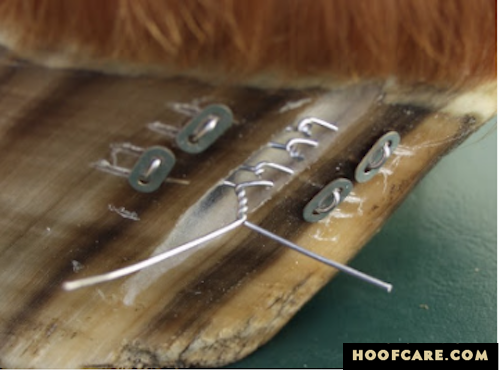
quarter crack repair by stainless steel lacing
This is an example of a quarter crack repair by lacing technique, using stainless steel sutures threaded through tiny and shallow guide holes drilled with a very fine drill bit. The idea is not to shut the crack but to hold it open and stabilize it so that any infection or "heat" can dissipate before a patch is applied. Quarter cracks have varying risks for infection and may or may not be associated with an abscess somewhere else under the hoof wall. The new complete hoof wall grows down from the hairline, much as you grow a new fingernail. (Ian McKinlay photo)


Did you know it’s been more than 50 years since the “invention” of the modern quarter crack patch?

Farriers have been stitching and clamping quarter cracks together for well over 100 years now, but a unique “modern” quarter crack patch was patented in 1964 by an enterprising Los Angeles racetrack horseshoer named William R. Bane. 

At first, Bane offered to patch horses for free, just to get the word out.  Bane's first patch was on the Thoroughbred Destructor, trained by John Nerud.

A horseshoer based at southern California tracks, Bane enjoyed early success with a champion Thoroughbred aptly named "Prove It." Once patched, Prove It won six stakes races in a row, including the Hollywood Gold Cup.

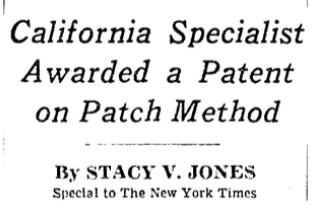
Bill Bane quarter crack patch headline in New York Times
In January of 1964, the US Patent Office awarded him patent number 3118449, to protect his secret method for repairing cracked hooves of Thoroughbred and Standardbreds so they could race again--and win.

It was enough of a big deal to be written up as a headline story in the New York Times.

Bane’s plan had been to train others at racetracks around the country, much like a franchise, but he ended up spending a lot of time on airplanes because owners and trainers wanted him to personally patch their horses. 

Bane’s patented secret turned out to be to cover the cleaned crack with a synthetic rubber called Neolite, a material very popular in the early 1960s for rubber-soled shoes, which were quite a sensation at the time. 
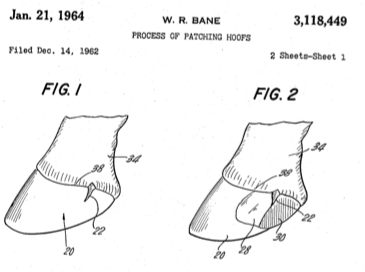
Bill Bane patent for quarter crack patch


In 1962, Bane was called east to work on Su Mac Lad, who at that time was the world’s all-time high-money winning trotter. It took Bane eight hours to patch that crack for trainer Stanley Dancer, but Su Mac Lad was training the next day and raced a week later. He went on to be United States Harness Horse of the Year, with a patched hoof. He raced an impressive 151 times in his life; Bane patched him six times. The 1960s were the heyday of harness racing in the United States, and Su Mac Lad is still revered for his racing record.

Bane charged $250 for his patches in 1962, plus his travel expenses.

The steps listed for Su Mac Lad’s eight-hour ordeal were:

1. remove some of the wall behind the crack
2. reshoe the horse;
3. apply the rubber;
4. apply plastic cement;
5. wrap with tape;
6. heat treatment for an unspecified time;
7. remove the tape;
8. finish the patch to conform to hoof wall contour.

Fiberglas eventually gained popularity over Bane's rubbery patch, and then in the 1990s, two-part polymethylmethacrylate (PMMA) adhesives came along for rebuilding walls, shoring up weak heels, and covering cracks after they were dry.

According to newspaper reports of the day, Bane was also called in to patch Northern Dancer, who won the Kentucky Derby and Preakness while wearing a Bane patch.

But no horse is more associated with Bane--and with quarter cracks in general-- than the great Buckpasser, who sat out the 1966 Kentucky Derby and Preakness while newspapers chronicled his crack woes, and what Bill Bane thought and did. Or didn't do.

Eventually, Buckpasser came back to racing and won just about everything, with 15 consecutive victories, setting track records and earnings records as he went, in spite of a recurring crack.
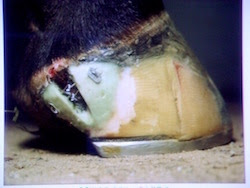
Big Brown Triple Crown quarter crack
Kentucky Derby and Preakness winner
Big Brown in 2008; his cracks had cracks.
(© Ian 
McKinlay  photo)
I should mention that 13 (by my count) of those victories where in the second half of 1966 alone. Many horses today may not have that many starts in a lifetime, let alone do it on a cracked foot.

Buckpasser was never actually patched by Bane. He did fly from California to Florida to examine the horse days after the crack was noticed following the colt's victory in the Flamingo in March. Bane determined that the crack was infected and should not be patched right away. He stayed and checked the foot repeatedly, waiting for it dry up. He refused to patch it until he deemed it free of infection.

Bane also told the press that the crack was far back in the heel area, a difficult area to work on. Without a patch, the horse couldn't train.

A week later, a New York paper announced that the trainer admitted that Bane had not patched the horse, perhaps because of the unfortunate location or perhaps because of the persistent infection--or both. The world waited to see the great horse return to racing.

Newsday (New York) headline

Bane went back to California. Buckpasser ended up eventually being "patched" by Louis Grasso, an auto-body mechanic and sometimes harness horseshoer from The Bronx, who had some success patching Standardbreds. 

Grasso's high-tech materials were actually variations of auto body repair materials, which he described as more of a coating than a patch, when applied to a cracked hoof. He called his material "Nu-Hoof".

Ultimately, the crack bothered the horse enough to warrant his retirement after one of the most successful US racing careers in history, including setting track records, in spite of the crack. His jockey, Braulio Baeza, told the trainer that the horse had had enough and was running on heart alone, not hooves.
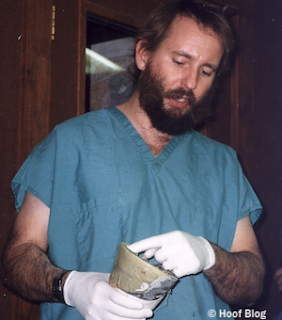
Penn Vet farrier Rob Sigafoos pioneered
multiple applications for polymers on the hoof.
In the 1980s, the great Standardbred Nihilator raced with quarter cracks that were patched by farrier Joey Carroll. His heel was basically removed, and he wore a z-bar shoe. 

In 1992, Carroll was in the news again, putting a patch on A.P. Indy before the Belmont Stakes that year, after the great horse sat out the Derby and Preakness, much like Buckpasser, while his foot healed. 

Before the 1992 Belmont, the New York Racing Association had to issue a press release denying that A.P. Indy was lame. Conspiracy theories sprang up when he was secretly vanned to a different racetrack to train without an audience. When Joey removed A.P. Indy's bar shoe before the race, and replaced it with a regular plate, it was news. (And he won.)

Buckpasser's quarter crack experience in the mid-1960s came at the same time that researchers Jenny and Evans at the University of Pennsylvania's New Bolton Center were publishing papers in the Journal of the American Veterinary Medical Association on their experiments with acrylics for hoof repair. 

Twenty years later, Penn Vet farrier Rob Sigafoos continued their research with acrylics and polymers to not only patch hooves: Sigafoos had the first widely-recognized success with glueing cuffed shoes to the foot by using the hoof wall as the attachment site instead of the bottom of the foot.
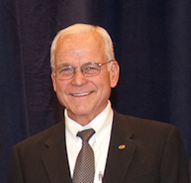
William Moyer, DVM
Professor Bill Moyer (file photo)
Penn Vet's Dr Bill Moyer claimed to have worked on 74 different cases of quarter cracks in one year. That would average out to more than six per month. He said that most were Standardbreds; Moyer received funding from Standardbred leader Billy Haughton to study crack repair. He loaded feet in a vise and found that the crack closed when the horse was weightbearing, and sometimes even overlapped, which would pinch tissue and cause a horse a lot of pain.

Sigafoos and Moyer even collaborated on an instructional book.

The study of the hoof wall received a major boost in 1980, with the publication of Doug Leach's doctoral thesis at the University of Saskatchewan. "The structure and function of equine hoof wall" Importantly, in 1987, Canadian researchers Bertram and Gosline at the University of British Columbia delved into the structural properties of the hoof wall, as well as of keratin and the effects of moisture on wall strength.

Quarter crack repair is still a task best left to the experts. Done incorrectly, a well-meaning lacing and/or patching job done at the wrong stage of crack therapy can seal in infection so that a major problem erupts. 

Or, it could impede normal growth from the coronet, causing a hoof deformity or a growth defect in that area. The goal of repair is a clean, dry crack growing out under the protective patch so that the horse is sound and pain-free.

Today, equine podiatry has advanced to the placement of drainage tubes under patches, as well as antibiotic-impregnated hoof repair materials. We still need a way to evaluate weightbearing in field and clinic conditions, before and after patching and during the rehabilitation period, to prevent subtle gait changes or imbalances that will affect healthy wall growth around the entire circumference of the coronet.

I am fortunate to have a great library of new and old books, as well as files that bulge with notes and proceedings from the hundreds of meetings I've attended, and (most of all) input from farriers and vets who generously share their cases, experiences, videos, and photos. 

How different things were in Bill Bane's day. But one thing has not changed: Quarter cracks are still a challenge to a horse and everyone who tries to help.
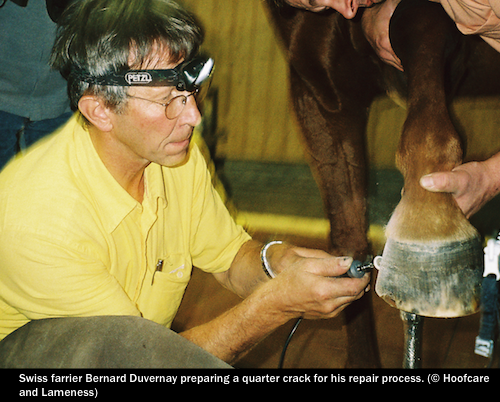
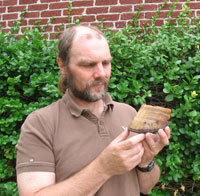
Swiss farrier Bernard Duvernay

In spite of the availability of skilled practitioners, in spite of advances in technology, and in spite of advanced medications and therapeutics, quarter crack recovery is still compromised by owners and trainers who fail to act quickly to intervene and who fail to appreciate the need for continued care and monitoring.  A quarter crack is not a "fix it and forget it" problem for a horse; it can be a bump in the road for an equine athlete or a prolonged, painful lameness issue that limits a horse's career, value, and welfare. 


Click here for free signup for Hoof Blog newsletter updates.


© Fran Jurga and Hoofcare Publishing; Fran Jurga's Hoof Blog is the news service for Hoofcare and Lameness Publishing. Please, no use without permission. You only need to ask. This blog may be read online at the blog page, checked via RSS feed, or received via a headlines-link email (requires signup in box at top right of blog page). Questions or problems with this blog? Send email to
hoofblog@gmail.com.
  

Read this blog's headlines on the Hoofcare + Lameness Facebook Page
 
Disclosure of Material Connection: The Hoof Blog (Hoofcare Publishing) has not received any direct compensation for writing this post. Hoofcare Publishing has no material connection to the brands, products, or services mentioned, other than products and services of Hoofcare Publishing. I am disclosing this in accordance with the Federal Trade Commission’s 16 CFR, Part 255: Guides Concerning the Use of Endorsements and Testimonials in Advertising.

Sunday, June 08, 2008

Big Brown's Owner Says Loose Hind Shoe "Not An Issue"


The Blood-Horse is quoting one of Big Brown's owners, Michael Iavarone of IEAH, this morning:

"His feet are ice cold, quarter crack not an issue. He had a very loose hind left shoe, but that’s not an issue."

The jockey complained that the horse was not handling the track well. Various reports from the media describe the track as loose and deep and suggest that the track was not watered because of the water pressure problems at the track yesterday (which left almost 100,000 racegoers without toilets).

(CORRECTION: This turned out to not be the case, according to one eye-witness. The track was watered. The grandstand had no water or toilets, but the track did! Other comments suggest that the holding barn did not have water, either.)

Much has been written about Big Brown's problem-packed front feet, but not much about his hinds. He won the Derby with turndowns on his hinds; turndowns are popular at Churchill Downs, according to crack specialist Tom Curl, who worked on Big Brown's right front foot. My guess is that all or most of the runners in the Derby also had them.

A turndown is the practice of turning the heels of the hind raceplate down so they become, in effect, like mud calks. They are believed to help with traction.

Big Brown's hind shoes were pulled after the Derby and he exercised and lived barefoot behind for a couple of days until Todd Boston, a shoer at Churchill, re-did his hinds.

I don't know what he had on behind for the Preakness but I do know that turndowns are illegal in New York. They do allow a small bend, but no sharp angles, that's for sure. Fred Sellerberg is NYRA's man in the paddock; his job is looking at the shoes. The guy has some sort of x-ray vision and seems to be able to spot an illegal shoe before the horse leaves the holding barn. Or at least he says he can. He just nods his head and says, "Believe me, Fran, I can tell". He is roughly my age and does not wear glasses, so I'm impressed.

Fred also would have seen a loose hind shoe. A paddock shoer, in addition to Fred, is on hand for exactly that reason and occasionally a race is held up in the paddock while a shoe is re-nailed.

So a loose shoe was probably a function of another horse stepping on it during the race or the horse stumbling and grabbing, or just normal wear and tear in the course of the race.
Big Brown hit serious traffic problems in the first mile of the race and one ABC commentator suggested that he may even have been kicked by Da'Tara as he came up too close and had to be pulled back.

Watch the replay on slow-motion mode; at times it looks like Big Brown is a carousel horse, going up in the air, although still making forward progress.
Even more likely is that it was pulled loose when Big Brown was yanked up by the jockey. There are some dismal photos of the horse in biomechanical disarray as the rest of the horses charge past him. I wonder how his mouth feels today.

Tale of Ekati received a tough gash in the race and has a pretty serious wound on his leg, according to trainer Barclay Tagg.

When Rags to Riches didn't come back after the Belmont last year, she was sent to New Bolton Center for a complete medical and orthopedic analysis, from head to toe. Coolmore (her owners) insisted. They didn't find anything wrong that was ever made public but the filly spent the summer hanging out in her stall.

IEAH is the midst of building a new equine hospital next door to Belmont Park. Let's hope that they put their future staff to work checking out Big Brown so he can run again. If they are going to be in the equine health business this fall anyway, they can get a head start and protect the horse from further injury or illness if there is any doubt.

What Would Mr. Gibbs Say About Big Brown's Feet? Horseshoes Mean Something to New York's New Governor

What would the New York governor's great grandfather think of glueable Yasha shoes?

New York Governor David Paterson has a lot of firsts to his credit. He took over the leadership of the state on March 17, after the resignation of then-governor Spitzer. Paterson is New York's first African-American governor and the state's first blind governor.

What we didn't know until today is that he has piles of horseshoes in his past. While presenting the Belmont Stakes trophy to trainer Nick Zito, Paterson shared his family's horseshoeing connection.

Paterson's great grandfather was horseshoer to the powerhouse breeder/owner H.P. Whitney, owner of Greentree Stud, in the years after World War I in New York. In particular, Mr. Gibbs shod a horse with the apt name of Upset. Upset would hand the great Man 'o War his only defeat, in August 1919 in the Sanford Stakes at Saratoga, with Mr. Gibbs' shoes on his hooves.

Mr. Whitney, who just happened to be one of the wealthiest people in America, rewarded his blacksmith by buying him a house in the Fort Green section of Brooklyn. He also bought homes for some other members of his stable staff.

As Paterson describes it, the new house helped lift his family to a new level of possibility in pursuit of the American dream. Without Whitney's generosity, the house wouldn't have happened. It was the house where Paterson spent his childhood. And it was a house that some very lucky horseshoes built.

Thanks to the Left at the Gate blog and other sources for help in piecing together this story from Governor Paterson's remarks.

Saturday, June 07, 2008

Big Brown Turns Beige, Never Fires in Belmont Stakes; No Triple Crown Winner for 2008


No Triple Crown This Year: Big Brown was eased to finish last after a bumpy, unhappy trip for the first mile or so of the Belmont Stakes. That's assistant trainer Michelle Nevin, his regular rider, who ran out on the track to take charge of the horse. Photo credited to TIMOTHY A. CLARY/AFP/Getty Images. 

Oh boy. They turned for home in the 2008 Belmont Stakes and there was he was: Big Brown, patched hooves flashing in the summer sun, rolling along on the outside, ready to make his move, just like he always does. Make his move. Make his move. Make his...

Jockey Kent Desormeaux stood up in the irons and pulled back and up. The race was over for his horse. They both knew it, apparently. He pulled up and cantered home last.

In an interview later he is quoted as saying (referring to the patched hooves), “There were no popped tires. He was just out of gas."

Did I miss it or were there no on-air post-race interviews with the IEAH power brokers who own Big Brown? Did they not congratulate the winners? I understand that it is the trainer's responsibility to be with the horse and make decisions about his health and care back at the barn.

Winning trainer Nick Zito, one of New York's most popular and successful trainers, won the race with a long shot who ran an incredible race and just kept going. He deserved to be congratulated.

Also to be congratulated: the Japanese connections of pre-race second favorite, the lightly raced Casino Drive, who is laid up with some sort of bruise on his foot. They chose not to poke holes in their horse's sole to drain the problem area. It probably could have been soaked, poked, and drawn out and then patched or glued. But kudos to them: they didn't take a chance with their horse.

Dutrow took all the chances. His horse has a patch on a patch on one foot, the remnants of a reconstructed heel made out of adhesive material on the other. His horse missed his monthly Winstrol (steroid) injection in the face of criticism over the medication, even though it is legal (whether right or wrong, it is legal). He was running without the turndowns that he sported on his hind feet in the Kentucky Derby (note that the jockey complained that the horse wasn't handling the track well) and he was coming back from rundown injuries on his hind pasterns and heel bulbs suffered in the Preakness.

And it was 93 degrees and humid. And his third race in five weeks.

Big Brown's trainer took all the chances. The jockey chose not to take a chance, not to whip and drive the horse to a middle of the pack finish over the line with possible dire consequences in the final furlong in front of the grandstand. He did not know what was wrong with his horse. He just knew he was out of horse.

Meanwhile, a horse we never heard of ran a great race for a great trainer at their home track in their home town.

Pop the champagne anyway. We've just come off three months of high-profile reporting about horses' hooves, injured hooves, and the people who are trying to help horses get sound and stay sound. Hoof repair specialist Ian McKinlay is still the man of the hour and has made a lot of friends in the media that will benefit the rest of the hoof world.

One more quote, again from the jockey, referring to Thoroughbreds of the past: “I cannot fathom what kind of freaks the Triple Crown champions were.”

So pop the champagne, and I'll do the same. Maybe stay home tonight and watch some archival video footage of Affirmed, Seattle Slew, Secretariat, Citation, Assault, Count Fleet, War Admiral, Gallant Fox, Omaha, Whirlaway and Sir Barton. Enjoy the freak show, it's as close as you're going to get, for now.

Wednesday, June 04, 2008

ESPN, CBS Hoof It with the Hoof Pros at New York's Belmont Park


ESPN spent a morning with Tim Shortell at Belmont Park this week. Tim, a horseshoer on the New York tracks, explained the difference between low-toes, XTs, mud calks, etc. and shod a horse for the camera. Click here to go to the ESPN site to watch the video; sorry I can't post it here. Tim looks more like Clint Eastwood every day.

Meanwhile, CBS News called Hoofcare and Lameness to track down Ian McKinlay, and once they found him, reporter Dr. Debbye Turner (she's also a veterinarian) did a weekend feature on the quarter crack specialist. They will be posting the video online. It's nice to know that CBS reporters and producers are reading this blog!

Monday, June 02, 2008

Event Wrapup: UPenn Technical Horseshoeing Symposium at New Bolton Center

2008 speakers at the University of Pennsylvania's Technical Horseshoeing Conference: (left to right) Course organizer and UPenn resident farrier Pat Reilly; Dr. Jeff Thomason from University of Guelph, Canada; equine podiatrist Bryan Fraley DVM from Kentucky; hoof repair specialist Ian McKinlay of New Jersey.

Technical horseshoeing covered a lot of ground at the University of Pennsylvania's New Bolton Center in Kennett Square on Saturday. From biomechanics to anatomy to podiatry and finally to 911-level hoof repair, speakers touched on many aspects of the scientific and practical bodies of information about the horse's hoof. Speakers zoomed in and out of the gray areas like the cars that would be passing me a few hours later on the way back to the Philadelphia airport.

The morning began with introductions and an overview of the new laminitis research center (tentatively called The Laminitis Institute) at the University of Pennsylvania. Dr. Jim Orsini, associate professor of surgery at New Bolton Center and director of the Institute, explained the exciting new concept to the audience. Click here to read more about the Institute.

Dr. Jeff Thomason lectured on the basics of foot biomechanics and the research undertaken in his laboratory at the University of Guelph in Canada. Included in his research was updated material on the finite element analysis modeling he has been working on, with beautiful graphic images. Later in the day, he spoke on the nuances of functional anatomy and the "design" of the horse's legs, with interesting images and challenges.

Thomason (shown at left, looking at a hoof capsule, in a University of Guelph photo) enlivened his presentations by standing on dinner plates (illustrating that weight alone won't fracture a fragile object), then smashing it with a hammer (showing the effect of force being much more destructive than mere weight). It's not easy keeping an audience awake during a biomechanics lecture, but smashing dinner plates with a rounding hammer definitely set a new standard.

Interestingly, Thomason's biomechanics research on vibrational properties of horseshoes found that unshod feet actually showed an increase in vibrationi over shod feet of about 25 percent, but he felt that it was statistically irrelevant, other than as an anecdote for those who use vibration as a criticism of horseshoes.

Conference leader Pat Reilly, who is now resident farrier at New Bolton Center, reviewed his use of high-tech measuring systems to question the probability factor of correcting what he feels are the universal malady of the horse's foot: underrun heels. According to a study quoted by Pat, as many as 60 percent of horses are affected by low-heel syndrome and he maintained that every foal he has seen has had underrun heels. He defines "underrun" at being as least five degrees lower than the toe angle, as set in stone by Tracy Turner DVM in published papers.

Reilly contends that underrun heels is an irreversible condition in many horses and a variation of normal hoof conformation.

Kentucky farrier Bryan Fraley DVM reviewed a deep file of cases related to puncture wounds, foot infections and cracks. He took the time to delve into the nuances of poulticing the foot, which many people skip right over. A number of his cases fell under the heading of "digital instability"--an apt moniker!

New Bolton Center has one of the best collections of antique horseshoes in the world. They were crafted in the 1800s by resident farrier and "professor of podology" Franz Enge, a German immigrant who was a disciple of the world-renowned Professor Lungwitz. At this end of the display are some modern braces and support devices for orthopedic cases.

On the second day, New Jersey farrier Bruce Daniels shared insights into the lovely antique shoes in the University's secret vault of farrier treasures and New Zealand native farrier Trevor Sutherland worked at the forge with attendees.

Man of the moment: Ian McKinlay (Pat Reilly photo)

Hoof repair specialist Ian McKinlay escaped from the mobs of press at Belmont Park, where he had been working on Triple Crown hopeful Big Brown, to drive down to Pennsylvania and speak at the University of Pennsylvania's Technical Horseshoeing Symposium on Saturday.

Yes, he did show Big Brown's week-old quarter crack, which is sutured (not patched over) in a way I had not seen before. Hopefully, I can post some photos soon.

McKinlay acknowledged that that farrier world "is trying to move forward" but gave evidence of progress on several fronts, such as the loosening of the Belmont track after Big Brown's trainer, Rick Dutrow, complained that it was too hard. "Times slowed down," McKinlay said, "and people were saying, 'Hey, nice cushion'!"

He asked the audience to help him list the disadvantages of glue on shoes and went on to explain more about Big Brown's abscesses and their consequences. He bemoaned the practice of leaving the bars lower than the walls, saying that this led to the prevalence of sore heels in racehorses.

This conference's goal, according to Pat Reilly is "to present scientific information relating to hoofcare"; "to describe techniques for managing hoof-related pathologies"; and to "create an atmosphere of open dialogue between New Bolton Center and the farrier/veterinarian community".

Those are all lofty and worthy goals. As with all such undertakings, the hardest step is the first one. By re-establishing this conference on the worldwide hoof science calendar, the University of Pennsylvania has the potential to add a valuable platter of substance to a table often overloaded with appetizers and desserts.

Canker: Seldom Seen But Important to Recognize


Canker in Hoof, originally uploaded by krissid2001.

I can almost smell this photo right through the computer screen. And it doesn't smell good.

Have you ever seen a horse with hoof canker? I've only seen it a few times, but it certainly made an impact. I know that this is becoming more of a problem in horses in the USA, and people are reporting more cases all the time.

The problem is that many owners don't recognize what it is and rarely contact a veterinarian until it is so advanced that you can see it (and smell it) from across the paddock.

Another problem is that it often strikes draft horses, like this Clydesdale or Shire, so the feathers cover it.

If you see something ugly growing on the bottom of a horse's foot, either in the cleft of the frog or the sulci or in the heel bulbs, don't just assume it is a bad case of thrush that will go away when the pasture dries up or when summer comes. Canker often requires the services of a consulting vet or farrier and horses are sometimes put down because of it. Medications and soaking and diligent cleaning are all on the list of treatments.

Thanks to Krissid2001 for allowing me to blog this photo for you all.

Wednesday, May 28, 2008

So Long, Wonder Pony: Theodore O'Connor 1995-2008


06_XC_Teddy5, originally uploaded by Squib Girl.

America's favorite pony was put to sleep today after an accident on the Team O'Connor eventing training center in The Plains, Virginia. Karen O'Connor's diminutive 14.1-hand Pan Am gold-medal winning sport pony (ArabxShetlandxThoroughbred) captivated eventing fans with his gravity-defying leaps and amazing athletic precision.

Teddy had been shortlisted for the upcoming Olympics this summer in Hong Kong.

Thanks to Squib Girl for this great photo of him in action. He was an action hero of the horse world, that's for sure.

Tuesday, May 27, 2008

New York Veterinarian Dead Following Head Injuries from Horse Mishap

,Veterinarian John Steiner has died in the hospital in Albany, New York. As reported here last week, he was injured while performing services at the Rhinebeck Equine practice in Rhinebeck, New York. Dr. Steiner suffered massive head injuries. Scroll down to read more about this tragedy in last week's posts.

Rhinebeck Equine has posted a biography of John Steiner. He had recently moved back to New York to his family's farm after many years living and working in Lexington, Kentucky as a reproduction-specialist veterinarian.

Monday, May 26, 2008

Triple Crown "Crack"down: Update from Ian McKinlay on Big Brown's Latest Hoof Malady

This device from Holland was marketed in Europe for stabilizing quarter cracks on Standardbreds. This photo shows clearly what a typical quarter crack would look like after being cleaned up. Notice where the start of the crack is at the hairline vs where the bottom of the crack is at the shoe. A quarter crack is a fissure in the hoof wall and is a reaction to stress so it will generally follow the angle of the horn tubules if the intertubular horn is weak, or the path of least resistance. Big Brown's crack is only 3/4" long, according to Ian, and is up at the top of the wall.

As promised yesterday, Hoofcare and Lameness caught up with hoof repair specialist Ian McKinlay today. Ian has promised a photo of Big Brown's new quarter crack on Wednesday of this week.

Ian was called to Belmont Park the other day when trainer Rick Dutrow noticed something wrong with the medial (inside) hoof wall on Big Brown's left front foot.

As avid Big Browners will recall, the left front foot is the site of the original wall separation that started the chain of hoof repair and layups for the champion colt over the winter months. Ian had removed the heel tissue on the inside heel of the left front, as detailed in previous posts and videos on this blog. The horse then shipped to Florida, where his right front inside heel was removed and repaired by Tom Curl.

Since then, Big Brown has been training and racing on a designer adaptation of a Thoro'Bred racaing plate that is glued on his foot without nails. The Yasha shoe system is like an orthotic insert between the shoe and the foot. One density of plastic, similar to the gasket that holds your truck's windshield in place, circuits the shoe and holds adhesive in place. Another density is a thick block pillow on which the remains of the heel sits as it grows out. Big Brown raced successfully in these shoes, winning the Florida Derby, Kentucky Derby and Preakness Stakes.


Note: in the "combi" Yasha paradigm, the plastic coats the foot surface of the shoe and acts like a dual-density rim pad. Some Yasha shoes have dual densities for different parts of the foot. Big Brown's shoes do not look like this.

"He doesn't even need the shoes anymore," McKinlay said today. "He could be in a regular shoe now."

My first thought was that a crack had developed at the hair line above the patch because of the stress from the material as the colt pounded down on the heel but Ian assured me that was not the case. "It's back around a little ways toward the heel," he said, "but not near that area. Besides that heel is all grown down now."

Many reports state that the crack has been "patched" but that is not the case. The crack has been cleaned up and treated with drying agents to dry it out and allow drainage of any infected area inside the crack. Then it was laced with the sutures as illustrated in the video posted on this blog last night (scroll down to May 25 video post to see that technique illustrated).

"As soon as I tightened it down, the foot started to cool out," Ian said. "Call me Wednesday to find out how it went."

Ian will check Big Brown again on Wednesday and decide what the next step will be in, in terms of replacing or relocating sutures, covering the crack with hoof wall adhesive, etc. The horse would then have nine days to train up to the mile-and-a-half Belmont.

In an email just received this evening, Ian gave an update: "By the way, his foot went cold within five hours of lacing him up, couldn't ask for more than that."


Sunday, May 25, 2008

Nike Signs Big Brown to $90 Million Horseshoe Contract: Onion Makes Light of the Triple Crown Hoof Madness

The article that was posted here on Sunday has been deleted because too many people took it too literally. Click here to read this article on THEONION.COM.

I'm sure that The Onion's writers thought they were making all this high-tech horseshoeing stuff up; little could they know that the technology they describe is available...yet Big Brown wears a stock out-of-the-box shoe that is customized into the "designer model" Yasha cushion-heel prototype.

For those of you who don't know, The Onion is the nation's leading humor/satire publication and one the most popular web sites on the Internet!

Not even dearly departed Barbaro escapes the mirth of The Onion. Click here to read about The Onion's report on the Ghost of Barbaro appearing on the anniversary of his death to teach the world the True Meaning of Barbaro Day...

Note: The Onion is not intended for readers under 18 years of age. If you go to the site, prepare to possibly be offended.

Big Brown Really Does Have a Quarter Crack This Time

According to Ian McKinlay on Sunday night, this horse's crack would be similar to the one that Big Brown has.

It's 12 days to the deciding race of the Triple Crown. We are on the verge of possibly the first Triple Crown winner since Affirmed in 1978. How wonderful it would be to have a new racehorse hero.

But...reports coming out of Belmont Park tell us that Big Brown has developed a quarter crack that is being disinfected and will be patched by specialist Ian McKinlay later this week when it is dry.

Hoofcare and Lameness received verification this evening from Ian McKinlay that the news is correct. Ian has posted some photos of the type of minor crack that Big Brown has on his web site for his Yasha shoes.

The irony here is that it was reported back in the winter months that Big Brown was suffering from quarter cracks on both front feet, when he actually had wall separations. This time, he really does have a quarter crack, apparently.

There are all sorts of hoof cracks and some quarter cracks are much worse than others. Some are painful for the horse while others are not.

A true quarter crack is a fracture in the hoof wall, much life a painful vertical split in your fingernail. Imagine how painful that split would be if you had to bear your weight on it!

The word "patch" or "repair" in conjunction with a quarter crack is a bit of a misnomer. The word "stabilize" would be more apt. The goal is to prevent shearing movement between the two parts of the hoof separated by the crack. Some people lace the crack to stay open a small bit so the coronet (hair line) stays at its normal angle while others lace it up very tightly to prevent any movement at all. Most decisions are based on two factors: the severity of the crack and the risk of infection.

In all cases, the horse is evaluated for its individual suitability to treatment. Some horses are very sensitive to hoof pain. Some have damage to the coronary band. Some have old chronic cracks that reappear. And some have infected quarter cracks, which cannot be patched until the infection is gone and the fissure is "dry". The age of the horse also affects the treatment plan.

Big Brown is in good hands and we all know that some horses have run--and won--with quarter cracks patched as little as a week before a big race.

Remember: Ferdinand won the 1987 Breeders Cup Classic with his foot patched for a quarter crack. He slipped by Alysheba to win.

Scroll down the blog to read some past stories about Big Brown and his special shoes and his famous wall separation problems.

And stand by for more news.

Quarter Crack Repair: What Lies Ahead for Big Brown?


This video by Ian McKinlay explain the steps he goes through to "patch" a quarter crack so a horse can continue to train and race. Hit the "play" icon to watch the video; it is almost ten minutes long.

This video is part 2 of the first video we posted about quarter cracks back before the Derby, when there was confusion between wall separations and quarter cracks. We all thought Big Brown had quarter cracks until Ian clarified the situation. The first part of the video can be viewed here but it does not much, if any, narration.

The steps you see here are the final ones in the process. First the horse needs to be wrapped for a few days to draw out any infection and let the crack drain. Once the crack is clean, the repair process begins.

THE HORSE IN THIS VIDEO IS NOT BIG BROWN. This horse is being repaired for a chronic, pre-existing quarter crack that had become infected, not a fresh one like Big Brown's, but this will give you an idea of what process Ian McKinlay normally uses.

You will hear Ian comment on the prevalence of hoof injuries at Belmont this year.

By the way, Ian McKinlay is scheduled to be demonstrating his Yasha shoes at the University of Pennsylvania's Technical Horseshoeing Conference next weekend. Click here to go to yesterday's post about the conference.

Friends at Work: Lauren Carey Aces Farrier Apprenticeship, Wins Worshipful Company's Essay Contest


Lauren Carey DipWCF is a rookie farrier in England. She's just completed her four-year apprenticeship, as required by the Farriers Registration Act, and is launching her own business in Peterborough, a city north of London.

What sets Lauren apart is that she has excelled in her training and recently was named the national first place winner in the Worshipful Company of Farriers' essay competition.

Farrier instructor Alan Woodyatt said of Lauren: "I have been involved with the Diploma exam students for 18 years and she was very nearly the best student I have taught for the anatomy written paper and 'hands-on' horse assessments."

And that is very high praise, indeed!

Congratulations, Lauren!

Read all about Lauren and how she earned her rewarding new career in this British newspaper article.

PS It's interesting to see that Lauren is shown working with the horse's foot on an American-style hoofstand. Not too many years ago, when Welshman Tommy Williams ran the farriers college program in the UK, hoof stands were banned and he used to rant and rave about how farriers shouldn't learn to shoe with a stand. They weren't allowed in farrier competitions, either. Things must be changing (in a few small ways) in England!

UPenn Technical Horseshoeing Symposium at New Bolton Center Announcement: Late Registration Opportunity

The forge at the University of Pennsylvania was originally in downtown Philadelphia and was one of the first buildings constructed on the campus when the school began. This photo was taken in the late 1800s; notice the bellows in the ceiling. (Double click on photo to view larger image; I believe that's a woman in the long apron down at the end of the room. Notice that the "students" are not wearing aprons; I bet they were proud of the cinder burns in their nice clothes.)

Event: Technical Horseshoeing Symposium at Penn Vet/New Bolton Center

Date: Saturday May 31 and Sunday June 1, 2008

Location: Woerner Amphitheatre in the George C. Widener Large Animal Hospital at the University of Pennsylvania School of Veterinary Medicine at New Bolton Center, Kennett Square, PA (near Philadelphia and Wilmington, Delaware).

Wet labs will be held in the Outpatient Clinic of the Hospital, the Farrier Shop and the Pathology Lab.

Cost: Saturday or Sunday only $150, Saturday and Sunday $225

Highlights:
• Jeff Thomason lecture on functional anatomy of the limb, as well as hoof deformation and ground force interaction
• Bryan Fraley lecture on managing problems- from laminitis to hoof cracks to “hoof first-aid” (dealing with emergency hoof traumas).
• Jim Orsini will be updating the Laminitis Institute and the research projects underway at Penn
• Andrew Van Eps will discuss laminitis, cryotherapy and the effectiveness of commonly utilized techniques for cooling feet.
• Sunday’s wet labs include:
• Dissection of the equine limb with regard to biomechanics and anatomy by Jeff Thomason
• Shoeing lab with Bryan Fraley
• Bruce Daniels will discuss the Podological Museum of the University of Pennsylvania
• Trevor Sutherland will demonstrate forging techniques and shoe building

PLUS demonstration by hoof repair specialist Ian McKinlay (featured on the Hoof Blog for his work with the Yasha glue-on shoe customized for champion racehorse Big Brown in the 2008 Triple Crown races)

Conference Format
Saturday, May 31, 2008- Lectures 8AM- 5PM
Sunday, June 1, 2008- Lectures 9AM- 11AM; Demonstrations 12PM -3PM

Hotel list available; nearest airport is Philadelphia.

More details: http://www.vet.upenn.edu/nbc/equine/farrier-symposium.htm
If you attend, please mention that you learned about the event on the Hoof Blog.

(Double click on page images to view and print full page flyer and registration form.)

Saturday, May 24, 2008

New York Vet Injured While Treating Horse, Remains in Coma

Theriogenologist John Steiner DVM, Dip. ACT is hospitalized in Albany, New York this weekend after being injured in the head during a procedure on a Morgan stallion.

Dr. Steiner is in a medically-induced coma, according to local newspaper reports, with severe brain injuries. He is reported to be in critical condition.

This news brings home the message to all professionals that working around horses can be (and is) a dangerous job and that every precaution should be taken while on the job.

Dr. Steiner was a very experienced veterinarian and certainly this was a freak accident.

He is known for his work for many years in the field of equine reproduction while on staff at the Hagyard Equine Medical Institute in Lexington, Kentucky and had recently moved to New York where he joined the Rhinebeck Equine group practice in the very horsey Dutchess County area, outside New York City.

A statement from his family said that notes and cards may be sent in care of the Rhinebeck Equine Clinic at 26 Losee Lane; Rhinebeck, NY 12572 or to the New York State Veterinary Medical Society.

(By the way, a theriogenologist is someone who specializes in reproduction.)

Kind, healing wishes to Dr. Steiner. And be careful out there, friends.

Friday, May 23, 2008

Mike Wildenstein and Cornell Vet School Unveil Enlarged Farrier Shop; Dedication to Former Instructors Is Built In!

Cornell University’s College of Veterinary Medicine in Ithaca, New York has a newly enlarged farrier shop and teaching area at the large animal hospital. Thanks to farrier student Richard Mercer for his reporting of the completion of the project.

The enlarged shop will enable Adjunct Professor Michael Wildenstein FWCF (Hons) to increase the enrollment of students in the basic program and accommodate more working farriers and veterinarians who wish to study foot science and problems under his direction at Cornell.


Left to right above are current Cornell farrier students Ryan Poole, Chad Blasch, Jon Grigat, and Richard Mercer. Standing behind is instructor Mike Wildenstein. Notice the five draft horse shoes that Mike forged and laid when the concrete was poured, cementing the legacy of Cornell’s past resident farriers. Each shoe contains the name and years of service. Left to right Henry Asmus 1913-1939 (Asmus was also the school’s founder), Eugene Layton 1931-1965, Harold Mowers 1965-1976, Buster Conklin 1976-1991, Michael Wildenstein 1991-?. Mike’s previous class would not allow him to stamp an end date.


This long view shows the length of the shop with the new work stations for forging. Notice the shoe case on the wall above the Belgian; it contains specimen shoes made by German immigrant farrier Henry Asmus almost 100 years ago. Asmus is widely regarded as the most influential farrier in American history. He was a tireless educator whose heart lay both in the veterinary school and in the farms. He believed in educating farriers working in the field, and in helping horse owners learn more about proper hoof care. He was a visionary man with an extraordinary combination of intellect to understand lameness in horses and artistic skill in blacksmithing. He was the only professor of horseshoeing in the United States, until Mike Wildenstein's appointment in 2007, and was an adviser to the US Army and the US Department of Agriculture. Farriers who studied under him at Cornell received advanced rank when they enlisted in the military to serve in World War I. Asmus died in 1939.


The shoeing area is also enlarged; note another case of Henry Asmus’s shoes hangs in this area. The expanded shop has doubled in size, with six forging stations, and an expanded safer area for the horses. The school now takes four students for each semester (up from three, for the first time in the course's history) and has sufficient space for those wanting to take advanced classes or for visiting farriers.

To learn more about Cornell’s farrier school and farrier services, visit http://www.vet.cornell.edu/education/farrier/

Mark your calendar: Cornell will host the 25th Annual Farrier Conference on November 8-9, 2008. Confirmed speakers include British farrier instructor Mark Caldwell FWCF of Myerscough College and Neil Madden FWCF, formerly of the British Army farrier school. For information about attending or exhibiting at this excellent event, email Amanda Mott in the Office of Continuing Education or call (USA) 607.253.3200.

Special thanks to Mr. Dick Russell for handling "Belle" and to Debbie Crane for taking these pictures and for the use of "Belle" and "Fantasy".

Blogger’s note: I can’t believe how clean it is! And the designer dousing buckets must have a story behind them! For non-farriers: the metal contraptions on the counters are not robots from Star Wars, they are gas forges for making or heating steel horseshoes so they can be worked (shaped) while hot, making the steel more malleable. Obviously Cornell believes in the future of metal horseshoes!

If you double click on the photos, you should be able to see them at full size and look at more details. Thanks to Richard for sending high-res photos!

All HoofBlog text and images © Hoofcare Publishing 2008 unless otherwise noted. To learn more about new research, products, and treatments for the horse's hooves and legs as reported to veterinarians and farriers in the award-winning "Hoofcare & Lameness Journal", go to http://www.hoofcare.com Direct “subscribe now” link to Hoofcare & Lameness Journal: http://www.hoofcare.com/subscribe.html Contact Hoofcare Publishing anytime: tel 978 281 3222 fax 978 283 8775 email bloginquiry@hoofcare.com